

Getting a new loan officer from hire to productive closer is one of the hardest challenges in mortgage. Most companies hand new hires a stack of manuals and call it a plan. The result is slow ramp-up, high turnover, and frustrated managers. The good news is that several organizations have built loan officer onboarding program examples worth studying closely. This article breaks down what those programs actually look like, what makes them work, and how you can adapt the best elements for your own team.
Table of Contents
- Key takeaways
- 1. Core criteria for effective loan officer onboarding programs
- 2. NewDay USA's immersive, practice-first onboarding model
- 3. Gustan Cho Associates' full-cycle training for new and transitioning officers
- 4. OnCourse Learning's technology-enabled onboarding with AI support
- 5. Comparing three onboarding models side by side
- My take on what actually makes these programs work
- How 1smtg supports your loan officer onboarding process
- FAQ
Key takeaways
| Point | Details |
|---|---|
| First 90 days define outcomes | New loan officers need structured, hands-on activity in the first 90 days to build confidence and foundational skills. |
| Real-world programs vary widely | Leading onboarding models range from immersive calling programs to AI-powered licensing prep platforms. |
| Mentorship accelerates skill acquisition | Pairing new officers with experienced MLOs shortens ramp-up time and reduces early attrition. |
| Technology supports but does not replace humans | AI tools like adaptive exam prep are most effective when layered with human coaching and live feedback. |
| Compliance and selling must be taught together | Programs that integrate licensing education with practical sales activity produce more confident, capable officers. |
1. Core criteria for effective loan officer onboarding programs
Before reviewing specific loan officer onboarding program examples, you need a framework for evaluating them. Not every program will fit your organization, and knowing what to look for prevents you from copying a model that works at a 500-person firm when you run a 12-person shop.
The most effective onboarding processes for loan officers share several features. They are structured from day one, not improvised. They set a clear timeline, usually anchored around the fact that new officers ramp up over 6 to 12 months, with the first 90 days being the most critical window for building foundational habits. They also balance licensing compliance with actual sales activity, because classroom-heavy programs that delay real work until after the SAFE exam often produce exam-certified officers who have no idea how to talk to a borrower.
Key criteria to assess any program:
- Duration and pacing: Does the program cover the full ramp period, or only pre-licensing?
- Hands-on activity: Are trainees working with real leads or simulated scenarios during training?
- Mentorship structure: Is mentorship assigned, scheduled, and measured, or casual and optional?
- Technology integration: Does the program use a loan origination system, CRM, and digital tools from day one?
- Compliance preparation: Is SAFE Act pre-licensing education woven into the timeline, not bolted on at the end?
- Cultural onboarding: Are team-building activities and cultural integration part of the plan?
Pro Tip: Map your onboarding program against the 90-day window specifically. If you cannot name what a new hire should be able to do at day 30, day 60, and day 90, your program lacks the structure to reliably produce results.
Highly structured onboarding from day one measurably shortens time to productivity by standardizing the training path and removing ambiguity about expectations.
2. NewDay USA's immersive, practice-first onboarding model
NewDay USA built one of the most cited loan officer onboarding program examples in the mortgage industry. What makes it distinctive is that it deliberately reverses the traditional classroom-first approach. Instead of teaching product knowledge before new hires speak to anyone, NewDay puts trainees on the phones immediately.
The program works in two phases:
- Months 1 through 3: New hires spend their time doing "boots on the ground" calling to prospective customers. They are not yet licensed, so any qualified leads get transferred to licensed staff. The goal is confidence and conversational fluency, not closes.
- Months 4 and 5: Trainees are paired with an assigned mentor who focuses on mortgage principles, product knowledge, and compliance.
- Month 5 and beyond: Trainees sit for the SAFE MLO exam after about 5 months of total training.
The compensation model is built to support this structure. Trainees earn income during the calling phase, and lead transfers to licensed staff create a financial bridge that makes the program sustainable for both parties.
"Reverse the new hire experience" was the guiding philosophy behind NewDay's model, inspired directly by Marine Corps training principles that prioritize doing over studying. The result is officers who arrive at their licensing exam with real conversational experience and genuine confidence, not just textbook knowledge.
Cultural integration is also baked into the program. Group workouts, social activities, and team rituals reinforce the kind of camaraderie that reduces early attrition and keeps new officers engaged through the harder stretches of training. This is not a soft add-on. It is a deliberate retention mechanism.
3. Gustan Cho Associates' full-cycle training for new and transitioning officers

Gustan Cho Associates offers one of the more thorough new loan officer training programs for people entering the industry with no prior mortgage experience, including real estate agents making the transition to licensed MLO roles.
The program is built around a step-by-step progression from orientation to independent loan closing:
- Day one orientation: Introduction to company culture, compliance requirements, and the loan origination system used in daily work.
- Week one through four: Structured training on loan products, guidelines, and borrower qualification basics, with direct supervision throughout.
- Weeks five through eight: Mentorship pairing with a seasoned MLO who reviews active files, explains underwriting decisions, and coaches on borrower communication.
- Weekly coaching sessions: Ongoing one-on-one sessions covering pipeline management, CRM use, and sales skill development.
- Technology fluency module: Dedicated time learning the LOS, CRM platforms, and digital tools used for processing and borrower tracking.
- AI-assisted learning: Use of AI tools to support borrower analysis, scenario modeling, and real-time guidance during complex file reviews.
- Independent closing milestone: Trainees close their first loan independently only after demonstrating competency across all prior stages.
The program also creates a unique pathway for licensed real estate agents who want to become MLOs simultaneously, combining their existing client relationship skills with mortgage product education. Mentorship pairing with experienced officers is central to this model and is credited with faster skill acquisition across trainee cohorts.
4. OnCourse Learning's technology-enabled onboarding with AI support
OnCourse Learning represents a different category of loan officer onboarding program examples. Rather than a single employer's internal training, it is a third-party platform built specifically to support mortgage companies that need scalable, tech-forward onboarding infrastructure.
The centerpiece is their Prep xL SAFE exam prep platform, which uses an AI learning assistant called Rubi. Rubi provides personalized coaching that adapts to each learner's weak areas, adjusting study plans in real time rather than delivering the same material to every trainee regardless of their baseline.
The results are notable. OnCourse Learning's MLO Test Ready program reports an 85% first-time pass rate, compared to the 56% national average. That gap matters practically. Every failed exam attempt costs the company time, licensing fees, and delayed productivity from a hire who still cannot close loans.
| Feature | OnCourse Learning Prep xL | National Average |
|---|---|---|
| First-time SAFE exam pass rate | 85% | 56% |
| Study plan personalization | AI-adaptive (Rubi) | Static / self-directed |
| Exam prep format | Focused 10-day course | Variable |
| Support model | AI coaching plus content library | Self-study only |
Adaptive training platforms also reduce onboarding timeline unpredictability. When you can forecast exam pass rates more reliably, you can plan your hiring pipeline with more precision.
Pro Tip: If your company is scaling hiring, a platform like this removes the single biggest bottleneck in onboarding. A failed SAFE exam does not just delay one hire. It creates a ripple effect on your entire staffing plan.
The SAFE Act requires at least 20 hours of pre-licensing education covering federal and state law, ethics, and mortgage origination, followed by a 125-question NMLS exam with a 75% passing threshold. Any onboarding program that does not account for this timeline in its design is setting trainees up to rush through required material.
5. Comparing three onboarding models side by side
Understanding individual programs is useful. Comparing them directly helps you decide which approach fits your organization's size, budget, and trainee profile.
| Criteria | NewDay USA | Gustan Cho Associates | OnCourse Learning |
|---|---|---|---|
| Primary focus | Confidence through calling | Full-cycle mentorship | Licensing exam prep |
| Onboarding duration | 5+ months to SAFE exam | Variable, milestone-based | 10-day focused SAFE prep |
| Mentorship structure | Assigned after month 3 | Paired from week one | AI-driven with Rubi |
| Technology use | Moderate | High (LOS, CRM, AI tools) | Very high (adaptive platform) |
| Best for | Companies with lead volume | Brokerages training novices | Any org scaling MLO hiring |
| Cost model | Internal program | Internal program | Third-party subscription |
A few observations from this comparison:
- Intensive calling-based programs like NewDay's work best when you have consistent lead volume and a licensing-compliant lead transfer system already in place.
- Full-cycle mentorship programs like Gustan Cho's demand seasoned MLOs with time and interest in coaching. Without that, the program degrades quickly.
- Technology-enabled platforms solve the exam prep problem efficiently but do not address the sales and relationship skills that determine long-term performance.
Integrating licensing prep with practical skills from the start produces officers who are better prepared for real-world challenges than programs that treat them as separate tracks. The most effective loan officer programs find ways to run both simultaneously rather than sequentially.
My take on what actually makes these programs work
I have spent years studying and working with onboarding programs across the mortgage industry, and the pattern is consistent. The programs that produce high-performing officers are not the ones with the most content. They are the ones with the clearest structure.
What I have seen fail repeatedly is the "information dump" model. Companies load new hires with product guides, compliance manuals, and policy documents in week one, then wonder why those people are still struggling to close loans six months later. Overemphasizing product knowledge before building confidence actively slows down performance stabilization in the first 90 days. Confidence comes from doing, not from reading.
My experience is that the 90-day window is not just important. It is decisive. Officers who hit meaningful activity milestones in their first 90 days, whether that is a set number of borrower conversations, a first file submitted, or a first loan closed under supervision, almost always make it. Those who spend those 90 days in passive training rarely reach the same productivity levels, even after they get licensed.
I also believe most organizations underestimate culture as an onboarding variable. A team environment with real-time feedback and genuine camaraderie does more for a new officer's confidence than any training module. The officers who stay and produce are the ones who feel like they belong to something.
My recommendation: use technology for what it does well, which is scaling exam prep and tracking progress. Then invest the human hours in mentorship, coaching, and the cultural integration that no platform can replicate.
— Omar
How 1smtg supports your loan officer onboarding process
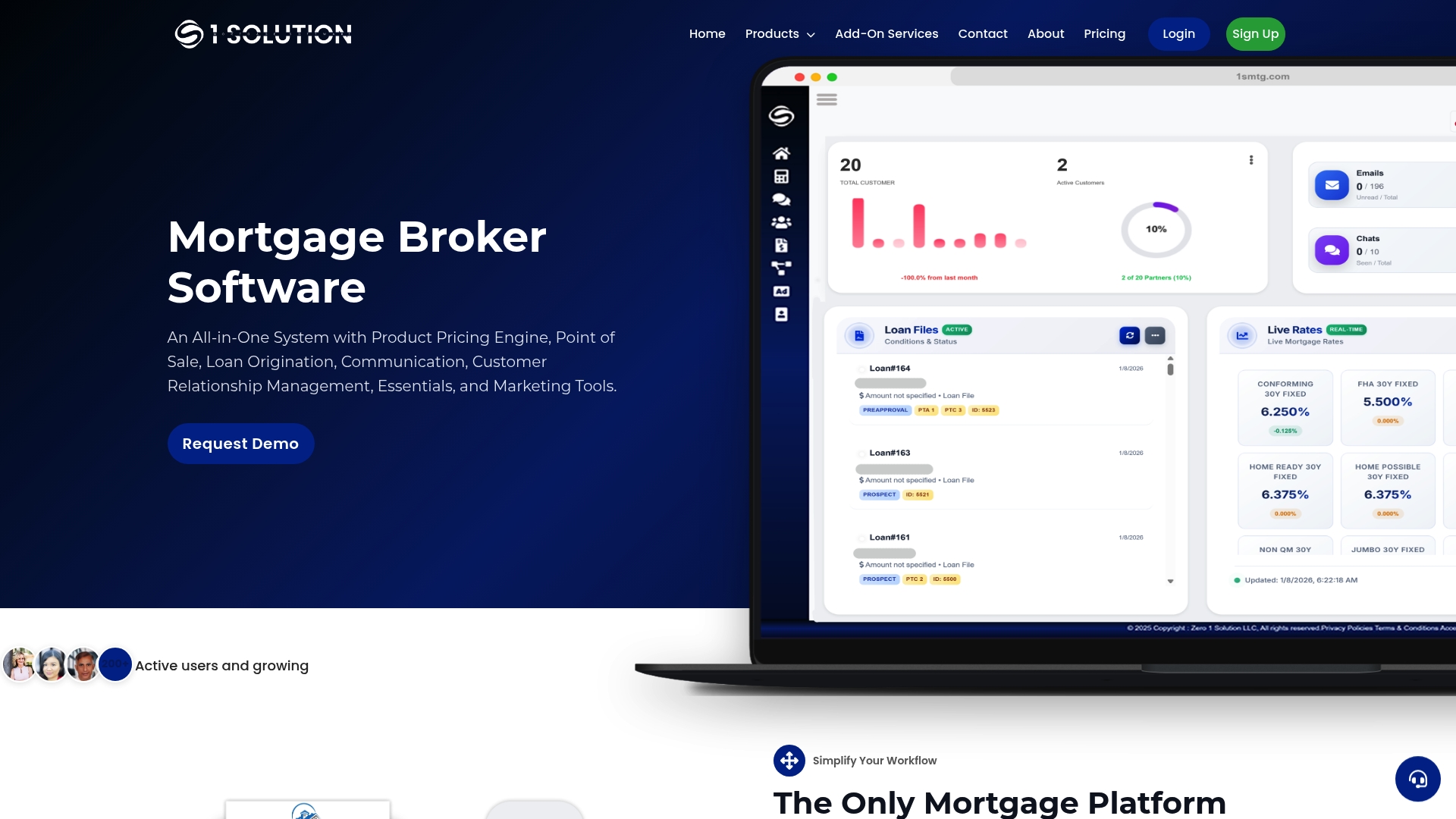
Running an effective onboarding process for loan officers gets significantly harder when your team is juggling multiple disconnected systems. New hires cannot learn a workflow that does not exist yet. 1smtg was built specifically to give loan officers and brokers a single platform that combines a Loan Origination System, a Pricing Engine, and an integrated CRM in one place. New hires learn one system instead of three, which cuts the technology learning curve out of your onboarding timeline entirely. The platform includes dedicated training for new users and live human support rather than automated help. If your onboarding program needs a technology foundation that actually holds together, explore what 1smtg offers for your team.
FAQ
What are the key components of a loan officer onboarding program?
Effective programs combine hands-on lead activity, structured mentorship, compliance and licensing preparation, and technology training into a clear timeline. The first 90 days should include measurable activity milestones, not just classroom content.
How long does loan officer onboarding typically take?
Most new loan officers reach full productivity within 6 to 12 months. The SAFE exam alone requires at least 20 hours of pre-licensing education before a trainee can sit for the 125-question NMLS test.
What is the average SAFE exam pass rate for new MLOs?
The national first-time pass rate for the SAFE MLO exam is approximately 56%. Programs using structured prep courses with adaptive technology report pass rates as high as 85%.
Should new loan officers work with real leads before getting licensed?
Yes, with proper compliance controls. Programs like NewDay USA's model allow trainees to handle early-stage calls and transfer qualified leads to licensed staff, which builds confidence without violating licensing requirements.
How important is mentorship in new loan officer training?
Mentorship is one of the strongest predictors of early success. Structured pairing with an experienced MLO accelerates skill acquisition and reduces attrition during the critical first months of employment.