
Mortgage API integration lets your CRM, LOS, POS, pricing engine and e-signature tools pass data to each other without anyone rekeying it. For an independent broker, the simplest way to get that result is a platform where those tools already share one database. That is how we built 1 Solution: pricing, CRM, communication, POS, LOS, compliance and marketing in one connected system, so you spend your time on loans and not on connectors.
TL;DR
- An API is a software intermediary that lets two applications exchange data automatically, so your staff does not retype it.
- In mortgage, the data that moves a loan through production sits in the CRM, POS, LOS and fulfillment systems. Integration keeps them in sync.
- Every separate tool you add is another connection to build, secure, test and maintain.
- Security expectations are specific: encryption, multifactor authentication, audit trails and controlled third-party access.
- A single broker-built platform removes most of the integration work, because the modules were designed to work together.
Table of Contents
- What an API means in mortgage technology
- What data and actions integration moves
- A real example: pricing and committing through APIs
- What it takes to build an integration
- Security and data quality: what to hold any integration to
- How an eClosing flow shows why connected systems matter
- Choosing between connecting tools and consolidating them
- What 1 Solution brings together
- Our perspective
- FAQ
- Sources
What an API means in mortgage technology
An API (application programming interface) is a defined way for one piece of software to ask another for data or to send it an instruction. Freddie Mac's Origination API Playbook (November 2024) describes an API as a software intermediary that connects applications so they can "talk to" each other, with the integration invisible to the people using the systems.
That playbook also shows what such calls look like in practice. An Affordable Product Eligibility API returns income limits, Area Median Income and Duty-to-Serve messaging for loan officers and brokers. A Current Mortgage Snapshot API returns loan amount, principal, interest payments and rates for refinance net tangible benefit calculations. In both cases the loan officer does not look anything up by hand. The answer shows up inside the system they already work in.
When people search for an "API mortgage CRM," they usually want the same thing: a CRM that talks to the rest of the stack, so a lead's data becomes an application, a price quote and a closing package without being entered again.

What data and actions integration moves
The MBA white paper by Prabhakar Bhogaraju on AI and blockchain in digital mortgages identifies the data sets that carry a loan through production and servicing as those in CRM systems, point-of-sale systems, loan origination systems and fulfillment systems. Those are the four places your information lives, and the places an integration has to keep consistent.
In a broker shop, that usually means:
- CRM to POS: a lead becomes a borrower invitation, and the borrower's answers flow back to the contact record.
- POS to LOS: the application, income and asset data land in the loan file with no re-entry.
- LOS to pricing engine: loan scenario details go out, rate and eligibility results come back.
- LOS to e-signature and document storage: disclosures go out for signature and signed copies return to the file.
- Everything to communication tools: email, text, chat and voice activity is logged against the borrower.
Each arrow is a connection someone has to build and keep working. Each one is also a place where a field can map wrong, a sync can fail quietly, or two systems can disagree about which record is current.
A real example: pricing and committing through APIs
Freddie Mac's Secondary Market Advisor page gives a clear picture of a system-to-system workflow. A seller enters or imports data in a vendor system and selects a pricing or commitment function. The request goes through APIs to Freddie Mac's Loan Selling Advisor. The response returns to the vendor system, which displays the pricing results and can execute cash and guarantor commitments. All of it runs under a single system-to-system ID rather than client-specific credentials.
The lesson for a broker is the shape of the flow: one entry, a request out, a result back, an action taken, all inside one screen. That is what good integration feels like to the loan officer. It is also why the quality of the integration matters more than the number of tools.
What it takes to build an integration
If you connect separate vendors, expect a project and not a switch. Freddie Mac's published process for its pricing and committing APIs is a fair model of the work, even if your connections are smaller:
- Confirm eligibility requirements, such as an executed agreement or an approved vendor agreement.
- Request the integration.
- Hold an introductory call to set the integration plan.
- Receive the technical specifications.
- Set up secured test accounts in a test environment.
- Develop and test, with regular verification checkpoints.
- Submit test cases for final verification and receive a formal verification letter.
- Go live with production onboarding, API credentials and client relationships.
Those steps come from the same Freddie Mac page. Now picture a broker running a CRM from one vendor, a POS from another, a pricing engine from a third and an e-signature tool from a fourth. That is several plans, several sets of credentials, several test cycles, and a fresh round every time one vendor changes its API.
This is the practical case for an all-in-one platform. When pricing, CRM, POS, LOS and e-signature are parts of one system, the data model is shared from the start. You do not own the mapping project, and you do not find out about a broken sync when a borrower calls.
Security and data quality: what to hold any integration to
Mortgage files hold Social Security numbers, income documents and bank statements. Whatever you connect, hold it to the standards the industry's own guides set.
Encryption and authentication. Freddie Mac's eMortgage Guide (March 2019) says systems that process and store sensitive eClosing data should use NIST- and FIPS 140-2-compliant algorithms, X.509 certificates with at least a SHA-256 signing hash, and TLS sessions with a minimum 2048-bit RSA key and 128-bit AES key. It lists multifactor authentication methods including passwords, tokens, biometrics, smart cards and certificates.
Due diligence. The same guide describes a review process for eClosing and eNote vault systems: a demonstration, a certified third-party security assessment within 30 days of the approval request, testing of integration with MERS eRegistry and eDelivery, and a certification form executed by the vendor's CTO or security officer.
Tamper-evidence and audit trails. Fannie Mae's How to Implement eMortgages (March 2007) requires each electronic document delivered to it to be tamper-sealed with a digital signature, server-based tamperseal private keys to sit in a hardware security module, and the eClosing platform to keep a permanent audit trail of every change before and through closing and MERS eRegistry registration.
Third-party access. The MBA's Tech Exchange schedule describes mortgage technology as dependent on legacy platforms and a growing network of third parties, and features a session on limiting the blast radius of a compromised account, application or partner, covering identity controls, segmentation, API security and third-party access. Every vendor you connect is one more party with a path to your borrower data.
A short checklist follows from this:
- Who can see which borrower data, and can you remove access instantly?
- Is each integration using its own credentials, and are they rotated?
- Is there an audit trail of changes to documents and loan data?
- If one vendor is breached, what else is exposed?
Fewer vendors means fewer answers to chase. Within one platform you manage one set of users, roles and permissions.
How an eClosing flow shows why connected systems matter
Fannie Mae's guide walks through the eClosing sequence, and it is a good test of whether your systems really connect. The platform receives the eNote and closing documents. The closing agent verifies borrower identification. The borrower logs in and eSigns the eNote. The system attaches the signature, applies a tamper-evident seal after the final signature, stores the sealed eNote in an eVault, and registers it with the MERS eRegistry. At delivery, loan-level data and documents move to the investor.

Every handoff in that chain is a data exchange. If your e-signature, document storage and LOS are separate products, each handoff is an integration to maintain. If they are modules of one platform, the handoff is internal.
Choosing between connecting tools and consolidating them
Brokers evaluating mortgage technology, or thinking about leaving a tool that no longer fits, tend to face the same question: keep adding connectors or consolidate. Use these criteria.
| Question | Many connected tools | One connected platform |
|---|---|---|
| Who maps the data fields? | You or each vendor | Built in from the start |
| Number of logins and credentials | One set per tool | One set |
| Where a failure shows up | Between systems, often unnoticed | Inside a single system |
| Subscriptions to manage | Several | One |
| Audit trail | Pieced together | In one place |
Many brokers come to us after juggling separate CRM, POS, pricing and e-signature subscriptions. The pattern is common: each tool is fine alone, and the cost is in the gaps between them.
What 1 Solution brings together
Our cloud platform is built for brokers and lenders, and it covers LOS, CRM, a product pricing engine, a borrower POS portal, e-signature, compliance, marketing automation, and communication tools including email, SMS, chat, voice and video. It also includes partner and vendor management, lead and recruitment tracking, an employee dashboard, rate comparison, proposal and pre-approval generation, document storage and a customer portal, with onboarding included.
Usage fees are published: phone system minutes, text messages sent or received, and fax are each $0.10. Add-ons such as a mortgage website, SMTP domain setup and PBX solutions are available, and you can see everything on the 1 Solution site.
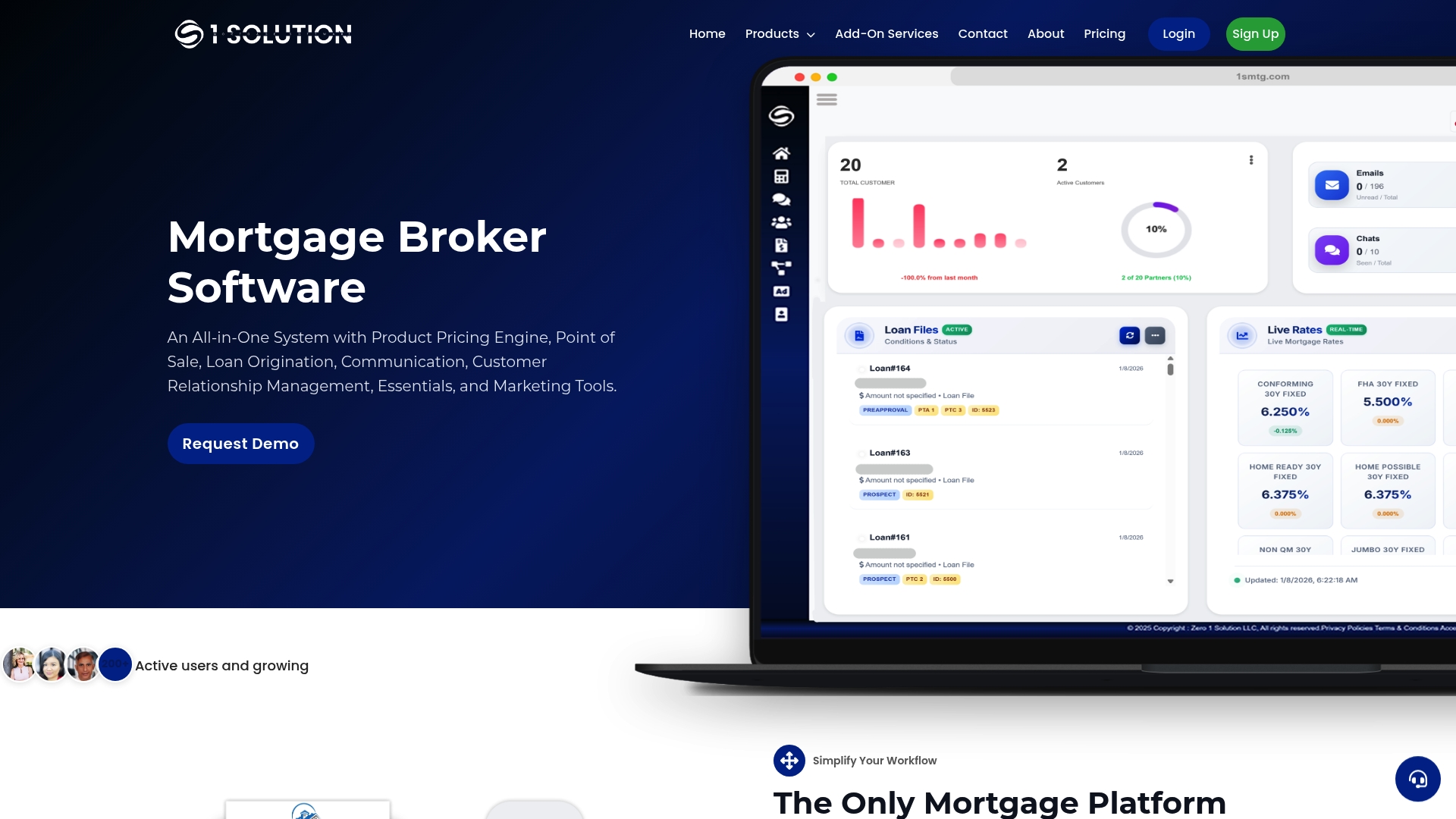
If you are replacing several subscriptions, start with the loan flow you run most, from lead to close, and see it in one system. You can request a look at the platform.
Our perspective
I spent over 20 years as a processor, underwriter, loan originator and systems consultant. In that time I watched brokers pay for tools built for banks, then pay again for the connectors to make those tools talk.
Integration is a means. What a broker wants is to enter a borrower once and see that data everywhere it matters: the pricing, the file, the signature, the conversation. We built 1 Solution so that happens by design and not by project.
We are self-funded and independent. Nobody outside the industry tells us what to build. That is why we focus on control: you decide how your team works, and your data stays in one place you can manage.
Omar Khamisa
FAQ
What is an API in mortgage?
An API is a defined way for software systems to exchange data and instructions automatically. In mortgage, it lets a CRM, POS, LOS, pricing engine or e-signature tool share borrower and loan data without manual entry.
What is an example of API integration?
A loan officer enters a scenario in their system, the system sends a pricing request through an API, and the results come back and display on the same screen. Freddie Mac's pricing and committing APIs work this way between vendor systems and its Loan Selling Advisor.
Do I need a developer to integrate my mortgage CRM with my LOS?
With separate vendors, usually someone has to plan, configure and test the connection. With a platform where CRM, LOS, POS and pricing are modules of one system, the data already flows between them.
What should I check on security before connecting a new tool?
Look at encryption, multifactor authentication, audit trails and what access a third party gets to borrower data. Freddie Mac's eMortgage Guide lists specific encryption and authentication expectations for systems that handle sensitive data.