

Running a mortgage brokerage without a well-structured compliance program is less a matter of "if" something goes wrong and more a matter of when. This mortgage broker compliance management guide walks you through the exact components that regulators examine, the documentation they demand, and the daily workflows that separate brokers who pass exams from those who get cited. Whether you are a compliance officer building a program from scratch or a broker trying to identify gaps before your next examination, the strategies ahead reflect current CFPB expectations, AML obligations, and the hard lessons that only come from real audit encounters.
Table of Contents
- Key takeaways
- Your mortgage broker compliance management guide starts here
- Building your compliance management system step by step
- Staying audit-ready through internal verification
- Common compliance mistakes and how to fix them
- My take on what actually separates compliant brokers from cited ones
- How 1smtg supports your compliance program
- FAQ
Key takeaways
| Point | Details |
|---|---|
| Systems beat individuals | Embed controls into daily workflows rather than assigning compliance responsibility to one person. |
| Documentation is the exam | Regulators evaluate evidence of what you did, not your intentions, so every file must be complete and retrievable. |
| AML obligations are non-negotiable | Brokers must maintain active AML programs with suspicious transaction reporting and thorough record-keeping. |
| Complaint data drives improvement | Analyzing complaints and linking them to corrective actions signals a mature, responsive compliance culture to examiners. |
| Technology reduces human error | Purpose-built broker compliance software automates audit trails, training records, and policy version control. |
Your mortgage broker compliance management guide starts here
Compliance management in the mortgage industry is the formal practice of building and sustaining a program that keeps your business aligned with applicable laws, regulations, and regulatory guidance. The Consumer Financial Protection Bureau refers to this structure as a Compliance Management System, or CMS. Knowing that term matters because when a CFPB examiner walks through your door, the conversation will use that vocabulary. The CFPB CMS framework evaluates board oversight, policy infrastructure, training, monitoring, complaint handling, and corrective action as integrated elements, not isolated checkboxes.
Every broker needs foundational documents and credentials in place before anything else. Your Nationwide Multistate Licensing System (NMLS) registration must be current, and your state-specific licenses must reflect your actual business activities. Beyond licensing, your program requires written policies covering anti-money laundering under the Bank Secrecy Act, privacy notices under the Gramm-Leach-Bliley Act, fair lending practices, and consumer disclosure procedures.
The essential documentation and tools
The table below captures what regulators typically want to see during an examination:
| Component | What it covers |
|---|---|
| NMLS license records | Active, accurate, and up to date for all originators |
| AML / BSA policy | Suspicious activity reporting, customer identification, and record retention |
| Privacy policy and notices | Sent to all borrowers before sharing their information |
| Fair lending policy | ECOA and HMDA compliance procedures |
| Training records | Dates, topics, attendees, and completion evidence |
| Complaint log | Date received, description, resolution, and root cause notation |
| Internal audit reports | Findings, corrective actions, and sign-off by responsible parties |
Canadian brokers face parallel obligations. FINTRAC requires mortgage brokers to maintain full AML compliance programs covering transaction monitoring, suspicious transaction reporting, and record retention under the Proceeds of Crime (Money Laundering) and Terrorist Financing Act. If you work across borders or with Canadian lenders, understanding those FINTRAC PCMLTFA requirements is not optional.
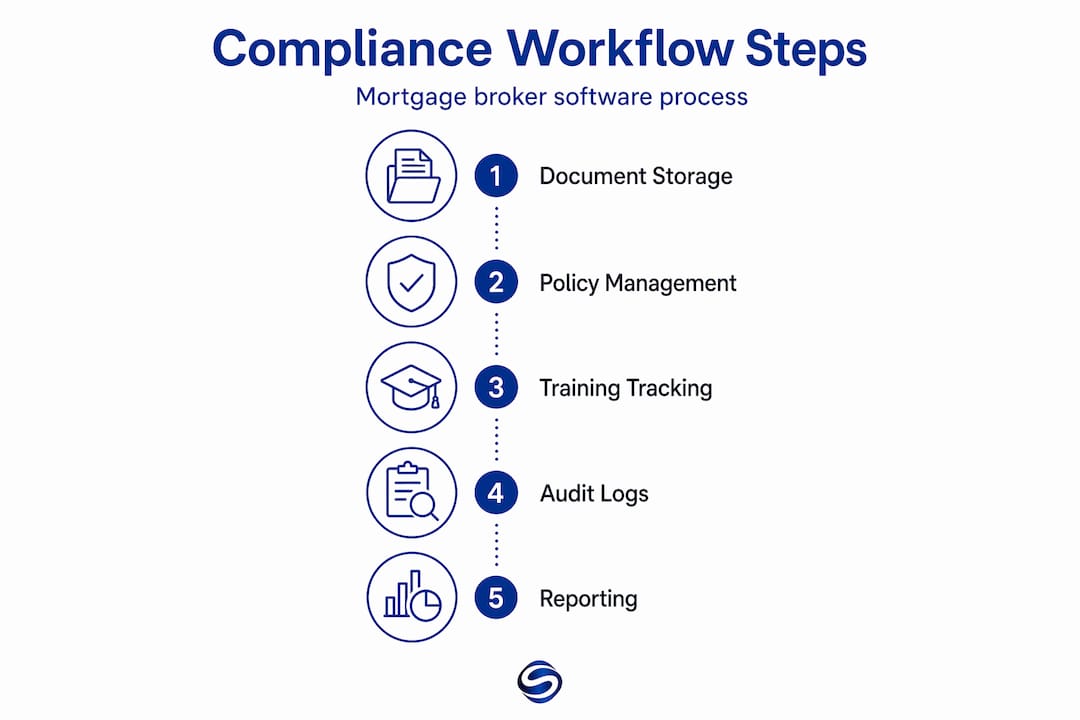
On the technology side, broker compliance software centralizes policy management, tracks training completions, stores audit logs, and timestamps corrective actions. Running these functions out of spreadsheets and email folders is how brokers get caught with incomplete records during a surprise exam.
Pro Tip: Assign a dedicated compliance officer or designate someone with explicit, documented authority to own the program. Regulators expect a named individual to be accountable, even at small shops.
Building your compliance management system step by step
Most compliance failures are not caused by brokers who ignored the rules. They are caused by brokers who built their program on intentions rather than processes. Here is how to build one that survives scrutiny.
-
Develop and approve written policies. Every major risk area needs a written policy signed off by your board or ownership. Generic templates are a starting point only. Your policies must reflect your actual loan products, markets, and workflows. Outdated policies are one of the most common CFPB exam deficiencies and they signal to examiners that compliance is not an active priority.
-
Design a training program with proof of completion. Compliance training for mortgage brokers should cover fair lending, AML, privacy, and any product-specific requirements. Training must happen at onboarding and at regular intervals thereafter. Attendance sheets, quiz scores, and course completion certificates are the evidence that proves it actually happened.
-
Conduct a documented risk assessment. The CFPB expects you to identify risks, assess their likelihood and potential impact, and then document specific mitigations. A systems-based risk mitigation approach connects each identified risk to a specific control embedded in your daily process, not just a note in a policy binder. Review your risk assessment at least annually and after any significant regulatory or business change.
-
Integrate controls into daily workflows. Your mortgage compliance checklist for individual loan files should be part of your standard operating procedure, not a retrospective exercise before an exam. Automating reminders for required disclosures, built-in approval gates in your loan origination system, and mandatory fields for required exhibits all produce consistent compliance outcomes without relying on memory or individual vigilance.
-
Build a complaint response process. Every complaint must be logged, investigated, and resolved with a documented explanation. More importantly, complaint data should be analyzed regularly and the findings reported to management. Patterns in complaints often signal systemic issues that, if caught early, prevent regulatory action.
-
Establish corrective action tracking. When an internal audit or monitoring activity finds a problem, you need a system to assign ownership, set a resolution date, and verify completion. Examiners want to see that findings lead to fixes, not just acknowledgment.
Pro Tip: The CFPB's own risk assessment model separates the task of identifying risks from the task of designing mitigations. Avoid collapsing these into a single meeting. Identifying risks first, without jumping to solutions, produces more accurate and defensible assessments.
Staying audit-ready through internal verification
Audit readiness is not a sprint you run before an examination. It is a state you maintain continuously. The practical framing that works best: treat every loan file as if a regulator will pull it tomorrow.
A complete loan file should contain the application, all credit documentation, every required disclosure with signatures and timestamps, the final HUD-1 or Closing Disclosure, the AML screening result, and any borrower eligibility evidence your state requires. One of the most common and preventable audit failures is assuming that lender or wholesaler file pulls contain all required broker exhibits. They often do not.

Texas is a useful example. State mortgage examiners in Texas expect brokers to independently scrub each loan file to confirm that all required disclosures and jurisdiction-specific exhibits are present. Privacy notices must be sent on every loan file before any customer information is shared, and examiners will check. Relying on the lender's version of the file without independent verification has resulted in citation after citation during Texas examinations.
For AML, your logs must show every transaction that triggered review, the decision made, who made it, and what documentation supported it. Standardizing who decides on suspicious transaction reports and building a workflow with defined roles and retention requirements transforms AML from a vague obligation into a defensible practice.
The internal audit function should operate on a fixed schedule. Quarterly file reviews, annual policy reviews, and periodic testing of your complaint process are the minimum. Findings must be documented with clear ownership and tracked to resolution. An audit that surfaces issues and then goes nowhere is worse than no audit at all because it creates a written record of known problems that were never corrected.
Pro Tip: Build a pre-exam checklist that mirrors what regulators actually request. Audit-ready documentation includes loan files, disclosures, AML SAR logs, training records, complaint logs, and prior audit findings with resolution notes. Running through this list quarterly means you are never caught scrambling.
Common compliance mistakes and how to fix them
Even experienced brokers fall into predictable traps. Recognizing them is the first step to fixing them.
- Assuming lender packages are complete. As noted above, broker-specific disclosures and exhibits are not always included in what a lender pulls. You are responsible for your own file completeness, full stop.
- Letting policies go stale. Regulations change. Products change. Your written policies must reflect current reality. A policy dated three years ago that references a product you no longer offer signals neglect to an examiner.
- Building compliance around one person. If your entire compliance program lives in one employee's head, a resignation or illness creates immediate regulatory exposure. Embed controls into systems, not people.
- Ignoring complaint trends. Individual complaints get resolved. The bigger risk is never analyzing them as a dataset. A pattern of complaints about fee disclosures, for example, almost always points to a systemic training or disclosure process failure.
- Using disconnected tools. Running your loan origination in one system, tracking training in a spreadsheet, storing audit notes in email folders, and managing disclosures in paper files is a recipe for retrieval failure during an exam. Broker compliance software that consolidates these functions removes the most dangerous single point of failure in most small-to-midsize brokerage compliance programs.
My take on what actually separates compliant brokers from cited ones
I have reviewed enough compliance programs to say with confidence that the difference between a broker who passes a CFPB exam and one who does not is rarely about knowledge of the regulations. Both usually know the rules. The difference is almost always about whether the rules are embedded in the process or just written on paper.
I have seen shops with beautiful policy binders that had not been updated in two years. I have seen training logs that listed completion dates for courses the broker could not actually produce. What examiners are doing is testing whether your documentation matches reality. When it does not, the deficiency finding is about the gap between your stated program and your actual behavior, and those findings carry serious weight.
What I have found genuinely effective is treating complaint management as a diagnostic tool rather than a legal obligation. Brokers who analyze complaint data monthly and report findings to ownership are not just satisfying CFPB expectations. They are catching process failures before they become exam findings. That mindset shift, from compliance as defense to compliance as quality control, is what distinguishes programs that thrive under examination from those that barely survive.
Leadership engagement is the other piece most articles underemphasize. Board or ownership involvement is not ceremonial. Regulators look for evidence that the people running the business are actively engaged in the compliance program. Approving policies, reviewing audit reports, and asking questions at management meetings creates a paper trail of engagement that signals accountability at the top.
— Omar
How 1smtg supports your compliance program
Managing a mortgage compliance program across disconnected tools creates exactly the kind of retrieval and documentation gaps that regulators cite. 1smtg consolidates the functions that matter most to compliance officers and brokers into a single platform. Policy tracking, training record management, audit trail logging, and complaint workflows are built into the same environment where loan origination happens, which means your compliance evidence is generated automatically as your team works.
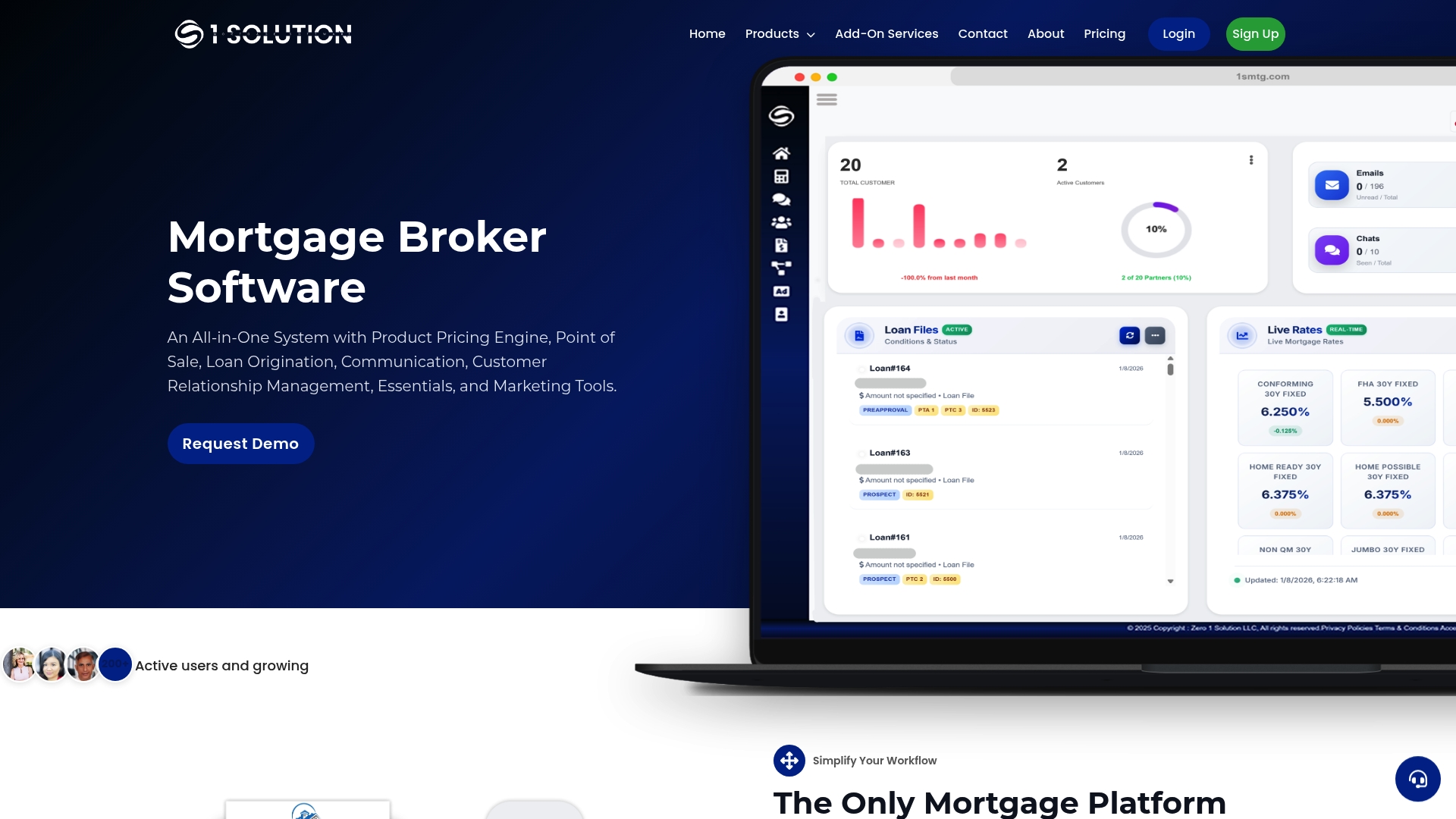
The platform is built for the way mortgage professionals actually operate, with real-time updates, human support, and onboarding training so your team does not have to figure it out alone. If your current setup involves spreadsheets, email chains, and separate systems for every compliance function, 1smtg is worth a close look. Explore what a unified mortgage software platform can do for your compliance program at 1smtg.com.
FAQ
What is a compliance management system for mortgage brokers?
A Compliance Management System (CMS) is the structured program a mortgage broker uses to identify regulatory obligations, create policies, train staff, monitor compliance, handle complaints, and take corrective action. The CFPB evaluates all of these components as an integrated system during examinations.
What should be on a mortgage compliance checklist?
A mortgage compliance checklist should include license verification, signed and timestamped disclosures, AML screening results, borrower eligibility documentation, privacy notices, training completion records, and complaint logs, all organized by loan file for easy retrieval.
How often should compliance training happen?
Compliance training for mortgage brokers should occur at initial onboarding and at least annually thereafter, with additional sessions whenever regulations change or new products are introduced. Training must be documented with dates, topics, and completion evidence.
Why do mortgage brokers fail compliance audits?
Most audit failures trace back to incomplete loan files, outdated policies, missing training records, or lack of documentation showing that identified risks were actually mitigated within daily workflows rather than just described in writing.
What broker compliance software features matter most?
The most critical features are audit trail logging, policy version control with approval timestamps, training record management, and complaint tracking with corrective action workflows, all integrated with your loan origination process to generate compliance evidence automatically.