

Mortgage deal comparison is the process of evaluating standardized loan terms, costs, and fees side by side to find the most affordable mortgage for your financial situation. The federal government requires lenders to issue a Loan Estimate within three business days of receiving your application, giving you a consistent document to compare across lenders. Most buyers focus on the interest rate and miss the bigger picture. The real differences between offers show up in APR, lender fees, closing costs, and cash to close. Tools like the Consumer Financial Protection Bureau (CFPB) guidelines, Bankrate resources, and the Loan Estimate form itself make this process far more precise than most buyers realize.
What is a Loan Estimate and how does mortgage deal comparison work?
The Loan Estimate is a three-page federal disclosure form that every lender must provide in the same standardized format, making side-by-side comparison possible regardless of which lender you use. This standardization is the foundation of any fair mortgage deal comparison. Without it, comparing offers would be like comparing grocery receipts from stores that use different units of measurement.
Page one shows the loan terms: interest rate, monthly principal and interest payment, whether the rate can rise, and whether a prepayment penalty applies. Page two breaks down closing costs into lender fees and third-party fees. Page three shows cash to close, the total amount you need to bring to the closing table.
The figures that matter most when comparing offers:
- Interest rate: Your base borrowing cost, before fees
- APR (Annual Percentage Rate): The interest rate plus lender fees, expressed as a yearly rate
- Estimated monthly payment: Principal, interest, taxes, and insurance combined
- Closing costs: Total fees due at settlement
- Cash to close: Down payment plus closing costs minus any credits
One critical distinction: lender-controlled fees listed in Section A of the Loan Estimate are negotiable and vary between lenders. Third-party fees like title insurance or appraisal costs are largely fixed. Focusing your comparison on Section A fees reveals where lenders actually differ.
Pro Tip: Request all Loan Estimates on the same day, for the same loan amount, loan type, and rate lock period. Any variation in those inputs makes the comparison unreliable.
How to gather and compare mortgage offers effectively
Obtaining 3 to 5 mortgage quotes before choosing a lender is the industry standard recommendation. Each additional quote gives you more negotiating leverage and a clearer picture of the market rate for your credit profile. Stopping at one or two quotes is one of the most expensive mistakes a homebuyer can make.
Preapproval is not the same as prequalification. Prequalification is a quick estimate based on self-reported data. Preapproval involves a hard credit pull and verified income documentation. Only preapproval quotes reflect the actual rate and terms a lender will offer you.
When you contact lenders, ask these specific questions:
- What is the APR, not just the interest rate?
- Are there origination fees, and are they negotiable?
- What is the rate lock period, and what does extending it cost?
- Are discount points included in this quote, or is this a no-points rate?
- What credits are available to offset closing costs?
Once you have multiple Loan Estimates, build a simple spreadsheet with one row per lender. Columns should include interest rate, APR, Section A lender fees, total closing costs, and cash to close. This format makes the comparison visual and fast.
Negotiating mortgage terms is entirely possible when you hold competing offers. If Lender A has a lower rate but Lender B has lower fees, show each lender the competing offer and ask them to match or beat it. Lenders with room to move will often reduce origination fees or offer a rate credit rather than lose the deal.

Pro Tip: Multiple mortgage applications within a 45-day window count as a single hard inquiry under FICO scoring models, so shopping aggressively will not damage your credit score.
Understanding interest rate, APR, fees, and closing costs
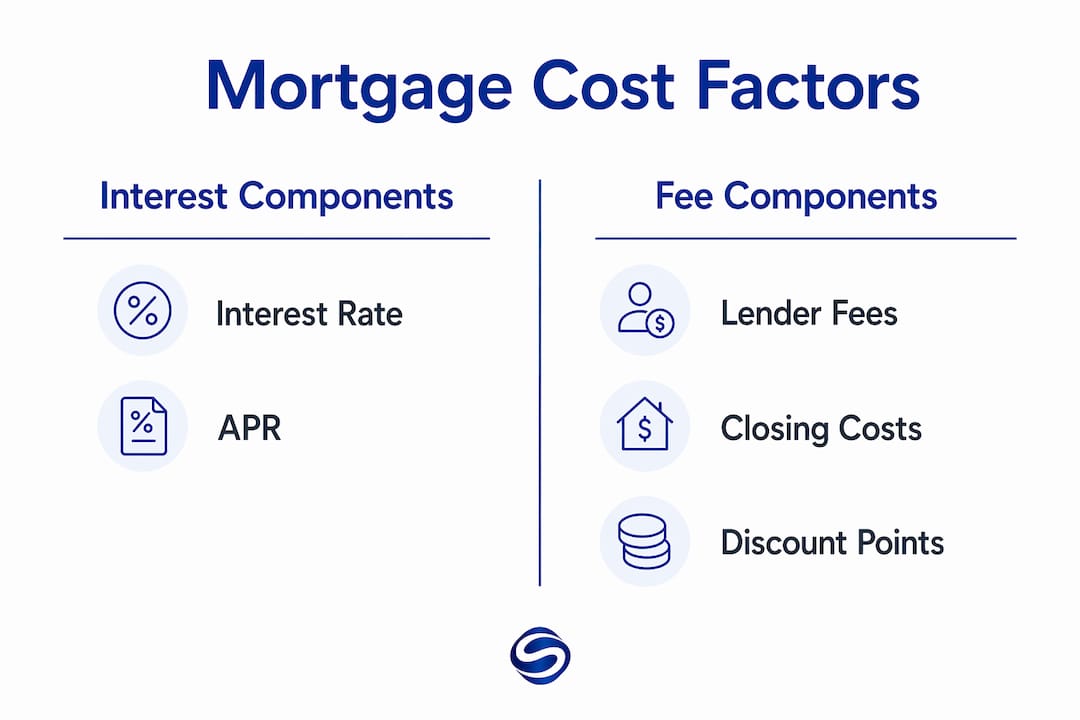
The interest rate and APR measure different things, and confusing them leads to bad decisions. The interest rate is the annual cost of borrowing the principal. APR adds lender fees into that calculation and spreads them across the loan term, giving you a more complete cost view. A lender offering 6.5% with $4,000 in origination fees may be more expensive than one offering 6.75% with zero fees, depending on how long you keep the loan.
| Cost component | What it measures | Negotiable? |
|---|---|---|
| Interest rate | Annual borrowing cost on principal | Sometimes, via points |
| APR | Rate plus lender fees annualized | Reflects true cost |
| Origination fees | Lender's processing charge | Yes, directly |
| Third-party fees | Title, appraisal, attorney costs | Limited |
| Cash to close | Total upfront funds needed | Partially, via credits |
Closing costs range from 2% to 6% of the home's purchase price. On a $400,000 home, that spread represents $8,000 to $24,000. A 0.25% difference in interest rate between two lenders is often smaller in dollar terms than a $3,000 difference in origination fees, especially if you plan to sell or refinance within five years.
Discount points add another layer to the comparison. One mortgage point costs 1% of the loan amount and typically reduces the interest rate by about 0.25%. Paying points makes sense only if you hold the loan long enough for the monthly savings to exceed the upfront cost. That calculation is the break-even analysis covered in the next section.
Some lenders also offer float-down options, which let you lock a rate but capture a lower rate if the market drops before closing. Float-down options require a minimum rate decrease and must be exercised within a specific window. They add upfront cost but reduce rate risk during volatile markets.
Pro Tip: Use a mortgage APR calculator to convert competing offers into a single comparable number. APR strips away the noise of different fee structures and shows you the true annual cost.
Fixed vs. adjustable mortgage deals: which should you compare?
Fixed-rate mortgages offer payment stability for the entire loan term, while adjustable-rate mortgages (ARMs) and tracker mortgages vary with market or base rates. The right choice depends on how long you plan to stay in the home and how much payment uncertainty you can absorb.
Key differences to weigh when comparing mortgage types:
- Fixed-rate loans lock your rate at origination. Your principal and interest payment never changes, regardless of what happens to market rates.
- ARMs typically offer a lower initial rate for a fixed period (commonly 5 or 7 years), then adjust annually based on a benchmark index like SOFR.
- Tracker mortgages reprice directly with a central bank rate. In the UK, tracker payments rise proportionally with Bank of England base rate changes.
The decision between fixed and adjustable rates hinges less on the initial rate difference and more on payment certainty preferences and early repayment penalties. A 5/1 ARM at 5.75% looks attractive against a 30-year fixed at 6.75%, but if rates rise sharply in year six, your payment could jump by hundreds of dollars per month.
Early repayment charges deserve attention in any deal comparison. Some fixed-rate products carry penalties for paying off the loan early or refinancing within the fixed term. Those penalties can eliminate the savings from a lower rate if your plans change. Always check the prepayment penalty disclosure on page one of the Loan Estimate before committing.
How to calculate total cost and break-even points
The most accurate way to compare mortgage deals is to calculate the total cost over your expected holding period, not just the monthly payment. Summing total interest plus lender fees over a typical five-year ownership window gives a far more reliable comparison than the headline rate alone.
Here is a straightforward process for any two offers:
- Calculate five-year interest cost. Multiply the monthly payment by 60, then subtract the principal paid down over that period.
- Add Section A lender fees. Pull these directly from page two of each Loan Estimate.
- Subtract any lender credits. Credits reduce upfront costs but are often offset by a higher rate.
- Compare total five-year cost. The lower number is the better deal for a five-year horizon.
- Calculate the break-even point for points. Divide the cost of buying points by the monthly savings to find how many months until you recover the upfront cost.
| Scenario | Loan A | Loan B |
|---|---|---|
| Interest rate | 6.50% | 6.75% |
| Origination fees | $4,500 | $0 |
| 5-year interest cost | $62,400 | $64,800 |
| Total 5-year cost | $66,900 | $64,800 |
| Better deal at 5 years | No | Yes |
The table above illustrates a counterintuitive result: the lower interest rate produces the higher total cost because of origination fees. This outcome is common, and it is exactly why break-even analysis belongs in every mortgage comparison.
Pro Tip: If you expect to sell or refinance within seven years, prioritize lower upfront fees over a marginally lower rate. The math almost always favors the lower-fee option at shorter holding periods.
Key takeaways
Mortgage deal comparison requires evaluating APR, lender fees, and total five-year cost together, because the lowest interest rate rarely produces the lowest overall cost.
| Point | Details |
|---|---|
| Use the Loan Estimate | Compare Section A lender fees across offers, not just the headline rate. |
| APR beats interest rate alone | APR includes lender fees and gives a truer picture of annual borrowing cost. |
| Get 3 to 5 quotes | Multiple preapproval quotes create negotiating leverage and reveal market pricing. |
| Run a break-even analysis | Calculate total interest plus fees over your expected holding period before deciding. |
| Match loan type to your timeline | Fixed rates suit long-term owners; ARMs or trackers may cost less for short-term holds. |
What I've learned from watching buyers compare mortgage deals
After years of writing about mortgage finance, the pattern I see most often is buyers who treat the interest rate as the only number that matters. They walk away from a lender offering 6.75% with zero fees to take 6.50% with $5,000 in origination charges, and they feel good about it. The math says otherwise.
The second most common mistake is not negotiating at all. Lenders expect it. When you show up with three competing Loan Estimates and a strong credit profile, you have real leverage. I have seen origination fees drop by $1,500 to $2,000 in a single conversation. That is money that stays in your pocket at closing.
The third issue is ignoring the cash to close figure on page three of the Loan Estimate. Two loans with nearly identical monthly payments can require very different amounts of cash at closing. If you are working with limited reserves, that difference is not academic. It determines whether the deal closes.
My honest advice: build the five-year total cost spreadsheet before you make any final decision. It takes 20 minutes and it will almost certainly change which offer you choose. Align your mortgage choice with how long you actually plan to stay in the home, not how long the loan term runs on paper.
— Omar
Compare mortgage deals smarter with 1smtg
Tracking multiple Loan Estimates, monitoring rate changes, and managing lender communications across separate tools creates real risk of missed details and delayed closings. 1smtg brings all of that into one place.
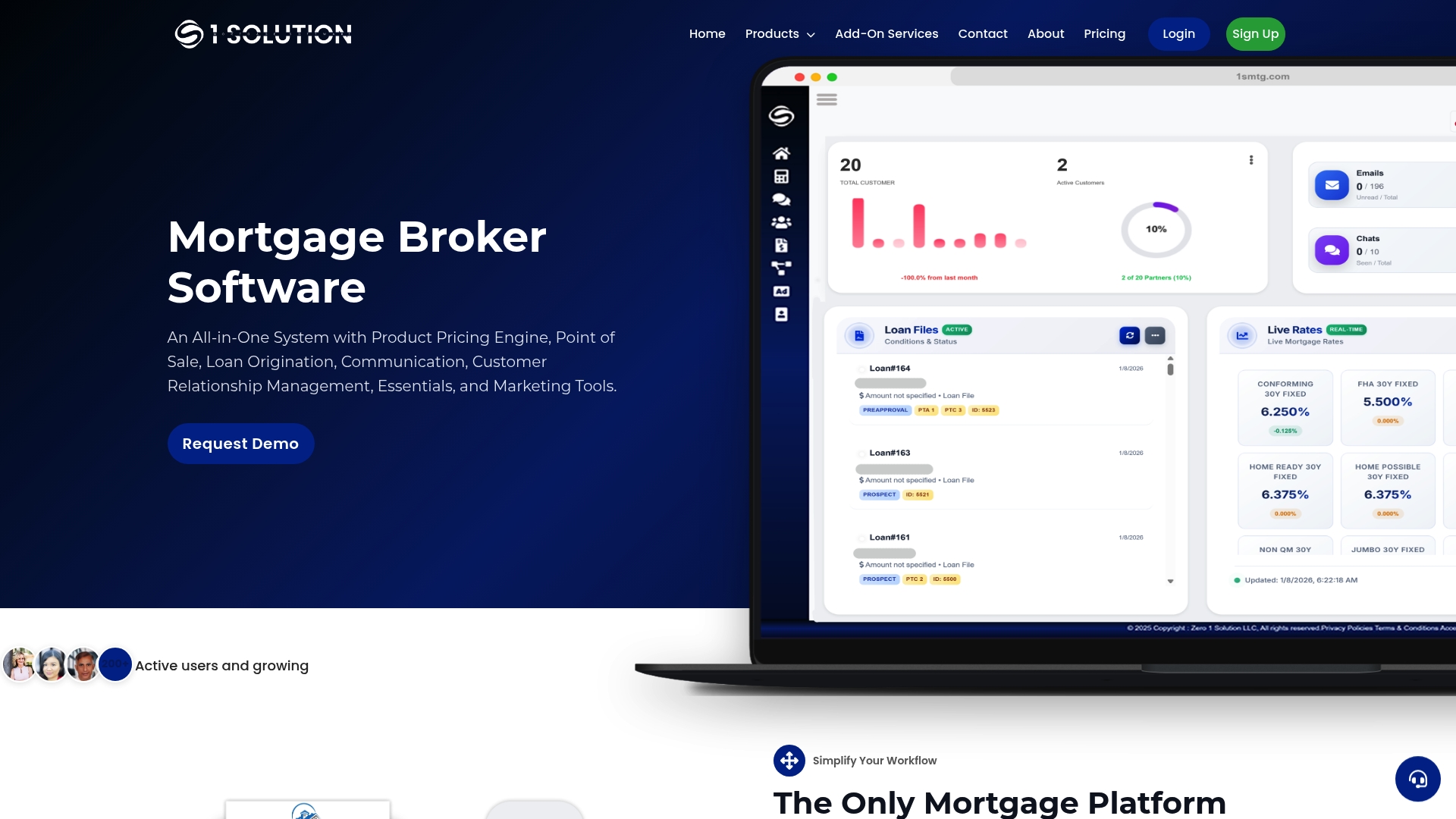
The 1smtg mortgage platform gives loan officers and brokers a single interface that combines a Loan Origination System, a Product and Pricing Engine, and an integrated CRM. Real-time rate monitoring means you catch better pricing windows without switching between systems. Mortgage condition tracking and milestone tracking keep every deal moving without manual follow-up. If you are managing multiple borrowers comparing multiple offers, 1smtg removes the friction that slows closings and causes errors.
FAQ
What is the most important number to compare on a Loan Estimate?
APR is the most reliable single number for comparing mortgage offers because it combines the interest rate and lender fees into one annualized figure. For a complete picture, also compare Section A lender fees and total cash to close.
How many mortgage quotes should I get before deciding?
Industry guidance recommends obtaining 3 to 5 preapproval quotes. Each additional quote increases your negotiating leverage and reduces the risk of overpaying on fees or rate.
Does shopping multiple lenders hurt my credit score?
Multiple mortgage applications submitted within a 45-day window count as a single hard inquiry under FICO scoring models. Shopping aggressively within that window does not meaningfully affect your credit score.
When does a lower interest rate not mean a cheaper mortgage?
A lower interest rate can produce a higher total cost when origination fees are significantly higher than a competing offer. The break-even analysis, which compares total interest plus lender fees over your expected holding period, reveals which deal is actually cheaper.
What is the difference between cash to close and closing costs?
Closing costs are the fees paid at settlement, including lender fees and third-party charges. Cash to close is the total amount you bring to the closing table, which includes closing costs, your down payment, and prepaid items, minus any lender credits.