

Mortgage scenario analysis explained simply means this: running multiple financial projections on a single borrower's profile to understand what happens under different conditions before committing to a loan. Most people think affordability is just about qualifying numbers. It isn't. The difference between a borrower who qualifies and a borrower who thrives five years into a mortgage often comes down to whether anyone ran the right scenarios upfront. This guide breaks down the methodology, the metrics that matter, and how to apply scenario analysis in real loan origination and personal planning.
Table of Contents
- Key takeaways
- Mortgage scenario analysis explained: the core metrics
- Modeling best-case, base-case, and worst-case scenarios
- Pitfalls and limitations in mortgage scenario analysis
- How to apply scenario analysis in practice
- My take on what most people get wrong
- How 1smtg supports your scenario analysis workflow
- FAQ
Key takeaways
| Point | Details |
|---|---|
| DTI ratios are the foundation | Front-end should stay at or below 28% and back-end between 43% and 50% for standard approval. |
| Scenario types guide decisions | Base-case, best-case, and worst-case projections reveal affordability ranges, not just qualification ceilings. |
| AUS systems produce different results | Fannie Mae DU and Freddie Mac LP use different algorithms and can return opposite recommendations on the same file. |
| AI tools have real limitations | AI mortgage calculators produce inconsistent outputs and should not replace professional scenario review. |
| Scenario analysis is not pre-approval | A scenario review identifies loan viability and documentation gaps before a formal application is submitted. |
Mortgage scenario analysis explained: the core metrics
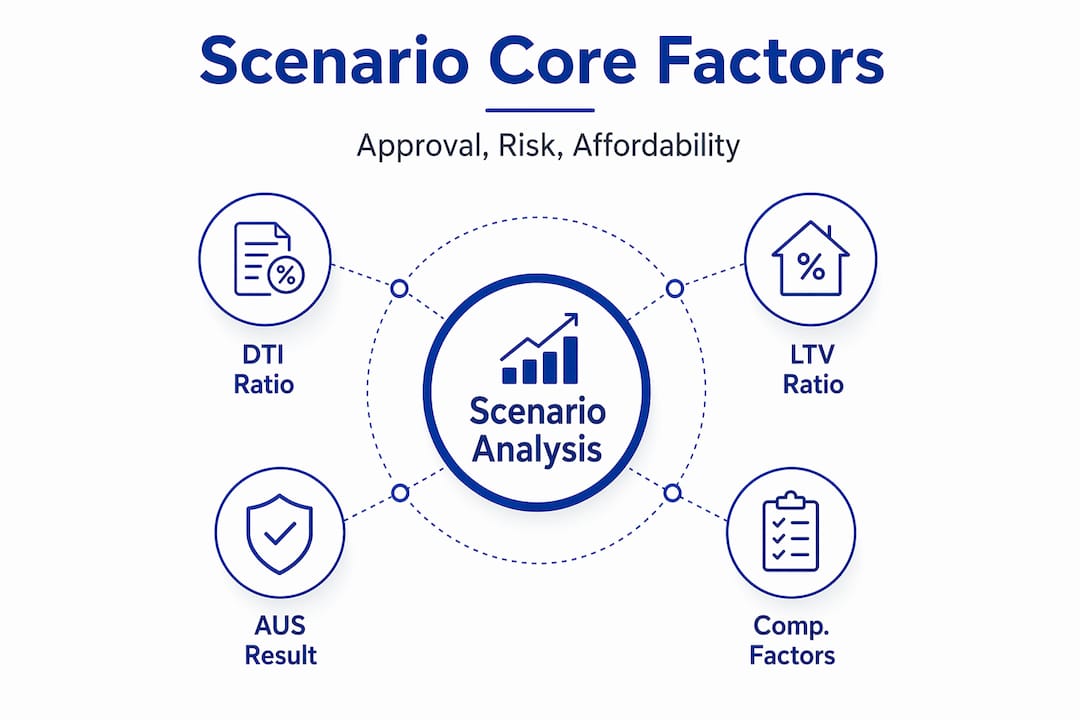
Before you can model scenarios, you need to understand the financial ratios that underwriters actually use. Two numbers dominate every mortgage decision: the front-end debt-to-income ratio and the back-end debt-to-income ratio.
The front-end ratio measures housing costs against gross monthly income. This includes your principal, interest, taxes, and insurance. Lenders target a front-end ratio of 28% or below, with back-end DTI capped between 43% and 50% depending on the loan type. The back-end ratio captures all monthly debt obligations: the mortgage, car payments, student loans, credit card minimums, and anything else hitting your credit report.
Beyond DTI, the loan-to-value ratio matters significantly. LTV is simply the loan amount divided by the appraised property value. A lower LTV signals less lender risk and typically unlocks better rates and terms. Cross 80% LTV and you're usually looking at private mortgage insurance costs that affect affordability calculations directly.
Then there's the automated underwriting system layer. DU and LP produce divergent approvals for roughly 5 to 8% of borrowers because they use different algorithms and weigh compensating factors differently. Experienced loan officers run the same file through both Fannie Mae's Desktop Underwriter and Freddie Mac's Loan Prospector to find the most favorable path without triggering additional credit inquiries.
Compensating factors are the variables that can push a borderline file into approval territory. Strong cash reserves, a long employment history, minimal credit utilization, and a large down payment all carry weight. In fact, DU approves back-end DTI as high as 57% when compensating factors are strong enough, well beyond the standard qualified mortgage guidelines.
Pro Tip: When building a scenario, always identify the borrower's compensating factors first. They may allow you to model scenarios with higher DTI thresholds that would otherwise look disqualifying on paper.
Modeling best-case, base-case, and worst-case scenarios
This is where mortgage scenario analysis moves from calculation to strategy. The goal isn't to find the maximum loan amount a borrower qualifies for. The goal is to map a range of outcomes and identify where comfort lives within that range.
Here's how the three scenario types work in practice:
- Base-case scenario: This uses current verified income, existing debts, today's interest rate, and a realistic purchase price. It represents the most probable outcome if nothing changes. For rate assumptions, Fannie Mae projects the 30-year fixed rate at approximately 6.3% through early 2027, making this a reasonable baseline for current scenario work.
- Best-case scenario: This models favorable conditions. Rate drops to 5.75%, the borrower pays off a car loan before closing, or a bonus income stream qualifies. This scenario reveals the ceiling of what becomes possible with modest improvements.
- Worst-case scenario: Rate rises to 7%, an employer changes compensation structure, or property taxes come in higher than estimated. This scenario tests whether the borrower can still service the debt without financial strain.
Sensitivity analysis sits underneath all three. It answers one question: how much does the monthly payment change if one variable shifts? The table below shows how a single rate change reshapes a $400,000 loan.
| Interest rate | Monthly payment (P&I) | Monthly difference vs. 6.3% |
|---|---|---|
| 5.75% | $2,335 | -$148 |
| 6.30% | $2,483 | Baseline |
| 6.75% | $2,594 | +$111 |
| 7.25% | $2,740 | +$257 |

The housing affordability index improved from 101.4 to 110.6 between April 2025 and April 2026 as rates declined. That nine-point swing represents real purchasing power. Scenario modeling captures exactly this kind of shift and translates it into dollars.
Income fluctuation deserves its own attention. Self-employed borrowers, commission-based earners, and gig workers face income variability that makes the worst-case scenario especially important. Modeling a 15% income reduction against current debt obligations tells you whether a borrower has genuine buffer or is stretched to the edge of qualification.
Pro Tip: Run a scenario where the borrower makes no extra payments and another where they apply just $200 extra per month to principal. The payoff timeline difference is often dramatic enough to change the client's entire decision-making framework.
Pitfalls and limitations in mortgage scenario analysis
Understanding the methodology is only half the work. The other half is knowing where analysis goes wrong.
The biggest risk right now is overreliance on AI tools. AI mortgage tools produce inconsistent outputs prone to hallucination and should not be used as the primary basis for underwriting decisions. A borrower who runs their numbers through three different AI calculators will often get three meaningfully different affordability estimates. None of them account for actual underwriting guidelines, lender overlays, or compensating factor nuances.
Here are the most common pitfalls to watch for:
- Confusing pre-approval with scenario review. A scenario review identifies loan viability and documentation gaps before a formal application. Pre-approval is a lender commitment based on verified documents. Treating a scenario review as a guarantee creates dangerous expectations.
- Ignoring lender overlays. Many lenders impose DTI caps below what DU or LP technically approves. A file that passes automated underwriting at 52% back-end DTI may still get declined by a specific lender whose overlay caps at 45%.
- Treating AUS approval as final. AUS recommendations require human underwriter validation before any loan closes. Automated approval is conditional, not final.
- Underestimating documentation requirements. Self-employed income, rental income, and bonus pay all require two-year histories and specific documentation. A scenario built on income that can't be documented is not a viable scenario.
"Mortgage scenario reviews help spot risks early and reconcile compensating factors before formal underwriting, saving weeks in processing." — buildbuyrefi.com
The deeper issue is that many borrowers and even some loan officers conflate qualification with affordability. Qualifying for a $600,000 mortgage and comfortably affording a $600,000 mortgage are two different things. Overextension risks rise sharply when borrowers push DTI limits without accounting for net take-home pay, irregular expenses, and cash reserves.
How to apply scenario analysis in practice
Whether you're a loan officer building client presentations or an individual planning your first purchase, the process follows the same logic.
- Gather clean inputs. Collect gross monthly income (documented), all monthly debt obligations from the credit report, estimated property taxes and insurance for the target area, and the current rate environment. Garbage inputs produce garbage scenarios.
- Set your baseline. Build the base-case scenario first. Use verified income, current debts, and today's prevailing rate. Calculate front-end and back-end DTI. Identify where the file sits relative to standard thresholds.
- Stress-test with rate changes. Model the payment at rates 0.5% and 1% above your baseline. If the borrower's DTI crosses into uncomfortable territory at a modest rate increase, that's a signal to either reduce the purchase price or pay down debt before applying.
- Model debt payoff scenarios. If a borrower has a car loan with 10 months remaining, run a scenario where that debt is gone at closing. The DTI improvement is often significant enough to qualify for a better rate tier or a larger loan.
- Set a comfort range, not a ceiling. The most valuable output of scenario analysis isn't the maximum loan amount. It's the range within which the borrower maintains financial flexibility. Present three payment scenarios and let the client choose where they feel secure, not just where they qualify.
For loan officers, scenario analysis also serves as a client communication tool. Walking a borrower through a rate sensitivity table builds trust and sets realistic expectations before they fall in love with a property. It also surfaces documentation issues early. Mortgage scenario reviews uncover overlooked compensating factors and prepare stronger applications before they reach underwriting.
Pro Tip: For clients with variable income, build a scenario using only their base salary and exclude bonuses entirely. If they qualify comfortably on base alone, the bonus income becomes a safety net rather than a requirement. That's a much stronger financial position.
My take on what most people get wrong
I've watched loan officers run a single scenario, get an automated approval, and consider the analysis done. That approach works until it doesn't. The files that blow up in underwriting are almost always the ones where nobody stress-tested the assumptions.
The most underrated part of scenario analysis isn't the math. It's the conversation it creates. When you show a client what their payment looks like at 6.3% versus 7.25%, and then show them what happens if they carry that car loan into closing, you're not just running numbers. You're changing how they think about the decision. That shift in perspective is what separates a loan officer who closes deals from one who closes good deals.
I've also seen the AI reliance problem get worse over the past two years. Borrowers come in with AI-generated affordability numbers that have no connection to actual underwriting guidelines. The inconsistency in AI mortgage tools isn't a minor inconvenience. It creates misaligned expectations that cost everyone time.
My honest advice: use scenario analysis to find the payment range where a borrower sleeps well at night, not just the number that gets the deal done. The borrower who is financially comfortable two years after closing is the one who refers their friends.
— Omar
How 1smtg supports your scenario analysis workflow
Running thorough mortgage scenario analysis requires more than a spreadsheet. It requires a platform that connects your pricing, origination, and client data in one place so nothing falls through the cracks.
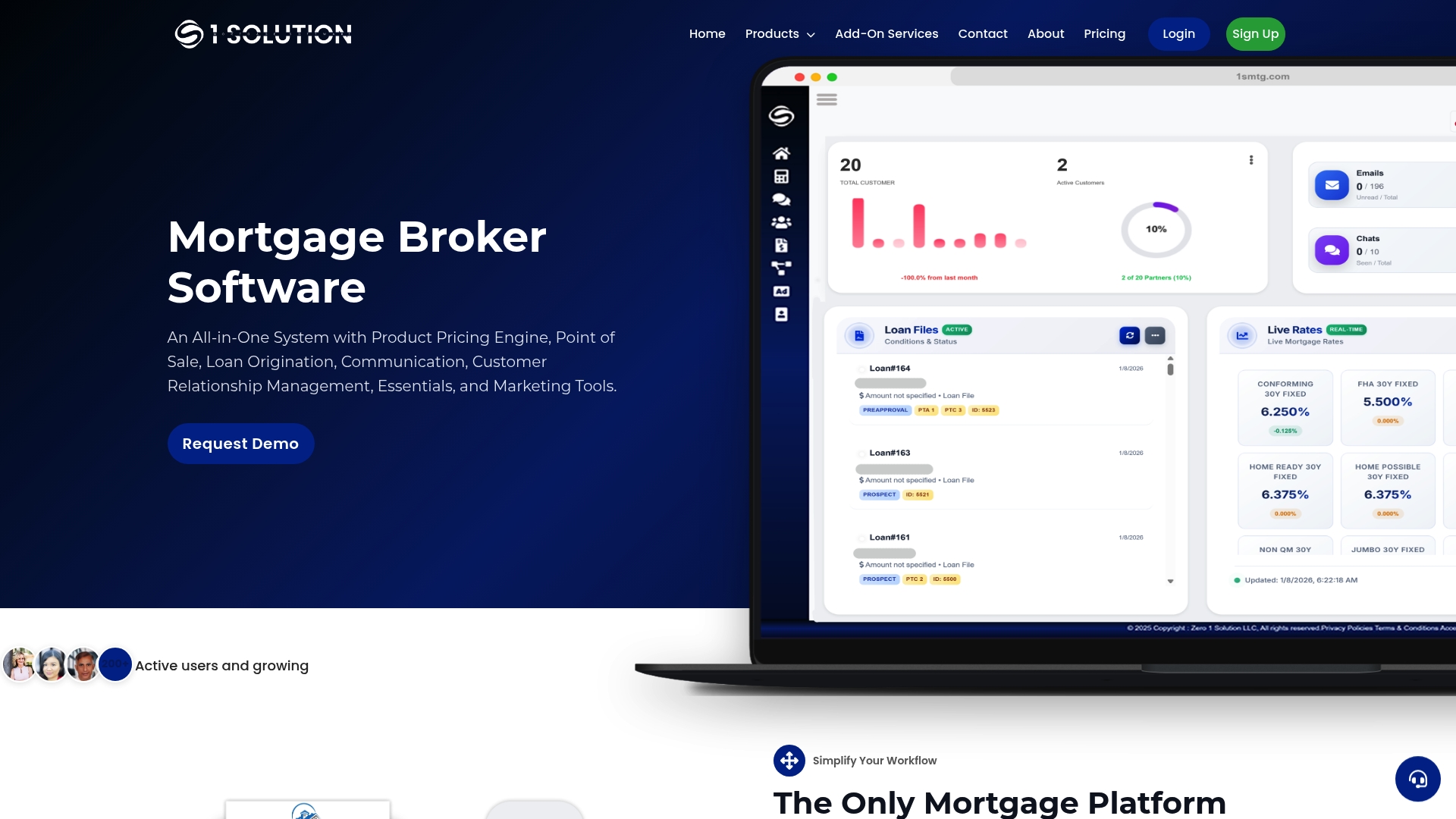
1smtg's mortgage software platform combines a Loan Origination System, Product and Pricing Engine, and integrated CRM into a single interface built specifically for loan officers and brokers. Instead of toggling between disconnected tools to model different scenarios, you work from one dashboard with real-time rate updates and consistent data across every calculation. The platform includes dedicated human support and comprehensive onboarding, which means your team gets up to speed fast and applies scenario analysis correctly from day one. If you're serious about building better loan presentations and catching documentation gaps before underwriting, this is the platform worth exploring.
FAQ
What is mortgage scenario analysis?
Mortgage scenario analysis is the process of modeling multiple financial outcomes on a borrower's profile by varying key inputs like interest rates, income, and debt levels. It helps both borrowers and loan officers understand affordability ranges and loan viability before submitting a formal application.
How is a scenario review different from a pre-approval?
A scenario review assesses loan viability and identifies documentation gaps without constituting a lender commitment. A pre-approval is based on verified documents and represents an actual lending decision, making it a later and more formal step in the process.
What DTI ratio do lenders use for mortgage approval?
Most lenders target a front-end DTI at or below 28% and a back-end DTI between 43% and 50%. With strong compensating factors, automated underwriting systems like DU can approve back-end DTI as high as 57%.
Why do DU and LP sometimes give different results?
Fannie Mae's Desktop Underwriter and Freddie Mac's Loan Prospector use different algorithms and weigh borrower factors differently. Roughly 5 to 8% of borrowers receive divergent recommendations from the two systems, which is why experienced loan officers often run files through both.
Can I rely on AI tools for mortgage scenario analysis?
AI mortgage calculators are useful for rough initial estimates but produce inconsistent outputs that don't reflect actual underwriting guidelines or lender overlays. Professional scenario analysis using verified data and a qualified loan officer remains the more reliable approach for real decisions.