

For independent mortgage brokers evaluating mortgage technology platforms, the strongest boxhomeloans.com alternatives are 1 Solution Mortgage Software, along with platform categories including LOS-first hosted systems, POS-first consumer portals with broker add-ons, and integrated broker suites. Of these, 1 Solution Mortgage Software is the broker-first pick: it combines LOS, CRM, POS, a product pricing engine (PPE), compliance tools, and marketing automation in one connected platform built specifically for independent brokers, not banks. If you want a single platform that covers every module without stitching together separate vendors, start your demo there. The comparison table below breaks down how these categories stack up across the dimensions that matter most to your brokerage.
Table of Contents
- How do boxhomeloans.com alternatives compare side by side?
- How to choose the right Box Home Loans alternative for your brokerage
- Vendor profiles: which platform fits your brokerage?
- What does migrating to a new platform actually involve?
- How this comparison was built and who wrote it
- What do brokers say about these platforms?
- How does vendor reputation factor into your platform decision?
- Key Takeaways
- Why broker-first platforms are the only rational choice right now
- Sources and further reading
How do boxhomeloans.com alternatives compare side by side?
| Dimension | Box Home Loans (Baseline) | 1 Solution Mortgage Software | LOS-First Platform | POS-First Portal |
|---|---|---|---|---|
| Best for | Retail lender workflows | Independent brokers, any size | Mid-to-large brokerages | Consumer-facing teams |
| Core modules | LOS, basic POS | LOS, CRM, POS, PPE, compliance, marketing | LOS, AUS, basic CRM | POS, lead capture, add-on LOS |
| Pricing model | Not publicly listed | Subscription SaaS; optional add-ons | Per-loan or tiered subscription | Subscription; heavy add-on fees |
| Migration & onboarding | Varies; limited broker support | Guided onboarding with dedicated support | Long implementation cycles | Faster setup; limited LOS depth |
| Integrations | Limited broker-specific feeds | Pricing engines, investor delivery, title/insurance, e-signature | Deep AUS/investor connections | Consumer credit APIs; fewer lender feeds |
| Security & compliance | SOC 2 attestation varies | SOC 2, ESIGN-compliant e-signature, audit trails | SOC 2 Type II common | SOC 2 varies; ESIGN compliant |
| Support & SLAs | Standard support tiers | Dedicated broker support | Enterprise SLA tiers | Tiered; broker-specific SLAs rare |
| White-labeling | Limited | Full white-label borrower portal | Partial | Partial |
The single biggest differentiator to weigh: integration depth versus out-of-the-box workflow. A modern LOS is only half the answer; the integration layer connecting LOS to pricing engines, AUS, CRM, and document repositories determines whether a platform swap is a bounded connector change or a full operational rebuild. Brokers running 10–15 systems in a typical origination need a platform where the CRM acts as the integration hub, syncing bidirectionally with both LOS and POS to prevent data silos.
How to choose the right Box Home Loans alternative for your brokerage
Start with one decision rule: prioritize the platform that saves the most admin hours per case, captures compliance evidence natively, and covers your critical integrations without custom development. A platform that costs more per month but eliminates three hours of manual work per loan typically carries a lower total cost of ownership than a cheaper tool that requires workarounds. Evaluation frameworks that prioritize compliance evidence capture, automation hours saved, and integration quality consistently outperform those driven by headline subscription price.
Selection criteria, in priority order:
- Native integrations with your pricing engines, investor feeds, and title/insurance partners
- Measurable admin hours saved per case through automation
- Compliance evidence capture built into the workflow (not bolted on after)
- Transparent pricing with no hidden per-user or per-loan fees
- SOC 2 attestation and ESIGN-compliant e-signature
- Defined support SLA and named account management
- Realistic migration timeline with documented data mapping
- Custom workflow and white-label options for your brand
Must-ask questions for every vendor demo:
- How does your platform export loan data, audit trails, and lender submission history?
- What does your API surface cover, and which integrations are native versus third-party?
- Are there per-user, per-loan, or per-integration fees beyond the base subscription?
- What is your guaranteed uptime SLA, and how are outages communicated?
- What does your support model look like after go-live — dedicated rep or ticket queue?
- Can we build custom workflows without involving your engineering team?
- How long does a full data migration typically take for a brokerage our size?
- Can you provide a SOC 2 Type II report or equivalent attestation?
- How do you handle compliance evidence retrieval during a regulatory audit?
- Can we speak with two or three brokerages that migrated from a similar platform?
Red flags to watch for: hidden per-user fees that surface after contract signing, integrations listed as "coming soon" with no committed delivery date, vague API documentation, and vendors who cannot produce a SOC 2 report or equivalent security attestation. Also watch for pricing structures that bundle modules you already own elsewhere, inflating your total spend without adding coverage.
Vendor profiles: which platform fits your brokerage?
Box Home Loans: the baseline
Box Home Loans operates primarily as a retail lender workflow tool. Brokers who have used it report adequate LOS functionality for straightforward loan pipelines, but common gaps include limited CRM depth, minimal broker-specific compliance evidence capture, and restricted white-labeling for borrower portals. It fits lenders with in-house operations teams more naturally than independent brokers managing multi-lender pipelines.
1 Solution Mortgage Software: the broker-first pick
Built by Omar Khamisa after 20+ years working as a processor, underwriter, loan originator, and systems consultant, 1 Solution was designed from the ground up for independent brokers. The platform covers LOS, CRM, POS, PPE, e-signature, compliance, marketing automation, and communication tools (email, SMS, chat, voice, video) in one subscription. White-label borrower portals, lead and recruitment tracking, rate comparison, and proposal generation are included. Onboarding is guided, with dedicated broker support rather than a generic ticket queue. You can request a demo at 1smtg.com and ask specifically about data migration timelines and pricing engine connections.
For mortgage CRM selection criteria and a deeper look at loan processing software options, the 1 Solution blog covers both in detail.
LOS-first hosted platforms
These platforms lead with deep AUS and investor connections, making them strong for high-volume lenders. For independent brokers, the tradeoff is real: implementation cycles run longer, CRM functionality is often shallow, and broker-specific workflows require customization. The Broker Experience Index puts CRM satisfaction at 62.8 with a negative NPS (specifically, NPS -11.8), confirming that brokers consistently find CRM usability the weakest link in LOS-first stacks.
POS-first consumer portals with add-on broker tools
These platforms excel at borrower-facing experiences and lead capture. Their limitation for brokers is structural: the LOS layer is typically an add-on, investor delivery connections are fewer, and compliance evidence capture requires manual steps. They work well for consumer-direct teams but add friction for multi-lender broker workflows.
Which to pilot first: If your brokerage runs fewer than 50 loans per month and needs to replace a fragmented stack quickly, start with 1 Solution. If you run 200+ loans monthly with complex AUS requirements, evaluate an LOS-first platform alongside 1 Solution to compare integration depth against workflow efficiency.
| Platform category | CRM depth | Broker compliance evidence | White-label POS | Typical onboarding |
|---|---|---|---|---|
| 1 Solution Mortgage Software | Full, native | Built-in | Yes | Weeks |
| LOS-first hosted | Shallow | Manual | Partial | Months |
| POS-first portal | Moderate | Limited | Partial | Weeks |
A minimal effective broker stack in 2026 centers a mortgage-tailored CRM, a modular LOS, secure cloud storage, e-signature, and an integration layer with SSO/MFA. 1 Solution covers all of these natively.
What does migrating to a new platform actually involve?
Pre-migration checklist:
- Export all loan data in raw format, including lender submission history and audit trail fields (both document metadata and binary objects)
- Map data fields between your current system and the new platform before any import
- Inventory all active integrations: pricing engines, investor feeds, title/insurance partners, e-signature providers
- Confirm SSO/MFA setup requirements and user permission structures
- Document e-signature continuity: active loan packages must not break during cutover
- Map compliance evidence fields to the new platform's audit trail structure
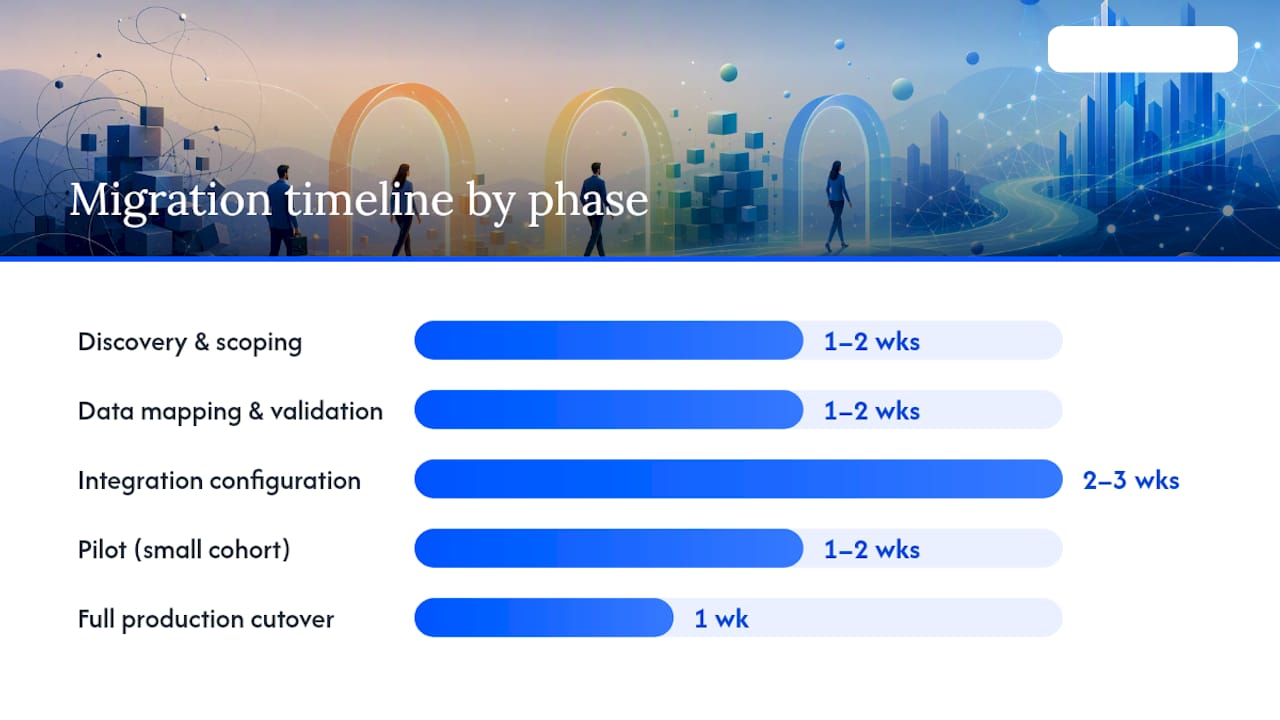
Realistic timeline milestones:
- Discovery and scoping: 1–2 weeks
- Data mapping and field validation: 1–2 weeks
- Integration configuration (pricing engines, investor feeds): 2–3 weeks
- Pilot with a small loan cohort: 1–2 weeks
- Full production cutover: 1 week
Total for a well-prepared brokerage: roughly 6–10 weeks. Poorly documented integrations and incomplete data exports are the two most common blockers that extend timelines.
Pro Tip: Export audit trail and lender submission records in their raw, unprocessed form before decommissioning your old system. Reconstructing these fields post-migration for a compliance review is time-consuming and sometimes impossible if the source system has been deprovisioned.
The integration layer is what determines whether your LOS swap is a bounded connector change or a full rebuild. Confirm with any vendor that their API surface covers your existing integrations before signing.
How this comparison was built and who wrote it
This comparison was built using industry practitioner guides, LOS integration analysis, broker software evaluation frameworks, and direct platform research. Criteria weighted in order: integration coverage, compliance evidence capture, admin hours saved per case, onboarding timeline, and total cost of ownership.
1 Solution Mortgage Software is the publisher of this article. Recommendations reflect genuine evaluation criteria; 1 Solution is included as a recommended option because it meets the criteria above for independent brokers, not because it is the publisher. You are encouraged to request vendor documentation, SOC 2 reports, and peer references from any platform on your shortlist.
What do brokers say about these platforms?
Independent brokers who have migrated away from retail-lender-first platforms consistently cite the same friction points: CRM tools that don't adapt to advice-led workflows, compliance evidence that requires manual assembly, and pricing engine connections that break during platform updates. The Broker Experience Index puts CRM satisfaction at 62.8 with a negative NPS (specifically, NPS -11.8), a signal that most CRM tools in the market still aren't built around how brokers advise clients.
Brokers who consolidate onto a single integrated platform report fewer data entry errors, faster compliance evidence retrieval, and reduced time spent managing vendor relationships. The pattern holds across brokerage sizes: the administrative cost of a fragmented stack compounds as loan volume grows.
How does vendor reputation factor into your platform decision?
Reputation in mortgage technology is built on two things: how long a vendor has served independent brokers specifically, and how they behave when something goes wrong. A vendor with deep enterprise roots may have strong brand recognition but limited responsiveness to broker-specific workflow requests. Self-funded, broker-first vendors tend to iterate faster on the features brokers actually need because their revenue depends entirely on broker retention.
Market presence matters for integration partnerships. Platforms with established relationships with major pricing engines, investor delivery networks, and title/insurance partners reduce your integration risk. Verify these connections are live and maintained, not listed as "available upon request." The mortgage tech consolidation trend has made it more important than ever to confirm that a vendor's integration roster reflects current, active partnerships.
Key Takeaways
1 Solution Mortgage Software is the recommended broker-first alternative to Box Home Loans, covering LOS, CRM, POS, PPE, and compliance in one subscription with guided onboarding and full white-labeling.
| Point | Details |
|---|---|
| Integration depth decides TCO | A platform that saves admin hours per case costs less over time than a cheaper tool requiring manual workarounds. |
| CRM is the weakest link | The Broker Experience Index scores CRM notably low, with brokers expressing significant dissatisfaction; prioritize platforms with native CRM-LOS-POS sync. |
| Migration takes 6–10 weeks | Export audit trails and lender submission history in raw form before decommissioning your current system. |
| Ask 10 demo questions | Cover data migration, API surface, hidden fees, SOC 2 attestation, and support model before signing. |
| 1 Solution Mortgage Software | Covers all core broker modules natively; request a demo at 1smtg.com to verify integration coverage and onboarding timeline. |
Why broker-first platforms are the only rational choice right now
The conventional wisdom says pick the platform with the longest feature list. That's the wrong frame. A typical mortgage origination touches 10–15 different systems, and the real cost isn't the subscription — it's the hours your team spends moving data between them. Platforms built for banks and direct lenders carry more complexity by design. Independent brokers often face higher admin time, compliance challenges, and integration difficulties as a result.
Consolidating onto a broker-first platform doesn't just reduce your vendor count. It changes the economics of your operation. Compliance evidence that used to take hours to assemble becomes a one-click export. Pricing comparisons that required three separate tools happen inside one workflow. That's not a feature benefit — it's a structural advantage that compounds every month.
If you want peer references from brokerages that have made this switch, reach out directly. Real references from real brokers matter more than any vendor case study.
Sources and further reading
- Broker technology continues to evolve, but not all are adopted or trusted — The Intermediary - Latest UK mortgage news
- Modern Loan Origination Systems Redefining Mortgage Efficiency
- Mortgage Broker Software Comparison 2026: How to Choose the Right Platform for Your Brokerage | Cleera Insights | Cleera
- Minimal Tech Stack for Mortgage Brokers in 2026
- Mortgage Sales Technology Stack: Tools Every Team Needs
For vendor documentation, SOC 2 reports, or broker peer references, contact the 1 Solution team directly through 1smtg.com.