
For independent U.S. mortgage brokers who need an integrated LOS, POS, CRM, and pricing engine, 1 Solution Mortgage Software is the most broker-focused alternative to ableplatform.io, followed by a short list of platforms worth evaluating based on your size, budget, and migration tolerance.
Here is the practical shortlist:
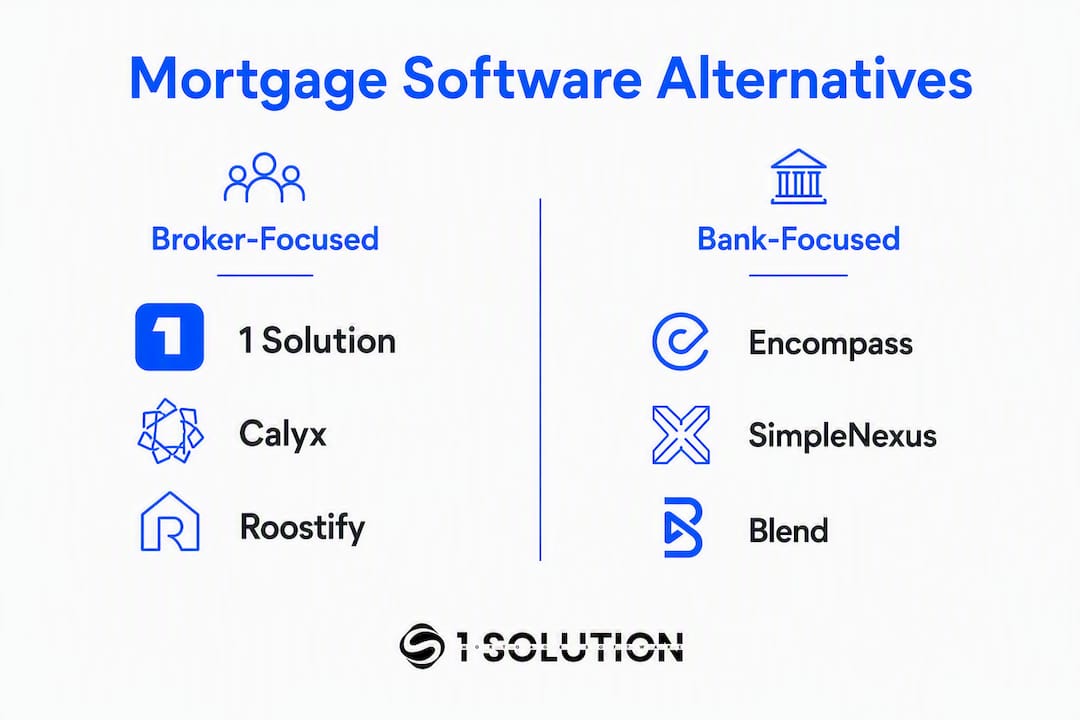
- 1 Solution Mortgage Software — built specifically for independent brokers; combines LOS, POS, CRM, PPE, compliance, and communication tools in one subscription
- Encompass by ICE Mortgage Technology — deep LOS functionality for mid-market and larger brokerages; strong lender integrations but higher complexity
- SimpleNexus (now nCino Mortgage) — strong borrower-facing POS with solid mobile experience; better fit for brokerages prioritizing borrower engagement
- Blend — clean digital application layer with bank-grade infrastructure; best for brokerages that already have a core LOS and need a POS overlay
- Calyx Software — long-established LOS with a loyal independent broker base; on-prem and cloud options available
TL;DR: If you are a small-to-mid independent broker who wants one platform with no fragmented stack, evaluate 1 Solution Mortgage Software first. If you have a larger team and need deep lender-portal integrations, Encompass deserves a demo. If borrower experience is your top priority, SimpleNexus is worth a look.
Table of Contents
- How do these ableplatform.io alternatives compare side by side?
- What does each platform actually do for brokers?
- How do you choose the right alternative for your brokerage?
- How we evaluated these alternatives and who wrote this guide
- What does a phased migration actually look like?
- Key Takeaways
- What brokers actually need from a platform switch
- 1 Solution Mortgage Software: built for brokers, not boardrooms
- Useful sources and vendor pages for further reading
How do these ableplatform.io alternatives compare side by side?
| Platform | Target Customer | Core Modules | Pricing Shape | Integrations & API | Migration Complexity | Hosting | Independence |
|---|---|---|---|---|---|---|---|
| 1 Solution Mortgage Software | Independent brokers, brokerages | LOS, POS, CRM, PPE, compliance, marketing, communication | Subscription SaaS; optional add-ons | API-connected; credit, AUS, e-sign, lender portals | Low–Medium | Cloud-native | 100% self-funded |
| Encompass (ICE) | Mid-market to enterprise | LOS, compliance, docs, reporting | Custom quote; per-user or volume | Extensive integrations | High | Cloud + hybrid | Publicly traded (ICE) |
| SimpleNexus | Brokerages, retail lenders | POS, mobile app, LOS-lite, CRM | Custom quote | Strong; integrates with major LOS platforms | Medium | Cloud-native | Acquired by nCino |
| Blend | Banks, mid-market brokerages | POS, digital application, LOS overlay | Custom quote; volume-based | API-first; strong bank integrations | Medium | Cloud-native | VC-backed |
| Calyx Software | Independent brokers, small teams | LOS (Point/Path), POS, compliance | Subscription; modular | Moderate; established lender connections | Low–Medium | Cloud + on-prem | Private |
| Roostify | Banks, credit unions, brokerages | POS, digital mortgage, workflow | Custom quote | API-first; integrates with major LOS | Medium | Cloud-native | VC-backed |
The biggest trade-off brokers miss: Platforms built for banks and enterprise lenders often carry pricing structures and implementation timelines that assume a large IT team and a long runway. Disconnected systems are the primary operational friction point for independent brokers — and a platform that solves the enterprise problem rarely solves the broker problem at the same cost or speed.
Where 1 Solution Mortgage Software stands apart: it is the only option on this list that is 100% self-funded, built by a practicing mortgage professional, and priced as a subscription without the enterprise customization overhead. For brokers who cannot afford a six-month implementation, that matters.
What does each platform actually do for brokers?
1 Solution Mortgage Software
An all-in-one cloud platform covering LOS, POS, CRM, PPE, e-signature, compliance, marketing automation, and communication tools (email, SMS, voice, video, chat). Designed from the ground up for independent brokers and brokerages. Subscription SaaS with optional add-ons for website development, branded email, and PBX. Migration complexity is low because the platform is purpose-built for broker workflows, not adapted from a bank product.

Pros: Single subscription covers the full stack; no investor pressure; built by a 20-year mortgage veteran; fast to deploy Cons: Newer brand than legacy players; enterprise-scale reporting is less mature than Encompass
Best for: Independent brokers who want one platform, one bill, and no fragmented stack.
Encompass by ICE Mortgage Technology
The most widely used LOS in U.S. mortgage. Deep compliance automation, document management, and lender-portal integrations make it a natural fit for larger brokerages. Implementation timelines run long, and pricing is custom.
Pros: Unmatched lender integrations; deep compliance tooling; large support ecosystem Cons: High cost; long implementation; designed for enterprise, not the independent broker
Best for: Mid-market brokerages with a dedicated ops team and budget for a full LOS deployment.
SimpleNexus (nCino Mortgage)
Strong borrower-facing POS with a polished mobile experience. Works best as a front-end layer over an existing LOS. Since its acquisition by nCino, the platform has expanded but also added enterprise complexity.
Pros: Best-in-class borrower experience; strong mobile app; solid LOS integrations Cons: Not a standalone LOS; pricing is custom and can scale quickly with volume
Best for: Brokerages that already have a core LOS and want to upgrade the borrower application experience.
Blend
A digital mortgage application platform with bank-grade infrastructure. Blend is primarily a POS and digital application layer, not a full LOS. Its API-first architecture makes it flexible, but it requires an existing LOS to function as a complete origination stack.
Pros: Clean UX; strong API; trusted by major banks Cons: Not a standalone solution; pricing is volume-based and enterprise-oriented
Best for: Brokerages with an existing LOS that need a modern borrower-facing interface.
Calyx Software
One of the longest-standing independent broker LOS platforms in the U.S. Calyx Point (desktop) and Calyx Path (cloud) serve a loyal base of independent brokers. Pricing is modular and more transparent than most enterprise alternatives.
Pros: Proven track record; familiar to many brokers; on-prem option for data sovereignty Cons: Interface feels dated; cloud version (Path) is still maturing; fewer modern automation features
Best for: Brokers who want a known quantity with a straightforward pricing model and on-prem flexibility.
Roostify
A digital mortgage platform focused on the borrower journey and workflow automation. Roostify works primarily as a POS and workflow layer, with API integrations into major LOS platforms. It targets banks and credit unions more than independent brokers.
Pros: Clean borrower experience; API-first; configurable workflows Cons: Not designed for independent brokers; pricing and support are enterprise-oriented
Best for: Brokerages aligned with bank or credit union partners that need a shared digital application layer.
Pro Tip: Before any demo, ask each vendor to walk you through a live integration with your current credit bureau provider and AUS system. That single test reveals more about real-world usability than any feature checklist.
How do you choose the right alternative for your brokerage?
Evaluation checklist
- Ecosystem connectivity — does the platform connect natively to your credit bureaus, AUS (DU/LP), e-sign provider, and lender portals, or does every integration require custom development?
- Broker-specific workflows — is the platform built for originators and processors, or adapted from a bank product? Mortgage-specific platforms deliver more usable compliance and communication workflows.
- Pricing model shape — is pricing per-user, volume-based, or modular? Per-user pricing that scales linearly can become expensive fast as your team grows.
- Total cost of ownership — separate the subscription fee from implementation, customization, and training costs. Many vendors bury significant fees in implementation and customization line items.
- Migration complexity — how long does a typical migration take, and what does the vendor provide in terms of data export, mapping, and parallel-run support?
- Deployment model — cloud-only, hybrid, or on-prem? Brokerages with strict data-sovereignty requirements may need hybrid or self-hosted options.
- Company independence — is the vendor VC-backed or publicly traded? Funding model affects pricing stability and product direction over time.
Must-ask vendor questions
- What is the full implementation cost, separate from the recurring subscription?
- Who owns the data, and what is the export process if we leave?
- What is your API versioning policy, and how do you handle breaking changes?
- What SLAs cover integration uptime for credit, AUS, and e-sign connectors?
- How long does a typical migration take for a brokerage our size?
Red flags to watch for
- Customization timelines quoted in months, not weeks
- No clear data-export or migration-support process
- Per-user pricing with no volume cap or tier
- API documentation that is incomplete or not publicly available
- Vague answers about compliance workflow coverage for TRID, RESPA, and NMLS requirements
How we evaluated these alternatives and who wrote this guide
Every platform on this list was assessed against the same criteria independent brokers actually care about: broker-specific workflow fidelity, pricing transparency, integration depth, migration complexity, and company independence. We drew on industry analyst guidance, vendor documentation, practitioner roundups, and direct product knowledge.
This guide was authored by Omar Khamisa, founder of 1 Solution Mortgage Software and a 20-year mortgage industry veteran who has worked as a processor, underwriter, loan originator, and systems consultant. The perspective here is deliberately broker-first: the platforms ranked highest are the ones that solve the problems independent brokers actually face, not the ones with the largest marketing budgets.
One important limit: pricing and feature sets change. Treat every figure in this guide as a starting point, and validate current pricing and integration capabilities directly with each vendor before making a decision.
What does a phased migration actually look like?
Rip-and-replace migrations fail. The most successful approach keeps critical integrations live and moves core operations in stages, with each phase requiring several weeks depending on brokerage size.
Operational checklist before cutover:
- Export and verify all active loan data from the current platform
- Confirm data field mapping between old and new systems
- Test API connections with credit bureaus, AUS, and e-sign providers
- Run a parallel-entry window (new platform + legacy) for at least two weeks
- Notify lender and channel partners of the transition timeline
- Confirm fallback plan if a critical integration fails post-cutover
Pro Tip: Prioritize your AUS and credit bureau integrations in the pilot phase. If those two connections work cleanly, the rest of the migration is manageable. If they don't, you'll know before you've committed the full team.
Key Takeaways
For independent U.S. mortgage brokers, the right ableplatform.io alternative is the one built for broker workflows, priced transparently, and deployable without a six-month implementation runway.
| Point | Details |
|---|---|
| Broker-first fit matters most | Platforms built for banks add cost and complexity brokers don't need. |
| Hidden costs are the real risk | Always separate implementation and customization fees from the recurring subscription before comparing TCO. |
| Phased migration protects originations | Keep critical integrations live and migrate core operations in stages to avoid pipeline disruption. |
| API quality beats feature lists | Test credit bureau and AUS integrations in the pilot phase before committing to any platform. |
| 1 Solution Mortgage Software | The only self-funded, broker-built option on this list: LOS, POS, CRM, PPE, and compliance in one subscription. |
What brokers actually need from a platform switch
The conversation around mortgage tech alternatives tends to focus on feature checklists. That misses the real question: does this platform understand how a broker's day actually works?
Most enterprise platforms were designed for bank operations teams with dedicated IT staff and multi-month implementation budgets. When an independent broker tries to run one of those systems, they end up paying for features they don't need and missing the ones they do. The compliance workflow built for a bank's underwriting department is not the same as what a two-person brokerage needs to stay NMLS-compliant and close loans on time.
Migration planning matters for the same reason. A platform switch that disrupts your active pipeline for even two weeks can cost more than a year of subscription fees. The phased approach outlined here is not a nice-to-have — it is the difference between a smooth transition and a crisis.
The platforms worth evaluating are the ones that were built with your daily reality in mind, priced so you can actually afford them, and supported by people who understand what it means to close a loan under pressure.
1 Solution Mortgage Software: built for brokers, not boardrooms
Every platform on this list solves part of the problem. 1 Solution Mortgage Software solves all of it in one place. LOS, POS, CRM, PPE, e-signature, compliance, marketing automation, and communication tools — all under one subscription, with no outside investors and no enterprise overhead.
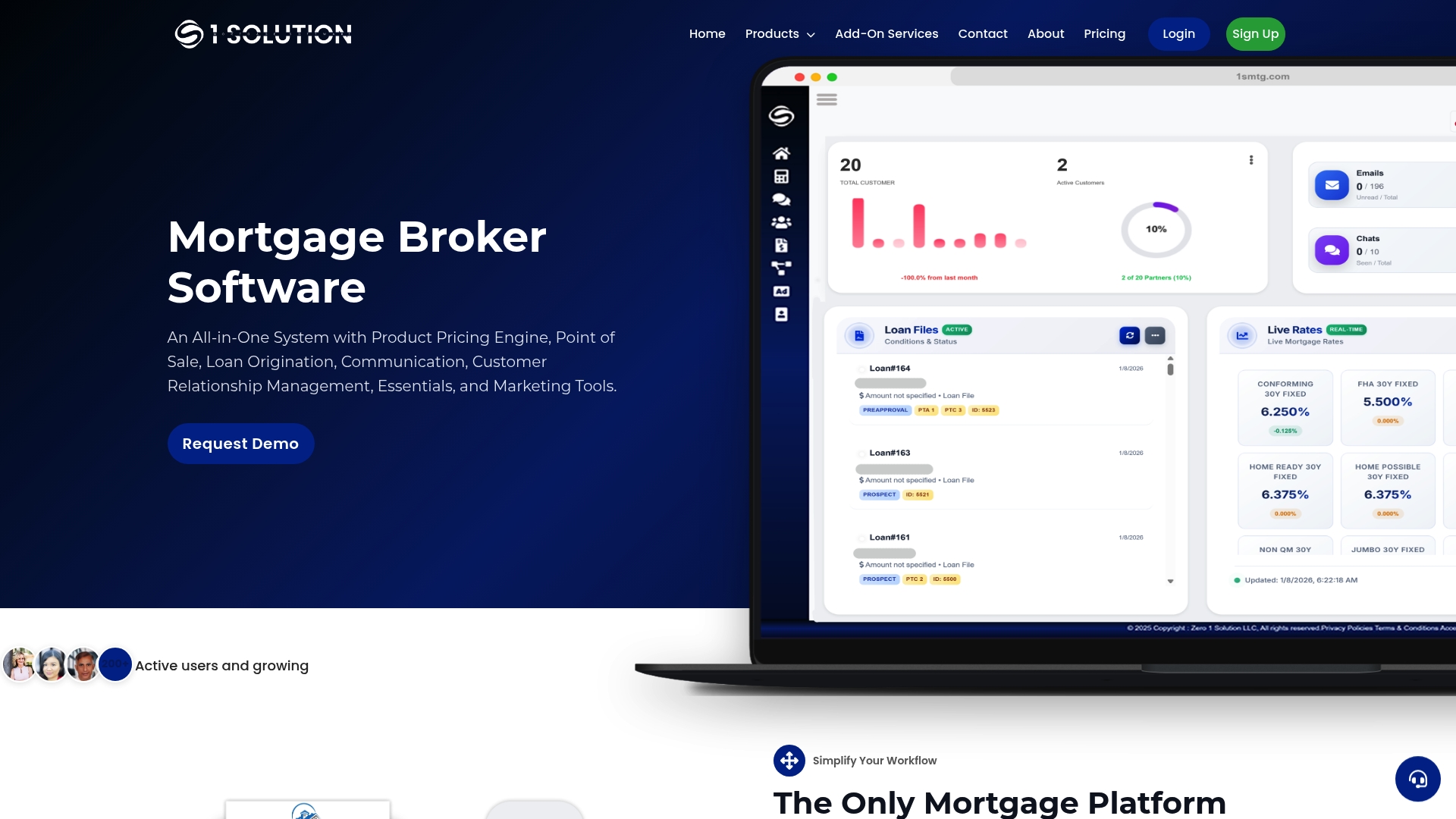
Pricing is straightforward: a recurring SaaS subscription with optional add-ons for website development, branded email setup, and PBX solutions. There are no hidden customization fees buried in a statement of work. Implementation is designed for brokers who need to be operational quickly without long delays.
If you are evaluating alternatives and want to see exactly how 1 Solution handles your specific workflow, the clearest next step is a live demo. Book a demo and bring your current integration list — we will walk through every connection that matters to your operation.
Useful sources and vendor pages for further reading
Use these sources to validate claims, review vendor documentation, and dig deeper into specific platforms during your evaluation:
- TheLOSDirectory — Best ABLE Platform alternatives (2026) — the most comprehensive roundup of deployment models, pricing shapes, and migration notes for ABLE Platform substitutes
- Nortridge blog — Nortridge vs. ABLE Platform — useful for understanding ecosystem connectivity and integration priorities
- SaaSHub — ABLE Origination alternatives — aggregated vendor listings with pricing model notes; good for spotting hidden implementation costs
- CB Insights — ABLE Platform alternatives and competitors — broad competitive landscape view; use to filter by target customer and funding model
- ABLE Platform — Top loan management solution providers — vendor's own perspective on the category; useful for understanding where ABLE Platform positions itself
- Friendly Financial Group — financial services partner resource for brokers evaluating vendor and partner relationships
- 1 Solution Mortgage Software — product landing page; request a demo or migration assessment directly