
The right software to manage multiple lender relationships does more than track loan statuses. It routes applications in parallel across lenders, executes each lender's actual underwriting logic, and surfaces binding offers in real time. Platforms that do this well can boost approval rates by up to 40% over single-lender workflows. Below is a high-level look at the leading platforms mortgage professionals are evaluating in 2026.
Top platforms at a glance:
- LoanPro — API-first loan servicing with strong configurability for complex lender portfolios
- Finastra — Enterprise-grade, open API architecture supporting over 100 integrations across retail and commercial lending
- Mambu — Cloud-native core banking engine suited for lenders building custom product configurations
- nCino — Built on Salesforce, strong CRM-to-loan pipeline visibility for commercial lenders
- Fiserv — Broad financial services infrastructure with established loan servicing modules
- Nortridge — Loan CRM and servicing combined, with detailed borrower relationship tracking
- Turnkey Lender — AI-driven decisioning with 75+ preconfigured integrations and a no-code credit product builder
- Peach — Modern loan servicing API designed for fintech lenders needing flexible payment structures
- HES FinTech — End-to-end origination and servicing with configurable underwriting workflows
- Canopy — Loan servicing focused on collections, borrower communication, and portfolio reporting
- 1 Solution Mortgage Software — All-in-one platform built specifically for independent mortgage brokers, combining pricing, CRM, POS, LOS, compliance, and multi-lender workflow tools
| Platform | Proven Scale | Multi-Lender Suitability | Pricing Model (no unsupported numeric claim) |
|---|---|---|---|
| LoanPro | Large portfolios | High | Usage-based |
| Finastra | Enterprise | High | Enterprise contract |
| Mambu | Mid to large | Moderate | Subscription |
| nCino | Commercial focus | Moderate | Enterprise contract |
| Fiserv | Enterprise | Moderate | Enterprise contract |
| Nortridge | Mid-market | High | License + support |
| Turnkey Lender | SMB to mid-market | High | Subscription |
| Peach | Fintech/mid-market | Moderate | API usage-based |
| HES FinTech | Mid-market | High | Project-based |
| Canopy | SMB to mid-market | Moderate | Subscription |
| 1 Solution | Independent brokers | High | Subscription |
Which platforms lead in multi-lender management capabilities?
Choosing the right lender relationship management tool comes down to how deeply each platform executes lender-specific logic, not just how many lenders it can list. Here is a detailed breakdown of where each platform stands.

| Platform | Implementation Speed | Configurability | Feature Richness | Multi-Lender Routing | Integration Depth |
|---|---|---|---|---|---|
| LoanPro | Moderate | High | High | Strong | REST API |
| Finastra | Slow (enterprise) | High | Very High | Strong | 100+ integrations |
| Mambu | Moderate | Very High | High | Moderate | Open API |
| nCino | Slow | Moderate | High | Moderate | Salesforce ecosystem |
| Fiserv | Slow | Moderate | High | Moderate | Broad but proprietary |
| Nortridge | Moderate | High | High | Strong | CRM + servicing APIs |
| Turnkey Lender | Fast | High | High | Strong | 75+ preconfigured |
| Peach | Fast | High | Moderate | Moderate | API-first |
| HES FinTech | Moderate | High | High | Strong | Custom integrations |
| Canopy | Fast | Moderate | Moderate | Moderate | Standard APIs |
| 1 Solution | Fast | High | High | Strong | All-in-one native |
LoanPro
LoanPro's API-first design gives lenders precise control over loan lifecycle events, from origination through payoff. Its configurability suits brokers managing complex, multi-product portfolios. The trade-off is a steeper technical setup that benefits teams with developer resources.
Finastra
Finastra's Loan IQ and LaserPro solutions are built for institutions handling syndicated, bilateral, and retail lending on one platform. Its open API architecture means connecting to third-party origination systems or credit bureaus rarely requires custom engineering. The implementation timeline is long, and pricing reflects an enterprise buyer.
Mambu
Mambu's cloud-native engine excels at product configurability. Lenders can build custom loan products without touching code, which is valuable when managing lenders with distinct product requirements. Multi-lender routing is not a native strength; it typically requires middleware.
nCino
nCino's Salesforce foundation gives commercial lending teams a familiar CRM experience with loan pipeline visibility built in. For brokers managing multiple lender relationships across a large commercial book, the CRM depth is a genuine advantage. Consumer mortgage workflows are less developed.
Fiserv
Fiserv covers a wide range of financial services infrastructure, and its loan servicing modules are proven at scale. Multi-lender routing is not a core differentiator. Brokers evaluating Fiserv should confirm whether the specific module they need supports parallel lender submission natively.
Nortridge
Nortridge combines loan CRM with servicing in one system, giving brokers a 360-degree borrower view alongside payment tracking and communication logs. Its multi-lender suitability is strong for mid-market operations that need relationship depth without enterprise complexity.
Turnkey Lender
Turnkey Lender's AI-driven decisioning and no-code credit product builder make it one of the faster platforms to deploy for multi-lender workflows. Its 75+ preconfigured integrations cover credit bureaus, KYC/AML providers, and payment processors. Teams with limited IT resources find the low-code setup particularly practical.
Peach
Peach is an API-first servicing platform designed for fintech lenders who need flexible payment structures and borrower communication tools. Its multi-lender routing capabilities are moderate. It fits best when the primary need is servicing flexibility rather than origination-side lender matching.
HES FinTech
HES FinTech delivers end-to-end origination and servicing with configurable underwriting workflows. Its strength is the ability to model lender-specific credit policies, which matters when you need each lender's actual logic executed rather than a generic proxy. Implementation is project-based and typically requires vendor involvement.
Canopy
Canopy focuses on loan servicing, collections, and borrower communication. Its portfolio reporting tools give servicers clear visibility into delinquencies and payment statuses. For brokers whose primary pain point is post-close servicing rather than multi-lender origination routing, Canopy is a practical fit.
1 Solution Mortgage Software
1 Solution Mortgage Software was built from the ground up for independent mortgage brokers, not banks or direct lenders. It brings pricing, CRM, POS, LOS, compliance, and communication into one connected platform. Brokers managing relationships across multiple lenders get a single workspace instead of a patchwork of disconnected tools.
Key integration and compliance considerations across all platforms:
- Integrated origination and servicing on a single platform eliminates data silos and reduces compliance risk
- Centralized dashboards with borrower profiles, payment tracking, and communication logs cut operational complexity
- Security and audit trail requirements under RESPA, TILA, and state-level regulations demand platforms with built-in compliance visibility
- User training burden varies widely: no-code platforms like Turnkey Lender and 1 Solution reduce onboarding time compared to enterprise systems requiring dedicated IT support
How to select the best software for managing multiple lender relationships
The evaluation criteria that separate a genuinely useful lender tracking software from a generic loan management tool are specific. Here is what to prioritize.
Critical evaluation factors:
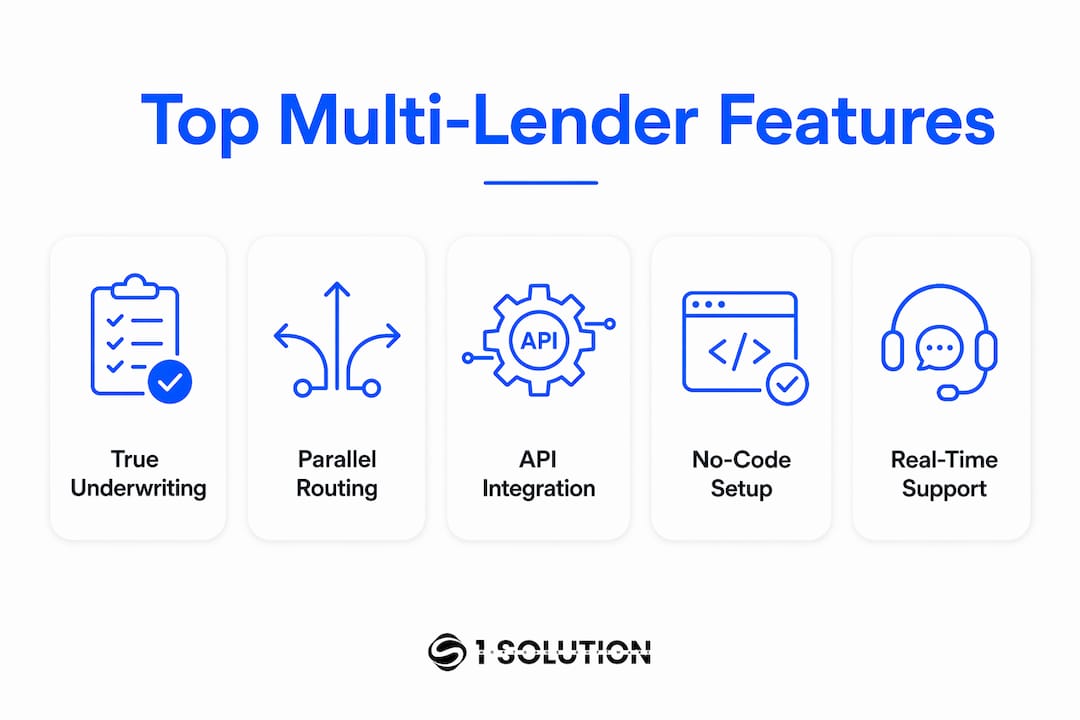
- True-to-lender underwriting execution. The platform must run each lender's actual underwriting model, not a scorecard proxy. Binding real-time offers that reflect exact APRs and terms build borrower confidence and reduce fallout.
- Parallel routing capability. Software that submits a single application to multiple lenders simultaneously, rather than sequentially, maximizes approval chances. Borrowers can compare offers from multiple lenders and choose the best terms.
- Integration depth. Confirm the platform connects natively to your existing LOS, POS, credit bureaus, and compliance tools. Middleware workarounds add cost and failure points.
- Configurability. Lender guidelines change. The platform should let you update routing rules, credit policies, and product configurations without an engineering sprint.
- Transparent pricing. Total cost of ownership includes implementation fees, per-user charges, API call costs, and support tiers. Get a full breakdown before signing.
- Scalability. As your lender panel grows, the platform should onboard new lenders without adding operational headcount.
- Compliance and security. Look for SOC 2 certification, role-based access controls, and audit logs that satisfy CFPB and state examination requirements.
User experience and training:
Platforms with steep learning curves cost you in productivity during rollout. No-code or low-code platforms let your team focus on broker relationships rather than software configuration. Ask vendors for a realistic onboarding timeline, not a marketing estimate.

Customer support quality:
When a lender's API goes down at 9 PM on a Friday before a rate lock expires, you need a support team that picks up the phone. Evaluate support response times, escalation paths, and whether dedicated account management is included or priced separately.
Pro Tip: Require vendors to demonstrate real-time underwriting model execution during a live demo, not a recorded walkthrough. Ask them to show dynamic lender matching logic that routes by credit score, loan amount, or geography. If they cannot show it live, the capability may not exist as advertised.
What red flags should you watch for when evaluating loan management software?
Not every platform that markets itself as a multi-lender solution actually delivers one. These are the warning signs that should slow you down.
- Generic underwriting proxies. If the platform uses a single internal scorecard to approximate multiple lenders' decisions, the offers it generates are not binding. Borrowers who proceed based on those estimates face surprises at closing.
- Opaque pricing. Platforms that quote a base subscription price and reveal implementation fees, API costs, and support charges only after contract signing inflate your total cost of ownership significantly. Demand a full cost breakdown upfront.
- Poor integration capabilities. A platform that cannot connect to your existing LOS or credit bureau without a custom development project adds months to your timeline and thousands to your budget. Check the integration catalog before the demo.
- Limited configurability. If updating a lender's guidelines requires a support ticket and a two-week turnaround, your workflows will lag behind the market. You need control over routing rules and credit policies without vendor dependency.
- Fragmented workflows. Platforms that handle origination in one module and servicing in another, with no shared data layer, recreate the exact operational silos you are trying to eliminate. Fragmented systems increase compliance risk and data errors.
- Weak customer support. A vendor that is responsive during the sales cycle but slow after contract signing is a liability. Ask for references from clients who have been on the platform for at least 18 months.
- No scalability path. If adding a new lender to the panel requires engineering work or a contract amendment, the platform will become a bottleneck as your business grows.
- Lack of audit trails. Platforms without detailed logging of underwriting decisions, lender submissions, and borrower communications create examination risk under CFPB and state oversight.
For brokers managing high-risk or complex financial relationships, these red flags carry even higher stakes. Vet thoroughly before committing.
What do industry experts say about multi-lender platforms?
The efficiency gains from well-implemented multi-lender software are concrete, not theoretical. Routing a single application to multiple lenders in parallel can increase approval rates by up to 40% compared to submitting to one lender at a time. That gap closes fast when you are working a pipeline of 50 or 100 loans.
The mechanism behind those gains is true-to-lender decisioning. When a platform runs each lender's actual underwriting model rather than a proxy, the offers it returns are authentic. Borrowers see real APRs and real terms, not estimates that fall apart during processing. Binding offers in under 10 seconds are now a baseline expectation in competitive markets.
The waterfall financing model adds another layer of complexity. In a waterfall, applications route sequentially through lenders until one approves. That model only works accurately when each lender's specific underwriting logic runs at each step. A platform using a generic proxy for waterfall routing produces inaccurate APRs and terms that do not reflect what the lender will actually offer.
Dynamic matching logic takes this further. Routing applications by credit score, loan amount, geography, or custom variables maximizes lender fit without adding operational overhead. The best platforms let you adjust weighting rules through a UI, not a support ticket.
What 1 Solution Mortgage Software brings to this picture:
- Built by Omar Khamisa, with over 20 years of hands-on experience as a processor, underwriter, loan originator, and systems consultant
- Designed specifically for independent mortgage brokers, not banks or direct lenders
- Combines pricing, CRM, POS, LOS, compliance, and communication in one platform, eliminating the fragmented tool stacks that slow brokers down
- 100% self-funded and independent, with no outside investor pressure shaping product decisions
- Transparent pricing and a compliance-first architecture built for the regulatory environment brokers actually operate in
For brokers who want to understand how broker-lender relationships work at a structural level before choosing software, that foundation matters. The right platform reflects how those relationships actually function, not how a bank's IT department imagined they might.
Key Takeaways
The most effective software for managing multiple lender relationships combines true-to-lender underwriting execution, parallel routing, deep integration, and transparent pricing in one platform built for how brokers actually work.
| Point | Details |
|---|---|
| Parallel routing drives approvals | Multi-lender platforms routing applications simultaneously can boost approval rates by up to 40% over single-lender submission. |
| True-to-lender decisioning is non-negotiable | Platforms must execute each lender's actual underwriting model to return binding APRs and terms in real time. |
| Integration and configurability determine TCO | Hidden implementation fees, poor API coverage, and rigid routing rules inflate total cost of ownership significantly. |
| Red flags to avoid | Watch for generic underwriting proxies, opaque pricing, fragmented workflows, and weak post-sale support. |
| 1 Solution Mortgage Software | Built by mortgage professionals for independent brokers, combining pricing, CRM, LOS, POS, and compliance in one platform. |
Why 1 Solution Mortgage Software fits brokers managing multiple lenders
Most loan management platforms were built for banks. 1 Solution Mortgage Software was built from the trenches of actual mortgage operations, by people who have processed, underwritten, and originated loans themselves.
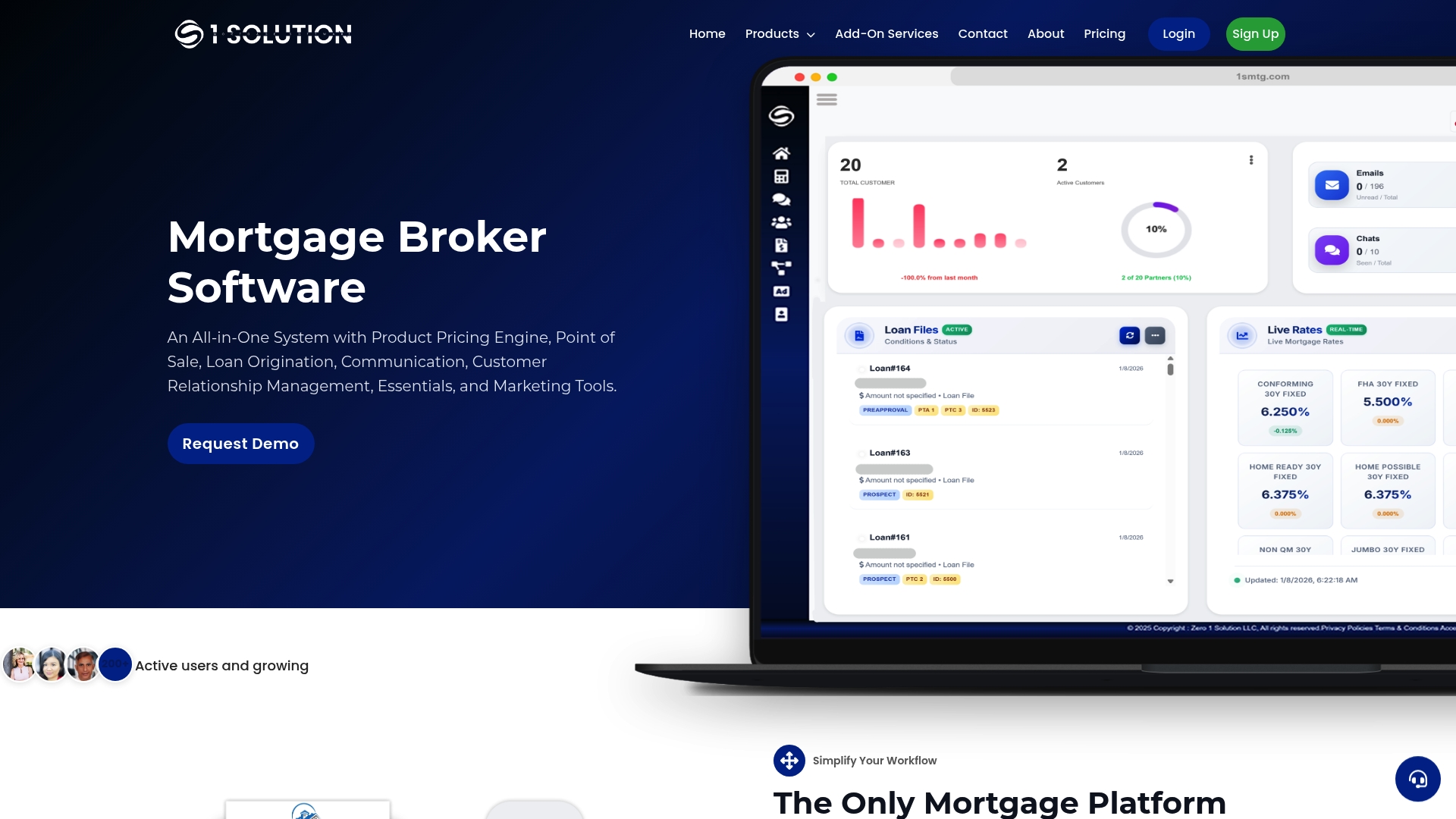
For independent brokers managing relationships across multiple lenders, the fragmented tool problem is real. You are switching between a pricing engine, a CRM, a POS, a LOS, and a compliance tracker, and none of them talk to each other cleanly. 1 Solution Mortgage Software consolidates all of that into one connected platform, giving you the control and visibility that enterprise systems reserve for large institutions.
Founder Omar Khamisa spent over 20 years working across every role in mortgage operations before building 1 Solution. That experience is in the product. The platform is 100% self-funded, which means product decisions are made for brokers, not for investors. Pricing is transparent, the compliance architecture reflects the regulatory environment brokers actually face, and the support team knows the industry.
If you are ready to stop duct-taping disconnected tools together and want a mortgage technology platform built specifically for how independent brokers work, explore 1 Solution Mortgage Software and request a demo today.