
A digital mortgage application is an online platform that collects borrower information, verifies documents electronically, and automates underwriting decisions to replace the paper-heavy process that once defined home lending. Understanding how digital mortgage applications work matters whether you are a first-time homebuyer or a seasoned real estate professional, because the technology directly affects how fast you close and what you pay. Freddie Mac research confirms that digital underwriting tools can decrease origination timelines and reduce closing costs while applying the same fundamental approval criteria as traditional methods. The shift is real, and knowing how to use it to your advantage puts you ahead.
How digital mortgage applications work: the five-phase process
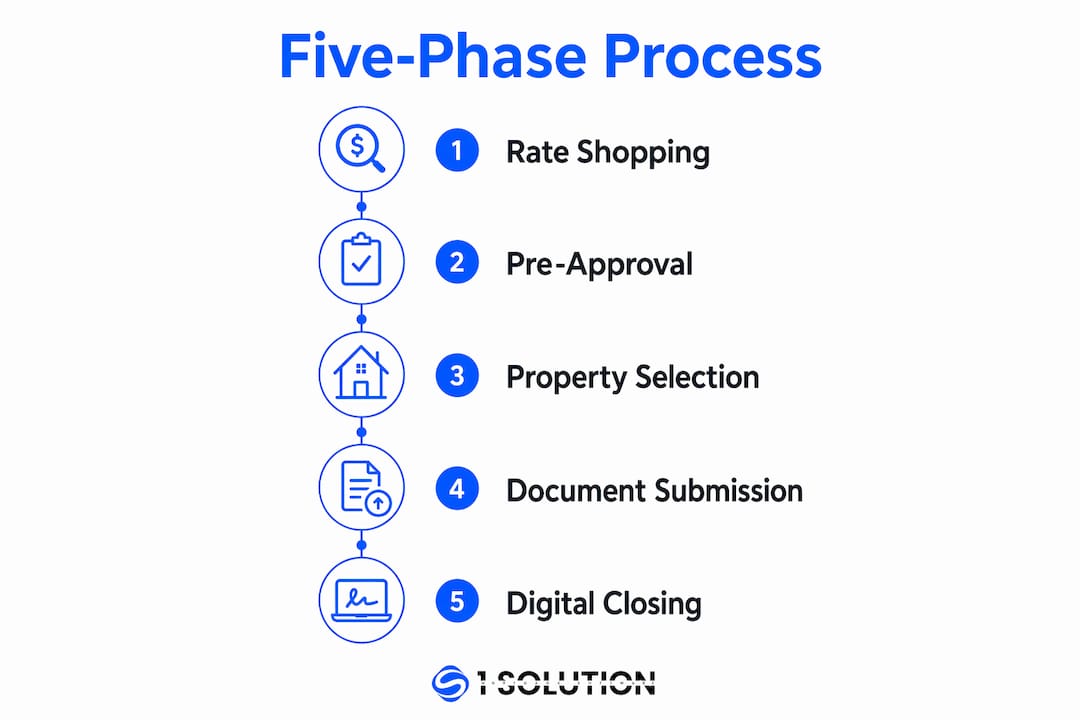
The digital mortgage process follows five distinct phases: rate shopping, pre-approval, property selection, document submission and underwriting, and closing. Fairway Mortgage Carolinas outlines these phases as the standard workflow for online applications in 2026. Each phase is faster digitally than its paper equivalent, but only if you know what to expect at each step.
Phase 1: Rate shopping. You compare lenders using online pricing engines and pre-qualification tools. Digital pre-qualification can take as little as two minutes without triggering a hard credit pull, giving you a realistic rate range before you commit. Applying to multiple lenders within a 45-day window counts as a single credit inquiry under standard scoring models, so comparison shopping carries no credit penalty.
Phase 2: Pre-approval. You submit a formal application through the lender's online portal, entering income, employment, and asset data. The system runs an initial automated check and returns a pre-approval letter, often within hours. This letter is what sellers and real estate agents take seriously.
Phase 3: Property selection. Once you have a signed purchase agreement, you return to the portal and update the application with the property address and purchase price. The lender orders an appraisal at this stage, which is often the longest single step in the entire process.
Phase 4: Document submission and underwriting. You upload required documents through the portal, and the automated underwriting system (AUS) evaluates your full file. This phase is where digital tools create the most measurable time savings.
Phase 5: Digital closing. You review and sign final documents electronically using eSigning platforms. Some lenders offer fully remote online notarization (RON), eliminating any in-person requirement.
Pro Tip: Complete your document upload in one session rather than piecemeal. Incomplete files are the single most common cause of underwriting delays, and every gap triggers a condition that adds days to your timeline.
How automated underwriting and digital verification speed up approvals
Automated underwriting systems are software engines that assess loan eligibility by evaluating credit, income, assets, and property data against investor guidelines in seconds. Fannie Mae's Desktop Underwriter (DU) and Freddie Mac's Loan Product Advisor (LPA) are the two dominant AUS platforms in U.S. mortgage lending. Both generate a findings report that lists every condition a borrower must satisfy before the loan can close.
The DU Validation Service takes this further by electronically verifying borrower data through permission-based account linking. Instead of manually reviewing three months of bank statements, the system connects directly to your financial institution and pulls verified asset data in real time. This replaces a process that once took days with one that takes minutes.
The critical detail most borrowers miss: digital validation results do not override what you entered on the application. They confirm it. If your linked bank data shows a different balance than what you reported, the system flags a discrepancy and a human underwriter must resolve it manually. This is why accuracy on the initial application matters as much as speed.
- Credit assessment: AUS pulls your credit report and scores it against program guidelines automatically.
- Income calculation: The system calculates qualifying income from W-2 data or tax transcripts pulled directly from the IRS through the 4506-C process.
- Asset verification: Account linking through services like Finicity or Plaid confirms liquid reserves without manual statement review.
- Appraisal waivers: For eligible properties, AUS can issue a property inspection waiver (PIW), skipping the traditional appraisal entirely and saving one to two weeks.
Pro Tip: Before linking your accounts for digital verification, review your bank statements yourself. Unusual deposits, transfers, or large withdrawals will trigger underwriter questions. Knowing what is there lets you prepare explanations in advance rather than scrambling mid-process.
The underwriting approval roadmap moves from conditional approval to clear-to-close status as each AUS condition gets satisfied. Think of the findings report as a checklist. Every item cleared moves you one step closer to closing.
What are the benefits and risks of digital mortgage applications?
Digital mortgage applications deliver measurable advantages, but they also introduce risks that borrowers and lenders must manage actively. The table below captures both sides clearly.
| Factor | Benefit | Risk |
|---|---|---|
| Speed | Automated underwriting decisions in 1 to 3 days | Fast approvals can mask errors that surface at closing |
| Convenience | Apply from any device, any time, without branch visits | Technical issues or portal outages can delay submissions |
| Transparency | Real-time status updates and document checklists | Borrowers may misinterpret automated status messages |
| Data security | Encrypted portals and multi-factor authentication | Data breaches and identity fraud remain active threats |
| Cost | Reduced processing overhead may lower lender fees | Automation errors can generate incorrect fee disclosures |
78% of consumers say they would embrace a fully digital mortgage process, reflecting how strongly borrower expectations have shifted toward self-service and speed. That preference is legitimate, but it does not eliminate the need for careful review at every stage.
On the regulatory side, digital delivery does not change federal timing requirements. Under TRID and Regulation Z, lenders must deliver the Loan Estimate within three business days of receiving a completed application, regardless of whether the process is digital or paper-based. This protection exists whether you apply online at midnight or walk into a branch at noon.
What documents do you need for an online mortgage application?
Document preparation is where most borrowers lose time in the digital mortgage process. Having your paperwork organized before you start the application cuts upload time and reduces the chance of underwriting conditions.
Standard documentation requirements for a digital mortgage application include the following:
- Income verification: Two most recent pay stubs, two years of W-2 forms, and two years of federal tax returns (all pages).
- Asset documentation: Two to three months of bank statements for all accounts you plan to use for down payment and reserves.
- Employment verification: Contact information for your employer's HR department, or a signed offer letter if you recently changed jobs.
- Identity: Government-issued photo ID and your Social Security number for credit authorization.
- Property documents: Signed purchase agreement once you are under contract.
Self-employed borrowers face a longer list. Expect to provide two years of business tax returns, a year-to-date profit and loss statement, and potentially 12 months of business bank statements. Lenders use these to calculate a two-year average of net income, which often differs significantly from gross revenue.
Digital portals from lenders like Rocket Mortgage, Better.com, and loanDepot allow you to upload documents directly from your phone camera or connect cloud storage accounts like Google Drive or Dropbox. The portal assigns each document to the correct condition in the AUS findings report automatically, reducing the back-and-forth that slows traditional processing. For tips on speeding up loan approval, organizing documents by category before uploading is consistently the highest-impact step.
How long does the digital mortgage process take compared to traditional methods?
The digital mortgage process typically takes 21 to 30 days from online application to closing. Traditional paper-based processes average 30 to 45 days. The table below breaks down where that time goes.
| Stage | Digital timeline | Traditional timeline |
|---|---|---|
| Application completion | 15 to 30 minutes | 1 to 2 hours in-branch |
| Document upload and review | 30 to 60 minutes | 3 to 5 business days |
| Automated underwriting decision | 1 to 3 days | 5 to 10 days manual review |
| Appraisal and final approval | 7 to 14 days | 10 to 21 days |
| Closing | Same day eSigning | 1 to 2 days for wet signatures |
Fast-track digital scenarios can close in as few as 15 to 20 days for borrowers with straightforward W-2 income, strong credit, and no appraisal requirement. That represents the best case, not the average.
The honest reality is that appraisal scheduling and underwriting conditions still introduce delays that automation cannot eliminate. A property in a rural area with few comparable sales can take two weeks just to appraise. A borrower with rental income or a recent job change will generate manual review conditions regardless of how good the AUS findings look. Total approval to closing can range from two weeks to two months depending on lender capacity and borrower complexity. Knowing this prevents the frustration of expecting a 15-day close and getting a 35-day one.
Key takeaways
Digital mortgage applications reduce origination timelines and costs by automating underwriting, enabling electronic document verification, and allowing borrowers to complete the entire process online without in-person steps.
| Point | Details |
|---|---|
| Five-phase digital process | Rate shopping, pre-approval, property selection, underwriting, and digital closing define the standard workflow. |
| AUS drives speed | Fannie Mae DU and Freddie Mac LPA generate findings in minutes, replacing days of manual review. |
| Document prep is the bottleneck | Incomplete or inaccurate uploads are the leading cause of underwriting delays in digital applications. |
| Federal protections still apply | TRID requires a Loan Estimate within three business days regardless of digital or paper delivery. |
| Timelines vary significantly | A 21 to 30 day average hides a range from 15 days to two months based on complexity and lender efficiency. |
What I have learned from 20 years inside the mortgage process
I have worked this industry from every angle: processor, underwriter, loan originator, systems consultant. I have seen the full arc from fax machines and manila folders to AUS engines and eSigning platforms. Here is what that experience actually teaches you about the digital mortgage process that most articles will not say.
The technology is genuinely better. Automated underwriting is faster and more consistent than manual review for straightforward files. Digital document portals reduce lost paperwork. eSigning saves real time at closing. None of that is marketing. It is just true.
But the biggest mistake I see borrowers make is treating digital speed as a substitute for preparation. They rush through the application because the portal makes it feel easy, then spend three weeks clearing conditions that a 20-minute document review would have prevented. The portal does not catch errors. It processes what you give it. Garbage in, garbage out, regardless of how good the technology is.
The second mistake is assuming that digital means no human involvement. The best digital mortgage experiences I have seen still involve a loan officer who knows the file, communicates proactively, and catches issues before they become conditions. Technology-driven efficiencies work best when a skilled professional is using them, not replacing them.
My practical advice: treat the digital application like a formal document, not a web form. Read every question. Verify every number against your actual statements. And find a loan officer who will pick up the phone when something goes sideways, because something always does.
— Omar Khamisa
How 1 Solution Mortgage Software supports your digital workflow
If you are a mortgage broker managing digital applications across multiple borrowers, fragmented tools and disconnected systems cost you time and deals.
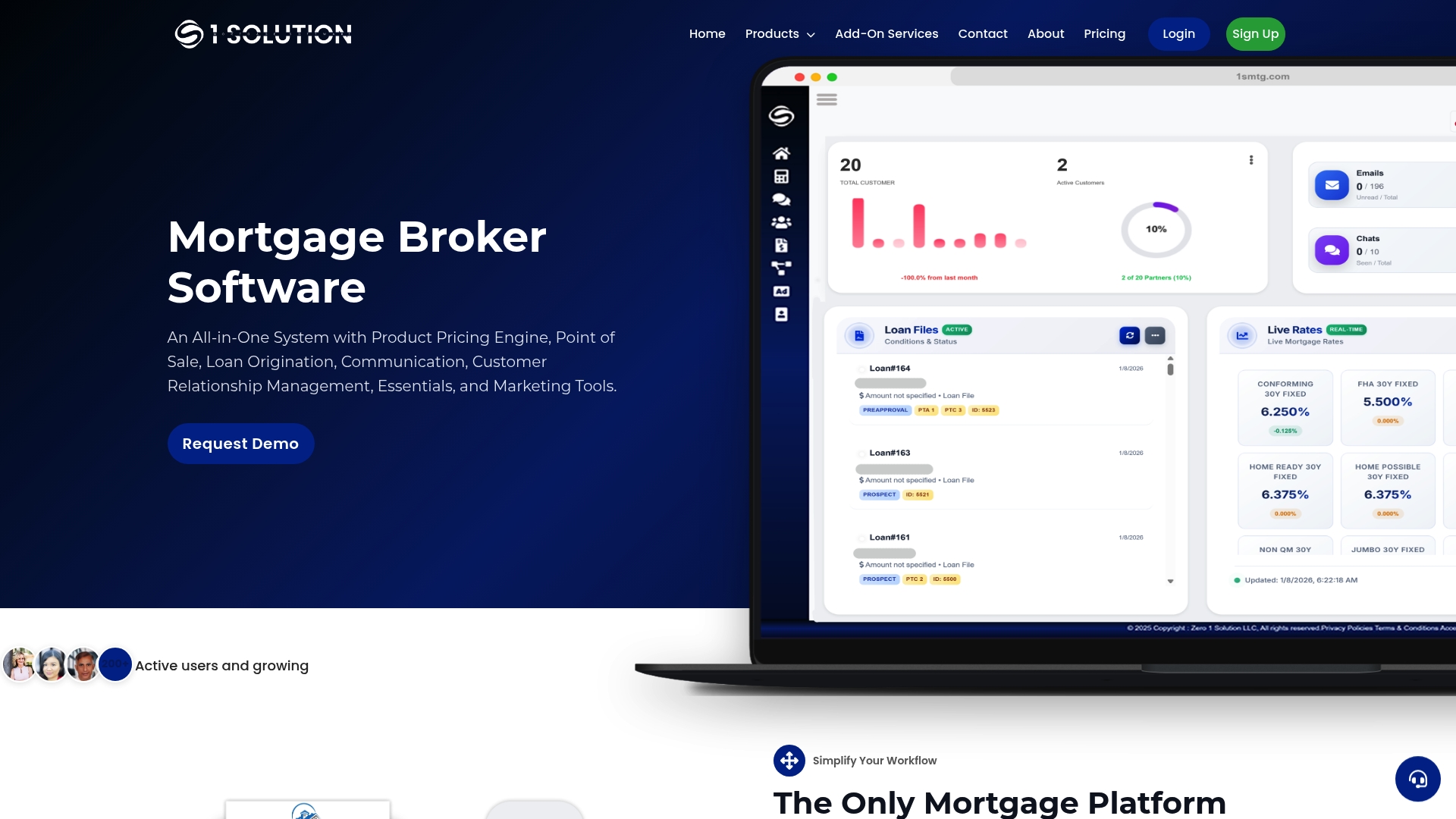
1 Solution Mortgage Software is built by mortgage professionals who have worked every role in this industry. The platform brings together POS, LOS, CRM, pricing, compliance, and communication tools into one connected system designed specifically for independent brokers. You get real-time visibility into every file, automated status updates for borrowers, and document management that keeps your pipeline moving without the manual follow-up that kills productivity. Built from the trenches, not a boardroom. See what a platform built for brokers actually looks like at 1smtg.com.
FAQ
What is a digital mortgage application?
A digital mortgage application is an online platform that collects borrower information, verifies documents electronically, and uses automated underwriting to assess loan eligibility without requiring in-person branch visits.
How long does an online mortgage application take to complete?
The application itself takes 15 to 30 minutes to complete online. The full process from application to closing typically spans 21 to 30 days, though complex files can take up to two months.
Are digital mortgage applications secure?
Reputable lenders use encrypted portals and multi-factor authentication to protect borrower data. Federal regulations also require lenders to safeguard personal financial information under the Gramm-Leach-Bliley Act.
Does applying digitally change the approval criteria?
No. Digital tools change how information is gathered and processed, not the fundamental criteria lenders use to approve loans. Credit, income, assets, and property standards remain the same.
What is the biggest advantage of applying for a mortgage online?
Speed and convenience are the primary advantages. Automated underwriting decisions arrive in one to three days, document uploads replace in-person meetings, and eSigning eliminates the need for a physical closing appointment.