
The E-Sign Act validates electronic signatures and records on most mortgage documents once a borrower affirmatively consents and can access the materials, but it does not cover every document the same way. An eNote, the electronic version of the promissory note, carries extra technical obligations involving MERS registration, MISMO SMART Doc formatting, and secure eVault custody that ordinary disclosures never trigger.
TL;DR:
- Marginal registration on the MERS eRegistry within one business day and correct MIN assignment are critical for valid eNote compliance.
- Borrowers must receive clear disclosures about their rights, including how to withdraw consent and request paper copies, before e-signing documents.
- ENotes require secure custody in an eVault and must follow MISMO SMART Doc formatting to ensure data and document linkage.
- County acceptance of electronically notarized and eRecorded documents varies, making local verification essential before relying on electronic signatures.
- Strong platform design with integrated consent capture, audit trails, and retention controls significantly reduces compliance risks during examinations.
Table of Contents
- What E-Sign and UETA Require for Mortgage Transactions
- How to Capture Valid Consumer Consent and Prove It Later
- Why eNotes and eMortgages Face a Higher Compliance Bar
- Notarization, eNotary Rules, and County Recording Limits
- Agency Guidance That Raises the Bar Beyond E-Sign
- A Practical Compliance Checklist and Where Lenders Go Wrong
- Why Platform Design Shapes Compliance Outcomes
- How 1 Solution Supports E-Sign and eMortgage Compliance
- FAQ
- Sources
What E-Sign and UETA Require for Mortgage Transactions
The E-Sign Act, signed into federal law on June 30, 2000, makes electronic signatures and records legally valid for interstate commerce whenever a consumer has given affirmative consent. Its substantive provisions took effect October 1, 2000, with record retention rules following on March 1, 2001. The Uniform Electronic Transactions Act, adopted state by state, does similar work at the state level, and most mortgage lenders operate under both frameworks simultaneously since transactions typically touch state contract law and federal commerce law at once.
Most mortgage documents fall under this umbrella: loan applications, early disclosures, closing disclosures, and servicing notices can all move electronically when consent requirements are satisfied. The promissory note is the exception that demands special handling because it is a negotiable instrument, not just a record.
Before relying on electronic delivery for any document type, confirm:
- The borrower received a clear disclosure describing the right to receive paper instead
- The consent process documented how the borrower can withdraw consent later
- Your systems can reproduce the exact record a legally entitled party might request
Our guide to E-Sign and UETA basics walks through the verification steps lenders use when building these workflows from scratch.
How to Capture Valid Consumer Consent and Prove It Later
Affirmative consent is the foundation of the entire framework, and examiners will ask for proof of it before they ask about anything else. The consent statement itself needs to cover several points in plain language, and skipping any of them weakens the record.
- State the borrower's right to receive the document on paper instead of electronically.
- Explain how the borrower can withdraw consent and whether any fee or condition applies.
- Describe the hardware and software needed to access, view, and retain the electronic record.
- Confirm the borrower can request a paper copy after the fact and note any associated cost.
Pro Tip: Send a test document before the real disclosure goes out. A successful open-and-view confirms the borrower's system can actually handle the format you intend to use, and that confirmation becomes part of your audit trail.
Retention matters as much as collection. Store the signed consent, the access confirmation, and the delivered document together, and keep them for as long as your regulator's record retention schedule requires, which for most mortgage files extends well beyond the loan's closing date. FDIC examiner guidance treats these three elements, consent, access verification, and retention, as the core of any E-Sign compliance review.

Why eNotes and eMortgages Face a Higher Compliance Bar
An eNote is not simply a promissory note with a digital signature. It is a transferable record, a legal category that requires the system managing it to maintain a single authoritative copy that can be identified, controlled, and transferred without ambiguity about who holds it. That distinction drives a separate set of technical rules on top of ordinary E-Sign requirements.
Fannie Mae's eMortgage guidance lays out what delivering an eNote to a GSE actually demands:
- Registration on the MERS eRegistry within one business day of signing
- A unique 18-digit Mortgage Identification Number assigned to the loan
- Formatting that follows the MISMO SMART Doc specification so the data and the document stay linked
- Custody of the authoritative copy inside a secure eVault, since a printed version is only a copy, never the legal original
Miss the one-day registration window and you create a gap between execution and registry record that examiners and investors both flag quickly. Our piece on MISMO-aligned cloud controls covers the tamper-evident storage standards that eVault custody depends on.
Notarization, eNotary Rules, and County Recording Limits
Notarization and recording sit outside the E-Sign Act's direct reach, and that gap trips up more lenders than almost any other part of the process. Remote online notarization is legal in most states now, but acceptance at the county recorder's office is a separate question entirely, and some counties still will not accept an electronically notarized security instrument even when state law permits RON.
Before you rely on electronic execution for a security instrument, confirm the following:
- Whether the state where the property sits authorizes remote online notarization for real estate documents
- Whether the specific county accepts eRecording, since state authorization does not guarantee county-level acceptance
- How you will handle a file that needs one wet-ink signature alongside otherwise electronic documents
A comparison of e-signatures and wet-ink signatures under U.S. law is a useful reference when a loan file mixes both signature types and the notary needs to document exactly what was signed how.
Agency Guidance That Raises the Bar Beyond E-Sign
Federal agencies and the GSEs layer their own rules on top of the baseline E-Sign Act, and these are the rules examiners actually test against during a review.
- HUD Mortgagee Letter 2014-03 accepts electronic signatures on most FHA-insured mortgage documents, but it carves out exceptions, including certain HECM notes, and requires documented authentication and a clear showing of signer intent.
- Fannie Mae's eMortgage requirements demand MERS eRegistry registration, a valid MIN, and SMART Doc formatting before an eNote is deliverable to the GSE.
- CFPB Regulation X cross-references E-Sign applicability for servicing disclosures, so lenders need to check both frameworks together rather than assuming E-Sign compliance alone satisfies servicing rules.
- Examiner manuals from the FDIC and similar guidance used by NCUA-supervised institutions focus reviews on consent documentation, hardware and software notices, and retention, the same three pillars that run through every agency's approach.
None of this guidance replaces the E-Sign Act. It narrows how lenders apply it inside mortgage-specific contexts where the stakes of a defective signature or a missing disclosure are higher than in a typical consumer transaction.
A Practical Compliance Checklist and Where Lenders Go Wrong
A workable eSign compliance process comes down to a short sequence, repeated consistently across every loan file.
- Document affirmative consent with the required disclosures, including the right to paper and withdrawal terms.
- Send a test document and record the borrower's successful access before relying on electronic delivery.
- Authenticate the signer's identity through a method you can reproduce later if challenged.
- Attach a complete audit trail to every signed document, showing who signed what and when.
- Register any eNote on the MERS eRegistry within one business day and confirm the MIN is correct.
- Maintain the authoritative copy in a secure eVault and verify county-level recordability before closing.
Pro Tip: Build vendor contracts around measurable acceptance criteria, specific audit trail fields, retention periods, and MISMO format compliance, rather than vague promises of "full compliance." A vendor that can't name the standard it meets usually can't prove it meets one.
The most common failures we see involve missing proof of consent, audit trails with gaps between steps, and MERS registrations filed days late after a rushed closing. Our mortgage compliance setup checklist maps these operational controls against what regulators expect to see during a review.
Why Platform Design Shapes Compliance Outcomes
Compliance officers often inherit eSigning tools chosen for speed rather than auditability, and that tradeoff shows up during an exam. A platform built with plain, reproducible documentation at every step, consent capture, access verification, and audit trails stored together, makes the difference between a quick examiner review and a drawn-out one. Vendor diligence matters because integration gaps between a POS system and an eVault are where authoritative copies get lost or duplicated.
— Omar Khamisa
How 1 Solution Supports E-Sign and eMortgage Compliance
Independent brokers often juggle a patchwork of eSigning, CRM, and loan origination tools that were never built to talk to each other, and that patchwork is exactly where consent records and audit trails go missing. We built our platform differently, bringing consent capture, document delivery, and compliance tracking into one connected system rather than stitching together separate vendors after the fact.
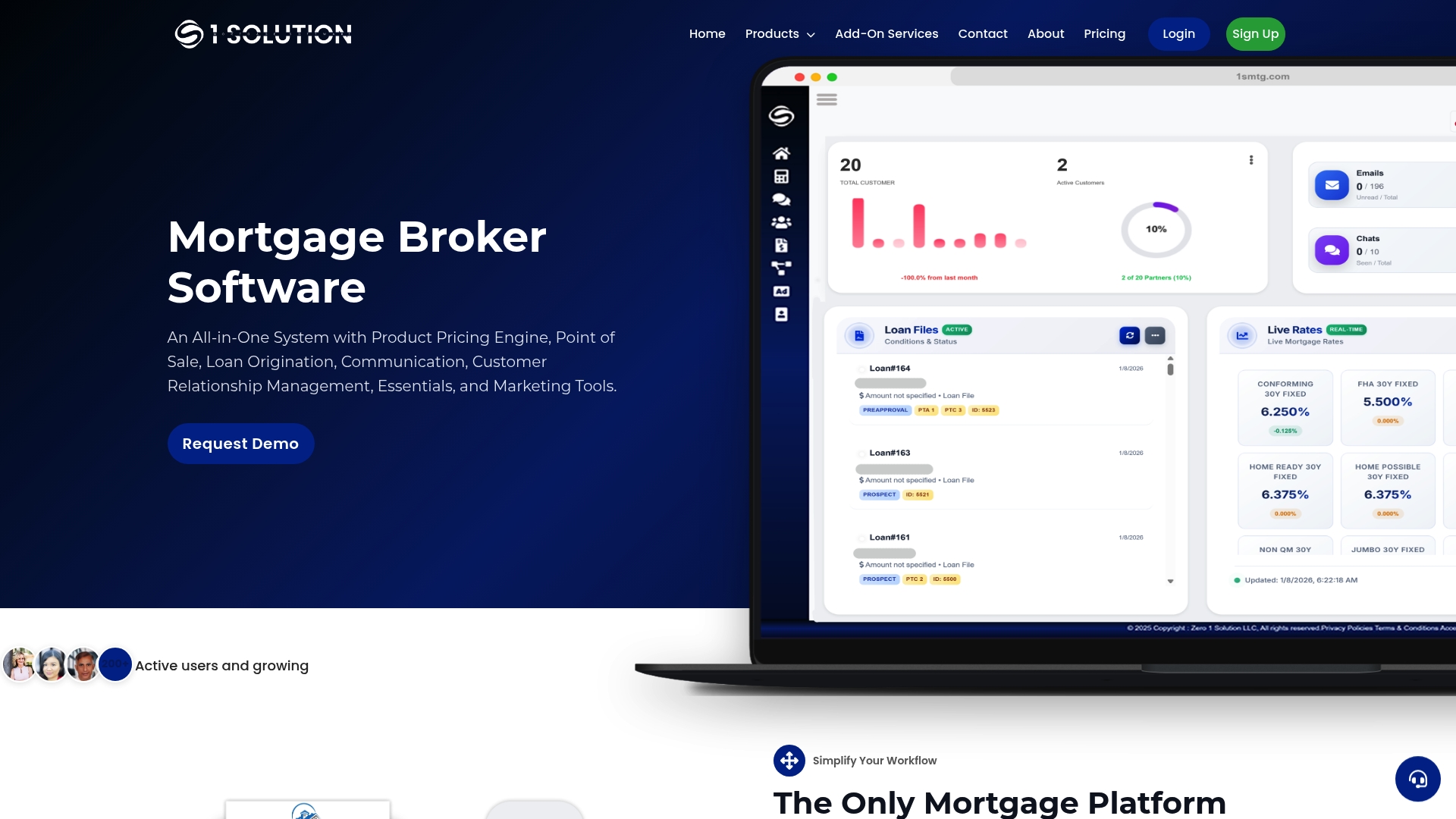
Our Subscription Account includes the operational pieces compliance officers ask for:
- Consent capture and access verification built into the borrower portal workflow
- Audit trails attached automatically to every signed document
- MISMO-aligned formatting support for eNote delivery readiness
- Secure document storage structured around retention requirements, not an afterthought
We are run by experienced mortgage professionals, so the controls we build reflect practical compliance requirements. If you want to see how the platform handles consent, audit trails, and eNote workflows for your shop, visit 1smtg to get a demo scheduled.
FAQ
Can a mortgage deed be electronically signed?
A mortgage or deed of trust can often be signed electronically under the E-Sign Act and state UETA law, but recording acceptance depends entirely on the county where the property sits. Some counties still reject electronically notarized security instruments even where state law permits remote online notarization, so verify local eRecording acceptance before relying on an e-signed deed.
When was the E-Sign Act passed by the US government?
The E-Sign Act was signed into law on June 30, 2000. Its main provisions took effect October 1, 2000, and the record retention requirements followed on March 1, 2001.
Is UETA still relevant today?
Yes, UETA remains the operating state-level framework that works alongside the federal E-Sign Act for most electronic mortgage transactions. Lenders generally need to satisfy both frameworks together since state contract law and federal commerce law both apply to a typical mortgage closing.
What is not permissible under the E-Sign Act?
The E-Sign Act does not override specific statutory exceptions, such as certain notices related to foreclosure, cancellation of utility services, or court orders in some contexts, and it does not eliminate state and local recording or notarization requirements. It also does not validate an electronic record when the consumer never gave the required affirmative consent or lacked the ability to access the format used.
Sources
- Electronic Signatures in Global and National Commerce Act (E-Sign Act) — NCUA
- FAQs: eClosings & eMortgages — Fannie Mae
- X-3 The Electronic Signatures in Global and National Commerce Act (E-Sign Act) — FDIC
- § 1024.3 E-Sign applicability — CFPB