
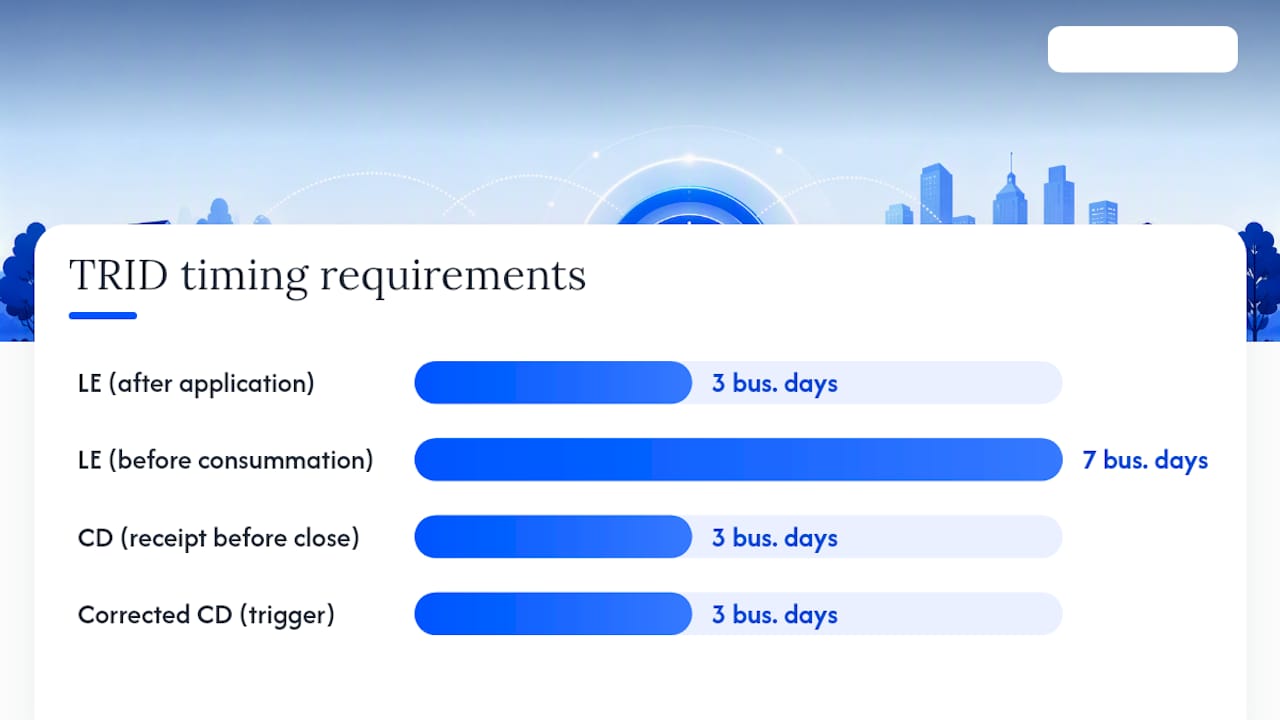
The deadlines are exact and non-negotiable. Under Regulation Z, a creditor must deliver or place the Loan Estimate in the mail no later than the third business day after receiving a consumer's application, and the initial Loan Estimate must also be provided no later than seven business days before consummation. For the Closing Disclosure, the consumer must receive it at least three business days before consummation. Those are the controlling rules under §§1026.19(e) and 1026.19(f) of Regulation Z (12 C.F.R. part 1026).
Three specific changes restart the three-business-day waiting period for a corrected Closing Disclosure:
- The APR becomes inaccurate beyond regulatory tolerance
- The loan product information changes
- A prepayment penalty is added
Everything else, routine fee corrections, updated title charges, minor escrow adjustments, can be delivered at or before consummation without resetting the clock. The CFPB's TRID FAQs confirm this three-trigger rule explicitly, and it is the single most operationally important distinction in TRID disclosure timing.
Key Takeaways
TRID disclosure timing compliance depends on three deadlines, two business-day definitions, and three specific triggers that restart the Closing Disclosure waiting period.
| Point | Details |
|---|---|
| Loan Estimate deadlines | Deliver or mail within 3 business days of application; initial LE also must be provided at least 7 business days before consummation. |
| Closing Disclosure receipt rule | Consumer must receive the CD at least 3 business days before consummation; mailed CDs add a 3-day presumption to the count. |
| Three CD reset triggers | Only APR inaccuracy, loan product change, or prepayment penalty addition requires a new 3-business-day wait. |
| Business-day definitions | Use the general definition (includes Saturdays) for LE sending; use the specific definition (excludes Saturdays) for CD receipt and the 7-day rule. |
| 1 Solution Mortgage Software | Automates timestamp capture, LE/CD delivery tracking, consummation-hold workflows, and audit logs to reduce manual timing errors. |
Table of Contents
- What are the exact TRID disclosure timing requirements under Regulation Z?
- What definitions control how TRID timing deadlines are counted?
- When do revised Loan Estimates and corrected Closing Disclosures require a new waiting period?
- How do you count business days for the 3-day and 7-day rules?
- Operational checklist to meet TRID timing requirements at every stage
- What timing mistakes do examiners flag most often?
- What mortgage operations teams get wrong about TRID timing controls
- How 1 Solution Mortgage Software supports TRID timing compliance
- Primary sources and further reading
- Sources
What are the exact TRID disclosure timing requirements under Regulation Z?
The TILA-RESPA Integrated Disclosure rule, commonly called TRID, is governed by Regulation Z (TILA) at 12 C.F.R. part 1026 and Regulation X (RESPA) at 12 C.F.R. part 1024. The primary timing provisions sit in §§1026.19(e) and 1026.19(f), with form-content requirements at §§1026.37 and 1026.38. The CFPB's compliance resources page and the full regulatory text at 12 C.F.R. part 1026 via eCFR are the primary sources compliance teams should have bookmarked.
Here is the core deadline structure:
| Form | Trigger | Required Timing | Citation |
|---|---|---|---|
| Loan Estimate (LE) | Receipt of application | Deliver or mail within 3 business days | §1026.19(e)(1)(iii) |
| Loan Estimate (LE) | Consummation | Initial LE no later than 7 business days before consummation | §1026.19(e)(1)(iv) |
| Closing Disclosure (CD) | Consummation | Consumer must receive CD at least 3 business days before consummation | §1026.19(f)(1)(ii) |
| Corrected CD (trigger change) | APR, product, or prepayment penalty change | New 3-business-day waiting period from receipt | §1026.19(f)(2)(ii) |
| Corrected CD (non-trigger) | Routine correction | May be provided at or before consummation | §1026.19(f)(2)(i) |
One distinction that trips up operations teams: the LE rule is about sending (deliver or place in the mail), while the CD rule is about receipt. The consumer must actually receive the CD three business days before consummation, not just have it sent. When the CD is not delivered in person, the regulation presumes receipt three business days after it is placed in the mail or delivered electronically, which means you need to build that presumption into your consummation date calculation.
The CFPB Small-Entity Compliance Guide walks through these timing obligations in plain language and is the most practical regulatory reference for operations managers who need to train staff or build SOPs.
What definitions control how TRID timing deadlines are counted?
Getting the definitions right is where most teams either gain or lose compliance control. Three definitions drive almost every timing calculation.

Application. Under TRID, an application is triggered when the creditor receives six specific data points from the consumer: (1) name, (2) income, (3) Social Security number, (4) property address, (5) estimated property value, and (6) the mortgage loan amount sought. The moment all six are in hand, the three-business-day LE clock starts. It does not matter whether the loan officer considers the file "complete" or whether a formal application form has been signed. The CFPB's Guide to the Loan Estimate and Closing Disclosure forms is explicit on this point, and it is the most common place where teams let the clock start late.
Consummation. Under Regulation Z, consummation is the moment the consumer becomes contractually obligated on the loan, which in most states aligns with the loan signing date. It is not the funding date or the disbursement date. For purchase transactions, consummation and closing typically coincide, but for refinances in states with a rescission period, the distinction matters operationally.
Business day. TRID uses two different definitions, and confusing them is one of the most common counting errors in the industry.
- The general business day definition (any calendar day except Sundays and federal public holidays) applies to the three-business-day LE sending requirement.
- The specific business day definition (any calendar day except Saturdays, Sundays, and federal public holidays) applies to the seven-business-day waiting period before consummation and to the three-business-day CD receipt requirement.
Saturdays count under the general definition but not the specific one. That single difference can shift a consummation date by a full day. Practical compliance commentary on TRID timing identifies this distinction as the most frequent source of miscounting across operations teams.
Delivery and receipt. In-person delivery satisfies the requirement on the day of delivery. When the LE or CD is mailed or sent electronically without confirmed same-day receipt, the regulation presumes the consumer receives it three business days later (using the specific definition). That presumption is rebuttable, but you need documented evidence to rebut it.
When do revised Loan Estimates and corrected Closing Disclosures require a new waiting period?
Not every revision restarts the clock. Knowing which changes trigger a new wait versus which do not is the difference between a smooth closing and an unnecessary delay.
Revised Loan Estimates after changed circumstances. A creditor may issue a revised LE when a valid changed circumstance occurs: an extraordinary event beyond anyone's control, information that was inaccurate or changed after the initial LE, or a new piece of information the consumer did not previously provide. Common examples include a rate lock that changes the interest rate, an appraisal that comes in with a different property value, or an underwriting condition that reveals a different loan structure. The revised LE must be delivered or placed in the mail no later than three business days after the creditor receives information sufficient to establish the changed circumstance. The CFPB's Guide to the Loan Estimate and Closing Disclosure forms provides practical examples of when revised LEs are required and when they are not.
One important constraint: a revised LE cannot be issued within three business days of consummation. At that point, the creditor is locked into the disclosed figures for tolerance purposes.
Corrected Closing Disclosures. The three-trigger rule is the operational heart of CD management. Per the CFPB FAQs, only these three changes require a new three-business-day waiting period from the date of consumer receipt:
- APR becomes inaccurate (increases by more than 1/8 of a percentage point for fixed-rate loans, or 1/4 of a percentage point for irregular transactions)
- Loan product changes (e.g., fixed to adjustable, or a different loan program)
- A prepayment penalty is added when one was not previously disclosed
Scenario examples:
- Rate lock after initial CD: If the rate lock causes the APR to increase beyond tolerance, a corrected CD is required and the three-day wait resets. If the rate lock simply confirms a previously disclosed rate, no reset is needed.
- Fee increase from a third-party vendor: If title fees increase but the APR remains within tolerance and the loan product does not change, a corrected CD can be delivered at or before consummation without resetting the wait.
- Loan program change at underwriting: If the consumer moves from a conventional to an FHA loan, the loan product has changed and a new three-day wait is mandatory.
Classifying every correction as "trigger" or "non-trigger" at the moment it is identified prevents last-minute closing delays.
How do you count business days for the 3-day and 7-day rules?
Counting correctly requires knowing which business-day definition applies and building in the mail presumption where relevant.
| Scenario | Event Date | Counting Steps | Earliest Consummation |
|---|---|---|---|
| LE mailed Monday (general def.) | Monday | Day 1: Tuesday, Day 2: Wednesday, Day 3: Thursday (sent by Thursday) | N/A (sending rule) |
| CD mailed Thursday (specific def.) | Thursday | Presumed receipt: Day 1: Friday, Day 2: Monday, Day 3: Tuesday | Wednesday at earliest |
| CD delivered in person Thursday | Thursday | Receipt confirmed same day; Day 1: Friday, Day 2: Monday, Day 3: Tuesday | Wednesday at earliest |
| Corrected CD (APR change) mailed Monday | Monday | Presumed receipt: Day 1: Tuesday, Day 2: Wednesday, Day 3: Thursday | Friday at earliest |
Federal holidays extend every count. If a federal holiday falls within the counting window, that day does not count and the window shifts forward by one day. Teams that do not maintain a current federal holiday calendar in their LOS will miscalculate at least once a year.
Electronic delivery does not automatically equal same-day receipt. Unless the consumer affirmatively acknowledges receipt on the day of delivery (via a documented e-signature or confirmation click), the three-business-day mail presumption applies. This is a detail that mortgage document packaging workflows must account for when building e-delivery procedures.
Construction loans present a separate consideration. Certain construction-to-permanent loans are covered by TRID, while standalone construction loans may not be. HELOCs are explicitly excluded from TRID. For covered construction-to-permanent transactions, the timing rules apply at each phase of consummation, and CFPB guidance addresses the specific disclosure approach for these loan types.
Operational checklist to meet TRID timing requirements at every stage
This checklist maps to the loan lifecycle from intake through consummation. Build it into your LOS workflow and SOP documentation.
- Timestamp application receipt. Record the exact date and time all six application data points are received. Use a system field that differentiates "application received" from "application completed" so the three-business-day LE clock is tied to the correct event, not a processor's manual entry.
- Generate and deliver the LE within three business days. Use the general business-day definition. If the application arrives on a Friday, the LE must be delivered or mailed by Monday (assuming no federal holiday). Auto-generate the LE from your LOS template on the same day the application is received where possible.
- Document proof of LE delivery. Retain the mailing receipt, e-delivery confirmation, or in-person acknowledgment. Log it in the loan file with the delivery date and method.
- Set the consummation hold. Flag the loan file with the earliest permissible consummation date based on the initial LE's seven-business-day rule. No closing date should be scheduled before this flag is cleared.
- Prepare and deliver the CD at least six business days before consummation when mailing (three days for mail presumption plus three days for the waiting period). For in-person or confirmed electronic delivery, three business days before consummation is sufficient.
- Classify any post-CD correction immediately. When a change occurs after the CD is issued, determine within 24 hours whether it is a trigger change (APR, product, prepayment penalty) or a non-trigger correction. Update the consummation hold accordingly.
- Retain all delivery evidence. Keep proof of mailing, e-delivery receipts, and revised disclosure logs for a minimum of three years from consummation per Regulation Z retention requirements. Store them in the LOS linked to the loan file.
- Conduct a pre-closing timing audit. The day before consummation, verify that the three-business-day CD receipt window has been satisfied and that no uncorrected trigger changes are outstanding.
Pro Tip: Build a separate LOS field called "Application Trigger Date" that auto-populates when the sixth data point is entered and sends an automatic alert to the processor. Teams that rely on a single "application date" field often start the LE clock from the wrong event, which is the most common intake-stage timing violation examiners find.
A practical closing-day coordination checklist can help your team confirm delivery evidence and timing clearances before the table is set.
What timing mistakes do examiners flag most often?
Examiners follow a predictable pattern. They pull loan files, check the application date against the LE delivery date, verify CD receipt against the consummation date, and look for delivery evidence. The gaps they find are consistent.
Common timing errors:
- Starting the LE clock from the date a formal application form was signed rather than the date all six data points were received
- Using the specific business-day definition (excluding Saturdays) for the three-business-day LE sending requirement, when the general definition (including Saturdays) applies
- Treating electronic delivery as confirmed receipt without a documented acknowledgment, then failing to add the three-day mail presumption to the consummation calculation
- Issuing a corrected CD after an APR change without resetting the three-day waiting period
Examiner red flags:
- Missing or inconsistent proof-of-delivery documentation across loan files
- Different business-day definitions applied by different processors in the same shop
- Last-minute fee increases with no revised LE and no documented changed-circumstance analysis
- Consummation dates that fall within the seven-business-day initial LE window with no documented waiver
What examiners typically ask: "Show me the application receipt date, the LE delivery date and method, the CD delivery date and method, and the consummation date for this loan. Now show me the delivery evidence for each." If you cannot produce a linked, timestamped record for each of those four events in under two minutes, you have a documentation gap that will become a finding.
When a timing risk surfaces late in the pipeline, escalate immediately to the compliance officer and document the discovery date, the nature of the issue, and the corrective action taken. A documented, good-faith correction is treated very differently in an exam than a gap with no paper trail. The ALTA guidance on the three-day rule reinforces the importance of centralized delivery evidence as the primary defense against exam citations.
What mortgage operations teams get wrong about TRID timing controls
The conventional wisdom says TRID compliance is primarily a forms problem. Get the right numbers on the LE and CD, and you are fine. That framing misses where most violations actually originate.
The real failure point is process architecture, specifically the handoff between the point-of-sale intake and the operations team. When the six application data points arrive through a borrower portal but the processor does not log them until the file is formally assigned, the LE clock has already been running for a day or two without anyone tracking it. By the time the LE is generated, the team may already be in violation without knowing it.
The second underestimated risk is the corrected-CD classification decision. Teams that default to "we'll just issue a corrected CD" without immediately classifying it as trigger or non-trigger create unnecessary closing delays and, worse, occasionally close without resetting the wait when they should have. That is the scenario that generates regulatory findings with real consequences, including potential rescission rights for the borrower and civil liability under TILA.
What actually works is building the timing logic into the system rather than relying on individual processors to remember the rules. Automated timestamp capture at the sixth data point, a consummation-hold flag that cannot be manually overridden without a compliance sign-off, and a centralized audit log that links every disclosure to its delivery receipt, these controls reduce timing errors more reliably than any training program alone. Training matters, but it degrades. System controls do not.

How 1 Solution Mortgage Software supports TRID timing compliance
Staying compliant with TRID disclosure timing is not just about knowing the rules. It is about having a system that enforces them consistently across every loan, every processor, and every closing.
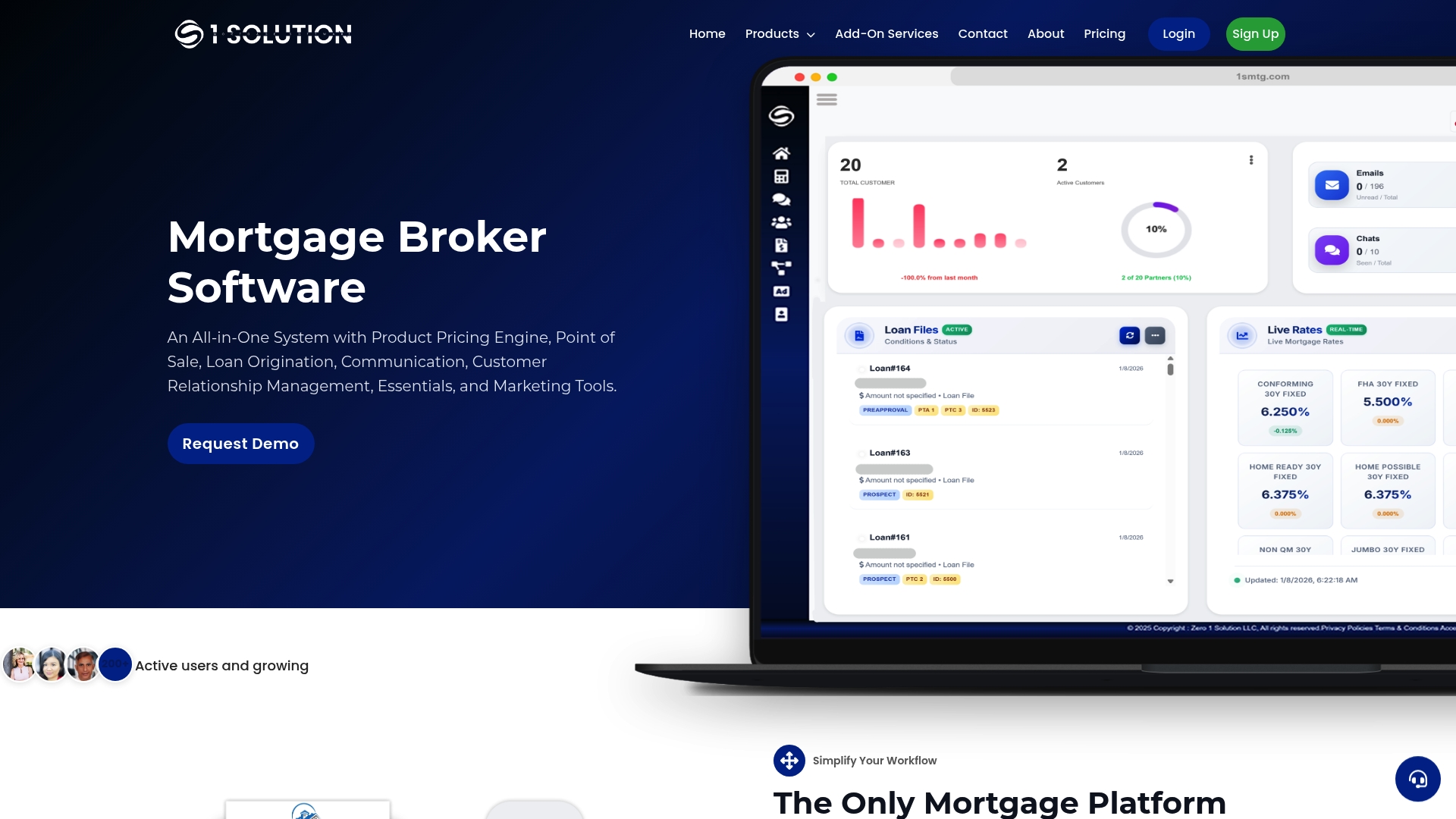
1 Solution Mortgage Software was built by mortgage professionals who have lived these compliance challenges from the operations side. The platform automatically timestamps application receipt when the sixth data point is entered, triggers LE generation within the required window, and logs every delivery event with a linked receipt. A built-in consummation-hold workflow prevents closing dates from being set before the seven-business-day and three-business-day windows are satisfied. When a corrected CD is issued, the system prompts the team to classify the change as trigger or non-trigger and adjusts the hold date accordingly.
For compliance officers, the audit log links every LE and CD to its delivery confirmation, giving you the documentation examiners ask for in seconds rather than minutes. No manual spreadsheets, no reconstructed timelines. Visit 1 Solution Mortgage Software to request a demo and see how the platform fits your team's workflow.
Primary sources and further reading
Every compliance team working with TRID should have these sources accessible for edge cases and SOP language.
- 12 C.F.R. part 1026 (eCFR): The full regulatory text of Regulation Z, including §§1026.19(e), 1026.19(f), 1026.37, and 1026.38. Use this for precise citation language in SOPs and policy documents.
- CFPB TRID Compliance Resources: The CFPB's central hub for TRID guidance, including the timeline illustration and links to all major guidance documents.
- CFPB TRID FAQs: The authoritative source for the three-trigger corrected-CD rule, the application definition, and common operational questions. Reference this when a scenario is not clearly addressed in the regulation itself.
- CFPB Small-Entity Compliance Guide: The most practical plain-language guide to TRID timing, definitions, and delivery rules. Useful for staff training and onboarding.
- CFPB Guide to the Loan Estimate and Closing Disclosure Forms: Covers form content, timing, and the practical differences between initial and revised LEs. Use for training on changed-circumstance scenarios.
- ALTA: How to Comply with the Closing Disclosure's Three-Day Rule: Industry-level process recommendations for meeting the CD rule and documenting delivery evidence. Practical for closing agents and operations managers.
- Mortgage Compliance Setup Checklist for 2026: A practical internal checklist for building TRID timing controls into your shop's SOP and LOS configuration.
- Mortgage Regulatory Compliance Explained for Brokers: An overview of TRID timing and compliance steps written for independent brokers and small operations teams.
This article provides general compliance information for mortgage industry professionals and does not constitute legal advice. Confirm current regulatory requirements with the CFPB, your legal counsel, or a qualified compliance professional.
This article is general information, not a substitute for advice from a qualified financial advisor. Consult a qualified financial professional about your own circumstances before acting on anything here.
Sources
- TILA-RESPA Integrated Disclosure FAQs | Consumer Financial Protection Bureau
- TILA-RESPA Integrated
- TILA-RESPA integrated disclosures (TRID)
- TILA-RESPA Integrated Disclosure: Guide to the Loan Estimate and Closing Disclosure forms
- How to Comply with the Closing Disclosure's Three-day Rule