

Accurate mortgage rate quotes don't happen by accident. They're the product of disciplined data collection, regulatory compliance, validated property valuations, and technology systems you can actually trust. Here are the core mortgage rate quote accuracy strategies every broker should have locked in:
- Enforce TRID APR tolerances within strict regulatory limits for regular and irregular transactions
- Collect detailed borrower data upfront — credit, income, property use, and occupancy — before building any scenario
- Validate Automated Valuation Models (AVMs) using Forecast Standard Deviation (FSD) metrics before accepting property values
- Use technology that exposes its decision logic and produces timestamped audit trails
- Monitor rate feeds continuously so quotes reflect live pricing, not yesterday's rate sheet
- Run compliance checks beyond APR accuracy, covering fee consistency, lock periods, and disclosure timing
- Reconcile rate sheets across investors with consistent lock-period alignment to avoid misleading comparisons
Table of Contents
- 1. How TRID regulations shape your APR accuracy requirements
- 2. Why upfront data collection determines quote reliability
- 3. How to use AVMs and market-specific data without getting burned
- 4. Transparent technology integrations protect your audit trail
- 5. How secondary market conditions create quote variability
- 6. How to reconcile rate sheets from multiple investors
- 7. Compliance checks that go beyond TRID APR requirements
- 8. Using predictive analytics to improve quote reliability
- Why 1 Solution Mortgage Software was built for exactly this
- Key Takeaways
1. How TRID regulations shape your APR accuracy requirements
TRID is the foundation every accurate quote is built on. Under US federal TRID regulations, APR tolerance limits are strictly enforced during regulatory examinations, with discrepancies frequently traced to inconsistent finance charge definitions in compliance software. For regular transactions, the APR must fall within one-eighth of one percentage point of the figure calculated under Regulation Z. Irregular transactions get a slightly wider band of one-quarter of one percentage point.
What trips brokers up most often isn't the math. It's the finance charge definition. A single misconfigured checkbox in your pricing software can silently miscalculate the APR across your entire loan volume. That's a systemic failure, not a one-off error.
Key compliance requirements to lock down:
- Loan Estimate (LE) delivery: The CFPB requires delivery within three business days of a completed application
- Closing Disclosure (CD) alignment: Fees and rates on the CD must reconcile with the LE; mismatches between disclosures signal systemic operational failures to examiners, not isolated mistakes
- Finance charge consistency: Every fee's finance charge designation must be applied uniformly across all loans
- Total of Payments accuracy: Understated by no more than $100, or disclosed above the actual amount
Pro Tip: Review your fee library settings quarterly. The finance charge checkboxes in your LOS or pricing engine are the single most common source of TRID examination findings. A quick audit of those settings costs an hour; a regulatory finding costs far more.
2. Why upfront data collection determines quote reliability
Superficial intake produces engagement numbers, not real quotes. Loan officers who skip detailed questions about credit, income, and property use tend to generate figures that look like quotes but fall apart during underwriting. According to Omar Khamisa, who has spent over 20 years working as a processor, underwriter, loan originator, and systems consultant:

That's not a philosophy. It's an operational reality. Mid-stream loan adjustments driven by missing data don't just delay closings; they create disclosure timing problems and fee recalculation requirements that put you squarely in TRID territory. The mortgage scenario analysis framework for loan officers reinforces this: the quality of your output is entirely determined by the quality of your intake.
Lock-period consistency belongs in this conversation too. Comparing quotes with different lock durations misrepresents pricing risk to borrowers. Every scenario you build should specify the lock period explicitly, and when you're comparing options across investors, lock-period alignment is non-negotiable for an honest comparison.
3. How to use AVMs and market-specific data without getting burned
Automated Valuation Models are powerful when used correctly and dangerous when accepted uncritically. The key metric is Forecast Standard Deviation (FSD), which measures the confidence level of an AVM's output.
| FSD Range | Confidence Level | Recommended Action |
|---|---|---|
| ≤ 0.10 | High | Accept AVM value for pricing |
| 0.10 < FSD ≤ 0.20 | Moderate | Cross-reference with comparable sales data |
| > 0.20 | Low | Escalate to alternative valuation methods |
An FSD above 0.20 means the model's confidence is low enough that relying on it for pricing exposes you to appraisal gaps downstream. That's a compliance and financial risk, not just a data quality issue.
The other trap is national-level data in local markets. Volatile or thin markets require market-specific valuation data. A national average tells you nothing useful about a rural county or a rapidly shifting urban submarket. Brokers who understand why property type affects lending decisions know that localized data isn't optional when accuracy matters. Regulatory demands for defensible valuations reinforce this: if your appraisal methodology can't withstand scrutiny, neither can your quote.
4. Transparent technology integrations protect your audit trail
Opaque automation is a liability. When AI systems surface outputs without exposing how those outputs were generated, reviewers are forced to recheck, validate, and reconcile the same data manually. That's what automation theater looks like in practice: technology that creates the appearance of efficiency while invisible rework accumulates underneath it.
Mortgage operations require traceability. When an auditor reviews a loan months after closing, you need to show which documents supported each decision, when data was validated, and how inconsistencies were resolved. Technology that can't expose its decision path creates friction not because it's inaccurate, but because it's unaccountable.
Build your technology stack around these transparency requirements:
- Timestamped quote delivery: Mortgage quoting automation that timestamps delivery and borrower acknowledgment provides the audit trail regulators require under TRID
- Continuous data validation: Systems that cross-check data as it enters the workflow catch exceptions early, before they become underwriting problems
- Visible decision logic: Every pricing calculation should expose the inputs, adjustments, and fee assumptions that produced the output
- Revision workflows: Changes to a Loan Estimate need documented triggers, timestamps, and borrower acknowledgments
Pro Tip: Run pre-funding data audits on a sample of files each month. Fee library errors and finance charge misconfiguration are systemic — they show up across multiple loans, not just one. Catching them before files reach regulatory review is far cheaper than explaining them after.
5. How secondary market conditions create quote variability
Secondary market conditions move mortgage pricing in ways that have nothing to do with your borrower's profile. When MBS spreads widen, investor appetite shifts, or the Federal Reserve signals policy changes, rate sheets from your wholesale partners can reprice multiple times in a single day. A quote built on a morning rate sheet can misstate the payment by afternoon.
The practical response is live pricing feeds connected directly to your LOS. Live rate integrations reduce Loan Estimate revision rates by eliminating stale data from the quoting process. Brokers who rely on static spreadsheets absorb that volatility as revision risk. Those with live feeds pass accurate pricing to borrowers in real time.
Understanding secondary market timing also means knowing when to lock. Rate locks are a hedge against market movement, and the cost of that hedge changes with volatility. Presenting lock options clearly, with honest explanations of the tradeoffs, is part of delivering a quote that holds.
6. How to reconcile rate sheets from multiple investors
Working with multiple investors or correspondents means managing multiple rate sheets, each with its own pricing adjustments, lock periods, and product eligibility rules. Without a structured reconciliation process, you're comparing apples to oranges and presenting that confusion to borrowers as a quote.
Start with lock-period normalization. A 30-day lock from Investor A and a 45-day lock from Investor B are not the same product at the same price. Align lock periods before comparing rates. Then layer in loan-level price adjustments (LLPAs) specific to each investor, because the same borrower profile can price differently across channels.
The mortgage deal comparison process works best when you build a standardized scenario template: same loan amount, same credit band, same property type, same lock period, run across every investor simultaneously. That's the only way to produce a genuinely comparable rate sheet reconciliation. Product and pricing engines (PPEs) that integrate directly with your LOS automate this process and eliminate the manual rekeying that introduces errors.
7. Compliance checks that go beyond TRID APR requirements
TRID APR accuracy is the floor, not the ceiling. Brokers who treat TRID compliance as the complete picture miss a range of other accuracy requirements that create examination risk. The mortgage broker compliance management framework covers the broader landscape, but here are the checks that directly affect quote accuracy:
State-level fee disclosure requirements vary significantly and can require disclosures beyond what TRID mandates federally. A quote that's TRID-clean may still violate state-specific rules.
ARM disclosure requirements add another layer. Adjustable-rate transactions require the Consumer Handbook on Adjustable Rate Mortgages (CHARM booklet), and the payment schedule must accurately reflect all finance charges payable after consummation.
Fee tolerance categories under TRID aren't uniform. Some fees have zero tolerance for increases, others allow up to 10%, and others are unlimited. Misclassifying a fee's tolerance category is a compliance error that shows up on the CD, not just in your internal records.
Patterns of inconsistent disclosures across multiple loans are what draw examiner attention. A single error reads as a mistake. Repeated errors in the same fee category read as a systemic failure in your workflow.
8. Using predictive analytics to improve quote reliability
Predictive analytics shifts your posture from reactive to anticipatory. Instead of repricing after the market moves, you build rate scenarios that account for likely movement within the borrower's decision window. That's a meaningful advantage when borrowers are comparing options across multiple lenders.
The practical application for brokers isn't building proprietary models. It's using platforms that incorporate rate trend data, MBS pricing signals, and economic indicators into their pricing engines. When your technology surfaces a rate forecast range alongside a current quote, you give borrowers context that builds trust and reduces the shock of a rate change between application and closing.
Connecting predictive capabilities to your compliance workflow matters too. If your analytics flag elevated rate volatility, that's a signal to recommend shorter lock periods or to document the rate risk conversation with the borrower explicitly. That documentation becomes part of your audit trail and demonstrates the kind of transparent, borrower-first practice that holds up under examination.
Why 1 Solution Mortgage Software was built for exactly this
Every strategy in this article requires technology that actually works the way brokers work. That's the gap Omar Khamisa built 1 Solution Mortgage Software to close. After two decades in mortgage operations as a processor, underwriter, originator, and systems consultant, he knew firsthand what fragmented, bank-first platforms cost independent brokers in time, compliance risk, and lost deals.
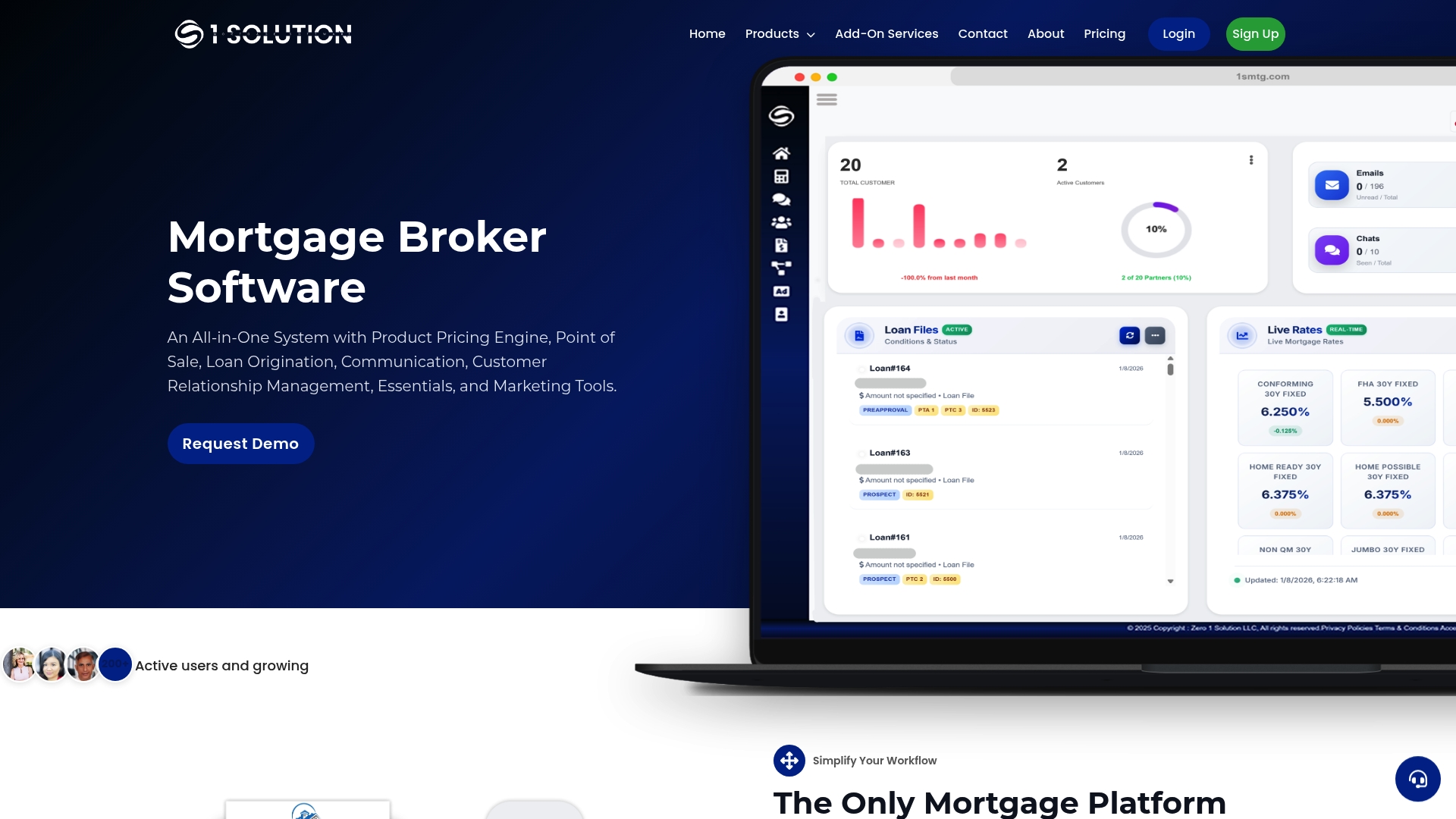
1 Solution Mortgage Software brings pricing, LOS, POS, CRM, compliance, and communication tools into one connected platform, built specifically for independent mortgage professionals. No outside investors. No hidden agendas. Just the control, transparency, and flexibility brokers deserve.
Key Takeaways
Accurate mortgage rate quotes require TRID compliance, rigorous intake, validated AVMs, and transparent technology working together from the first borrower conversation through closing.
| Point | Details |
|---|---|
| TRID APR tolerances | Regular transactions must fall within one-eighth of one percentage point; irregular within one-quarter. |
| Upfront data collection | Detailed intake on credit, income, and property use prevents mid-stream revisions and compliance gaps. |
| AVM validation with FSD | An FSD above 0.20 requires escalation to alternative valuation methods before using the value in pricing. |
| Transparent audit trails | Timestamped delivery and borrower acknowledgment are required by regulators under TRID examinations. |
| Lock-period alignment | Comparing quotes with different lock durations misrepresents pricing risk and undermines quote accuracy. |