

Mortgage broker efficiency metrics are quantifiable performance indicators that brokers and loan officers use to benchmark operations, identify bottlenecks, and make data-driven decisions about staffing and technology. The industry term for this practice is loan originator performance management, and it covers everything from pull-through rate and lock-to-close ratio to cost per loan and customer lifetime value. Tracking these metrics is not optional for brokers who want to grow. It is the difference between running a business and guessing your way through one. This guide breaks down the metrics that matter most and shows you how to use them.
1. What are the top mortgage broker efficiency metrics?
Conversion rates are the single most revealing metric about a mortgage broker's effectiveness, more so than raw loan volume. That means the pull-through rate, the lock-to-close ratio, and the lead-to-funded conversion rate deserve your attention before anything else.
The core mortgage broker KPIs every brokerage should track include:
- Pull-through rate: The percentage of applications that reach funded status. A healthy pull-through rate falls between 60% and 75%, with top-performing brokerages exceeding 75%.
- Lock-to-close ratio: The share of locked loans that actually close. A low ratio signals fallout problems that cost you real money on rate lock fees.
- Lead-to-funded conversion rate: Measures how efficiently your pipeline converts prospects into closed loans.
- Average loan cycle time: The number of days from application to funding. Shorter cycle times improve borrower satisfaction and free up pipeline capacity.
- Cost per loan originated: Total operating expenses divided by funded loans in a given period.
- Revenue per loan: Measured in basis points, this varies by product type and lender relationship.
- Customer satisfaction score (CSAT): A direct measure of borrower experience, often collected via post-close surveys.
Tracking these on daily, weekly, and monthly scorecards gives you a real-time view of where your pipeline is healthy and where it leaks.
Pro Tip: Segment every metric by lead source and loan type before drawing conclusions. Blended metrics mask which funnels leak revenue and skew your benchmarks. A 65% pull-through rate looks fine in aggregate but may hide a 40% rate on one lead channel dragging down a 90% rate on another.

2. How conversion and cycle time metrics impact profitability
Conversion metrics connect directly to revenue in ways that volume numbers never will. Improving lead-to-funded conversion by just 1–2% can generate millions in additional origination for high-volume teams. A team funding 50 loans per month at a $300,000 average loan size gains approximately $1,500,000 in monthly origination from a single percentage point improvement. That math makes conversion the highest-leverage metric in your business.
Faster average loan cycle times compound this effect. Borrowers who close quickly are far more likely to refer friends and family without being asked. Referral business costs nothing to acquire and converts at a higher rate than cold leads. Cycle time reduction is, in effect, a marketing strategy.
The national mortgage delinquency rate held at 3.35% in april 2026, which is 45 basis points below the January 2020 pre-pandemic benchmark. That context matters because it tells you the broader loan portfolio environment is stable, meaning underperformance in your own conversion or cycle time metrics is an internal problem, not a market problem.
Lock-to-close fallout carries a direct cost that brokers often underestimate. Every locked loan that does not close means you absorbed the cost of processing, underwriting review, and rate lock fees with zero revenue to show for it. Tracking your lead-to-close conversion rate monthly gives you the earliest possible warning when fallout is rising.
3. Evaluating cost efficiency: cost per loan and revenue per loan
Cost per loan originated is the total of all direct and indirect operating expenses divided by the number of funded loans in a period. This includes processor salaries, technology subscriptions, compliance costs, and marketing spend. Revenue per loan is measured in basis points and varies significantly by product type. Government loans typically carry different compensation structures than conventional products, so blending them produces a misleading average.
The comparison that matters is the gap between cost per loan and revenue per loan. That gap is your per-unit profit margin. Brokerages that track this monthly can spot margin compression early and adjust before it becomes a cash flow problem.
| Metric | Benchmark range | What it tells you |
|---|---|---|
| Pull-through rate | 60%–75% (75%+ is high-performing) | Pipeline conversion health |
| Average loan cycle time | Varies by product; shorter is better | Operational speed and borrower experience |
| Cost per loan | Varies by team size and tech stack | Operating efficiency per funded unit |
| Revenue per loan | Measured in basis points by product | Compensation and product mix effectiveness |
| Deals per staff member per month | Depends on role and support tools | True operational capacity |
Operational capacity depends on deals per staff member per month to reveal the point beyond which productive growth stalls without additional hiring. This metric is the clearest signal that your team has hit its ceiling. When deals per staff member plateau while pipeline grows, you are either losing deals to capacity constraints or burning out your team.
Pro Tip: Track revenue per staff member alongside cost per loan to measure the actual impact of technology investments. If you add a new platform and revenue per staff member does not improve within 90 days, the tool is adding complexity, not capacity.
4. Beyond volume: quality, compliance, and long-term client value
Completed loan volume alone is a vanity metric. Without file quality and clean audit records, high volume creates regulatory exposure that can shut a brokerage down faster than a slow market. Compliance tracking belongs in your efficiency framework, not in a separate silo.
Customer satisfaction, referral rates, and repeat business are qualitative metrics that reveal broker effectiveness beyond what any pipeline report shows. A broker who consistently generates referrals without asking for them is delivering an experience that volume numbers cannot capture. These metrics are proxies for trust, and trust is the foundation of a sustainable book of business.
Qualitative and compliance metrics that belong in your broker efficiency analysis:
- File quality rate: Percentage of loan files submitted with zero conditions or minimal conditions. High file quality reduces cycle time and lender friction.
- Clean audit rate: Percentage of files that pass internal or external compliance review without findings. This protects your license and your lender relationships.
- Customer satisfaction score: Post-close survey results that reveal borrower experience at every stage of the process.
- Referral rate: The share of new business that comes from past clients or professional partners. A rising referral rate signals that your process is worth talking about.
- Customer lifetime value (CLV): The projected revenue from a client across all future transactions, including refinances, purchases, and cross-sell opportunities like home equity products.
Brokerages that track CLV alongside conversion metrics make better decisions about where to invest in client relationships. A borrower with high CLV potential deserves a different level of follow-up than a one-time transaction client. Segmenting your database this way is a direct application of mortgage compliance management and client retention strategy working together.
5. How to use efficiency metrics to evaluate technology and AI investments
Technology investments must prove their value in the same metrics you use to run your business. Metric tracking clarifies the actual operational impact of new technology and helps firms avoid adding unnecessary complexity. Without a before-and-after measurement framework, you are buying software on faith.
The metrics that most clearly reveal whether a technology investment is working include:
- Average loan cycle time: Did it drop after implementation? By how many days?
- Cost per loan: Did operating costs per funded loan decrease, hold steady, or increase?
- Deals per staff member: Did your team's capacity grow without adding headcount?
- Conversion rate by stage: Did the tool improve conversion at the specific stage it was designed to address?
- Error and rework rate: Did file quality improve, reducing conditions and lender pushback?
Technology or AI implementations must be measured against productivity ratios like revenue per service staff to confirm they add operational value. If a tool does not move at least one of these metrics within a defined window, it is not solving a real problem. Reviewing mortgage automation tools through this lens before purchasing saves brokers from expensive mistakes.
Pro Tip: Set a 60-day measurement window before and after any new technology goes live. Document your baseline metrics in writing before you flip the switch. Without a written baseline, you will not be able to tell whether the tool made a difference or the market just shifted.
6. How to build a scorecard system that actually gets used
Top brokerages use monthly or quarterly scorecards for proactive management rather than annual reviews. Monthly scorecards catch bottlenecks in weeks, not quarters. Annual reviews catch them after the damage is done.
A practical scorecard for a mortgage brokerage includes three tiers. The first tier is daily: pipeline count, applications submitted, and locks placed. The second tier is weekly: conversion rates by stage, average days in each pipeline stage, and outstanding conditions by file. The third tier is monthly: cost per loan, revenue per loan, pull-through rate, referral rate, and customer satisfaction score.
The scorecard only works if the same person reviews it on the same schedule every period. Assign ownership of each metric to a specific role. When a metric moves outside its target range, the owner is responsible for identifying the cause and reporting back within five business days. That accountability loop is what separates a scorecard from a spreadsheet nobody reads.
Many brokers track only aggregate volume and miss the bottlenecks that limit real growth. Segmenting your scorecard by lead source, loan type, and team member turns a general report into a diagnostic tool. You will find that your best conversion rates often come from your smallest lead channels, and that insight alone can redirect your marketing budget more effectively than any campaign analysis.
Key takeaways
Mortgage broker efficiency metrics work best when tracked consistently, segmented by lead source and loan type, and tied directly to technology and staffing decisions.
| Point | Details |
|---|---|
| Conversion over volume | Pull-through rate and lead-to-funded conversion reveal more about brokerage health than total loan count. |
| Segment every metric | Blended KPIs mask which lead channels and loan types are dragging down overall performance. |
| Cost and revenue per loan | Tracking the gap between these two numbers gives you your per-unit profit margin each month. |
| Quality and compliance count | File quality rate and clean audit rate protect your license and lender relationships over the long term. |
| Measure tech with metrics | Set a written baseline before any new tool goes live and measure against it within 60 days. |
What I have learned from 20 years of watching brokers measure the wrong things
Most brokers I have worked with over the years were not short on ambition. They were short on the right numbers. The ones who scaled past $100 million in annual origination were not necessarily the best salespeople. They were the ones who knew their pull-through rate by lead source, their cost per loan by product type, and their average cycle time by processor. They ran their business like a numbers-driven operation, not a hustle.
The shift I advocate for is moving away from volume as the primary success signal. Volume is easy to celebrate and hard to learn from. Conversion rates are uncomfortable to look at because they expose waste directly. A 55% pull-through rate means nearly half of your applications are not funding. That is not a market problem. That is a process problem, and a metric is the only thing that will force you to confront it.
Monthly scorecards changed how I think about operations. When you review the same metrics on the same day every month, patterns become obvious fast. A cycle time that creeps up by two days over three months tells you something is slowing down in processing before it becomes a borrower complaint. An annual review would never catch that.
My strongest advice is this: use your metrics to make hiring and technology decisions, not gut feelings. If your deals per staff member have plateaued, you need either a new hire or a tool that removes manual work from your team's plate. The metric tells you which. If your conversion rate does not improve after 90 days with a new platform, the platform is not solving your actual bottleneck. The data will tell you that too, if you let it.
Brokers who build long-term client relationships do so because they track the metrics that reveal client experience, not just pipeline activity. Referral rate and customer satisfaction score are not soft metrics. They are leading indicators of next quarter's revenue.
— Omar Khamisa
See how 1 Solution Mortgage Software tracks what matters
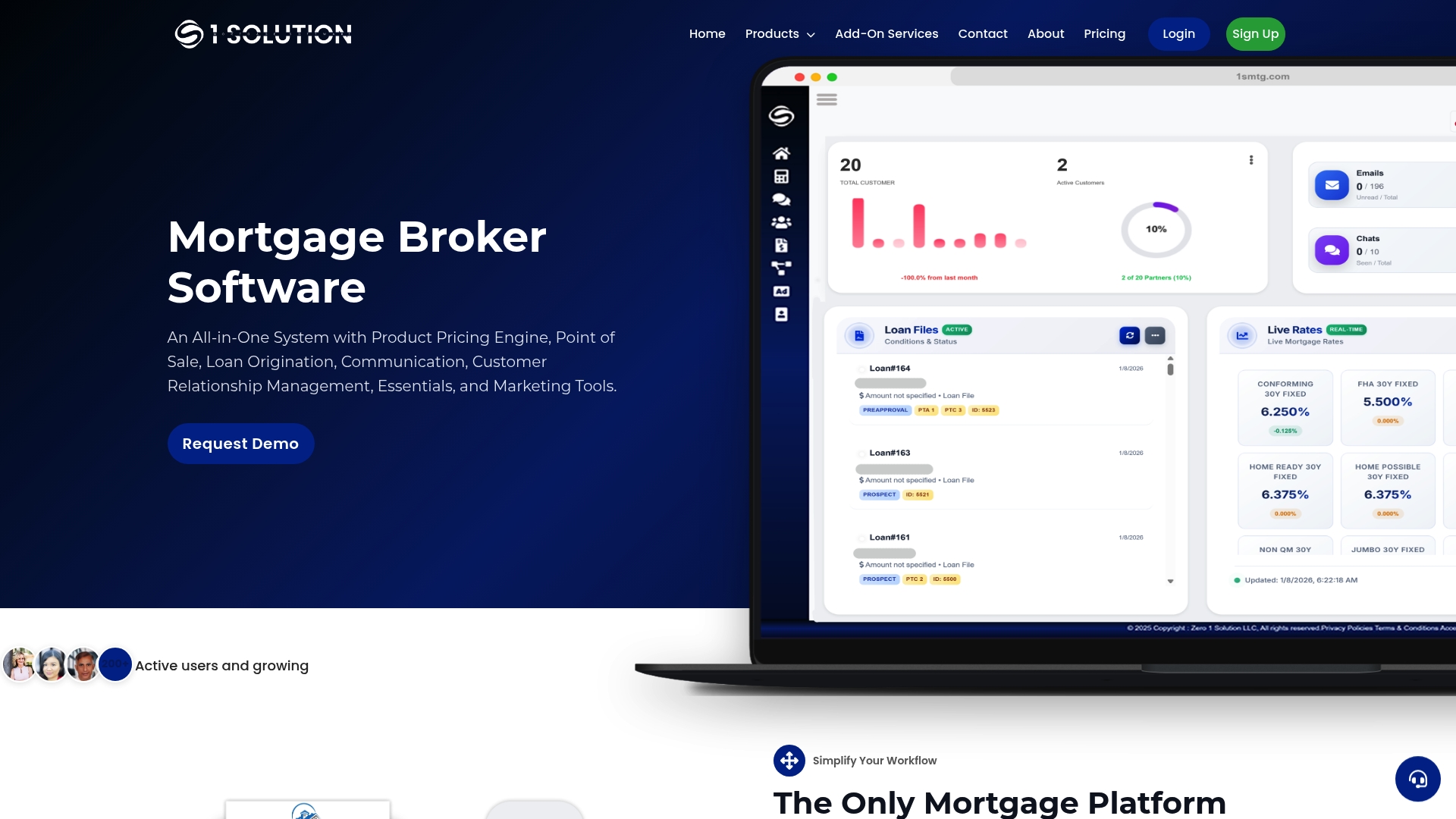
1 Solution Mortgage Software was built by mortgage professionals who spent years frustrated by platforms that tracked volume and ignored everything else. Our platform gives brokers and loan officers a connected dashboard that covers conversion tracking, automated reporting, pipeline scorecards, and compliance monitoring in one place. You do not need to stitch together five tools to see your pull-through rate next to your cost per loan. We built that view because we needed it ourselves. If you are ready to run your brokerage on real numbers, explore 1 Solution Mortgage Software and see what a purpose-built platform looks like for independent mortgage professionals.
FAQ
What is a good pull-through rate for a mortgage broker?
A pull-through rate between 60% and 75% is considered healthy, with brokerages above 75% classified as high-performing. Rates below 60% signal significant fallout problems that require immediate pipeline review.
How do mortgage broker KPIs differ from bank loan officer metrics?
Independent mortgage brokers track metrics like pull-through rate, cost per loan, and referral rate that reflect their direct operational control. Bank loan officers typically work within institutional reporting systems that prioritize volume and compliance over per-unit profitability.
Why should I segment efficiency metrics by lead source?
Blended metrics mask which lead channels and loan types are underperforming. Segmenting by lead source reveals the true cost of customer acquisition and shows exactly where your conversion funnel leaks revenue.
How often should I review my mortgage performance metrics?
Top brokerages review pipeline and conversion metrics weekly and pull-through rate, cost per loan, and referral rate monthly. Annual reviews catch problems too late to correct them within the same business cycle.
How do I know if a new technology tool is improving my efficiency?
Set a written baseline for cycle time, cost per loan, and deals per staff member before the tool goes live. Measure the same metrics 60 days after implementation. If none of those numbers improved, the tool is not solving your actual bottleneck.