
Mortgage automation tools are defined by their functional scope and integration depth, not by a single category. Five distinct tool types exist in the market today: end-to-end lending platforms, document intelligence tools, loan origination systems, enterprise workflow builders, and custom AI agents. Platforms like nCino, Ocrolus, and Encompass each solve different workflow problems, which means choosing the wrong type creates more friction than it removes. This guide breaks down each category by scope, integration requirements, and ideal use case so you can match the right tool to your actual bottleneck.
1. Types of mortgage automation tools: an overview of the five categories
The most common mistake mortgage professionals make is treating automation as a single product decision. Mortgage automation tools fall into five functional categories, and each category solves a different layer of the loan workflow. End-to-end platforms cover the full lifecycle. Document intelligence tools handle extraction and classification. LOS platforms manage origination through closing. Enterprise workflow builders create custom logic across systems. Custom AI agents handle non-standard, high-complexity decisions.
Selecting by scope first, then evaluating integration fit, is the correct sequence. Patching disparate systems together after the fact creates the interoperability problems that cost lenders the most time. The five-category framework gives you a structured way to audit your current stack and identify exactly where the gap is.

2. End-to-end mortgage lending platforms
End-to-end platforms cover the entire loan lifecycle from application intake through closing and post-close delivery. Platforms like nCino, TurnKey Lender, and MeridianLink are built to replace or modernize legacy systems rather than supplement them. They offer a unified user interface, a common data layer, and native integrations with pricing engines, credit bureaus, and compliance services.
The primary benefit of this category is the elimination of manual handoffs between systems. When document capture, underwriting rules, and closing workflows all run inside one platform, processors stop rekeying data between tools. Unified platforms and common data layers reduce operational complexity and improve productivity significantly, which is the core value proposition of end-to-end solutions.
End-to-end platforms are best suited for mid-to-large lenders replacing aging infrastructure, or for growing brokerages that want to avoid building a fragmented stack from the start.
- Unified UI: Processors, underwriters, and closers work inside one interface, reducing context switching and training overhead.
- Native compliance automation: Built-in TRID, RESPA, and MISMO-aligned workflows reduce the risk of regulatory errors at each stage.
- Third-party integrations: Pre-built connectors to appraisal management companies, flood certification providers, and title companies reduce custom development costs.
Pro Tip: Before committing to an end-to-end platform, map every system your team currently uses and confirm the platform has native connectors for each one. A platform that replaces your LOS but breaks your pricing engine integration is a net loss.
3. How document intelligence tools improve mortgage processing
Document-specific automation tools focus on one job: converting unstructured mortgage documents into clean, structured, validation-ready data. Ocrolus, Docsumo, and Lido are the leading examples in this category. They use optical character recognition combined with AI classification to extract data from pay stubs, bank statements, tax returns, and title documents.
The distinction that matters here is the difference between extraction and normalization. Document automation is effective only when it integrates advanced validation and normalizes data into LOS-ready formats, avoiding manual exception handling. A tool that extracts data but outputs it in inconsistent formats forces processors to reconcile the output manually, which defeats the purpose entirely.
These tools integrate with LOS platforms like Encompass through API connections. When the integration is complete and the data normalization is configured correctly, document processing time drops and audit-ready outputs are generated automatically.
- OCR plus AI classification: Identifies document type automatically and routes extraction logic accordingly, reducing setup time per document category.
- Data normalization: Converts extracted values into standardized formats aligned with MISMO field definitions before passing data downstream.
- Audit-ready outputs: Generates timestamped extraction logs that satisfy compliance review requirements without additional manual documentation.
Pro Tip: When evaluating document intelligence tools, ask the vendor specifically how they handle income calculation normalization for self-employed borrowers. This is where most tools break down and where manual reconciliation costs accumulate fastest.
The limitation of standalone document tools is clear: they only solve the document bottleneck. If your workflow problems extend to underwriting logic, pipeline visibility, or closing coordination, a document tool alone will not close the gap.
4. What role mortgage LOS software plays in automation
Loan origination systems are the operational core of most mortgage workflows. Encompass by ICE Mortgage Technology, Blend, and Floify each handle the loan application through closing process with built-in workflow rules, document management, and compliance enforcement. LOS platforms are not just filing systems. They are rule engines that enforce processing sequences, trigger task assignments, and generate required disclosures automatically.
Standalone document extraction tools focus on extracting data where the LOS is stable, while full platforms modernize entire lending workflows. This distinction tells you when to add a document tool versus when to upgrade the LOS itself. If your Encompass configuration is solid but document intake is slow, add Ocrolus. If your entire origination workflow is fragmented, the LOS is the right place to start.
Compliance is the strongest argument for investing in a purpose-built mortgage LOS. MISMO standards define prescriptive datasets including ULAD, UCD, UAD, and ULDD, and ULDD Phase 5 became mandatory on July 28, 2025, with fatal-edit enforcement for delivery file conformance. An LOS that is not aligned to these standards will generate hard rejects at delivery, creating downstream manual correction work.
- Built-in disclosure generation: TRID-compliant Loan Estimates and Closing Disclosures are generated automatically based on loan data, reducing compliance risk.
- Third-party service ordering: Credit pulls, appraisals, flood certifications, and title orders are triggered directly from the LOS without switching platforms.
- Pipeline visibility: Loan officers and processors see real-time status across every active file, which reduces status call volume and improves borrower communication.
5. How enterprise workflow builders and custom AI agents work
Enterprise workflow builders occupy a different category from LOS platforms and document tools. Tools like Jinba Flow are designed to create custom processing logic that connects disparate systems through configurable rules engines and API orchestration. They are not mortgage-specific out of the box. Their value is flexibility: you define the workflow, the data routing, and the decision logic.
Custom AI agents take this further by applying machine learning to non-standard mortgage scenarios. Complex jumbo loans, non-QM products, and portfolio lending often involve decision criteria that no off-the-shelf LOS handles well. Custom agents can be trained on historical loan data to flag risk patterns, suggest conditions, or route files based on criteria that a rules engine cannot anticipate.
The table below compares enterprise workflow builders against custom AI agents across the dimensions that matter most for mortgage operations:
| Dimension | Enterprise workflow builders | Custom AI agents |
|---|---|---|
| Setup complexity | Moderate, requires configuration | High, requires training data and ML expertise |
| Best use case | Connecting existing systems with custom logic | Non-standard loan decisions and pattern recognition |
| Compliance alignment | Depends on configuration | Requires explicit compliance guardrails |
| Scalability | High once configured | High after model maturation |
| Cost profile | Mid-range licensing | High upfront, lower marginal cost at scale |
The key challenge with fragmented tools is that much manual work is due to lack of interoperability rather than absence of automation. Enterprise workflow builders directly address this by creating a coordination layer above existing systems, reducing the rework that happens at every handoff point.
6. How to choose the right mortgage automation tool mix
Choosing the right combination of mortgage automation software starts with a workflow audit, not a vendor demo. The goal is to identify where data stops moving automatically and where processors are doing work that a configured system should handle. That bottleneck is your starting point.
- Map your current handoffs. Document every point where data moves from one system to another manually. These are your interoperability gaps and the highest-value targets for automation.
- Identify your primary bottleneck. If document intake is the slowest stage, a document intelligence tool like Ocrolus or Docsumo addresses it directly. If origination workflow is the problem, an LOS upgrade is the right move.
- Evaluate native integrations first. Starting with use-case scope and then evaluating native integrations prevents the trap of patching systems together with brittle custom connectors.
- Confirm MISMO compliance. Any tool that touches loan data delivery must conform to current MISMO standards. Validation behavior in automation tools, specifically early error detection versus late fatal rejects, determines whether your pipeline moves or stalls at delivery.
- Assess data standardization requirements. Data preparation including standardization and validation is a make-or-break step in AI mortgage automation. Inconsistent numeric and currency formats degrade efficiency regardless of how capable the automation tool is.
- Calculate the interoperability cost of your current stack. If your team is rekeying data between two automated systems, you are paying an interoperability tax. A connected workflow that moves data without manual intervention is worth more than any individual tool's feature list.
For independent brokers specifically, the mortgage broker platform decision is particularly high-stakes because you typically cannot afford redundant systems or expensive custom integrations. Choosing an all-in-one platform that covers POS, LOS, CRM, and compliance in one connected environment eliminates most interoperability problems before they start.
Key takeaways
Mortgage automation tools deliver maximum value when selected by functional scope and evaluated for integration fit before purchase, not after.
| Point | Details |
|---|---|
| Select by scope first | Match the tool category to your specific bottleneck before evaluating individual vendors. |
| Interoperability drives ROI | Manual rework between automated systems costs more than the absence of automation itself. |
| MISMO compliance is non-negotiable | ULDD Phase 5 fatal-edit enforcement means non-conforming tools create hard rejects at delivery. |
| Document tools need normalization | Extraction without data normalization produces output that still requires manual reconciliation. |
| All-in-one platforms reduce complexity | Brokers benefit most from connected ecosystems that eliminate handoff gaps across the full workflow. |
What I have learned about picking mortgage automation tools
By Omar Khamisa
After two decades working as a processor, underwriter, loan originator, and systems consultant, the pattern I see most often is this: lenders invest in automation and still have manual work. The tools are running. The processors are still rekeying data. The problem is almost never a missing tool. It is a missing connection between tools.
The interoperability tax is real, and it is expensive. I have watched shops spend six figures on a document intelligence platform only to have processors manually copy extracted values into their LOS because the API integration was never properly configured. The tool did its job. The workflow did not.
My honest recommendation is to start with your data layer, not your feature wishlist. If your loan data is not standardized and validated before it hits your automation tools, every downstream process degrades. Inconsistent data formats reduce automation ROI regardless of how capable the tool is. Fix the data standards first.
The future of mortgage automation is not more tools. It is fewer, better-connected tools that share a common data layer and enforce compliance at every handoff. Brokers who build toward that architecture now will have a structural advantage as MISMO standards tighten and AI decision tools mature. Those who keep patching systems together will keep paying the interoperability tax.
— Omar Khamisa
See how 1 Solution Mortgage Software connects your workflow
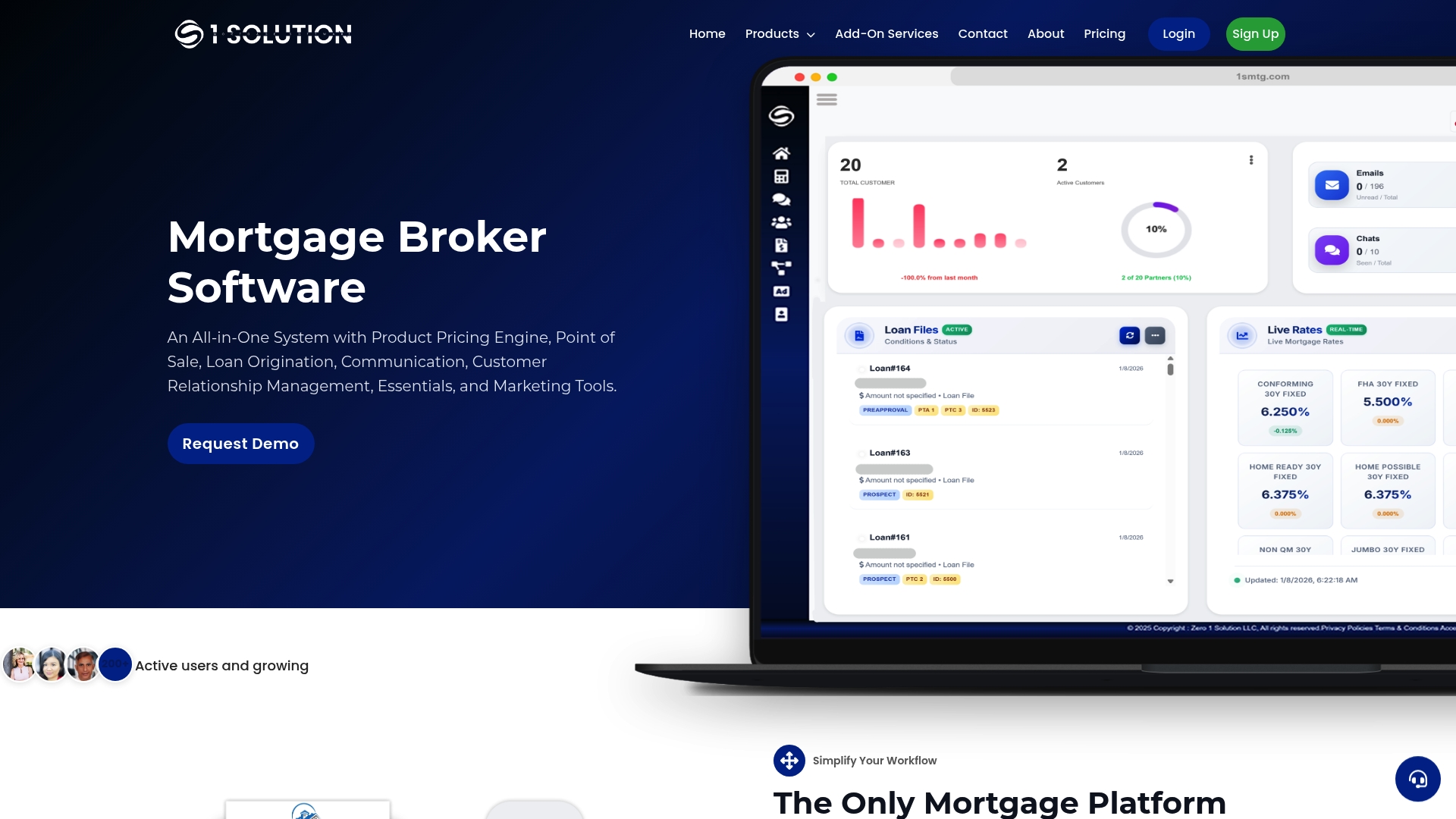
1 Solution Mortgage Software was built from real mortgage operations experience, not a boardroom. The platform brings together POS, LOS, CRM, pricing, compliance, and communication tools into one connected ecosystem designed specifically for independent brokers. There is no rekeying between modules, no fragmented data layers, and no hidden integration costs. If you are evaluating mortgage automation software that actually fits how brokers work, 1 Solution Mortgage Software is worth a close look. Explore the platform and see how time-saving features translate directly into faster loan cycles and fewer manual touchpoints.
FAQ
What are the main types of mortgage automation tools?
Mortgage automation tools fall into five categories: end-to-end lending platforms (nCino, TurnKey Lender), document intelligence tools (Ocrolus, Docsumo), LOS platforms (Encompass, Blend), enterprise workflow builders (Jinba Flow), and custom AI agents. Each category addresses a different layer of the loan workflow.
How does mortgage LOS software differ from document automation tools?
LOS software like Encompass manages the full origination workflow from application through closing, including compliance enforcement and task sequencing. Document automation tools like Ocrolus focus specifically on extracting and normalizing data from unstructured documents before passing it to the LOS.
Why does interoperability matter in mortgage workflow automation?
Most manual work in automated mortgage shops is caused by fragmented systems that do not share a common data layer, forcing processors to rekey data between tools. A connected workflow that moves data automatically between systems eliminates this rework and delivers the productivity gains automation promises.
What is MISMO and why does it affect tool selection?
MISMO is the mortgage industry data standards body that defines field requirements and formats for loan data delivery. ULDD Phase 5 became mandatory in July 2025 with fatal-edit enforcement, meaning any automation tool that does not conform to MISMO standards will generate hard rejects at delivery and require manual correction.
When should a broker use an all-in-one platform instead of point solutions?
Independent brokers benefit most from all-in-one platforms when their current stack requires manual data transfer between systems. A connected platform covering POS, LOS, CRM, and compliance in one environment eliminates integration gaps that point solutions create, reducing both cost and operational complexity.