
Cloud mortgage platforms can meet mortgage security and compliance expectations when configured with MISMO-aligned controls, BYOK key management, and a lender-owned audit regime. The verdict is yes, cloud is viable, and most independent brokerages already run on it. What separates a defensible setup from a liability comes down to three things: documented controls mapped to MISMO and GLBA, clear ownership under the shared responsibility model, and strong encryption paired with disciplined identity management. Get those right, and you also unlock the scalability and audit trails that make cloud worth the move in the first place.
TL;DR:
- Proper cloud mortgage security requires documented controls aligned with MISMO, clear ownership under shared responsibility, and strong encryption with disciplined identity management.
- Common vulnerabilities include misconfigurations, data exfiltration, insider risks, and unsecured third-party integrations, all mitigated by zero-trust controls and audit trails.
- Vendors must provide verifiable evidence of compliance, including SOC 2 reports, key management documentation, immutable logs, and recent penetration test results.
- Cloud infrastructure offers cost and availability advantages but demands strict configuration discipline, geographic redundancy, and ongoing monitoring to prevent drift and ensure business continuity.
- Lenders bear significant responsibility for configuration, key custody, and access control; focusing on these operational practices addresses the real risks that lead to breaches or audit failures.
Table of Contents
- Core Security Principles Behind Cloud Security Mortgage Software
- Compliance Mapping: MISMO, GLBA, and Audit-Readiness
- Shared Responsibility and Vendor Due Diligence Checklist
- Encryption, Identity, and Logging Controls to Demand
- Operational Benefits and the Cost Trade-Offs That Come With Them
- Migration Path and Risk Management Checklist
- Where Practitioner Experience Shapes These Recommendations
- Cloud vs. On-Premises: Comparing the Threat Models
- Incident Response and Breach Notification in Cloud Environments
- Data Residency and Cross-Jurisdictional Considerations
- Continuous Monitoring and Cloud Security Posture Management
- API and Third-Party Integration Risk
- Managing User Access Throughout the Employee Lifecycle
- Disaster Recovery Planning for Cloud-Hosted Platforms
- Where to Verify These Standards Yourself
- The Real Gap Between Cloud Marketing and Cloud Reality
- Get Cloud Security Built Into Your Mortgage Platform From Day One
- Sources
Core Security Principles Behind Cloud Security Mortgage Software
A defensible cloud security mortgage software setup relies on layers, not a single wall. Perimeter controls stop unauthorized network access, application controls govern what authenticated users can actually do inside the platform, and data-layer controls protect information even if the first two layers fail. This is defense-in-depth, and mortgage data demands it because a single leaked loan file exposes Social Security numbers, income records, and bank statements in one shot.
The threats that matter most in mortgage operations rarely look like a Hollywood hack. They look like a processor with excess file access, a misconfigured storage bucket left open to the internet, or a third-party appraisal vendor pulling more data than the integration requires.
- Misconfiguration: the leading cause of cloud breaches across financial services, often from default settings never locked down after deployment.
- Data exfiltration: bulk downloads of borrower files by compromised or malicious accounts.
- Insider risk: employees or contractors retaining access after role changes or termination.
- Third-party data flows: credit, title, and appraisal integrations that widen the attack surface with every new connection.
Encryption and strong identity verification sit underneath all of it. Without both, every other control is decoration.
Compliance Mapping: MISMO, GLBA, and Audit-Readiness
Compliance officers need more than a vendor's word that a platform is "secure." They need controls mapped to standards examiners actually check. The MISMO Information Security Guidelines set the mortgage industry's baseline for data governance, eVaulting, and access control, and they're the reference point most auditors use when reviewing eClosing and eNote handling.
GLBA and CFPB expectations translate those guidelines into practice: encrypt nonpublic personal information, restrict access by role, and define retention schedules instead of keeping loan files indefinitely. A platform that can't show how it enforces these three things in a technical, verifiable way isn't audit-ready, regardless of what its marketing page claims.
When your compliance team sits down with a vendor, request these artifacts directly:
- SOC 2 Type II report, covering a period of months rather than a point-in-time snapshot.
- Key management system (KMS) configuration documentation, showing how encryption keys are generated, rotated, and stored.
- Immutable audit logs, proving records can't be altered after the fact.
- Penetration test results, ideally from the past 12 months, with remediation evidence for anything critical.
Vendors that publish these proactively, the way platforms like LenderBox do with their SOC 2 documentation, save your team weeks during examiner season.
Shared Responsibility and Vendor Due Diligence Checklist
Cloud security follows a shared responsibility model: the vendor secures the underlying infrastructure, but your team owns configuration, user access, and data governance on top of it. Misconfiguration on the lender's side, not a vendor breach, is the most common cause of exposure. That means due diligence has to go further than reading a sales deck.
- Get the responsibility split in writing. Contract language should specify exactly which controls the vendor manages and which ones your team configures.
- Request subservice organization reports and SLAs. Ask for documented incident response times and defined patching windows, not vague promises.
- Verify data isolation evidence. Confirm your loan data is logically separated from other tenants, with documentation to back it up.
- Secure log and audit access. Your compliance team needs the ability to pull logs independently, not wait on a vendor support ticket.
- Ask for recent penetration test results. A vendor unwilling to share them is telling you something.
Treat this checklist as a contract negotiation tool, not a formality. Every item you skip becomes a gap you inherit.
Encryption, Identity, and Logging Controls to Demand
The technical specifics matter more than most vendor pitches suggest. Freddie Mac's eMortgage security best practices recommend TLS connections using X.509 certificates with SHA-256 signatures, plus AES-256 encryption at rest, aligned with FIPS 140-2 and NIST key management standards. Any platform touching borrower data should meet or exceed those benchmarks by default.
Encryption alone doesn't protect NPI if the vendor holds every key. That's why Bring Your Own Key (BYOK) arrangements have become a real differentiator, not a checkbox. With BYOK, the lender retains custody of the decryption keys, which limits what a vendor (or an attacker inside the vendor's environment) can actually access during an incident.
- Encryption: TLS with X.509/SHA-256 in transit, AES-256 at rest, FIPS-aligned key handling throughout.
- Key management: BYOK where volume of NPI justifies it, with documented rotation schedules and clear key custody.
- Identity: role-based access control (RBAC), least-privilege defaults, mandatory MFA, and a formal workflow for privileged access requests.
- Logging: immutable audit trails feeding into a SIEM, with retention schedules that match regulatory holding periods.
Pro Tip: Ask your vendor whether audit logs can be exported to your own SIEM in real time. A platform that only lets you view logs inside its own dashboard is handing you a smaller picture than you need during an incident.
Role design deserves its own conversation with IT, since a loosely scoped permission structure undoes every other control on this list. Guidance on setting up user permissions for brokers walks through building RBAC structures that hold up under audit scrutiny.
Operational Benefits and the Cost Trade-Offs That Come With Them
Cloud infrastructure earns its reputation for lowering total cost of ownership, but only when brokerages understand where the savings actually come from. You stop paying for server hardware you own and maintain, and you stop paying IT staff to patch it at 2 a.m. The surprise costs tend to show up in storage tiers and elastic compute, where a brokerage that doesn't archive old loan files to cheaper cold storage ends up paying premium rates for data nobody's actively using.
Availability planning matters just as much as cost. Recovery Time Objective (RTO) and Recovery Point Objective (RPO) targets tell you how long you can survive an outage and how much data you can afford to lose. Examiners increasingly expect lenders to state these numbers explicitly, not just claim "high availability" in a policy document.
- Geographic redundancy protects against regional outages, a real concern during hurricane season for East Coast operations.
- Multi-tenant architecture costs less but demands stronger logical isolation evidence for compliance.
- Single-tenant deployments cost more but simplify data isolation arguments during audits.
- Policy-as-code automation catches configuration drift before it becomes an examiner finding, cutting the manual audit burden significantly.
The right architecture choice depends on loan volume and risk tolerance more than any universal best practice.
Migration Path and Risk Management Checklist
Moving your loan origination workflow to the cloud without a phased plan is how brokerages end up with data integrity problems mid-closing season. A structured migration protects both your operations and your borrowers' data.
- Sandbox testing. Validate the platform's core functions in an isolated environment before any real loan data touches it.
- Pilot with a small loan volume. Run a handful of real files through the new system while keeping your legacy platform as the system of record.
- Parallel run. Process loans through both systems simultaneously to catch discrepancies before full dependence on the new platform.
- Cutover. Switch fully once the pilot and parallel run show consistent, accurate results.
- Post-cutover validation. Run integrity checks, load tests, and a fresh security scan to confirm nothing broke during the transition.
Keep a documented rollback runbook at every stage, along with incident communication templates ready to go. If something goes wrong mid-migration, you don't want your team improvising a regulator notification while borrower closings are on the line. Understanding your platform's automation categories ahead of migration also helps you sequence which workflows move first.
Where Practitioner Experience Shapes These Recommendations
Most cloud security guidance for mortgage platforms comes from generalist IT consultants who've never processed a loan file under a rate lock deadline. Omar Khamisa built these checklists differently, drawing on more than 20 years working as a processor, underwriter, loan originator, and systems consultant before founding 1 Solution Mortgage Software.
That operational background shapes how 1 Solution Mortgage Software approaches security. Controls aren't bolted on to satisfy an examiner checklist. They're built around how brokers actually move files through pricing, POS, LOS, and compliance in a single connected system. The vendor due diligence checklist and migration path outlined above reflect real transitions brokerages have had to manage, not theoretical best practices lifted from a generic cloud whitepaper.
Cloud vs. On-Premises: Comparing the Threat Models
The on-premises argument used to be "we control our own servers, so we control our own security." That argument hasn't aged well. A local server room secured by a single IT contractor and a firewall rarely gets patched on the same schedule that major cloud providers maintain for their infrastructure, and most small-to-midsize brokerages don't have the budget to hire round-the-clock security staff.
On-premises systems put the entire security burden on the lender: physical server security, network perimeter defense, patch management, and backup infrastructure all fall on internal IT, often a single generalist wearing five hats. Cloud platforms split that burden. The vendor secures physical data centers, network infrastructure, and the underlying compute layer, while the lender configures access controls, encryption settings, and data governance policies on top.
The threat model shifts accordingly. On-prem systems face concentrated risk: one compromised server can expose everything, and recovery depends entirely on backups the lender maintains themselves. Cloud systems face distributed risk with stronger baseline infrastructure security, but they introduce new failure points around misconfiguration and third-party access that on-prem systems simply don't have.
Neither model is automatically safer. A well-configured cloud platform with BYOK, RBAC, and immutable logging outperforms a legacy on-prem server running unpatched software from three years ago. A poorly configured cloud tenant with default permissions left wide open can be worse than a locked-down local server. Configuration discipline, not the hosting location itself, determines the outcome.
Incident Response and Breach Notification in Cloud Environments
Incident response in a cloud environment moves faster than legacy IT teams are used to, and that speed cuts both ways. Cloud platforms typically detect anomalous activity through automated monitoring within minutes, but the lender still owns the notification clock once a breach involving NPI is confirmed.
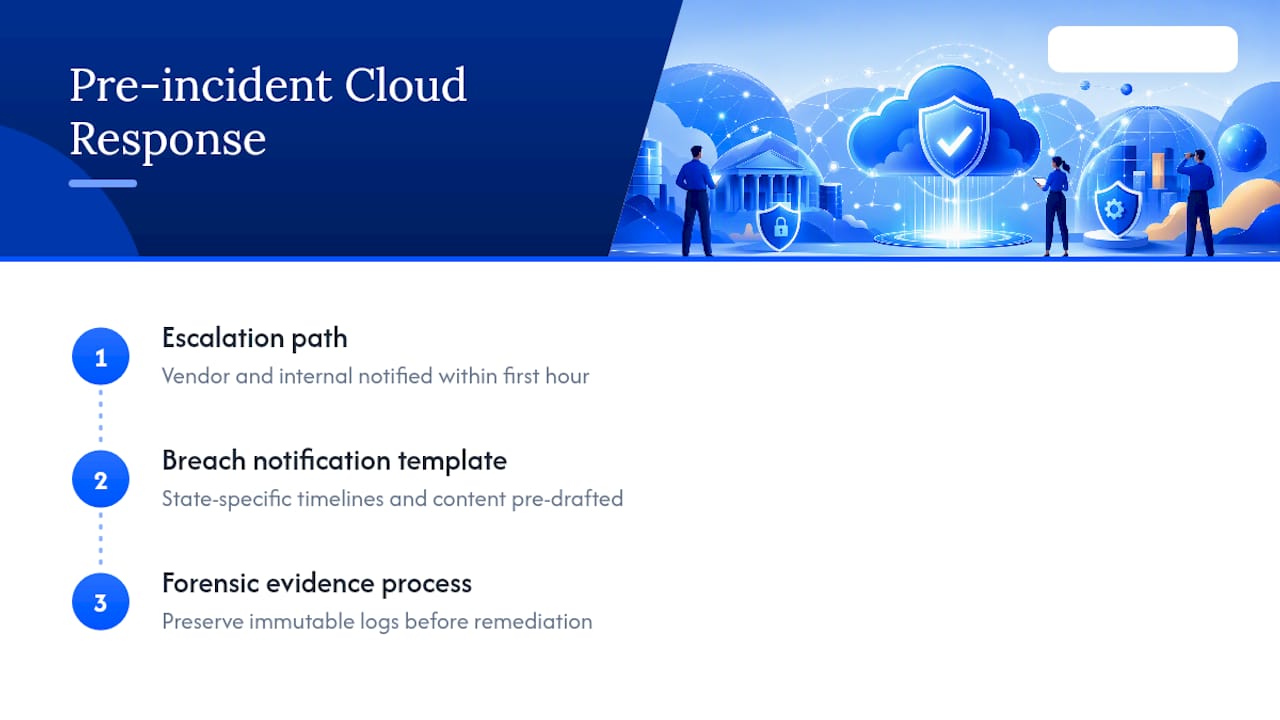
A workable incident response plan for cloud mortgage platforms needs three components ready before an incident happens, not during one. First, a clear escalation path defining who at the vendor and who internally gets notified within the first hour. Second, a pre-drafted breach notification template that satisfies state-level requirements, since notification timelines and content requirements vary significantly by state. Third, a forensic evidence process that preserves logs before anyone starts remediating, since overwriting evidence during cleanup destroys your ability to determine scope.
Contract language should specify the vendor's obligation to notify you of a security incident within a defined window, typically 24 to 72 hours depending on severity. Vendors that won't commit to a specific notification timeframe in writing are asking you to take their incident response process on faith.
Immutable audit logs matter enormously here. When logs can't be altered after the fact, your team can reconstruct exactly what happened, when, and who accessed what, which shortens both the investigation and the eventual regulator conversation. Lenders that treat logging as a compliance afterthought rather than an incident response tool consistently take longer to close out breach investigations.
Data Residency and Cross-Jurisdictional Considerations
Most independent brokerages operate within a single state or a handful of neighboring states, which simplifies data residency concerns considerably compared to national banks juggling multi-state licensing. Still, where your loan data physically resides matters more than brokers typically realize when they're evaluating a cloud platform.
Ask your vendor directly where data centers are physically located. Many cloud mortgage platforms host exclusively within U.S. data centers, which avoids the cross-border legal complications that arise when borrower data crosses international jurisdictions. If a vendor uses global infrastructure for redundancy, confirm that borrower NPI specifically stays within U.S.-based facilities, even if other system components don't.
State-level licensing requirements add another layer. A brokerage licensed across multiple states needs to confirm that a platform's data handling doesn't create conflicts with any single state's specific consumer protection or data privacy statutes. This becomes especially relevant as more states pass their own data privacy legislation modeled loosely on frameworks like the California Consumer Privacy Act, each with slightly different notification and consumer rights requirements.
The safest posture is asking vendors for a written statement on data residency, not assuming "cloud" automatically means borderless. A platform that can't tell you exactly where borrower data lives hasn't thought this through as carefully as it should have.
Continuous Monitoring and Cloud Security Posture Management
Static security reviews, the kind performed once a year during an audit, miss the reality that cloud configurations drift constantly. Someone adjusts a permission to fix an urgent access problem on a Friday afternoon and forgets to revert it. That's how misconfiguration risk compounds over time, and it's exactly what cloud security posture management tools are built to catch.
CSPM tools continuously scan cloud environments against a defined security baseline, flagging deviations before they become exploitable gaps. For a mortgage platform, that means automated alerts when a storage configuration changes, when a permission grant exceeds policy, or when an integration requests broader data access than it was originally scoped for.

Continuous monitoring pairs naturally with the SIEM integration discussed earlier in the technical controls section. Where SIEM aggregates and analyzes log data for suspicious activity, CSPM focuses specifically on configuration state, catching the kind of silent drift that doesn't generate a security alert on its own but quietly widens your attack surface. Together, they shift compliance from a once-a-year fire drill into an ongoing discipline your team can actually sustain.
Ask vendors whether CSPM or equivalent continuous configuration monitoring runs natively on their platform, or whether that responsibility falls entirely on your team. The answer tells you a lot about how seriously a vendor takes the shared responsibility model in practice, not just in their sales materials.
API and Third-Party Integration Risk
Every integration your mortgage platform maintains, credit pulls, appraisal ordering, title searches, is a door into your borrower data that someone outside your organization controls. The convenience of one-click integrations comes with a real security cost if those APIs aren't properly scoped and monitored.
The core principle is data minimization: an integration should request only the specific fields it needs to function, not blanket access to a borrower's entire file. A title search integration doesn't need income documentation. An appraisal ordering system doesn't need full bank statements. Vendors that build integrations with broad, unscoped API access create exposure that has nothing to do with your platform's core security and everything to do with a third party's weaker controls.

API authentication deserves the same scrutiny as user login credentials. Look for token-based authentication with short expiration windows rather than static API keys that, once leaked, grant indefinite access. Ask whether your platform logs every API call the same way it logs user activity, since an unmonitored integration is a blind spot in your audit trail.
Before activating any new third-party integration, confirm what data it can access, how long that access persists, and whether it appears in the same immutable logging system covering the rest of your platform. A platform's own security posture means little if a poorly vetted integration becomes the weak link.
Managing User Access Throughout the Employee Lifecycle
Access problems rarely start with a hack. They start with an employee who changed roles eight months ago and never had their permissions updated, or a loan officer who left the brokerage but still technically has an active account. Identity lifecycle management closes that gap by tying access permissions directly to employment status and role, automatically, rather than relying on someone remembering to update a spreadsheet.
A mortgage-specific identity lifecycle needs four stages handled deliberately: provisioning new hires with role-appropriate access from day one, adjusting permissions immediately when someone changes roles, reviewing privileged access on a regular schedule rather than never, and deprovisioning access the same day employment ends, not at the end of the pay period.
Role-based access control makes this manageable at scale. A processor's permission set should look different from a loan originator's, and neither should automatically inherit administrator-level access just because they've been with the brokerage for years. Guidance on setting up user permissions for brokers covers exactly how to structure these tiers without creating a bottleneck for day-to-day work.
Multifactor authentication should apply universally, not just to administrator accounts. NPI exposure through a compromised loan officer credential is just as damaging as exposure through a compromised admin account, and treating the two differently is a common oversight in access design.
Disaster Recovery Planning for Cloud-Hosted Platforms
Business continuity planning for a cloud-hosted mortgage platform looks fundamentally different than it did for a server room down the hall, and that difference is mostly a good thing. You're no longer solely responsible for maintaining redundant hardware, but you are responsible for understanding exactly what your vendor's disaster recovery capabilities actually cover.
Start with the RTO and RPO conversation raised earlier: how long can your brokerage function without system access, and how much transaction data can you afford to lose if the system goes down mid-day. Those two numbers should drive every other decision in your continuity plan, and they need to be documented, not assumed.
Geographic redundancy matters more than brokers in less disaster-prone regions typically realize. A platform running from a single data center, however well secured, represents a single point of failure if that region experiences a major outage. Look for vendors that maintain redundant infrastructure across separate geographic regions, so a regional event doesn't take your entire origination pipeline offline.
Test your continuity plan the same way you'd test a fire drill, not just on paper. Confirm you can actually access your loan pipeline data during a simulated outage, and that your team knows the manual workaround procedures if system access is delayed. Best practices from other regulated financial sectors, including banking's approach to secure transaction resilience, reinforce the same lesson: continuity planning that only exists in a document nobody has tested isn't really a plan.
Where to Verify These Standards Yourself
Compliance teams shouldn't take vendor claims at face value. The MISMO Information Security Guidelines define the industry's data governance baseline, while Freddie Mac's eMortgage security best practices spell out concrete encryption and authentication specs. For a practitioner walkthrough, the cloud security webinar for mortgage banking is worth an hour of your team's time.
The Real Gap Between Cloud Marketing and Cloud Reality
Most cloud security content aimed at mortgage professionals reads like it was written by someone who's never had to explain a permission structure to an examiner at 4 p.m. on a Friday. It talks about "enterprise-grade encryption" and "bank-level security" without specifying a single configuration detail an IT lead could actually verify.
The conventional advice treats cloud adoption as a single decision, secure or not secure, when the reality is a hundred smaller configuration decisions that determine the outcome. A platform built on solid infrastructure can still fail an audit because a brokerage never rotated its encryption keys or left default admin permissions active for six months after a role change.
What gets underestimated most is how much of this responsibility sits with the lender, not the vendor. Brokerages that treat cloud security as something they bought rather than something they configure are the ones that get caught flat during an examination. Prioritize BYOK key custody and RBAC discipline before you worry about which vendor has the flashiest security page. Those two controls address the failure modes that actually cause breaches: exposed keys and permission drift, not exotic attacks nobody in mortgage lending has actually experienced.
— Omar Khamisa
Get Cloud Security Built Into Your Mortgage Platform From Day One
Retrofitting security onto a fragmented stack of five disconnected tools is exactly the problem 1 Solution Mortgage Software was built to solve. Instead of stitching together a separate LOS, CRM, POS, and compliance tool from five different vendors, each with its own access controls and audit trail, brokers get one connected platform where encryption, RBAC, and logging apply consistently across every function.
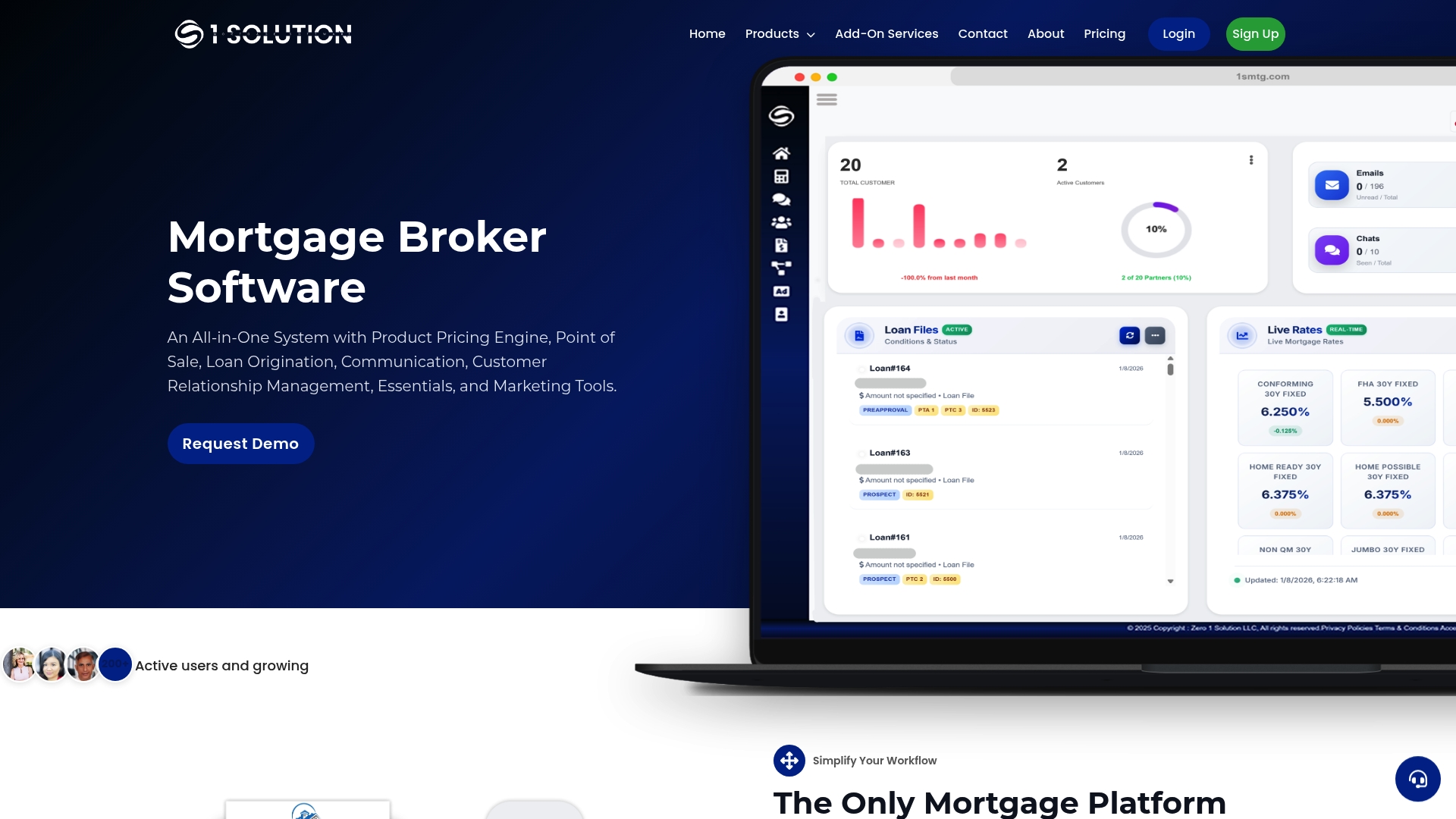
That consistency is what compliance teams actually need during an audit. When pricing, borrower communication, e-signature, and document storage all run through a single system built by mortgage professionals who've sat on the operations side of an examination, there's no gap between how one module handles NPI and how another one does. Omar Khamisa built the platform around the access control and audit-readiness problems he saw firsthand as a processor and underwriter, not around generic cloud security checklists.
If your brokerage is evaluating a migration or trying to close gaps a recent audit surfaced, start with a demo of 1 Solution Mortgage Software and walk through how its security architecture maps to your specific compliance requirements before you commit to a vendor.
Sources
- MISMO Information Security Guidelines
- eMortgage systems security best practices (Freddie Mac)
- What mortgage firms need to know about cloud security and liability | National Mortgage News