
ESIGN and UETA give lenders a valid federal and state framework to close mortgages electronically, but that validity has real edges. Disclosures, most closing documents, and assignments can be signed electronically today. The promissory note, county recording, and notarization each carry separate rules that can stop an eClosing cold. Before you market eClosings, confirm investor acceptance of your eNote process and your MERS eRegistry status.
TL;DR:
- Electronic signatures on disclosures, servicing notices, and most assignments are widely accepted today, but promissory notes require a reliable transferable record system.
- Investors like Fannie Mae, Freddie Mac, and Ginnie Mae impose strict approval and technical requirements, including registration on the MERS eRegistry and compatible eVaults.
- County recorder acceptance of e-recordings and remote notarization laws vary significantly, making local verification crucial before scheduling eClosings.
- Operational controls such as immediate tamper-evident sealing, signer identity proof, and comprehensive audit trails are necessary to ensure compliance and withstand legal scrutiny.
- Most compliant eClosing success depends on validating investor approval, testing technical integrations, and planning workflows for special cases like wet signatures or lien recordings.
Table of Contents
- Esign Ueta Mortgage Compliance: The Legal Baseline
- Which Mortgage Documents Qualify for Electronic Signature
- GSE and Ginnie Mae Rules for Delivering eNotes
- How to Confirm Recording and Notary Rules by State
- Building an ESIGN/UETA Compliance Checklist for eClosings
- What a Compliant eClosing System Actually Needs
- Why Integration Matters More Than the Signing Screen
- Get Your Mortgage Platform Ready for eSign and eNote Delivery
- Sources
Esign Ueta Mortgage Compliance: The Legal Baseline
The federal E-Sign Act sets the floor every lender builds on. Under 15 U.S.C. § 7001, an electronic signature or record cannot be denied legal effect solely because it is electronic, for any transaction affecting interstate commerce. That covers the overwhelming majority of residential mortgage lending. But ESIGN's general rule of validity comes bundled with conditions, and Section 101(c) is where most compliance gaps actually start.
Before a lender can rely on an electronic signature from a consumer, it has to clear four hurdles: obtain affirmative consent, disclose the consumer's right to receive paper instead, confirm the consumer can access and retain the electronic format offered, and retain records that prove all of that happened. Skip the hardware and software disclosure, and a court can treat the whole electronic transaction as if it never satisfied ESIGN at all.
UETA operates one layer down, as a model state law that most states have adopted (with local variations) to govern electronic transactions generally, including in situations ESIGN does not reach. Where UETA and ESIGN both apply, ESIGN generally preempts inconsistent state law, though states that adopt UETA without material modification are typically left alone. That distinction matters for lenders operating across state lines, because a handful of states adopted UETA with amendments that affect enforceability for certain transaction types.
What lenders actually need to prove, and retain evidence of, includes:
- Timestamped consent records showing the consumer agreed to electronic signature before signing
- Version control on every disclosure delivered electronically, tied to the exact document the consumer saw
- Access and error logs demonstrating the consumer could retrieve and retain what was sent
- A documented process for consumers who withdraw consent mid-transaction and switch to paper
Consumer choice is not optional. Freddie Mac's guidance reinforces that ESIGN never lets a lender force electronic execution. If a borrower wants paper, the lender has to provide it, and the loan file needs to reflect that offer was made regardless of which format the borrower ultimately chose. Regulators, including NCUA's compliance guidance, treat this as an examination point, not a formality.
Which Mortgage Documents Qualify for Electronic Signature
Most of a closing package clears ESIGN and UETA without issue. Disclosures under Regulation Z, the Closing Disclosure, servicing notices, appraisal acknowledgments, and most assignments can be executed electronically today, and have been for years. The document that breaks this pattern is the promissory note.
A promissory note is a negotiable instrument, and under commercial law it needs a single authoritative version that can be possessed, endorsed, and transferred. Paper handles that naturally: whoever holds the note holds the debt. Electronic records don't have physical possession, so ESIGN and UETA created a workaround called a transferable record. An eNote qualifies as a transferable record only if the system creating it can reliably establish one, and only one, authoritative copy at any time, identify the current holder of that copy, and prevent alteration without detection.

That's a technical bar most standard document-generation tools don't meet on their own. It requires a dedicated eVault, cryptographic sealing, and an audit trail that can survive a legal challenge years later when the loan is transferred, sold, or foreclosed on.
Here's how the typical closing package breaks down; see this list of documents subcontractors need for a mortgage for examples of relevant paperwork.
- Freely eSignable today: initial disclosures, Loan Estimate, Closing Disclosure, servicing disclosures, most riders, and many assignments
- eSignable with investor approval: the promissory note, when converted to an eNote through an approved eClosing platform
- Often still paper: the deed of trust or mortgage instrument, depending on the county recorder's format acceptance
- Frequently requires wet signature or notary presence: documents tied to power of attorney or certain title curative instruments, depending on state notary law
The deed or mortgage itself sits in an odd middle ground. ESIGN and UETA validate the electronic signature on it, but whether your county recorder will accept it electronically is a separate question entirely, covered later in this article. Some lenders eSign every document in the package except the note and still call it a "hybrid" closing, which is a fair description of where the market actually stands.
Pro Tip: Map every document in your standard closing package against these three categories before you configure an eClosing workflow. A single document routed through the wrong signing path can force a full paper re-execution days before your funding deadline.
For more detail on how packages are assembled and which pieces typically need special handling, see this breakdown of mortgage document packaging.
GSE and Ginnie Mae Rules for Delivering eNotes
Statutory validity gets you in the door. Investor approval gets you paid. That's the part of the eSign ueta mortgage equation too many operations teams underweight until a loan gets kicked back at delivery.
Fannie Mae requires lenders to obtain prior approval before delivering loans with eNotes, and that approval isn't automatic. According to Fannie Mae's eClosing guidance, lenders must register eNotes on the MERS eRegistry, use an approved eVault, and meet delivery certification steps that confirm the eNote's authoritative copy, its controller, and its location at the moment of delivery. Freddie Mac follows a comparable structure, treating ESIGN and UETA as the baseline while layering its own eNote eligibility and delivery process on top.
Ginnie Mae adds a third, separate track for government loans headed into Ginnie pools. Its eGuide requires eIssuers to integrate with a Qualified eRegistry, currently the MERS eRegistry, and to meet specific eligible-eNote and eMortgage standards before those loans can move into the Digital Pool/Loan Packages program, according to Ginnie Mae's Digital Collateral Program Guide.
Operationally, this creates a chain of dependencies most lenders underestimate at first:
- Your eClosing platform needs to output an eNote in the format your investor's eVault accepts, typically both a machine-readable XML file and a human-readable PDF view
- MERS registration has to happen at the right moment in the closing sequence, not as an afterthought after funding
- Your custodian, whether internal or third-party, needs eVault access and a documented chain-of-custody process for the eNote's controller status
- Servicing transfers require the eNote's MERS registration to update in step with the transfer, or the receiving servicer inherits a compliance gap
The insight that trips up the most brokers and small lenders: investor readiness, not statutory permissibility, is usually the real constraint. ESIGN and UETA might validate your signature perfectly, but if your investor hasn't approved your specific eClosing process or eNote format, you cannot deliver that loan as an eMortgage, full stop, according to Fannie Mae's own eClosing FAQ.
How to Confirm Recording and Notary Rules by State
County recorders are where a lot of eClosing plans meet reality. Even when ESIGN and UETA fully validate the signature on a deed of trust, the local recorder's office decides whether it accepts the document electronically, in what format, and through which vendor. That's a purely local decision, and it varies enormously from one county to the next.
- Call or check the recorder's published eRecording policy first, before you build any workflow around it. Most counties that accept eRecording only do so through specific approved vendors, and some accept eRecording for certain instrument types (releases, assignments) but not others (the deed of trust itself).
- Confirm remote online notarization (RON) authorization in the state where the property sits, not necessarily where the borrower or notary is physically located, since state RON laws differ on this point and on required technology standards for audio-visual recording and identity verification.
- Verify your notary platform meets that state's specific RON technology requirements, including tamper-evident seals, session recording retention periods, and journal logging, since these vary by state statute rather than following a single national standard.
- Build a paper fallback into your workflow from day one. When a recorder rejects electronic submission or a state hasn't authorized RON for the transaction type, you need a documented process to convert to a wet-signed, in-person closing without blowing your funding timeline.
ABA's analysis of electronic signatures and legal opinions makes a point worth repeating to anyone building an eClosing program: local recording and UCC filing practices can effectively override the federal framework's intent for recordable instruments, regardless of what ESIGN and UETA say about validity. Check the target county every time. Recorder practices change, vendor approvals lapse, and what worked for your last closing in that county isn't guaranteed for the next one.
Building an ESIGN/UETA Compliance Checklist for eClosings
Getting from "we can technically eSign this" to "we can defensibly deliver this loan" takes a sequence, not a single decision. Skipping steps here is exactly what generates repurchase demands months after closing.
Before you originate a single eClosing, confirm three things in writing: your investor has approved your specific eNote delivery process, your MERS eRegistry registration is active and tested, and you have the investor's current eligible-loan-type list so you're not attempting an eClosing on a loan type that isn't approved for it.
On the platform side, your system needs to apply a tamper-evident seal immediately after the final signature is captured, and it needs to capture signer identification evidence in close proximity to that signature event, not in a separate log that has to be cross-referenced later. Your platform should also generate both the machine-readable XML and the PDF view your investor's eVault requires for eNote certification, and every audit trail needs to be exportable in a format your investor and, eventually, an auditor or court, can actually use.
Operationally, a few controls separate lenders who scale eClosings safely from those who accumulate compliance debt:
- Assign clear staff roles for who confirms MERS registration, who verifies eVault transfer, and who signs off on delivery certification
- Document your process for handling certified power of attorney signings, since these often require additional verification steps beyond standard consumer consent
- Maintain a written eVault custody procedure, including what happens if custody needs to transfer to a different custodian or servicer
- Set a retention schedule for consent records, audit trails, and access logs that matches or exceeds your investor's requirements, not just your state's minimum
The gap that causes the most damage isn't legal, it's operational. Ginnie Mae's Digital Collateral Program Guide makes tamper-evident sealing and MERS registration non-negotiable technical controls. Lenders who cannot produce those artifacts on demand face blocked delivery and real repurchase exposure, not a warning letter.
A working reference on regulatory expectations more broadly can help operations teams build these steps into existing compliance programs; see this overview of mortgage regulatory compliance for brokers.
What a Compliant eClosing System Actually Needs
Most vendor pitches lead with the signing experience. That's the wrong place to start. What actually determines whether your eClosing program survives an investor audit or a foreclosure challenge five years from now is what happens behind the signature, not the interface the borrower sees.
Run every eClosing platform against this checklist before you commit to it: does it apply a tamper-evident seal the instant the final signature lands, not minutes or hours later? Does it capture signer identity metadata directly alongside the signature rather than in a disconnected system log? Can it generate both the XML and PDF VIEW format your investor requires for eNote certification? And can your compliance team pull a complete, investor-ready audit trail without calling the vendor's support line?
- Tamper-evident sealing applied immediately after final execution, not at batch-processing intervals
- Signer identification evidence attached at the signature level, exportable on demand
- Native XML and PDF VIEW generation matching current Fannie Mae eNote specifications
- MERS eDelivery integration tested against your actual investor relationships, not just in a sandbox environment
- Documented dual-custody procedures for eVault access, with named backup custodians
Pro Tip: Ask any eClosing vendor to produce a sample audit trail export before you sign a contract, then hand that export to your compliance officer and ask if it would survive a repurchase demand review. If the answer is uncertain, keep looking.
For a broader view of how these pieces fit into a full digital origination stack, see this walkthrough of how digital mortgage applications work.
Why Integration Matters More Than the Signing Screen
Brokers ask me which eClosing tool to buy. Wrong question. The right sequence is: confirm your investors will actually accept your eNote process, register with MERS before you need it, and only then evaluate signing interfaces. A polished signing screen backed by no eVault integration just produces paper closings with extra software.
Stage the rollout. Document policies, train staff on custody procedures, and treat eNote readiness as a compliance project with a timeline, not a feature flip you switch on before a launch announcement.
— Omar Khamisa
Get Your Mortgage Platform Ready for eSign and eNote Delivery
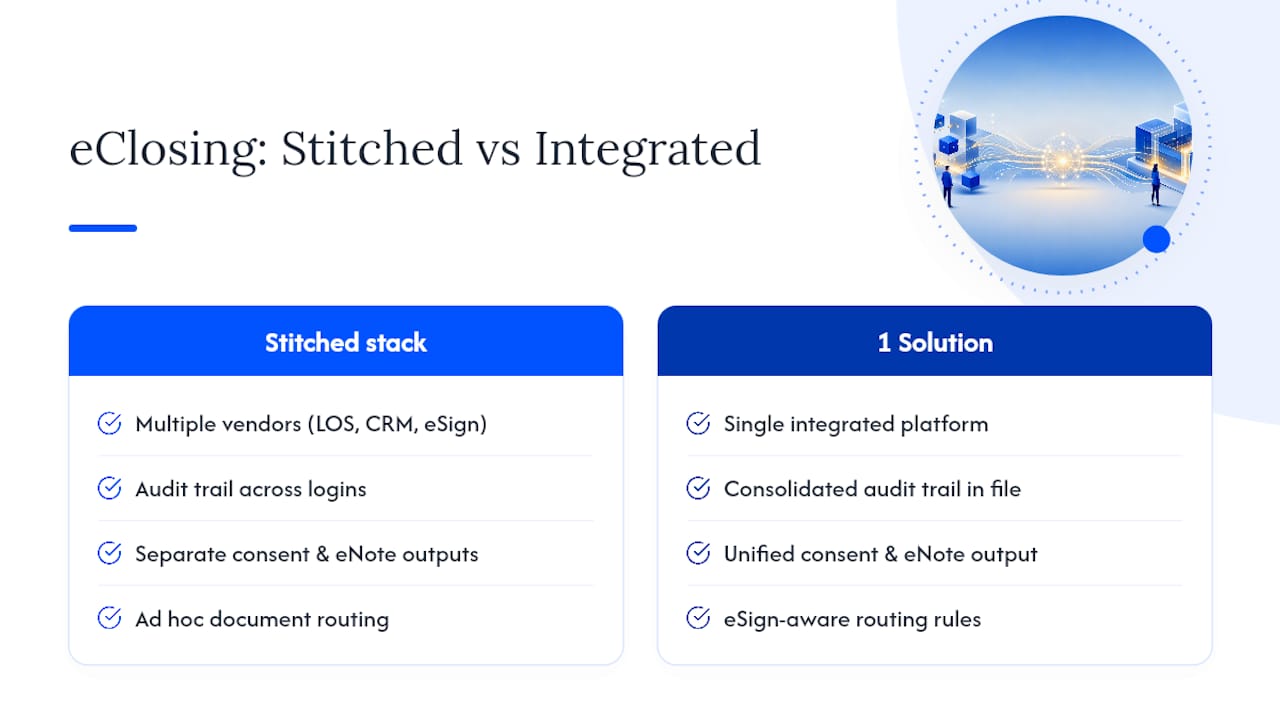
Most brokers piecing together a compliant eClosing setup end up stitching a signing tool, a separate LOS, a CRM, and a MERS connection into something that only sort of talks to itself. 1 Solution Mortgage Software was built to close that gap: our platform connects LOS, CRM, compliance, and eSignature workflows in one system, so your audit trail, consent records, and eNote outputs live in the same place your loan file does, instead of scattered across three vendor logins.
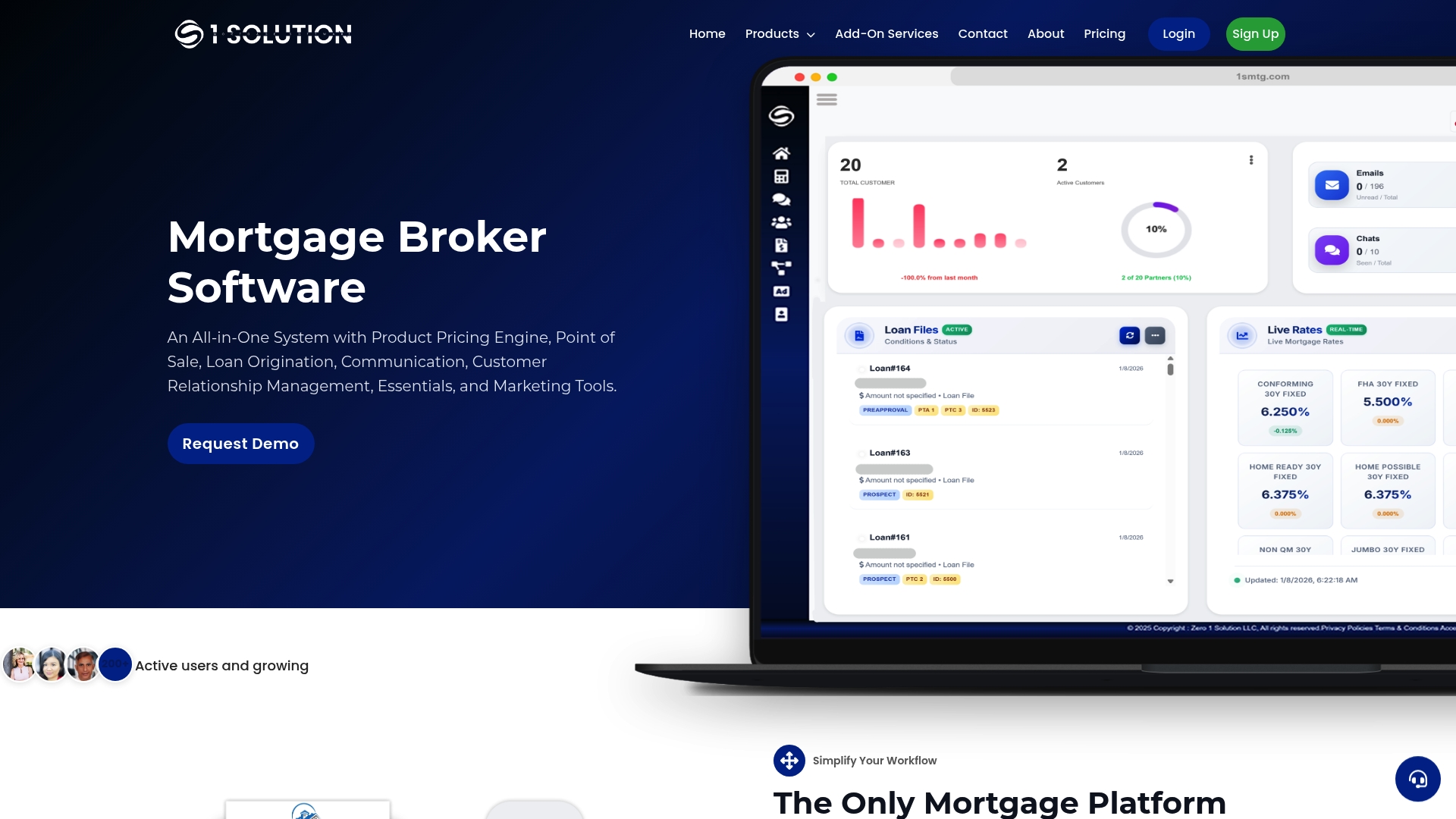
Because 1 Solution was built by a mortgage industry veteran who spent two decades as a processor, underwriter, and loan originator before building software, it's designed around the compliance steps this article just walked through, not bolted on after the fact. That means audit trail exports your compliance officer can actually use, document routing that respects which pieces of your closing package can be eSigned versus which need special handling, and a platform that grows with your MERS and eDelivery needs as your investor relationships expand.
If you're evaluating whether your current stack can actually support compliant eClosings and eNote delivery, request a demo of 1 Solution Mortgage Software and walk through your specific workflow with our team before your next closing.
This article is general information, not a substitute for advice from a qualified lawyer. Consult a qualified legal professional about your own circumstances before acting on anything here.
Sources
- Electronic Signatures in Global and National Commerce Act (E-Sign) — U.S. Code (15 U.S.C. § 7001)
- FAQs: eClosings & eMortgages | Fannie Mae
- Electronic Loan Documents FAQ - Freddie Mac Single-Family
- Ginnie Mae eGuide Appendix V-07 (Digital Collateral Program Guide)