
Communication logs create an immutable, searchable audit trail that materially reduces compliance risk and shortens audit response time. When a regulator asks "who told this borrower what, and when," a properly built log answers with a timestamped, hashed record instead of a scramble through inboxes and text threads.
Under SEC Rule 17a-4, regulated firms must store certain communications in a non-rewriteable, non-erasable format, which is exactly what WORM storage and SHA256 hashing are built to guarantee. A platform like 1 Solution ties that archive directly to CRM and loan files, so the record is never separated from the deal it documents.
The practical payoff shows up fast:
- Audit requests that used to take days of manual email pulls get answered in minutes.
- Findings tied to missing or incomplete records drop because gaps get caught before an examiner finds them.
- Supervisory reviews become documented events instead of informal, unrecorded judgment calls.
Key Takeaways
Communication logs work because they replace unreliable memory with immutable, hashed, chain-of-custody evidence that regulators can independently verify.
| Point | Details |
|---|---|
| Immutability is non-negotiable | WORM storage and SHA256 hashing satisfy the standard set by SEC Rule 17a-4 for defensible records. |
| Context beats content alone | Edits, attachments, and reactions often decide whether an examiner sees a record as complete. |
| Reconciliation catches gaps early | Regular checks of expected versus captured volume prevent surprise findings during an exam. |
| Supervision needs documentation | Every reviewer decision should carry a timestamp, an alert link, and a written rationale. |
| Integrated platforms reduce blind spots | 1 Solution Mortgage Software connects communications, CRM, and compliance archiving into one system rather than fragmented tools. |
Table of Contents
- What Is a Communication Log, and What Makes It Defensible?
- How Communication Logs Improve Compliance Outcomes During an Audit
- Technical Requirements for a Legally Defensible Archive
- Building a Retention and Supervision Policy That Actually Holds Up
- Examples of What an Audit-Ready Evidence Package Looks Like
- Why This Guidance Comes From Inside the Mortgage Industry
- Best Practices for Retention, Supervision, and Policy Enforcement
- The Gaps That Undermine Even Well-Intentioned Logging Programs
- Turning Communication Logs Into a Training and Awareness Tool
- How Automation and AI Are Changing Compliance Monitoring
- Privacy and Legal Considerations When Logging Employee Communications
- Metrics That Prove Your Communication Logs Are Actually Working
- What Compliance Teams Get Wrong About Logging Programs
- Getting Your Records House in Order With 1 Solution
- Frequently Asked Questions
- Sources
What Is a Communication Log, and What Makes It Defensible?
A communication log is a captured, timestamped record of an exchange, paired with enough metadata and surrounding context to prove what happened without relying on anyone's memory. That last part is where most homegrown systems fall apart. A saved email is not a log. A log needs structure that survives scrutiny months or years later, when the person who sent the message may not even work at the firm anymore.
A defensible entry needs to answer six questions on its own, with no outside explanation required:
- When did the exchange happen, down to the second?
- Who participated, mapped to a verified identity rather than a display name or phone number?
- Where did it happen, meaning which channel: email, SMS, chat, voice, or video?
- What was said, preserved as a full snapshot rather than a summary?
- What changed, including edits, deletions, and attachments added after the fact?
- What happened next, meaning any approval, attestation, or action item tied to the message?
Not every log serves the same purpose, and treating them all the same is a common mistake. A few types worth distinguishing:
- Client-facing logs, which document loan status updates, disclosures, and rate discussions borrowers rely on.
- Internal broadcast logs, covering policy announcements or rate-sheet changes sent to a whole team.
- Transactional logs, tied to specific loan events like conditions requests or closing coordination.
- Supervisory notes, capturing a manager's review of a communication, including the rationale for approving or escalating it.
The Workcast guide to compliance audit trails makes a point worth repeating: an audit trail that only proves a message was sent isn't enough. Regulators increasingly want proof of individual-level engagement, meaning who actually opened, read, or acknowledged it.
How Communication Logs Improve Compliance Outcomes During an Audit
The connection between logging and enhancing compliance through communication logs comes down to one thing: evidence that doesn't depend on human recall. Regulatory frameworks that require immutable recordkeeping, including the storage standard set by SEC Rule 17a-4, exist because memory is unreliable and paper trails get lost. A log fills that gap with something a regulator can independently verify.
The operational math is straightforward. Firms that consolidate capture and archiving into a single searchable system see material reductions in manual evidence-gathering time and fewer compliance exceptions during exams, because staff stop hunting across five different platforms for one conversation. Sub-second search across email, chat, and voice transcripts turns a multi-day production request into an afternoon task.
That speed matters beyond convenience. Regulators form judgments about a firm's culture based partly on how quickly and completely it produces records. A firm that takes three weeks to compile a partial response signals disorganization even when nothing improper happened. A firm that produces a certified, hashed export within hours signals control.
Communication logs also give examiners the one thing they consistently ask for and rarely get cleanly: proof of supervision. An alert flags a risky message, a reviewer makes a decision, and a remediation step closes the loop. Without a log, that entire chain lives in someone's memory or a scattered email thread. With one, it's a structured record examiners can trace start to finish.
A few specific benefits worth calling out:
- Certified exports with hashing let a firm prove a document hasn't been altered since capture, which matters enormously in disputes.
- A single searchable repository across email, SMS, chat, voice, and social channels removes the risk of an incomplete production, which is one of the fastest ways to turn a routine exam into an enforcement referral.
- Documented reviewer rationale, not just a checkbox, gives examiners confidence that supervision is substantive rather than performative.
Pro Tip: Don't wait for an exam letter to test your export process. Run a mock production request quarterly and time how long it takes your team to assemble a complete, hashed package. If it takes more than a few hours, you have a gap worth fixing now.
Technical Requirements for a Legally Defensible Archive
Capture, storage, and proof of completeness are the three pillars that separate a defensible archive from a folder of saved messages. Miss any one of them and the whole record becomes vulnerable to challenge.
Capture at the source. Native connectors and API-level journaling need to pull messages in near real time, not on a nightly batch job. A gap of even a few hours creates a window where a message could be altered, deleted, or simply lost before it's archived. Sub-second ingestion is what lets a firm say, credibly, that its capture never has a blind spot.
Immutable storage with a verifiable chain of custody. This is where WORM storage does its job: once a message lands in the archive, it cannot be rewritten or erased, satisfying the standard set by SEC Rule 17a-4. Certified exports should carry a SHA256 hash, so anyone downstream, whether that's a regulator, an auditor, or opposing counsel in litigation, can confirm the document matches the original byte for byte.
Full context, not just the message text. A conversation stripped of its edits, reactions, and attachments is a weaker record than the full exchange. Context retention often decides whether an examiner treats a communication as complete or incomplete, and that distinction shows up disproportionately in enforcement cases involving deleted or edited messages.
Reconciliation and proof of capture. Every system misses messages occasionally, whether from an API outage, a new app nobody flagged, or a connector that silently stopped working. Firms that reconcile expected volume against archived volume on a regular schedule catch these gaps proactively. Firms that don't find out about them when an examiner asks for a message that was never captured.
- Native, source-level capture with sub-second ingestion
- WORM or equivalent non-rewriteable storage
- SHA256-hashed certified exports with documented chain of custody
- Full context retention across every channel in use
- Scheduled reconciliation reporting to catch capture gaps early
Building a Retention and Supervision Policy That Actually Holds Up
Good technology without a governing policy is just an expensive filing cabinet. The policy layer is what tells the technology what to capture, how long to keep it, and who reviews it.
Start with these building blocks:
- Inventory every channel your team actually uses, including the ones nobody officially approved. Shadow apps are where gaps live.
- Build an approval matrix defining which message types require pre-review, post-review, or no review at all.
- Set retention schedules aligned to the strictest rule that applies to your firm, not the most convenient one.
- Map connectors to identity systems so every message ties to a verified person, not a shared inbox or generic number.
- Document your legal hold process before you need it, so a hold request doesn't turn into an improvised scramble.
Once the policy exists, operations has to make it real day to day:
- Surveillance rules should flag risk language, not just keyword matches that generate noise nobody reads.
- Supervisor review needs a documented rationale for every decision, not just an approve or reject click. Sedric's guidance on communications compliance treats these review records as primary evidence in their own right, timestamped and linked to the original alert.
- Remediation tracking should show a closed loop: alert, decision, action taken, confirmation of closure.
For high-stakes communications, like disclosures or rate commitments, consider pre-approved or simulive delivery formats. Locking the message format in advance prevents off-script deviations that create the exact liability a log is designed to catch.
Validate the whole system regularly. Daily reconciliation checks and quarterly sample production drills catch failures while they're still cheap to fix.
Examples of What an Audit-Ready Evidence Package Looks Like
Examiners don't want a narrative. They want a package they can independently verify, and the difference between those two things shows up the moment a request lands on your desk.
A certified export for a regulator request typically includes the original message, a SHA256 hash confirming it hasn't been altered, chain-of-custody metadata showing every system it passed through, and a reviewer attestation confirming supervisory sign-off. That combination is what turns a claim into proof.
A supervisory review record follows a specific chain: an alert fires on a flagged message, a reviewer records a decision with rationale, any remediation gets logged as a separate action, and a closure note confirms the issue was resolved. Each step needs its own timestamp.

Cross-channel reconstruction is often the hardest ask, and it's increasingly common. A single loan file might touch email for disclosures, chat for quick borrower questions, and a phone call for the final rate lock conversation. A defensible timeline links all three, with transcripts and attachments attached at the right point in the sequence.
| Evidence Type | What It Must Contain |
|---|---|
| Certified export | Original message, SHA256 hash, chain-of-custody metadata, reviewer attestation |
| Supervisory review record | Alert reference, reviewer decision, rationale, remediation action, closure confirmation |
| Cross-channel timeline | Linked email, chat, and voice records with attachments and transcripts in sequence |
- Keep evidence packages formatted for direct handoff, not for internal reading only.
- Practice assembling one before an examiner asks, using the audit process guidance built for mortgage teams specifically.
Why This Guidance Comes From Inside the Mortgage Industry
This guidance comes from Omar Khamisa, who spent more than 20 years working mortgage operations from every angle: as a processor, an underwriter, a loan originator, and later a systems consultant helping brokerages fix exactly the recordkeeping gaps described above. That background matters here, because most compliance content gets written by people who have never had to produce a communication record under deadline pressure during an actual exam.
1 Solution Mortgage Software was built by mortgage professionals, not in a boardroom, and the platform reflects that. It brings communications, CRM, loan origination, and compliance archiving into one connected system rather than forcing brokers to stitch together separate tools that don't talk to each other.
- The founder's operational background shapes what the platform actually tracks and why.
- The archive design ties directly to loan files, so context never gets separated from the record.
- The company remains independent and self-funded, with no outside investor agenda shaping product priorities.
Best Practices for Retention, Supervision, and Policy Enforcement
Retention schedules only work when they're built around the strictest rule your firm faces, not the easiest one to follow. Mortgage brokers often juggle federal recordkeeping expectations alongside state-specific rules, and defaulting to the shorter timeline is a common, costly mistake. Set one retention period per record type, document the reasoning, and apply it uniformly rather than letting individual teams decide case by case.
Supervision only holds up if review decisions are documented as they happen, not reconstructed later from memory. Every reviewer action needs a timestamp, a link to the original message or alert, and a short written rationale. That habit alone separates firms that pass exams smoothly from firms that get follow-up questions.
Policy enforcement fails most often at the edges: the channel nobody officially approved, the exception nobody wrote down. Build enforcement into onboarding rather than treating it as a one-time training event. New hires should learn which channels are sanctioned before they ever send a client message, and periodic spot checks should confirm the policy is being followed in practice, not just on paper.
Review the entire policy at least annually, or immediately after a regulatory change. A retention schedule written two years ago may no longer reflect current requirements, and firms that treat policy as a static document are the ones that get caught flat-footed during an exam.
The Gaps That Undermine Even Well-Intentioned Logging Programs
Fragmented tools are the single biggest reason communication logging programs fail audits. A firm might capture email perfectly while missing text messages entirely, or archive chat conversations while a newer video platform slips through unnoticed. Each fragmented tool is a potential blind spot, and examiners have gotten good at asking about channels firms didn't think to mention.
Ephemeral messaging makes this worse. Apps designed to auto-delete conversations, or personal messaging apps employees use without approval, create records that vanish before anyone can archive them. If a loan officer discusses rate terms over a personal texting app that isn't connected to the firm's capture system, that conversation effectively never existed from a compliance standpoint, which is precisely the scenario regulators worry about most.
Identity mapping is another quiet failure point. A logged message tied to a shared inbox or a generic support number is far weaker evidence than one tied to a verified individual. Firms often discover this gap only when an examiner asks "who specifically sent this," and the honest answer is nobody can say for certain.
The fix isn't more tools. It's fewer, better-connected ones, paired with a channel inventory that gets reviewed regularly enough to catch the shadow app before it becomes a six-month blind spot in your archive.
Turning Communication Logs Into a Training and Awareness Tool
Logs shouldn't sit isolated in a compliance department that nobody else interacts with. The most effective programs feed real examples, anonymized where needed, back into training so staff understand exactly what a compliant communication looks like versus one that generates a flag.
New employee onboarding should include a walkthrough of what gets captured, why, and what language patterns tend to trigger supervisory review. Loan officers who understand the reasoning behind a policy follow it more consistently than those who were simply handed a document to sign.
Periodic refreshers matter more than annual training modules that get clicked through without real attention. A short quarterly review of recent flagged examples, again anonymized, keeps the policy top of mind and shows staff that supervision is active rather than theoretical.
Awareness programs also benefit from closing the loop visibly. When a remediation action results in a policy clarification or a new approved phrase for disclosures, communicate that change back to the team with the reasoning attached. Staff who see the connection between a flagged message and a policy update are far more likely to internalize the rule than staff who receive it as an abstract directive from compliance.
This integration turns the archive from a defensive tool into a genuine culture builder, and examiners notice the difference between a firm with a paper policy and one where staff can explain, in their own words, why the policy exists.
How Automation and AI Are Changing Compliance Monitoring
Manual review of every message a firm sends stopped being realistic years ago, and automation has become the only practical way to keep supervision proportionate to communication volume. Pattern-matching tools that flag specific keywords catch obvious problems but generate enough false positives that reviewers start tuning them out, which defeats the purpose entirely.
Newer monitoring approaches focus on context rather than isolated words, evaluating a message alongside surrounding conversation, sender history, and channel norms before flagging it. This context-aware approach, discussed in Microsoft's guidance on communication compliance, reduces the noise that makes reviewers miss genuine problems buried among hundreds of harmless alerts.
Automation also handles the reconciliation work that used to fall through the cracks. Instead of a manual quarterly check of what should have been captured versus what actually was, automated systems can flag capture gaps within hours rather than months, catching a broken connector before it becomes a six-month blind spot discovered during an exam.
None of this replaces human judgment. A flagged message still needs a person to decide whether it represents a real problem or a false alarm, and that reviewer's rationale still needs to be documented. What automation changes is scale: a compliance team of three people can now meaningfully supervise communication volume that would have required thirty people doing manual review a decade ago.
Privacy and Legal Considerations When Logging Employee Communications
Capturing every message an employee sends raises legitimate privacy questions that a compliance program can't ignore, even when the underlying regulatory requirement is clear. Employees deserve to know, in writing, exactly which channels are monitored and archived before they use them for any work purpose.
Consent and disclosure requirements vary by jurisdiction, and firms operating across state lines need policies that account for the strictest applicable standard rather than assuming one blanket approach covers every employee. This is where privacy frameworks intersect directly with retention policy: a message can be both legally required to capture and subject to specific rules about how long it's kept and who can access it. The guidance on data privacy and retention in regulated communications offers a useful framework for thinking through consent and access controls, even for firms outside the language services industry it was written for.
Personal versus business use is another gray area worth addressing explicitly in policy. If an employee uses a company-issued phone for occasional personal texts, the firm needs a clear, documented position on whether those messages fall inside or outside the capture system, and employees need to know that position before it becomes a dispute.
Access controls matter as much as capture itself. An archive that any manager can browse freely creates its own liability. Limiting access to those with a documented business need, and logging who accessed which records and when, protects both the firm and the employees whose communications are being preserved.
Metrics That Prove Your Communication Logs Are Actually Working
A logging program that nobody measures is a program running on assumption. The most useful metrics tie directly back to the outcomes examiners and executives actually care about.
Audit response time is the clearest signal. Track how long it takes from a records request to a certified, hashed export, and watch that number trend downward as capture and search improve. A firm moving from days to hours has objective proof its program works.
Capture completeness rate, measured through regular reconciliation, shows what percentage of expected messages actually made it into the archive. Anything below near-total completeness deserves immediate investigation rather than a note for next quarter's review.
Supervisory review turnaround tracks how quickly flagged messages get a documented decision. A growing backlog of unreviewed alerts is an early warning sign that volume has outpaced review capacity, long before an examiner points it out.
False positive rate on surveillance alerts indicates whether monitoring rules are well tuned. A rate so high that reviewers start ignoring alerts defeats the entire purpose of automated monitoring.
Remediation closure rate shows whether flagged issues actually get resolved or simply accumulate. An open remediation item six months old is a finding waiting to happen.
Track these consistently, report them to leadership quarterly, and treat any negative trend as an early warning rather than waiting for an exam to surface it.
What Compliance Teams Get Wrong About Logging Programs
Most compliance teams overinvest in policy documents and underinvest in reconciliation. A retention schedule that looks perfect on paper means nothing if nobody checks whether the archive actually contains what the schedule promises it should. That gap, between what a policy claims and what a system actually captures, is where most enforcement findings originate.
The conventional advice treats communication logging as a storage problem: capture everything, keep it long enough, done. That framing misses what examiners actually test for, which is proof of active supervision, not passive accumulation. A firm with ten years of perfectly archived, never-reviewed messages is arguably worse positioned than one with three years of archived messages showing consistent, documented review.
If you take one thing from this article, prioritize reconciliation over retention length. Extending your archive from five years to seven does little if you can't prove the archive is complete in the first place. Build the habit of checking capture completeness before worrying about how long you're keeping records you may not have captured accurately to begin with.
Getting Your Records House in Order With 1 Solution
Fragmented tools are the root cause behind most of the compliance gaps this article walked through, and stitching together a separate archiving vendor, a separate CRM, and a separate loan origination system just recreates the fragmentation problem in a new form. 1 Solution Mortgage Software was built specifically to close that gap for independent mortgage brokers, connecting communications, compliance archiving, CRM, and loan origination inside one platform instead of forcing your team to reconcile records across five disconnected logins.
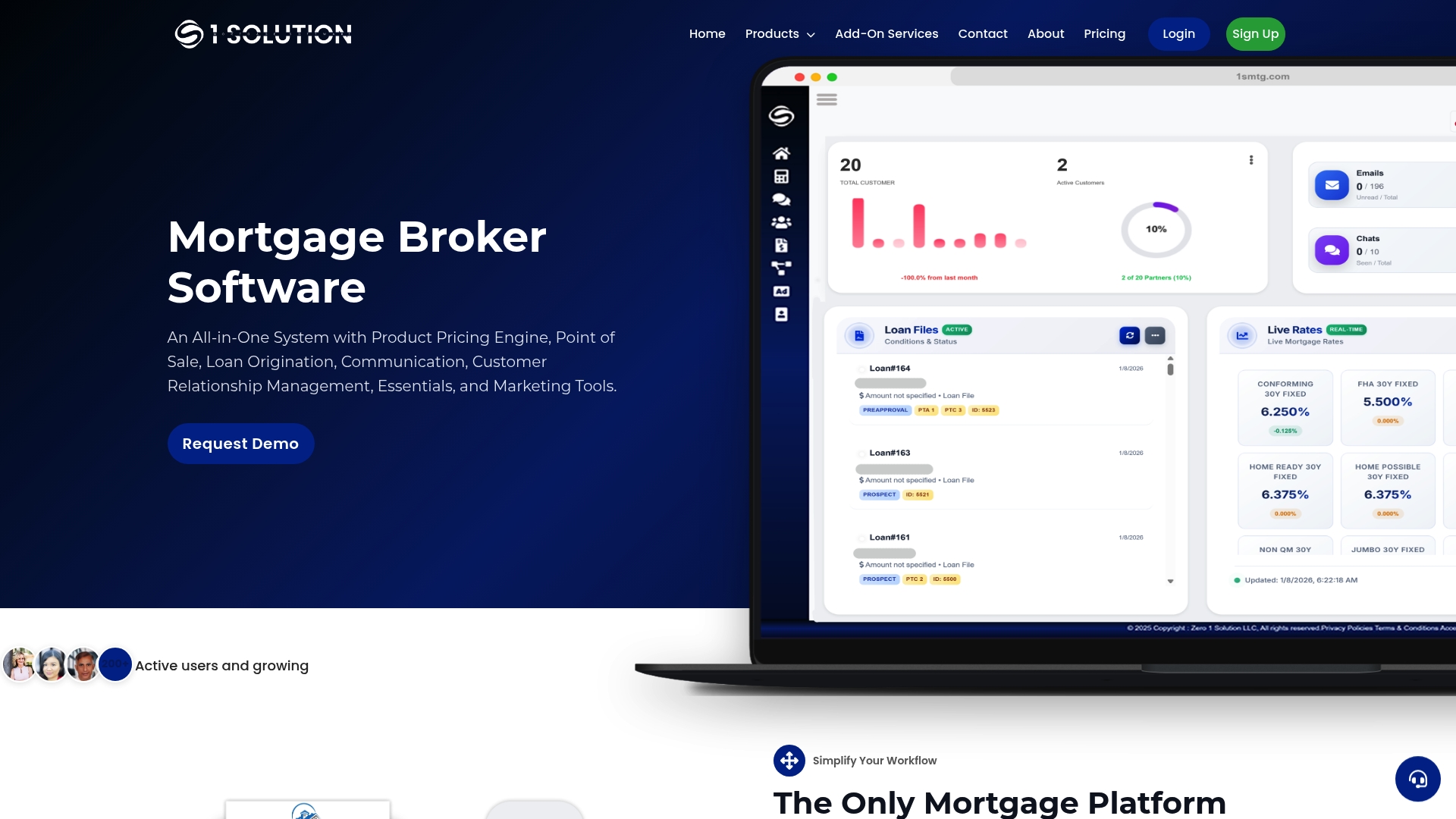
Because the platform was built by a mortgage industry veteran rather than a generic compliance vendor, the archive design reflects how loan files, disclosures, and borrower conversations actually move through a brokerage day to day. If your current setup means pulling records from three separate systems every time an examiner asks a question, explore what an integrated mortgage platform looks like for your team and request a demo to see the communication archive in action against your own workflow.
Frequently Asked Questions
How do communication logs improve compliance for a small brokerage without a dedicated IT team?
Communication logs improve compliance by automating capture and storage so no one has to manually save messages or remember retention rules. A connected platform handles ingestion, hashing, and archiving in the background, which matters most for smaller teams that can't staff a full compliance department.
What is the role of logs in compliance management beyond just storing messages?
The role of logs in compliance management extends to proving supervision happened, not just that a message exists. A log paired with a documented reviewer decision and remediation trail shows examiners the firm actively monitors risk rather than passively archiving everything.
Can communication logs boost compliance scores during a regulatory exam?
Yes, though the honest framing is that logs reduce findings rather than boost a formal score most regulators don't publish. Faster, more complete production of certified records during an exam correlates strongly with fewer follow-up questions and cleaner exam outcomes.
How to use communication logs for an internal investigation, not just an external audit?
Use communication logs by reconstructing the full cross-channel timeline around the issue, including email, chat, and voice transcripts with attachments in sequence. That reconstruction should include the identity-mapped participants and any supervisory review that touched the relevant messages.
What's the difference between a communication log and general recordkeeping?
A communication log specifically captures the metadata and context, timestamp, participants, channel, edits, that make a message defensible on its own. General recordkeeping can include documents and files that were never part of a real-time exchange between people.
Sources
Start with SEC Rule 17a-4 and the audit trail guide.
- Learn about Communication Compliance
- How to build a compliance audit trail for internal communications