
Secure borrower messaging is a portal-first, protected-message workflow that suppresses sensitive previews, requires identity verification to unlock content, and pairs every wire or funds transfer with out-of-band verification. If your team is still emailing closing disclosures as PDF attachments or texting loan numbers in plain SMS, stop today. Move document exchange to portal links, turn on audit logs and exports, and require a callback on a verified number before any wire goes out.
TL;DR:
- Using a portal-link workflow with out-of-band verification ensures that sensitive documents are only accessible after borrower identity confirmation.
- Audit logs, retention policies, and exportable records are critical for demonstrating compliance and defending against disputes or audits.
- Implementing layered verification for wire transfers, including confirmed phone contact and portal-based instructions, greatly reduces fraud risk.
- Magic-link access and clear onboarding communication improve borrower adoption of secure messaging systems, reducing reliance on email attachments.
- A unified platform that integrates document exchange, protected messaging, and audit tracking streamlines compliance and enhances operational speed.
Table of Contents
- What Counts as Secure Borrower Messaging?
- What Regulators and Auditors Expect From Lender Communication Logs
- Building a Secure Messaging Program: The Implementation Checklist
- Getting Borrowers to Actually Use Secure Messaging
- An Operator's View: Why Speed and Security Are Not Actually in Conflict
- How 1 Solution Mortgage Software Handles Secure Messaging for You
- Sources
- FAQ
What Counts as Secure Borrower Messaging?
Most lenders think "secure messaging" means turning on TLS for their email server. That is the floor, not the standard. Real secure borrower messaging combines four things working together: protected-message behavior, a borrower portal, hardened email, and disciplined SMS.
A protected message is one where the notification itself carries no personally identifiable information. The borrower gets an alert that says something like "You have a new secure document," not one that shows an account number or a Social Security number in the preview pane. To open the actual content, the borrower has to verify their identity, either through a single-use code sent to a known device or by logging into the loan portal directly. That single design choice, suppress the preview and gate the content, is what separates protected messaging from a regular email or text.
Secure portals extend that same logic to full documents. Instead of attaching a W-2 or a bank statement to an email, the system generates a time-limited, role-based link. The borrower clicks it, authenticates, and views or uploads the file inside a controlled environment rather than a mail client that might sit unencrypted on three different servers. Encrypted email is the other legitimate option, but it demands both sides support the same encryption standard, which rarely happens with individual borrowers. Academic evaluation of email and SMS protocols in mortgage origination backs this up: end-to-end encryption for email works well between institutions, but usability drops fast once you ask a borrower to install a certificate just to open a document.
Protected SMS follows the portal pattern rather than trying to encrypt text messages themselves, which is technically difficult at scale. The text says "reply STOP to opt out" and includes a secure link. It never contains loan numbers, dollar figures, or account details.
Every one of these channels trades some convenience for security:
- Portal links require an account or a magic-link click, adding a step borrowers sometimes abandon.
- Protected messages need a verification step that slows down urgent exchanges.
- Encrypted email demands technical setup most borrowers never complete.
- Protected SMS depends on borrowers actually clicking through instead of ignoring "another text from the bank."
The tradeoff is real, but the alternative, sending Social Security numbers and bank statements as email attachments, is now treated as a baseline compliance failure rather than an acceptable shortcut.
What Regulators and Auditors Expect From Lender Communication Logs
Examiners no longer ask lenders to describe their communication security in the abstract. They ask for proof: show the audit trail, show the retention policy, show what happens when a borrower emails a driver's license photo to the wrong inbox.
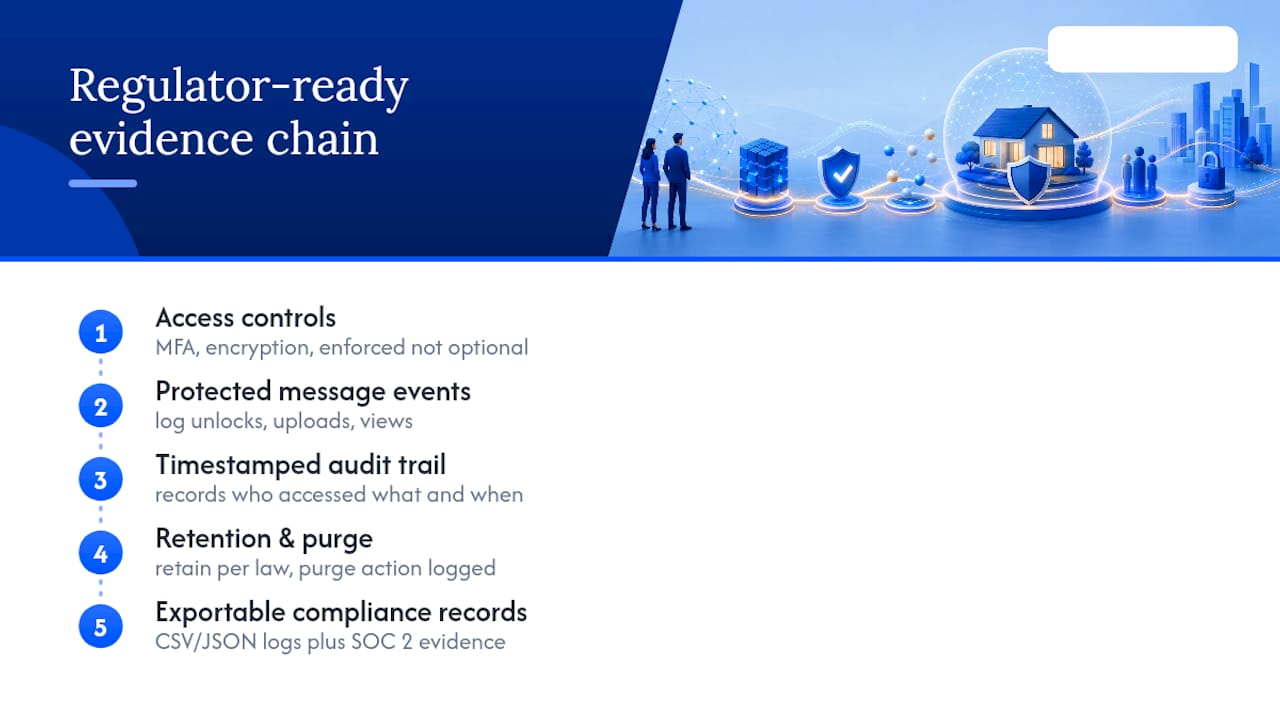
Audit trails matter because they are the only record that survives a dispute. When a borrower claims they never received disclosure documents, or a compliance reviewer asks who accessed a loan file and when, a system that logs every message unlock, upload, and view answers the question in seconds. Exportable logs in CSV or JSON format let compliance teams hand over exactly what an examiner requests without manually reconstructing an email thread from three different mailboxes. Systems that log message unlocks and access events for audit purposes have become a standard practitioner expectation, not a premium feature.
Retention policy is where a lot of lenders get sloppy. A defensible policy states clearly how long messages, uploaded documents, and access logs are kept, and when they get purged. Many teams default to retaining everything indefinitely because deleting feels risky, but indefinite retention of unencrypted PII sitting in old email threads is its own liability. A cleaner practice: retain loan-related communications for the period your state and federal requirements demand, then purge, with the purge action itself logged.
The regulatory backdrop makes this non-optional. The FTC Safeguards Rule requires financial institutions, including many non-bank mortgage lenders, to maintain a written information security program covering access controls, encryption, and monitoring. Industry guidance heading into 2026 has gone further, warning that unencrypted email attachments carrying borrower PII are now widely viewed as a critical security failure rather than a gray area.
When auditors evaluate a lender's messaging setup, they typically look for a few concrete attestations: a SOC 2 report or an equivalent independent security assessment, documented data handling policies that staff can actually produce on request, and evidence that access controls (like multi-factor authentication) are enforced rather than optional. A platform that can hand an examiner an exported log with timestamps, user IDs, and message content categories usually gets through a review faster than one relying on a compliance officer's memory of what happened.
Building a Secure Messaging Program: The Implementation Checklist
Rolling out secure borrower messaging is not a single software purchase. It is a sequence of technical controls, written policies, and staff habits that reinforce each other. Here is the order that actually works in a loan origination environment.
- Turn on portal-first document flows first. Every document request and delivery, from initial disclosures to the closing disclosure, should default to a secure portal link rather than an email attachment.
- Enable protected-message handling. Configure notifications so previews never display account numbers, Social Security numbers, or dollar figures. Require a login or single-use code to unlock the actual message.
- Offer magic-link access for borrowers. A one-time, time-limited link that logs a borrower in without forcing full account creation removes the single biggest adoption barrier.
- Require multi-factor authentication for staff. Loan officers, processors, and underwriters accessing borrower data should authenticate with more than a password, whether through an authenticator app or a passwordless method like FIDO2.
- Harden your email domain. Set up SPF, DKIM, and DMARC records so spoofed emails claiming to be from your company get flagged or rejected before they reach a borrower's inbox.
- Block or discourage sensitive attachments. Where your email system allows it, configure rules that flag outgoing messages containing patterns that look like Social Security numbers or account numbers.
- Write a canned redirect policy. When a borrower emails a document containing PII to an insecure address, staff should have a pre-approved response ready that redirects them to the portal, plus a triggered action to purge the insecure copy from the mailbox.
- Lock down wire instructions with layered verification. Generate wire details only inside the portal, send a notification email with zero sensitive data, require the borrower to log in and confirm, then call the borrower on a phone number verified independently, never one pulled from the same email thread. This sequence mirrors the layered verification approach that has become standard practice as AI-driven phishing and cloned-voice scams targeting closings have increased.
- Enable exports and set a retention window. Confirm your platform can produce CSV or JSON exports on demand, and document exactly how long messages and logs stay before they are purged.
- Test the whole sequence twice a year. Run a mock wire-fraud attempt and a mock examiner data request through your own system to confirm the controls actually work under pressure, not just on paper.
Pro Tip: Before you release any wire instructions, verify the borrower's phone number against a source you controlled from day one, like the number collected at application, never a number that appeared in a recent email. If in doubt, NMLS Consumer Access can help confirm licensing details for a lender or originator involved in the transaction.
Getting Borrowers to Actually Use Secure Messaging
The most secure system in the world fails if borrowers route around it because logging in feels like a hassle. Adoption design matters as much as the underlying encryption.
Magic links solve the biggest friction point. Instead of asking a first-time borrower to create a username, set a password, and remember security questions, a time-limited link sent by email or text drops them directly into the document they need to review or upload. Practitioner experience across loan origination platforms consistently shows that mandatory account creation depresses completion rates, while single-use tokens raise them.
Clear, short onboarding language does more work than most teams expect. A one-page guide explaining "you'll get a text with a secure link, click it, upload your pay stub, done" outperforms a lengthy security explanation nobody reads. Message copy itself should never ask for or display PII in the notification text; save that for inside the authenticated portal.
Not every borrower is comfortable with a portal-only experience, especially older borrowers or those less familiar with two-factor prompts. Build a fallback path: a phone-assisted upload option where a processor walks the borrower through the portal live, or a verified staff member handles the upload on the borrower's behalf after confirming identity by phone.
Track a few numbers to know if the system is actually working:
- Upload completion rate, the share of requested documents borrowers actually submit through the secure channel rather than emailing around it.
- Time-to-first-upload, how long after a request goes out before the borrower responds.
- Dispute rate, how often borrowers or staff report confusion, lost documents, or claims of non-receipt.
If completion rates lag or disputes climb, the problem is usually friction in the portal experience, not a lack of borrower diligence.
An Operator's View: Why Speed and Security Are Not Actually in Conflict
The biggest myth in loan operations is that security slows down a pipeline. It does not, if the controls are built into the workflow instead of bolted on as an afterthought. A processor who has to stop, dig through an inbox, and manually redact a Social Security number before forwarding a document loses more time than a portal upload that takes thirty seconds.
The rule I hold hardest: nobody, ever, sends wire details by email, full stop. Every team I have worked with eventually gets tested by a fraud attempt on a closing, and the ones who survive it are the ones with a scripted callback requirement baked into policy, not left to individual judgment. Staff training should spend less time on general cybersecurity awareness and more time rehearsing the exact canned response to a borrower who emails a bank statement to the wrong address. That single scripted redirect, practiced until it is automatic, closes more real exposure than another slide deck on phishing.
— Omar Khamisa
How 1 Solution Mortgage Software Handles Secure Messaging for You
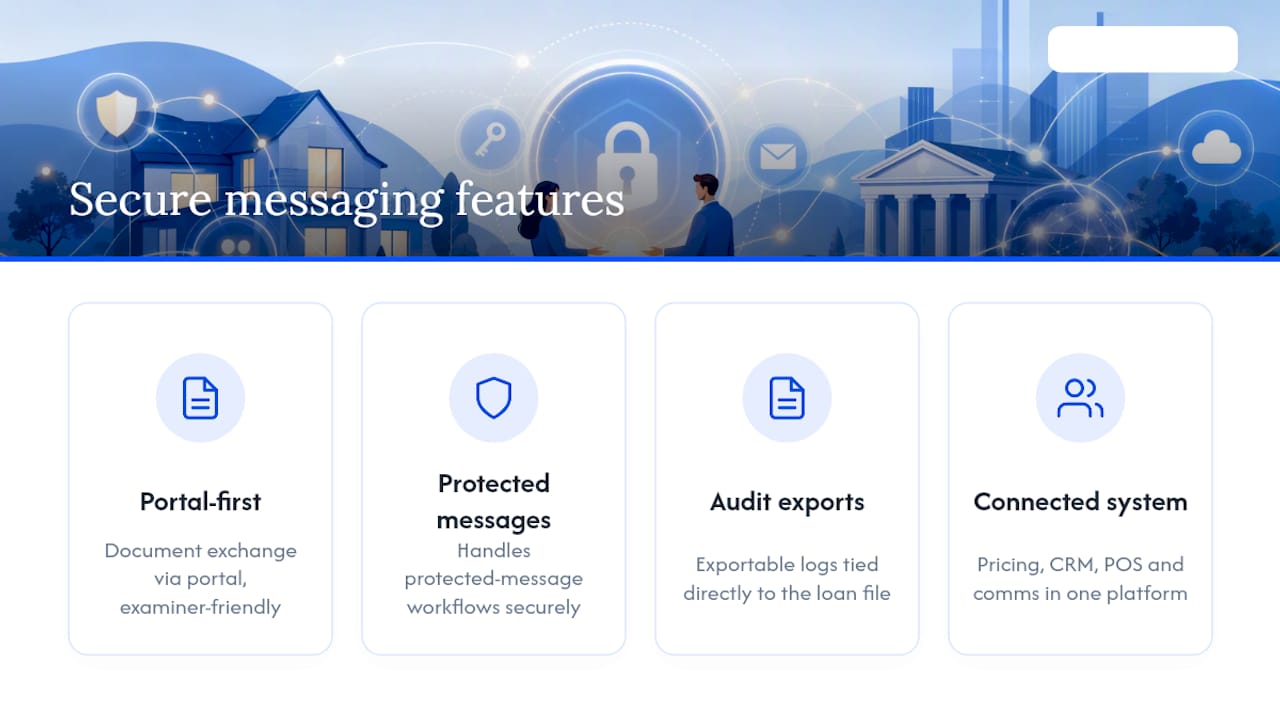
You do not build a compliant messaging program by stitching together five separate tools and hoping the audit trail lines up. That is exactly the fragmentation problem 1 Solution Mortgage Software was built to solve. As a platform built by mortgage professionals rather than outside investors, we designed the communication layer around what examiners actually ask for: portal-first document exchange, protected-message handling, and exportable logs tied directly to the loan file instead of scattered across separate inboxes.
[Image illustrating the platform's features]
Because pricing, CRM, POS, and communication tools live in one connected system, your team is not manually reconciling email threads with portal activity when a compliance review lands on your desk. If you want to see how portal-first messaging, staff MFA, and audit exports work inside a single loan pipeline, request a demo of the Subscription Account and walk through your own implementation checklist with our team directly.
Sources
The following sources back the specific claims made throughout this guide and are worth reading directly if you are building out your own policy documents:
- Enhancing Data Security in Mortgage Origination: A Cybersecurity Evaluation of Email and SMS Protocols
- Secure Mortgage Email Communication in 2026
- NMLS Consumer Access
FAQ
What Is a Secure Message in Banking?
A secure message in banking is a communication where sensitive content, like account numbers or balances, is hidden behind an authentication step rather than displayed in a plain notification. The borrower typically gets an alert with no PII visible, then logs in or enters a single-use code to view the actual content.
What Are the 3 C's in a Mortgage?
The traditional "3 C's" of mortgage underwriting are capacity, credit, and collateral, referring to a borrower's ability to repay, credit history, and the value of the property securing the loan. Some versions add a fourth C for capital, but definitions vary by lender and program.
What Is Secure Messaging?
Secure messaging is a communication method that protects message content through encryption, identity verification, or both, so only the intended recipient can read it. In mortgage lending, that usually means portal-first document exchange and protected messages that suppress sensitive previews until the borrower verifies their identity, an approach platforms like 1 Solution Mortgage Software build directly into the loan workflow.
How Do I Stop Receiving Messages From Loan Apps?
Most protected SMS and portal notifications include an opt-out instruction, commonly "reply STOP," directly in the text message. If messages continue after opting out, contact the lender directly and ask them to remove your number from their communication system, since some notifications may be tied to servicing rather than marketing and require a separate request.