
Yes, TRID disclosure automation is practical for U.S. brokers and lenders today, and it's becoming standard practice for anyone serious about compliance. The systems that actually hold up under a compliance exam share three capabilities: durable timing enforcement for the 3-business-day Closing Disclosure wait required under 12 CFR § 1026.19, automated tolerance checks that trigger re-disclosure without a human hunting for the problem, and an audit-grade log that shows examiners exactly why every document changed.
TL;DR:
- Effective TRID automation requires systems with durable timing enforcement that maintains countdowns through outages and deployment changes.
- Automated tolerance checks must distinguish between shopped and unshopped services to avoid false violations and ensure compliance accuracy.
- Integration of loan data across LOS, POS, and CRM should be prioritized with clear field ownership and event-driven rechecks for real-time accuracy.
- A robust audit trail must capture specific data changes, user actions, and timing events to withstand regulatory review and facilitate testing.
- Implementation should follow a structured four-phase process, prioritizing discovery, design, testing, and phased rollout, with pilot testing on refinance files recommended first.
Table of Contents
- What Are the TRID Timing Rules and Disclosure Triggers?
- What Must Automation Actually Do to Enforce TRID?
- How Should TRID Automation Integrate With LOS, POS, and CRM Systems?
- What Audit Trail and Testing Standards Make TRID Automation Defensible?
- How Do You Implement TRID Disclosure Automation Step by Step?
- Why Practitioner Experience Shapes Better TRID Automation
- When Should You Automate TRID and When Should a Human Sign Off?
- How 1 Solution Mortgage Software Supports TRID Disclosure Automation
- Where to Verify TRID Rules and Automation Guidance
- Sources
- FAQ
- The Gap Between Automation Marketing and Automation That Holds Up
What Are the TRID Timing Rules and Disclosure Triggers?
The Closing Disclosure has to reach the borrower at least 3 business days before consummation, and that clock is unforgiving. 12 CFR § 1026.19 sets the rule, and the CFPB has been consistent about enforcing it since TRID's rollout. The Loan Estimate carries its own timing obligations too. It generally has to go out within three business days of application, and the borrower's intent to proceed can't be treated as automatic. Someone has to document it.
Where brokers get tripped up isn't the initial delivery. It's the re-disclosure triggers that reset or extend the clock mid-file. The most common ones:
- APR changes beyond the regulatory tolerance threshold, which almost always force a new 3-day wait.
- New or increased fees that weren't disclosed on the original Loan Estimate.
- Changes in settlement service providers, especially when the borrower didn't choose from the provider list.
- Loan product changes, like a switch from fixed to adjustable that alters the payment schedule.
- Tolerance breaches on recording fees or other categories with zero or 10% tolerance limits.
Each of these doesn't just create a new document. It can restart the waiting period entirely, which is exactly where manual tracking falls apart on a busy pipeline.
What Must Automation Actually Do to Enforce TRID?
Automating TRID disclosures isn't about generating a PDF faster. It's about building a system that behaves the same way every time, regardless of who's on shift or how many files are in the pipeline. Four capabilities separate a real compliance system from a glorified template generator.
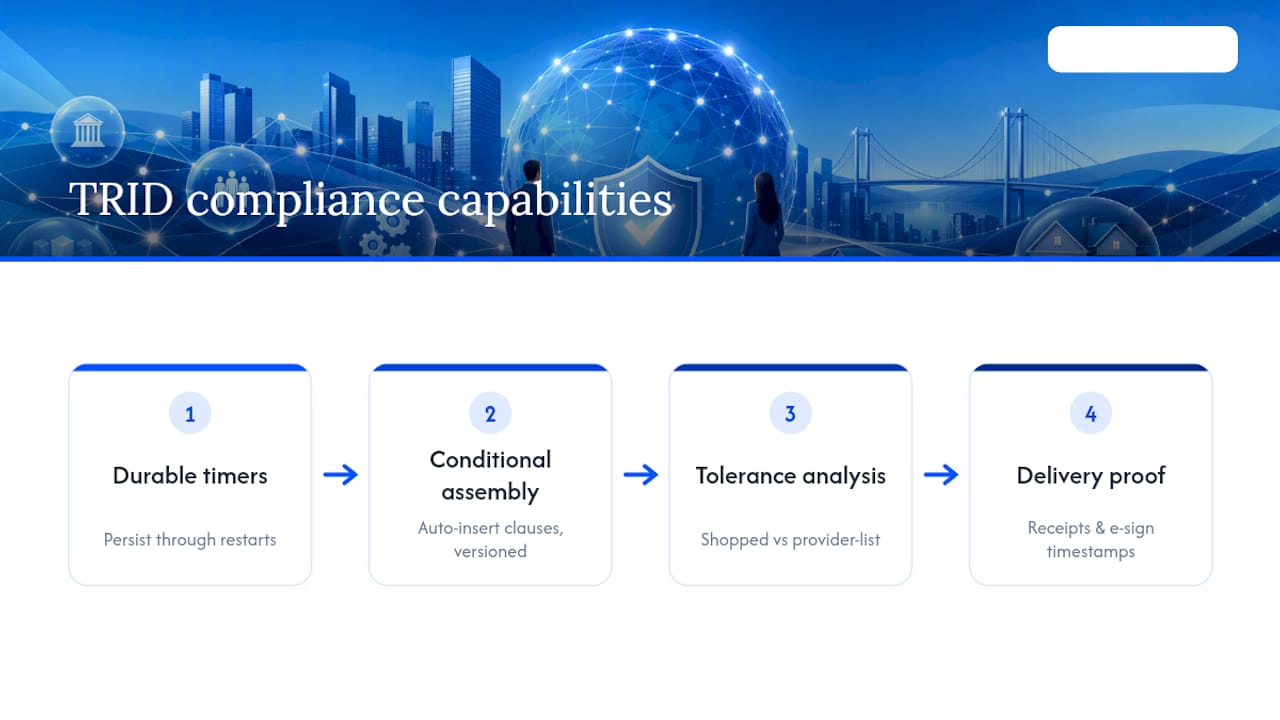
Durable timing engines. A timer that lives in application memory dies the moment a server restarts or a deployment goes out. Durable execution workflows persist that state through outages and redeployments, so a 3-business-day countdown that started Tuesday morning is still accurate Thursday afternoon even if the underlying system rebooted in between. That distinction matters more than most vendors admit, because a lost timer doesn't just create an inconvenience. It creates a TRID violation.
Conditional document assembly. Modern disclosure platforms use conditional logic to populate APR, finance charges, and payment schedules directly from loan data, then maintain version history so nobody is guessing which draft was actually delivered. Real estate-focused document engines take this further, inserting state-specific clauses automatically based on property location and loan type, which cuts down the manual editing that introduces errors in the first place.
Tolerance analysis with provider-list awareness. This is the part generic automation gets wrong most often. A tolerance engine has to distinguish between services the borrower shopped for and services from the creditor's own provider list, because treating a shopped title company the same as an unshopped one will falsely flag legitimate fee variance as a zero-tolerance violation.
Delivery with proof. Email with read receipts, e-signature timestamps, and borrower portal logs all create the delivery evidence examiners ask for.
Pro Tip: Build your tolerance rule catalog before you build anything else. Every other automation decision, from re-disclosure triggers to audit logging, depends on getting the shopped versus unshopped distinction right from day one.
How Should TRID Automation Integrate With LOS, POS, and CRM Systems?
Automation only works if the data feeding it is trustworthy, and that means deciding, system by system, which one owns which field.
- Map your integration touchpoints first. Loan terms typically live in the LOS, pricing comes from the product pricing engine, provider lists get maintained by compliance, rate locks flow from your secondary desk, and settlement fees arrive from title and escrow. Each of these needs a single authoritative source, not five copies drifting out of sync.
- Assign field ownership explicitly. If the LOS and the POS portal both store the loan amount, pick one as the source of truth and have the other reference it. Reconciliation processes should run automatically, not get discovered during a file audit.
- Choose event-driven rechecks over scheduled ones wherever possible. A scheduled nightly tolerance check misses same-day fee changes. An event-driven trigger that fires the moment a settlement fee updates catches the problem before it compounds.
- Insert manual review gates at genuine decision points. Automation should flag a provider list ambiguity or an unusual fee jump for human review, not push it through silently.
A platform like 1 Solution Mortgage Software connects LOS, POS, and CRM data under one roof specifically to avoid the field-ownership disputes that plague brokers running five disconnected tools, though the integration principles above apply regardless of which systems a shop is running.
What Audit Trail and Testing Standards Make TRID Automation Defensible?
An automated system that can't explain itself to an examiner is a liability, not a safeguard. The standard worth building toward is field-level traceability: logs that capture not just the final document version, but the precise data change that triggered each re-disclosure, along with which user or system process made it and when.
Solid audit infrastructure includes:
- Immutable logs that record the delta, not just a snapshot, so an examiner can see the "why" behind every correction.
- Exception dashboards that surface timing breaches and tolerance flags by severity, since compliance suites built around TRID monitors typically prioritize issues this way rather than treating every exception as equally urgent.
- Durable execution monitoring that alerts operations staff the moment a timer is at risk, not after the wait period has already lapsed.
Before go-live, run three categories of tests: tolerance simulations across shopped and unshopped services, re-disclosure edge cases like a mid-file provider switch, and full end-to-end timing dry runs that simulate a file from application through consummation. Skipping the dry run is the most common reason automated systems fail in production. The logic works fine in isolation but breaks when three triggers fire in the same 48-hour window.
The Consumer Financial Protection Bureau's own guidance on TRID timing has stayed the anchor for the 3-business-day rule since the regulation took effect, which is exactly why any automated timer needs to be built against that specific citation rather than a vendor's paraphrase of it.
How Do You Implement TRID Disclosure Automation Step by Step?
A realistic rollout runs in four phases, and rushing any one of them is how brokers end up automating a mistake instead of fixing it.
- Discovery. Map every system touching disclosure data, define who owns each field, and collect complete, current provider lists from your compliance team before writing a single rule.
- Design. Decide on a durable-timer approach, build out your tolerance rule catalog by fee category, and design the audit-log schema so it captures field-level deltas from the start rather than bolting that on later.
- Build and test. Run unit tests against known tolerance scenarios, validate integrations between LOS, POS, and your disclosure engine, and pilot on a small batch of live files with clear rollback criteria if something misfires.
- Go-live. Roll out in phases rather than flipping every branch on at once, monitor timing and tolerance flags in real time during the first cycle, and keep regulator-ready reporting templates ready before your first exam, not after.
Pro Tip: Run your pilot on refinance files first if you have the choice. They tend to surface fewer settlement-provider complications than purchase transactions, which makes it easier to isolate whether a problem is your automation logic or your data feed.
Most shops underestimate the design phase and overestimate the build phase. The rule catalog and audit schema decisions made in week two are what determine whether week ten's go-live goes smoothly.
Why Practitioner Experience Shapes Better TRID Automation
Omar Khamisa built 1 Solution Mortgage Software after two decades working as a processor, underwriter, loan originator, and systems consultant, which means the compliance logic in the platform reflects what actually breaks on a live file, not what looks clean in a product demo. That distinction shows up in how 1 Solution approaches single-source-of-truth data across its integrated LOS, POS, and compliance modules, keeping loan terms, pricing, and provider lists aligned in one system rather than reconciled after the fact between disconnected tools.
When Should You Automate TRID and When Should a Human Sign Off?
Automation should handle the repeatable decisions: tolerance math, timer enforcement, and standard re-disclosure generation. Human sign-off still belongs on genuinely ambiguous calls, like whether a fee change was borrower-initiated or lender-initiated, since that distinction affects the tolerance category.
Poorly tuned tolerance engines create their own risk. Set thresholds too tight and your team drowns in false positives on routine fee variance. Set them too loose and you miss a real violation. Governance matters here as much as the code: version-control every disclosure template, log every rule change with a timestamp and approver, and require sign-off before any tolerance threshold gets adjusted in production.
How 1 Solution Mortgage Software Supports TRID Disclosure Automation
Brokers juggling separate LOS, CRM, and compliance tools end up doing the reconciliation work that automation is supposed to eliminate. One connected system can bring LOS, POS, CRM, compliance, and document generation together to provide a single home for disclosure data instead of multiple disconnected tools.
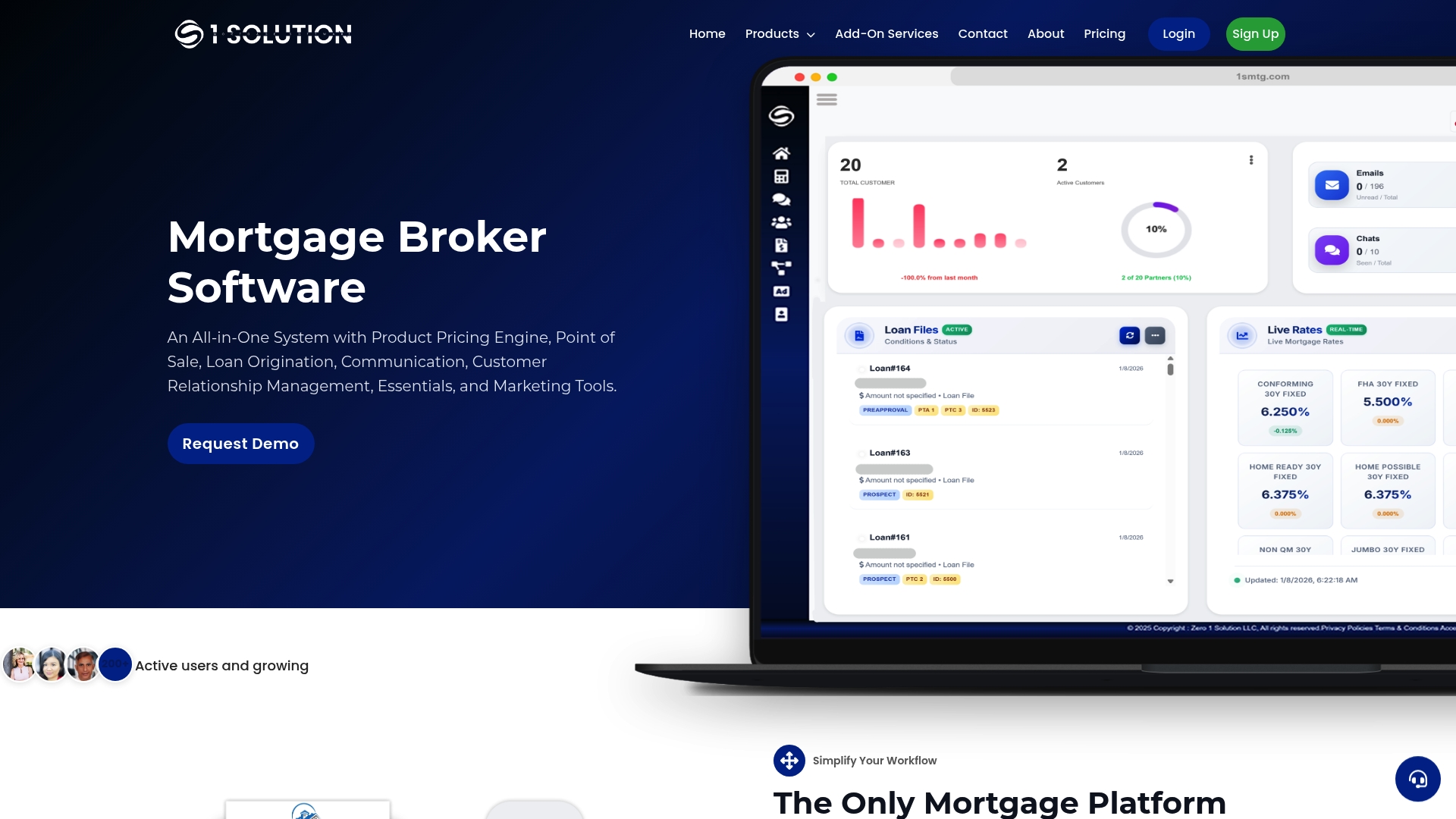
That matters directly for TRID work: when loan terms, pricing, and provider lists all live in the same platform that generates your disclosures, you eliminate the data-sync gaps where re-disclosure triggers slip through. 1 Solution's compliance tools work alongside its integrated document generation and e-signature features, giving brokers a single connected environment for managing timing, tolerance, and delivery evidence rather than stitching together point solutions. The platform runs on a straightforward Subscription Account, with pricing available directly on request.
If your current setup has you tracking re-disclosure triggers in a spreadsheet, or fielding a compliance question you can't answer without pulling logs from three systems, that's the moment to look at a unified platform. Visit 1 Solution Mortgage Software to see how the platform handles disclosure workflows and request a walkthrough for your team.
Where to Verify TRID Rules and Automation Guidance
- CFPB TILA-RESPA Integrated Disclosure FAQs covers the official 12 CFR § 1026.19 timing rule.
- TRID Disclosure Timing Rules Guide expands on delivery windows and edge cases.
- Mortgage Compliance Setup Checklist supports the implementation steps above.
- Automated Reporting Explained covers monitoring and alerting concepts referenced in the audit trail section.
This article is general information, not a substitute for advice from a qualified financial advisor. Consult a qualified financial professional about your own circumstances before acting on anything here.
Sources
- CFPB — TILA-RESPA Integrated Disclosure (TRID) FAQs
- Temporal — durable execution in harsh physical field operations
- Zafin — AI-powered disclosure management for banks
FAQ
Is TRID Still Being Updated?
Yes. The CFPB continues to issue interpretive guidance and FAQ updates on TRID compliance, and automation systems need periodic rule-catalog reviews to stay aligned with the latest interpretations rather than treating the regulation as static.
What Six Items Trigger a New TRID Disclosure?
The most common re-disclosure triggers are APR changes beyond tolerance, new or increased fees, a switch in settlement service providers, loan product changes, prepayment penalty additions, and loan amount changes. Any one of these can restart the 3-business-day Closing Disclosure wait depending on how it affects the loan's terms.
What Is the TRID 7-Day Rule?
TRID actually requires the Loan Estimate to be delivered within three business days of application, not seven, and the borrower must wait a minimum of seven business days between receiving that Loan Estimate and closing under earlier disclosure timing conventions. The rule most brokers confuse with it is the 3-business-day Closing Disclosure wait under 12 CFR § 1026.19, which applies before consummation, not after application.
What Loans Does TRID Not Apply To?
TRID generally doesn't apply to home equity lines of credit, reverse mortgages, loans secured by mobile homes or dwellings not attached to land, or loans made by lenders who originate five or fewer mortgages per year. Most closed-end consumer mortgages on residential property fall under TRID, so exceptions tend to be narrow and worth confirming case by case.
Can 1 Solution Mortgage Software Handle TRID Disclosure Automation?
Some platforms integrate LOS, POS, CRM, and compliance tools in one environment to support a single-source-of-truth data model important for reliable TRID automation. Pricing details and platform capabilities are available directly through 1 Solution's site.
The Gap Between Automation Marketing and Automation That Holds Up
Most vendor pitches on TRID automation focus on speed: faster document generation, fewer clicks, quicker turnaround. That's the wrong benchmark. Speed doesn't help you in a compliance exam. What helps you is being able to answer, for any disclosure your shop sent in the last three years, exactly what data changed, who approved it, and when the clock reset.
I'd argue the industry has it backwards on tolerance engines specifically. Everyone wants tighter thresholds to catch more violations, but an engine tuned too aggressively just trains your team to ignore alerts, which defeats the entire purpose. The real skill in building TRID automation isn't writing the tolerance rules. It's knowing which exceptions genuinely need a human and which ones the system should just handle and log.
Brokers who get this right treat automation as infrastructure, not a feature. They build the audit trail first, then the timing engine, then the document generation on top. That order feels slower going in. It's the only order that survives an exam.
— Omar Khamisa