
A disclosure management tool is software that prepares, delivers, and proves delivery of the Loan Estimate and Closing Disclosure, along with every borrower acknowledgement and e-signature tied to them. It reduces legal and operational risk by enforcing TRID timing rules, catching tolerance violations before they become fee cures, and keeping an audit trail regulators can actually verify.
If you originate loans for a living, you already know the stakes. Miss a Loan Estimate deadline or send a Closing Disclosure that doesn't restart the clock when it should, and you're not looking at a minor paperwork slip. You're looking at a compliance finding, a delayed closing, or worse.
Here's what these systems actually deliver:
- Automated generation of the Loan Estimate (LE) and Closing Disclosure (CD) pulled directly from live loan data, not re-keyed manually
- Enforcement of the TILA-RESPA (TRID) timing windows, including redisclosure triggers that restart waiting periods
- Secure, trackable delivery with e-signature capture and immutable timestamps
- Integration across your point-of-sale, loan origination system, and pricing engine so fee data stays consistent
- Audit logs detailed enough to survive an examiner's second look
Omar Khamisa, who spent over two decades in mortgage operations before founding 1 Solution Mortgage Software, has seen what happens when brokers treat disclosures as a checklist item instead of a system requirement. The rest of this guide walks through why that distinction matters and what to demand from any tool you're evaluating.
Key Takeaways
A disclosure management tool works because it turns TRID's timing and tolerance rules into automated, auditable system logic instead of manual steps someone has to remember.
| Point | Details |
|---|---|
| Enforce a single fee source | Keep fee data in one system of record to prevent the mismatches that trigger costly redisclosures. |
| Require immutable delivery evidence | Signed e-signature events and portal logs hold up in exams; email timestamps often don't. |
| Test redisclosure scenarios before buying | Confirm the three-business-day clock restarts correctly on an APR tolerance breach. |
| Automate business-day math | State-aware holiday calendars prevent illegal closing dates from bad date logic. |
| Run a parallel production month | Operate the new system alongside your current process before full cutover. |
| Evaluate integrated platforms like 1 Solution | 1 Solution Mortgage Software connects POS, LOS, pricing, and portal delivery in one system to reduce coordination failures. |
Table of Contents
- What Does a Disclosure Management Tool Actually Do?
- Why Does Disclosure Management Matter for TRID Compliance?
- What Technical Requirements Should a Disclosure Tool Meet?
- Common Ways Disclosure Processes Break
- How Do You Evaluate and Choose a Disclosure Management System?
- What Does a Disclosure Tool Implementation Timeline Look Like?
- What Lessons Come From Building Disclosure Systems That Actually Hold Up?
- How 1 Solution Mortgage Software Handles Disclosure Compliance
- Where to Verify These Rules and Standards
- Sources
What Does a Disclosure Management Tool Actually Do?
At its core, the software automates the part of your process that used to eat entire afternoons: pulling loan terms, calculating fees, checking them against tolerance thresholds, and generating a compliant Loan Estimate or Closing Disclosure without someone manually copying numbers between systems.
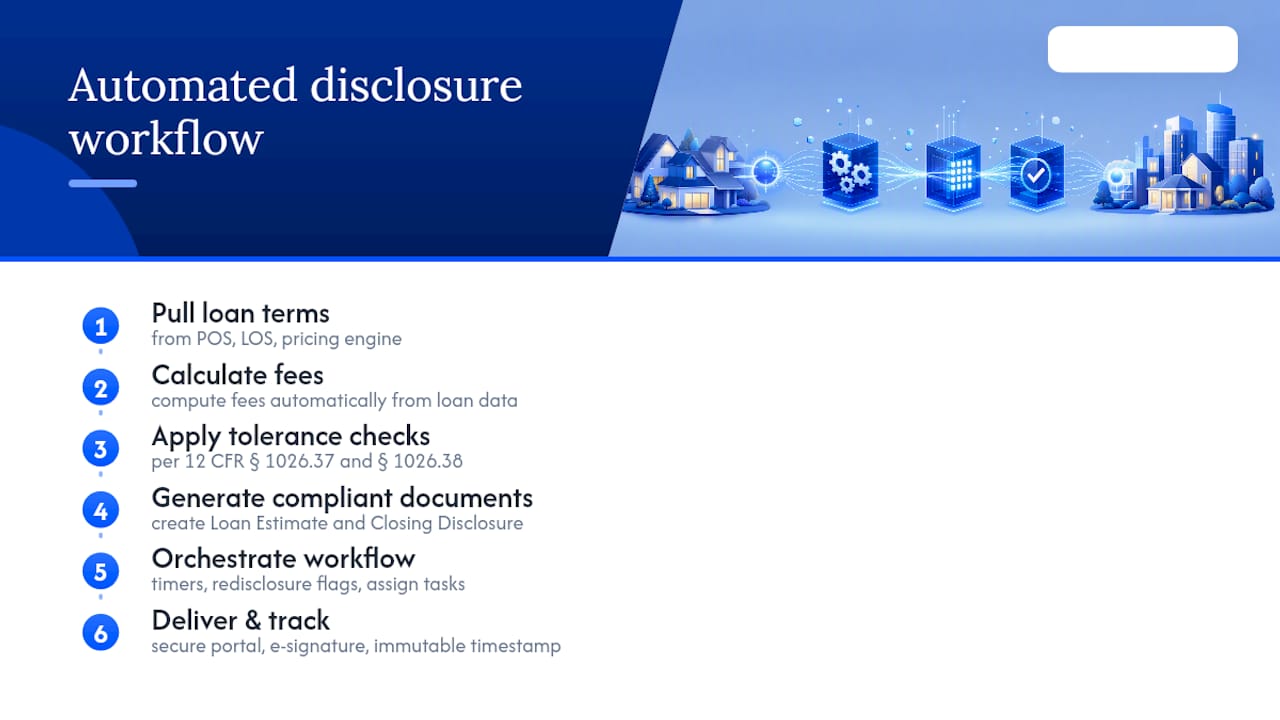
Rule-driven templates handle the generation. You feed in loan data, and the system applies the fee categories and tolerance math required under 12 CFR § 1026.37, which sets the content and form requirements for the Loan Estimate. The same logic applies on the closing side, governed by 12 CFR § 1026.38 for the Closing Disclosure.
Delivery is where a lot of these tools earn their keep. A secure borrower portal, a tracked e-signature flow, and a timestamp that can't be edited after the fact together create the kind of proof-of-receipt an examiner expects to see. Standard email, by contrast, rarely holds up under regulatory scrutiny because there's no reliable way to prove the borrower opened and acknowledged the document on a given date.

Workflow orchestration is the piece brokers underestimate until they don't have it. Good systems run disclosure timers in the background, flag when a redisclosure event has been triggered, and assign tasks to the right person, whether that's a loan officer, a processor, or a closer, without anyone having to remember a deadline manually.
None of this works in isolation. The tool has to talk to your point-of-sale system, your loan origination system (LOS), your pricing engine, and often the settlement agent's platform. That's usually where things break: a fee entered correctly at application gets mislabeled by the time it reaches the closing desk, and now you've got a mismatch nobody notices until the Closing Disclosure is already out the door. Coordinating mortgage file submissions across these handoffs is exactly where disclosure accuracy tends to fall apart.
Why Does Disclosure Management Matter for TRID Compliance?
The timing rules aren't guidelines. They're hard deadlines with legal consequences attached. Under the TILA-RESPA integrated disclosure rule, you must deliver the Loan Estimate within three business days of application and the Closing Disclosure at least three business days before consummation.
Redisclosure requirements add another layer. Certain changes, an APR that moves beyond tolerance, a loan product switch, an added prepayment penalty, trigger a new Closing Disclosure and restart the three-business-day waiting period. The 2017 TILA-RESPA amendments clarify exactly when those triggers apply, and getting them wrong isn't a small mistake.
When a redisclosure event slips through, you're not just fixing a form. You're potentially delaying the closing, exposing the loan to legal risk, and absorbing a remediation cost that didn't need to exist if the system had caught the tolerance breach automatically.
Fee-related errors carry a real price tag. Industry analysis tied to MISMO's fee standardization framework estimates that fee-related disclosure errors still affect more than 30% of loans, costing lenders roughly $1,200 per affected loan in cures and rework. Multiply that across a moderate monthly loan volume and the number stops looking small.
The coordination problem is bigger than most lenders admit. Fannie Mae's Mortgage Lender Sentiment Survey found that among lenders who flagged third-party vendor coordination as a TRID implementation challenge, a large majority still consider it an ongoing issue years after the rule took effect. That's not a startup problem. That's a systemic one, and it's exactly why bolt-on tools that don't talk cleanly to your POS and LOS keep causing the same failures year after year.
What Technical Requirements Should a Disclosure Tool Meet?
Before you sign anything, the platform needs to prove it handles the mechanics that regulators and auditors actually check. This isn't about flashy dashboards. It's about whether the underlying engineering is sound enough to survive an exam.
Pro Tip: Ask any vendor to show you their business-day calculation logic live, not in a slide deck. If they can't demonstrate how the system handles a federal holiday landing mid-disclosure-window, that's a red flag worth walking away from.
| Requirement | Why It Matters |
|---|---|
| State-aware business-day calendars | Naive date libraries miscount holidays, which can produce an illegal closing date |
| Single source of truth for fees | Prevents the mismatches between POS, LOS, and closing desk that trigger fee cures |
| Immutable audit trail | Signed acknowledgements and portal access logs hold up under examiner review, unlike email timestamps |
| Encryption at rest and in transit | Protects borrower financial data across every integration point |
| Role-based access control | Limits who can alter disclosure data, reducing both error and fraud risk |
A few things worth calling out beyond the table:
- Redisclosure timers need to run automatically, not depend on someone remembering to reset a countdown after a rate lock changes
- Data contracts between POS and LOS should map fee categories consistently, since MISMO's guidance shows standardized fee definitions are one of the more effective fixes for chronic redisclosure churn
- Vendor third-party risk management matters as much as your own security posture, since a weak link anywhere in the chain becomes your liability
Common Ways Disclosure Processes Break
Most disclosure failures aren't dramatic. They're quiet, repeated, and entirely preventable once you know what to look for.
- Bolt-on workflows relying on spreadsheets. When someone manually copies fee data from the LOS into a separate disclosure tool, a typo or a missed row creates a tolerance mismatch nobody catches until closing.
- Hard-coded holiday calendars. A system that doesn't account for a shifted state holiday can calculate a "three business day" window incorrectly, producing a closing date that violates TRID without anyone realizing it.
- Fee category mismatches across systems. The same charge gets labeled differently in the POS than in the LOS, and by the time it reaches the closing desk, the numbers don't reconcile.
- Vendor coordination failures. Configuration drift between your pricing engine and your e-signature platform can silently break data contracts, especially after either vendor pushes an update.
Fee-related errors alone affect more than 30% of loans, according to the MISMO analysis cited above, and most of those trace back to exactly this kind of category mismatch rather than any single catastrophic error. It's death by a thousand small inconsistencies, not one big failure.
How Do You Evaluate and Choose a Disclosure Management System?
Start with integration depth. A tool that doesn't connect cleanly to your point-of-sale system, your LOS, and your pricing engine is going to leave you doing manual reconciliation regardless of how polished its interface looks.
Ask vendors to walk you through an actual end-to-end redisclosure scenario during the demo, not a hypothetical. Have them show you a loan where the APR breaches tolerance, trigger the redisclosure, and demonstrate that the three-business-day clock genuinely restarts. Ask how they prove receipt: is it a signed e-signature event, a portal access log, or something weaker? Ask how fees get normalized when data crosses from your POS into their system.
A short list of acceptance tests worth running before you sign a contract:
- An end-to-end test case that spans a federal holiday to confirm business-day math holds up
- A simulated redisclosure triggered by an APR tolerance breach
- A sample audit log export you can hand to a compliance officer for review
- An escrow and fee rounding check to confirm penny-level accuracy across integrations
Watch for red flags during procurement: opaque APIs that vendors won't let you inspect, no clear answer on how delivery evidence is stored, or a fee mapping process that sounds improvised rather than standardized. If a vendor can't answer these questions confidently in a demo, they likely haven't tested for them either. Reviewing your mortgage compliance audit expectations ahead of time gives you a clearer benchmark for what "audit-ready" actually looks like.
What Does a Disclosure Tool Implementation Timeline Look Like?
Rolling out a new disclosure system isn't a weekend project, and treating it like one is how gaps slip through unnoticed until an examiner finds them.
- Weeks 0 to 2: Kick off the project, scope your data contracts (fee maps, field mappings between POS and LOS), and lock in your holiday calendar policy.
- Weeks 3 to 6: Run integration sprints connecting POS, LOS, pricing engine, and e-signature or portal delivery. Build out a QA test-case catalog and run smoke tests across the full chain.
- Weeks 7 to 10: Operate the new system in parallel with your existing process. Run redisclosure drills, including edge cases like a rate lock expiring over a holiday weekend or a borrower who doesn't show for signing.
- Weeks 11 to 12: Complete an audit readiness check, hand off documentation, and cut over to live production.
Once you're live, keep an eye on a few metrics that tell you whether the system is actually working:
- Redisclosure rate as a percentage of total closed loans
- Average time-to-close, watching for any lengthening tied to disclosure delays
- Audit log completeness, checked on a sampling basis each month
Teams building out a compliance checklist for the year ahead often find the parallel-run phase is where the real gaps surface, not the initial build.
What Lessons Come From Building Disclosure Systems That Actually Hold Up?
Disclosure rules read like a checklist, but they behave like engineering constraints. A three-business-day waiting period isn't a policy reminder, it's a timer that has to fire correctly every single time, across every state holiday calendar, without a human remembering to check it. Teams that treat TRID compliance as something a project manager tracks in a spreadsheet are the same teams that end up with a redisclosure nobody caught until the closing table.
The mortgage technology field has plenty of engineering writeups warning about exactly this. Treating disclosure timing as a system-level property, meaning timers, state machines, and data schemas rather than manual steps, is what separates a tool that survives an audit from one that generates a legal exposure report.
What actually works isn't more oversight. It's fewer places where a human has to remember to do something manually. Prioritize acceptance tests that force a redisclosure scenario before you ever sign a contract, insist on audit exports you can hand to a compliance officer without translation, and never skip a genuine parallel run of at least a month before full cutover. The brokers who skip that step are the ones who find their first real bug during an actual closing, not a test one.
How 1 Solution Mortgage Software Handles Disclosure Compliance
Most disclosure headaches come from stitching together tools that were never built to talk to each other. 1 Solution Mortgage Software was built the opposite way: POS, LOS, pricing engine, and borrower portal live in one connected platform, so fee data doesn't drift between systems and disclosure timers don't depend on someone remembering to reset them manually.
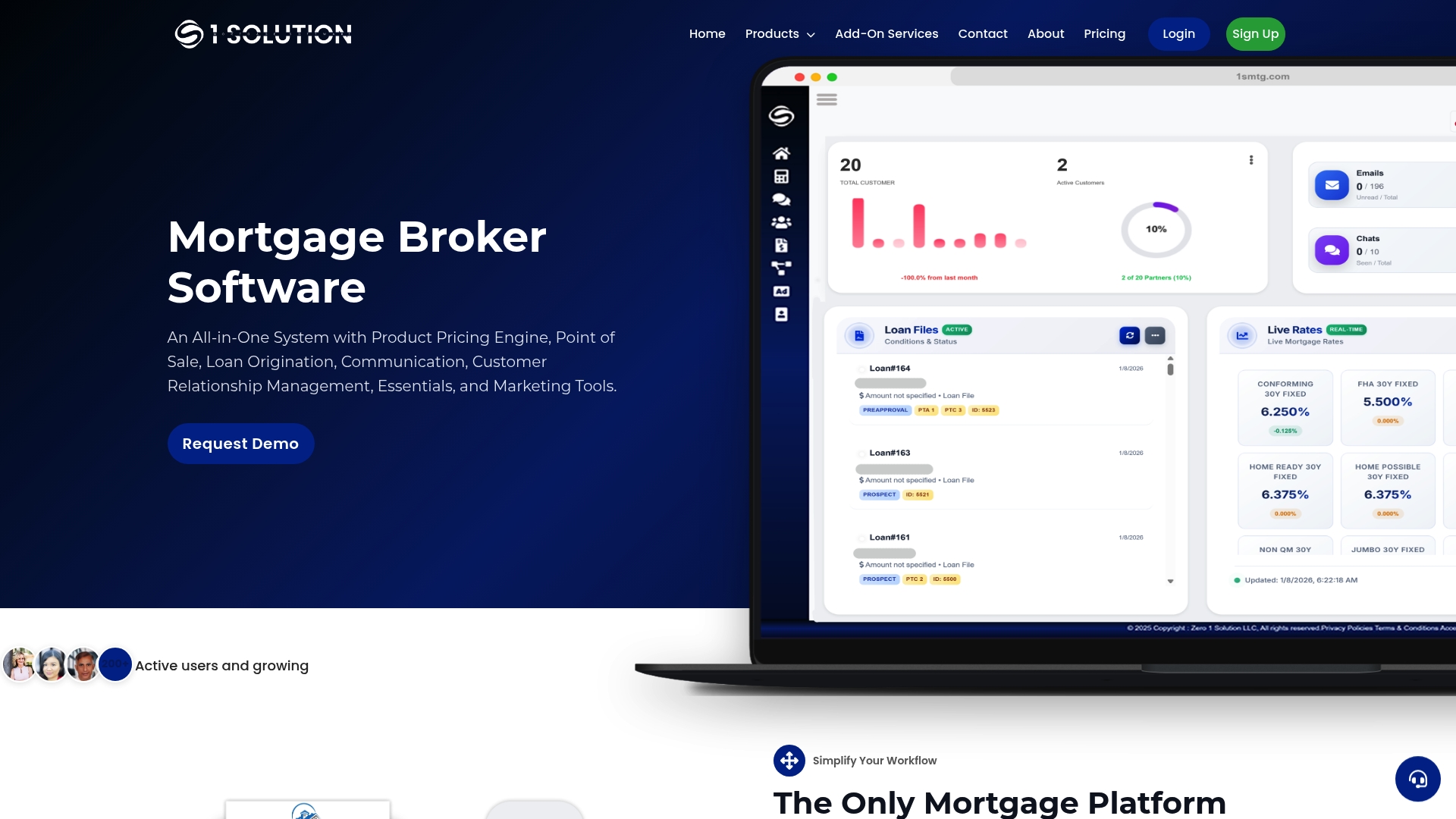
That means TRID timing enforcement, tolerance checks, and immutable audit trails are built into the same workflow your loan officers already use, not bolted onto it as an afterthought. In a demo, you can ask to see a live redisclosure scenario play out end to end, review an actual audit-log export, and watch how fee data stays consistent from application through closing.
If you're evaluating platforms right now, the practical next step is straightforward: schedule a demo and bring your toughest redisclosure edge case. 1 Solution's team, built by people who've run mortgage operations rather than just sold software to them, will walk through implementation support and what a parallel run would look like for your shop.
Where to Verify These Rules and Standards
- Federal Register's TILA-RESPA integrated disclosure rule for the original timing requirements behind the Loan Estimate and Closing Disclosure
- CFPB's 2017 TILA-RESPA amendments for clarified tolerance and redisclosure trigger rules
- 12 CFR § 1026.37 for Loan Estimate content and electronic delivery standards
- 12 CFR § 1026.38 for Closing Disclosure content requirements
- MISMO's fee standardization framework coverage for fee mapping standards and cure-cost data
- Fannie Mae's Mortgage Lender Sentiment Survey for third-party vendor coordination findings
For broader compliance planning beyond disclosures, the mortgage broker compliance management guide and regulatory compliance overview cover adjacent requirements worth reviewing alongside your disclosure workflow. Financial technology platforms outside mortgage, like FilingsIQ's work on auditable disclosure records, offer a useful parallel on what regulators expect from immutable evidence trails.
This article is general information, not a substitute for advice from a qualified financial advisor. Consult a qualified financial professional about your own circumstances before acting on anything here.
Sources
- Federal Register, Volume 78 Issue 251 (Tuesday, December 31, 2013)
- CFPB - Amendments to Federal Mortgage Disclosure Requirements (TILA) — Final Rule (executive summary)
- SECTION 1026.37—Content of Disclosures for Certain Mortgage Transactions (Loan Estimate)
- 12 CFR § 1026.38 - Content of disclosures for certain mortgage transactions (Closing Disclosure). | LII / Legal Information Institute
- Fannie Mae Mortgage Lender Sentiment Survey — TRID implementation insights