

A mortgage business model is defined as the framework a company uses to generate profit by originating, selling, and optionally servicing residential home loans. Understanding this framework matters whether you are launching a brokerage, evaluating a direct lending operation, or simply trying to understand how companies like Rocket Mortgage and Mr. Cooper actually make money. The model is not one-size-fits-all. It splits into distinct revenue engines, each with its own cost structure, risk profile, and growth logic. This guide breaks down every layer so you can see exactly how mortgage companies operate and where the real profit lives.
What is a mortgage business model and how does it generate revenue?
A mortgage business model generates revenue through two primary engines: loan origination and loan servicing. These are mostly disconnected businesses with different KPIs, cash flow timing, and risk exposures. Most lenders focus on one or the other, though vertically integrated firms like Rocket Mortgage operate both deliberately.

Origination revenue comes from fees charged at closing and the gain-on-sale margin earned when a lender sells the loan to the secondary market, typically to Fannie Mae, Freddie Mac, or private investors. The gain-on-sale is the spread between what the lender paid to fund the loan and what an investor pays to buy it. This margin fluctuates with interest rates and market competition, which is why origination income is inherently cyclical.
Servicing revenue is the recurring fee a company earns for collecting monthly payments, managing escrow accounts, handling delinquencies, and communicating with borrowers after the loan closes. Servicers typically earn 25 to 50 basis points annually on the unpaid principal balance of the loans they manage. This creates a predictable, annuity-like income stream that offsets the volatility of origination.
- Origination income is transactional and volume-dependent
- Servicing income is recurring and balance-dependent
- Most lenders sell their servicing rights after closing and move on
- Firms that retain servicing build a long-term customer relationship asset
Pro Tip: If you are building a mortgage business growth roadmap, decide early whether you want origination-only cash flow or a hybrid model. Retaining servicing requires capital and infrastructure, but it creates a customer base you can recapture when rates drop.
What are the main cost structures and profitability factors?
Mortgage lending operates on thin margins, and the numbers make that clear. Independent mortgage banks reported an average net production profit of $785 per loan in 2025, up from $443 in 2024, against total production costs of approximately $11,000 per loan. That means the average lender keeps less than 8 cents of every dollar spent producing a loan. The margin is real but fragile.
Compensation accounts for 65 to 70% of direct origination costs, making it the single largest lever in the entire cost structure. Per-loan origination costs have risen approximately 35% over three years, driven by wage growth and compliance overhead. That cost inflation does not automatically translate into higher loan prices because competition and rate sensitivity cap what borrowers will pay.
| Cost Category | Typical Share of Production Cost | Key Driver |
|---|---|---|
| Compensation (LOs, processors, underwriters) | 65–70% | Headcount and commission structure |
| Third-party fees (appraisal, title, credit) | 10–15% | Vendor contracts and loan mix |
| Technology and systems | 5–10% | Platform complexity and licensing |
| Overhead (occupancy, compliance, marketing) | 10–15% | Fixed cost base and scale |
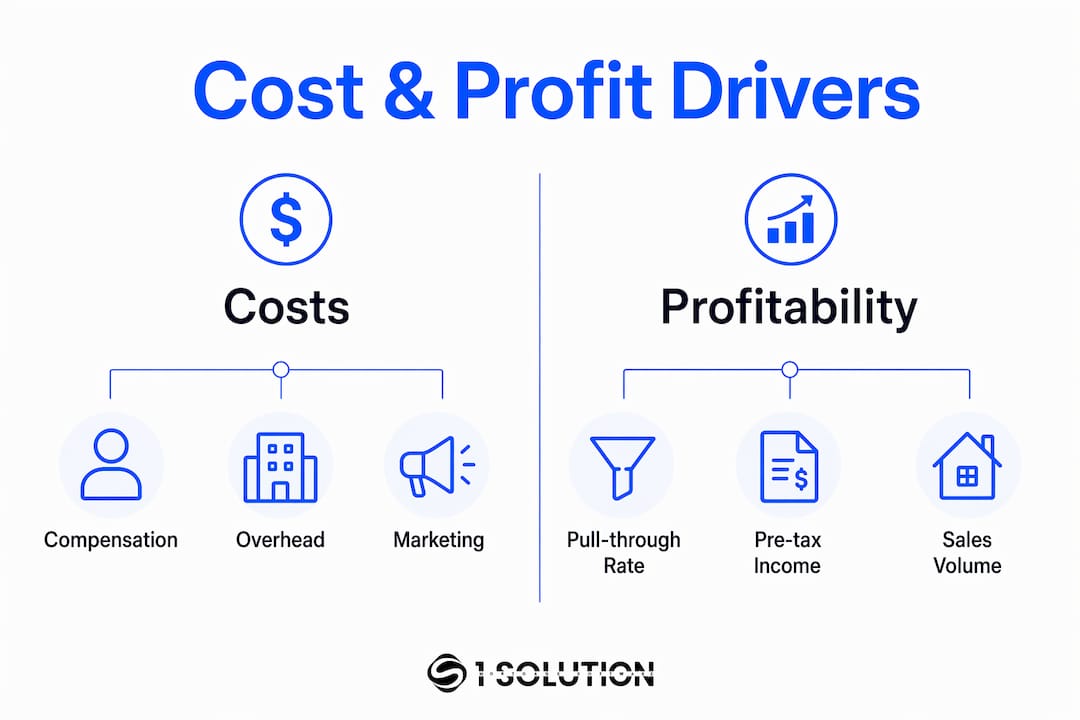
Pull-through rate is the profitability metric most lenders underestimate. Pull-through measures the percentage of applications that actually close. Small inefficiencies in pipeline conversion and document quality can severely depress profits even when marketing is generating strong application volume. A 5% improvement in pull-through on 500 loans per month can add hundreds of thousands of dollars to annual profit without adding a single new lead.
The top 20% of lenders earn significantly higher pre-tax production income per loan than the average, and the gap is driven by unit economics and cost discipline, not volume alone. This is the most important insight in mortgage business strategy: scale does not fix a broken cost structure.
Pro Tip: Map your cost per funded loan by channel and loan type before you scale. Refinance loans and purchase loans have different cost profiles. Mixing them without tracking separately hides where you are actually losing money.
How do mortgage servicing rights influence business strategy?
Mortgage servicing rights, commonly called MSRs, are the contractual rights to service a loan and collect the associated fees. MSRs generate recurring cash flow but also add operational cost, interest-rate sensitivity, and regulatory complexity. The decision to retain or sell MSRs is one of the most consequential strategic choices in any mortgage business model.
Retaining MSRs creates a long-term income stream and keeps the borrower relationship in-house, which enables recapture when that borrower refinances. Rocket Mortgage has built a significant portion of its competitive advantage around this logic, using retained servicing as a customer data asset for cross-selling insurance, real estate, and personal finance products. Selling MSRs generates immediate liquidity and removes the operational burden of servicing compliance, which is governed by CFPB regulations and state-level requirements.
| Strategy | Revenue Profile | Capital Impact | Operational Complexity | Best Fit |
|---|---|---|---|---|
| Retain MSRs | Recurring, rate-sensitive | Capital-intensive | High (compliance, delinquency mgmt) | Large lenders with servicing infrastructure |
| Sell MSRs | One-time gain at sale | Frees capital | Low | Smaller lenders, high-volume originators |
| Hybrid (retain with recapture rights) | Mixed | Moderate | Moderate | Mid-size lenders building long-term value |
Movement Mortgage uses a hybrid approach. The company negotiates MSR sales transaction-by-transaction, retaining recapture rights in 86% of its deals. This means Movement can sell the servicing cash flow to a buyer while preserving the right to refinance that borrower in the future. MSR strategy is not a binary choice, and dynamic MSR sales with negotiated recapture rights are a standard tool for firms that want liquidity without permanently surrendering the customer relationship.
MSR retention strategy is also shaped by capital priorities and accounting treatments, which is why two firms with identical loan portfolios can make opposite MSR decisions and both be right. Your mortgage business structure, balance sheet, and regulatory status all influence which path makes sense.
What types of mortgage business models exist?
The mortgage industry uses two primary structural models: the mortgage banker model and the mortgage broker model. Understanding the difference is foundational to any mortgage business launch plan.
Mortgage bankers act as direct lenders, funding loans with their own capital or warehouse lines of credit, then selling those loans to investors on the secondary market. They control the entire origination process, set their own underwriting overlays, and capture the full gain-on-sale margin. The trade-off is capital exposure, regulatory burden, and the cost of maintaining a full operations team.
Mortgage brokers do not fund loans. They act as intermediaries, matching borrowers with wholesale lenders who fund and underwrite the loan. Brokers earn a commission, typically paid by the lender as a yield spread premium or by the borrower as an origination fee. The broker model requires less capital and has lower fixed costs, but it also captures a narrower slice of the revenue per loan and depends heavily on the wholesale lender's pricing and guidelines.
Key distinctions between the two models:
- Direct lenders control pricing, underwriting, and closing timelines
- Mortgage brokers offer borrowers access to multiple lenders and competitive pricing
- Direct lenders carry more balance sheet risk but earn more per loan
- Brokers scale faster with less capital but face margin compression in competitive markets
A mortgage broker platform adds technology infrastructure that helps brokers manage multiple lender relationships, automate pricing comparisons, and track pipeline efficiently. For entrepreneurs entering the mortgage space, the broker model is typically the lower-barrier entry point, while the banker model suits those with capital, compliance infrastructure, and a long-term servicing strategy.
How to design a mortgage business model for profitability and growth
Building a profitable mortgage business model requires deliberate decisions across five operational dimensions. Volume is not a strategy. Execution is.
-
Define your revenue mix early. Decide whether you will rely solely on origination income or build a servicing portfolio. Each path requires different capital, technology, and staffing. A hybrid model is viable but demands clear operational separation between the two engines, because servicing and origination require tailored operating models with distinct KPIs and risk controls.
-
Control your cost per funded loan. Track compensation as a percentage of revenue, not just as a headcount number. Aligning compensation design to contribution margin is one of the clearest differentiators between top-performing lenders and average ones. Pay for closed loans, not applications.
-
Optimize pull-through before you scale. Use mortgage scenario analysis to identify where applications are falling out of the pipeline. Fix those leaks before adding marketing spend. Scaling a leaky pipeline multiplies losses, not profits.
-
Build compliance into operations from day one. Regulatory failures are expensive and reputational. A solid mortgage compliance setup protects your license, your lender relationships, and your borrowers. This is especially true if you plan to retain MSRs, where CFPB oversight is direct and ongoing.
-
Invest in technology that reduces per-loan cost. Manual processes inflate compensation costs and slow pull-through. The right platform connects pricing, CRM, LOS, and compliance into one workflow, cutting the time and headcount required per loan.
Pro Tip: Mortgage companies pursuing vertical integration, owning origination, servicing, and real estate platforms, can create powerful customer data ecosystems for cross-selling. Even small brokerages can replicate this logic at scale with the right CRM and touchpoint strategy.
Key takeaways
A mortgage business model succeeds when origination efficiency, cost discipline, and MSR strategy are aligned to the firm's capital position and growth objectives.
| Point | Details |
|---|---|
| Two revenue engines | Origination and servicing operate differently and require separate management strategies. |
| Thin margins demand discipline | At $785 average profit per loan, cost control and pull-through rates determine survival. |
| MSR strategy is not binary | Firms like Movement Mortgage retain recapture rights while selling servicing cash flow. |
| Model type shapes economics | Direct lenders capture more revenue per loan; brokers scale faster with less capital. |
| Technology reduces per-loan cost | Integrated platforms cut compensation overhead and improve pipeline conversion rates. |
What I've learned from 20 years inside mortgage operations
Most entrepreneurs entering the mortgage space focus on origination volume as the primary success metric. That instinct is understandable but incomplete. Volume without cost discipline produces losses at scale, and I have seen that pattern repeat across market cycles.
The MSR decision is where I see the most strategic confusion. Lenders treat it as a one-time choice rather than a dynamic tool. Movement Mortgage's approach of negotiating recapture rights deal-by-deal is exactly the kind of execution discipline that separates sophisticated operators from the rest. Selling MSRs does not mean giving up the customer. It means structuring the sale correctly.
The other pattern I consistently observe is underinvestment in pipeline operations. Lenders spend heavily on lead generation and almost nothing on the process between application and closing. That gap is where profit disappears. Fixing pull-through by 5 to 10 percentage points costs far less than generating equivalent new volume, and the math is not close.
Loan volume alone does not guarantee profitability. Operating discipline focused on unit economics is what separates the top 20% of lenders from everyone else. Build the model right before you build it big.
— Omar Khamisa
How 1 Solution Mortgage Software supports your mortgage business model
Running a profitable mortgage operation requires more than good loan officers. It requires systems that connect every part of your workflow without friction or data loss.
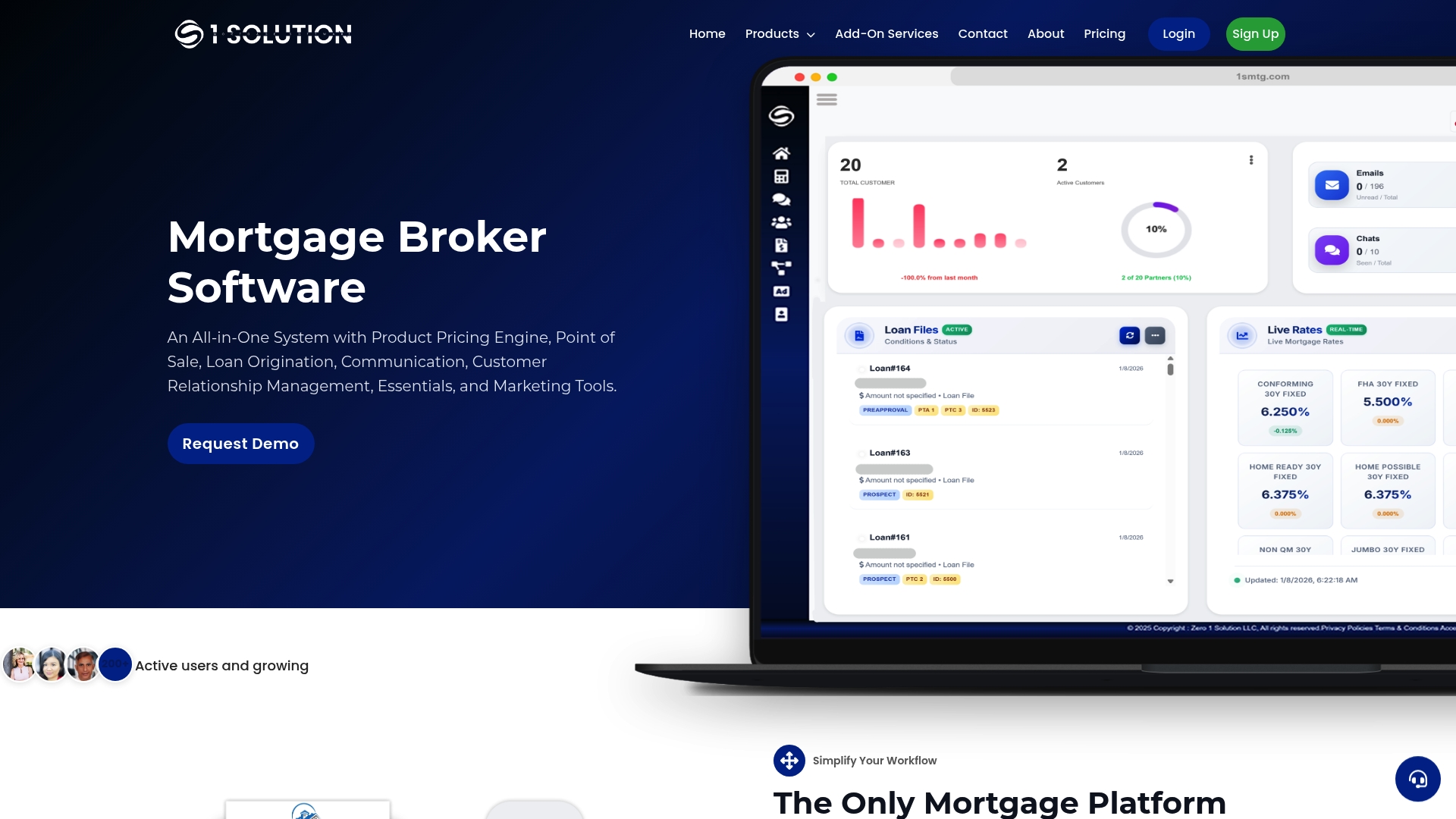
1 Solution Mortgage Software was built by mortgage professionals who have worked as processors, underwriters, and loan originators. The platform brings pricing, CRM, POS, LOS, compliance, and marketing tools into one connected ecosystem designed specifically for independent brokers and mortgage bankers. That means lower per-loan cost, better pull-through visibility, and operational control that most fragmented tech stacks cannot deliver. If you are serious about building a mortgage business that performs at the unit economics level, explore 1 Solution and see what a purpose-built platform actually looks like in practice.
FAQ
What is a mortgage business model in simple terms?
A mortgage business model is the structure a company uses to earn profit by originating, selling, and sometimes servicing home loans. Revenue comes from origination fees, gain-on-sale margins, and recurring servicing income.
How do mortgage companies make money on each loan?
Mortgage companies earn origination fees at closing and a gain-on-sale margin when they sell the loan to investors. If they retain servicing rights, they also collect an annual fee of roughly 25 to 50 basis points on the outstanding loan balance.
What are mortgage servicing rights and why do they matter?
Mortgage servicing rights are the contractual rights to collect payments and manage a loan after closing. Retaining MSRs creates recurring income and preserves the borrower relationship, while selling them generates immediate cash and reduces operational complexity.
What is the difference between a mortgage banker and a mortgage broker?
A mortgage banker funds loans directly using its own capital or warehouse lines, then sells them on the secondary market. A mortgage broker matches borrowers with wholesale lenders without funding the loan, earning a commission on each closed transaction.
What profit margin does the average mortgage lender earn per loan?
Independent mortgage banks reported an average net production profit of $785 per loan in 2025, according to the Mortgage Bankers Association, against total production costs of approximately $11,000 per loan.