
Loan officers should use an AI-capable mortgage CRM when it integrates natively with your LOS and comes with documented model controls and logging: without that pairing, you get faster outreach and a bigger compliance headache. The single criterion that matters most is LOS integration plus vendor-provided audit trails. Before you sign anything, book demos that use real demo data and run them against a compliance checklist.
TL;DR:
- An AI mortgage CRM must integrate natively with your LOS and provide documented audit trails to ensure compliance and avoid data errors.
- Effective AI features include 24/7 lead follow-up, automatic appointment scheduling, transparent lead scoring, and unified logging of calls and texts.
- Vendors should demonstrate real data handling during demos, confirm secure data flow before go-live, and be prepared for bias testing, ongoing audits, and regulatory requirements.
- Transitioning to an AI CRM should start with a small pilot, with backup plans and clear success metrics to prevent compliance or operational issues.
- Most brokers benefit from purpose-built platforms that connect CRM, LOS, POS, and communication tools within one integrated system to streamline workflows and maintain compliance.
Table of Contents
- AI features loan officers will actually use every day
- How AI features must connect to your LOS and daily workflows
- Checklist and demo script for evaluating AI CRM vendors
- Regulatory expectations and the controls brokers must require
- A safe rollout and migration plan for your team
- What AI should and should not decide in your pipeline
- How 1 Solution builds AI into one connected platform
- Where to go deeper on AI, valuations, and privacy rules
- Sources
- FAQ
AI features loan officers will actually use every day
The best mortgage CRMs now build AI into the parts of your day that used to eat the most time. Here is what each feature does and what to check when a vendor shows it to you.
- 24/7 lead follow-up and chat: catches inbound leads the moment they arrive, so nobody sits in a queue overnight while a competitor calls first.
- AI appointment setting: books calls and consultations automatically based on your calendar, cutting the back-and-forth that kills momentum.
- Lead scoring and propensity models: rank leads by likelihood to close, but only useful if the vendor can explain the inputs and update the score as new data comes in.
- Built-in dialer and two-way SMS: keeps every call and text logged inside the CRM instead of scattered across personal phones, which matters for both tracking and compliance.
- Marketing automation tied to pipeline stage: triggers the right content, rate update, or nurture email as a borrower moves from lead to application to closing.
In a demo, ask the vendor to show a live lead moving through each of these steps. If they can only show slides, that is your answer.
How AI features must connect to your LOS and daily workflows
A CRM full of AI features is only as good as its connection to your loan origination system. Without that link, your team ends up retyping the same borrower data twice, and every retype is a chance for an error that shows up later in an audit.
- Insist on native LOS sync: a true integration keeps one source of truth for borrower data and preserves the audit trail regulators expect.
- Accept API or webhook integrations only when documented: ask for the field mapping in writing, not a verbal promise that "it connects."
- Draw a hard line on autonomy: AI can send a follow-up text or schedule a call on its own, but a human loan officer must approve anything that touches disclosures, rate offers, or underwriting decisions.
- Test data flow before go-live: run a sample loan through intake, scoring, and LOS handoff, then check every field landed where it should.
A good data flow looks like a lead score updating automatically as new credit data arrives, then routing to a loan officer for review before any pricing is quoted. A risky one looks like an AI chatbot quoting a rate without a human in the loop.
Checklist and demo script for evaluating AI CRM vendors
A demo is where AI claims get tested against reality. Walk in with a script instead of letting the vendor drive.
Run these checks during every demo:
- Response time: send a test lead and time how fast the AI follow-up fires.
- Sample lead handling: feed in a realistic borrower profile and watch how scoring and routing behave.
- LOS sync test: confirm a file created in the CRM appears correctly in your LOS with no manual re-entry.
- Scoring explainability: ask the vendor to show what inputs drove a specific lead's score.
- Audit logs: request a sample log showing every automated action taken on a file.
- Data retention: ask how long records and logs are kept, and where.
Beyond the demo itself, ask pointed questions about training data, whether the model has been tested for bias, and how often it gets updated. Vendors who dodge these questions, or who cannot produce an audit trail on request, are showing you a red flag: opaque scoring, missing TCPA or RESPA controls, or vague answers on data handling are reasons to walk away, not negotiate.
Pro Tip: Run a 30-day pilot before committing to a full rollout, and track contact rate, appointments set, and pipeline velocity against your current numbers.
Regulatory expectations and the controls brokers must require
AI in lending is not a gray zone regulators have ignored. The CFPB has weighed in directly on artificial intelligence in financial services, emphasizing that AI-driven marketing and underwriting tools need testing for discriminatory outcomes, with enforcement risk for failures. When automated valuation models feed into credit decisions, the interagency AVM final rule requires quality-control standards including random-sample testing and documentation, and that responsibility sits with the institution using the model, not just the vendor that built it.
A model's accuracy is never assumed. It is tested, sampled, and documented on an ongoing basis.
The FTC adds a second layer: companies building or using AI tools must be transparent about data practices and privacy commitments, and marketing a tool as fully autonomous when it is not invites scrutiny.
Every institution using an AVM in a credit decision is expected to adopt policies and controls that ensure accuracy and nondiscrimination, according to the interagency final rule. That means before you trust a vendor's scoring model, you should require bias testing reports, logging of every automated decision, human-review gates on anything credit-affecting, and a written data-privacy contract. Keep your own records too: sample test results, vendor audit notes, and retained logs are what you show an examiner if asked.

A safe rollout and migration plan for your team
Moving to an AI-capable CRM works best as a controlled pilot, not a full switch overnight.
- Back up everything first: export your existing CRM data, map every field to the new system, and confirm your LOS vendor is aware of the migration timeline.
- Start with a small pilot group: pick a handful of loan officers and a representative slice of leads, then define what success looks like before you start.
- Train daily for the first 30 days: short coaching sessions on call scripts and AI handoffs catch bad habits before they spread.
- Set rollback triggers in advance: if appointment volume drops, lead scores start mis-ranking obvious wins, or you spot a compliance gap, pause and fix before expanding further.
A detailed migration guide built around a 30 day framework can help you preserve audit trails and LOS continuity through the switch.
What AI should and should not decide in your pipeline
AI earns its place when it takes repetitive outreach off your plate and surfaces the leads worth your time first. It has no place making the final call on credit terms or pricing, because that judgment still belongs to a licensed loan officer who understands the borrower's full picture. Roll it out in small pilots, measure what changes, then expand. Demand transparency from every vendor, and keep your own logs regardless of what they promise.
— Omar Khamisa
How 1 Solution builds AI into one connected platform
Most brokers do not want another point solution to bolt onto an already messy stack. 1 Solution Mortgage Software was built by mortgage professionals to bring CRM, LOS, POS, and communications together in one place, so AI-driven follow-up and scoring connect directly to the same system handling your files and compliance.
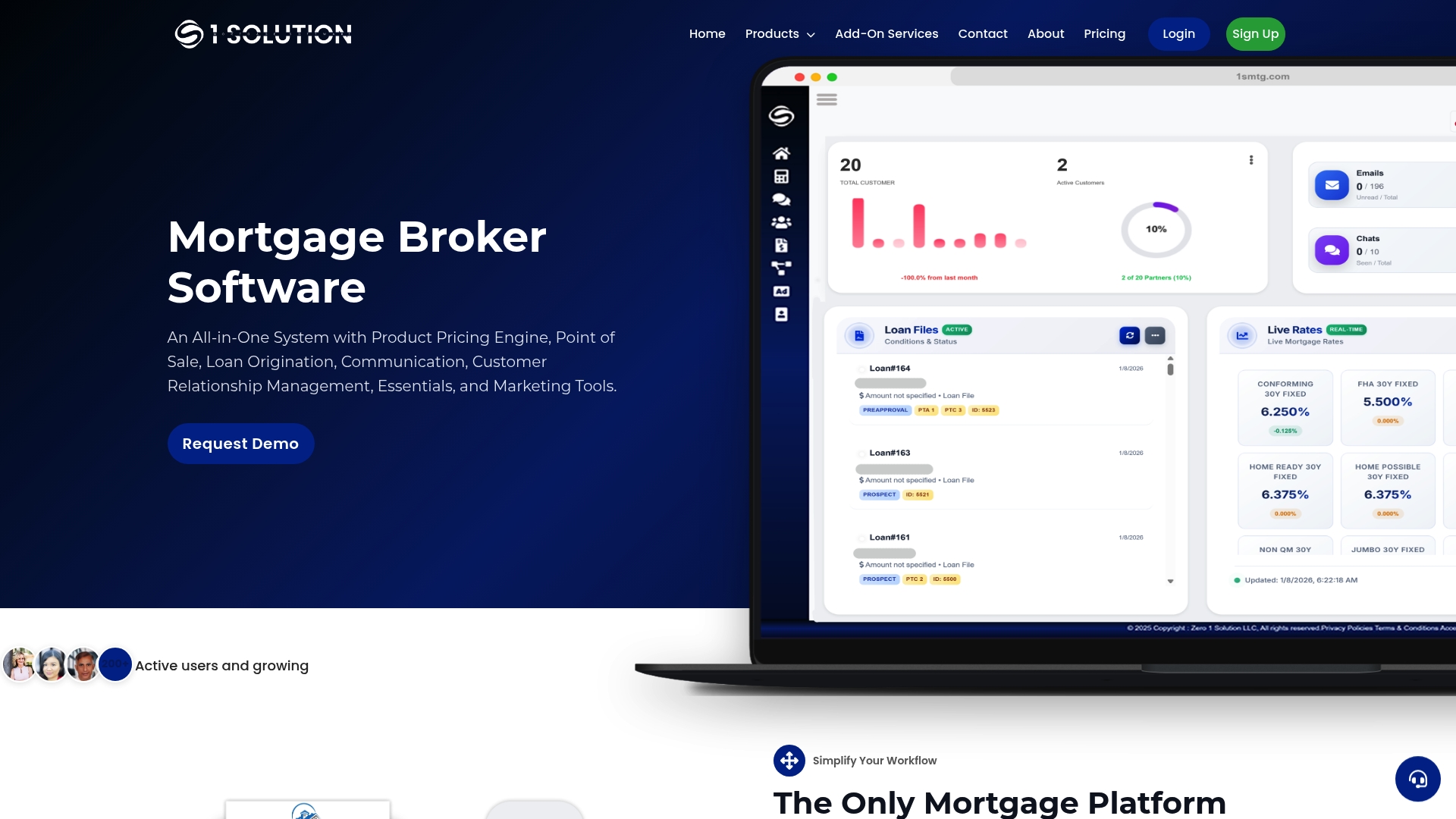
- CRM and LOS/POS connectivity live in one platform, removing the double entry that creates audit gaps.
- Marketing automation ties campaigns to pipeline stage without a separate tool.
- PBX and SMS communications, billed at $0.10 per minute for calls and $0.10 per message sent or received, stay logged inside the same system.
- Compliance-aware workflows are built around brokers, not banks, with real support behind them.
Independent brokers get fewer integrations to manage and one vendor to hold accountable. If you want to see how it fits your pipeline, request a demo or check subscription options.
Where to go deeper on AI, valuations, and privacy rules
For the regulatory detail behind this article, review the CFPB's AVM final rule, FTC guidance on data privacy, and the NIST AI risk management framework for structuring your own oversight.

This article is general information, not a substitute for advice from a qualified financial advisor. Consult a qualified financial professional about your own circumstances before acting on anything here.
Sources
- CFPB comment on uses, opportunities, and risks of artificial intelligence in the financial services sector
- Interagency automated valuation models final rule (CFPB PDF)
- AI companies: uphold your privacy and confidentiality commitments (FTC)
FAQ
Can AI build me a CRM system?
AI tools can help generate parts of a workflow or automate tasks inside an existing CRM, but building a compliant mortgage CRM from scratch requires licensed origination features, LOS integration, and regulatory controls that go well beyond what a general AI tool can assemble. Most brokers are better served choosing a purpose-built platform than trying to construct one with generic AI.
What is the best CRM software for mortgage professionals?
The right choice depends on whether the platform integrates natively with your LOS, logs automated decisions for audit purposes, and fits your team's size and budget. Buyer guides consistently point to native LOS sync and documented compliance workflows as the deciding factors over a long feature list.
Which CRM is best for mortgage brokers specifically?
Independent brokers tend to do better with platforms built specifically for brokers rather than adapted from bank or direct-lender software, since broker workflows differ on compliance, pricing, and vendor relationships. Look for one connected system over several disconnected tools to avoid double entry and audit gaps.
What are the best AI tools for mortgage loan officers?
The most useful AI tools for loan officers handle 24/7 lead follow-up, appointment setting, lead scoring, and marketing automation tied to pipeline stage. The features that matter most are the ones that connect directly to your LOS and keep a documented audit trail, not the ones with the flashiest chatbot.
How much does an AI mortgage CRM cost?
Pricing varies widely by vendor and by which features and communication tools are included. 1 Solution, for example, lists its Subscription Account with communication fees billed at $0.10 per minute for phone calls and $0.10 per message for texts and faxes, with the base subscription price available on request.