
The integration that matters is bidirectional status write-back, not prefill. If your CRM can populate a loan file but can't receive real-time status updates back from your LOS, you've built half a system. Start with a field audit, turn on live status sync between the two platforms, and phase your rollout instead of trying to launch everything at once.
TL;DR:
- Proper bidirectional status write-back, not just prefill, ensures real-time updates between CRM and LOS, critical for pipeline accuracy and borrower trust.
- Visual demos of live write-back are essential; many vendors fail to showcase real-time updates under failure or edge cases.
- Mapping fields continuously, not just at launch, prevents integration breakdowns as loan products and processes evolve.
- Using MISMO standards and admin-configurable mapping reduces maintenance and speeds onboarding of new loan types or vendors.
- Fully integrated platforms eliminate vendor management issues and reduce support tickets caused by disconnected systems.
Table of Contents
- What Is CRM LOS Integration, and Why Does It Matter for Mortgage Teams?
- What Disconnected Systems Actually Cost You
- Why Do So Many CRM–LOS Integrations Fail?
- A Tactical Blueprint: Map, Connect, Surface
- APIs, MISMO, and the Architecture Decisions That Matter
- Checklist, Timeline, and What It Actually Costs
- What 20 Years in Mortgage Operations Teaches You About Integration Projects
- Why Most Integration Advice Skips the Part That Actually Breaks
- How 1 Solution Handles CRM and LOS Under One Roof
- Developer Portals and Standards Worth Bookmarking
- Sources
- FAQ
What Is CRM LOS Integration, and Why Does It Matter for Mortgage Teams?
CRM LOS integration connects your customer relationship management system to your loan origination system so borrower data, loan status, and communication history move automatically between them, instead of being retyped by a processor at 6 p.m. on a Friday. Done right, it turns two separate tools into one connected pipeline view.
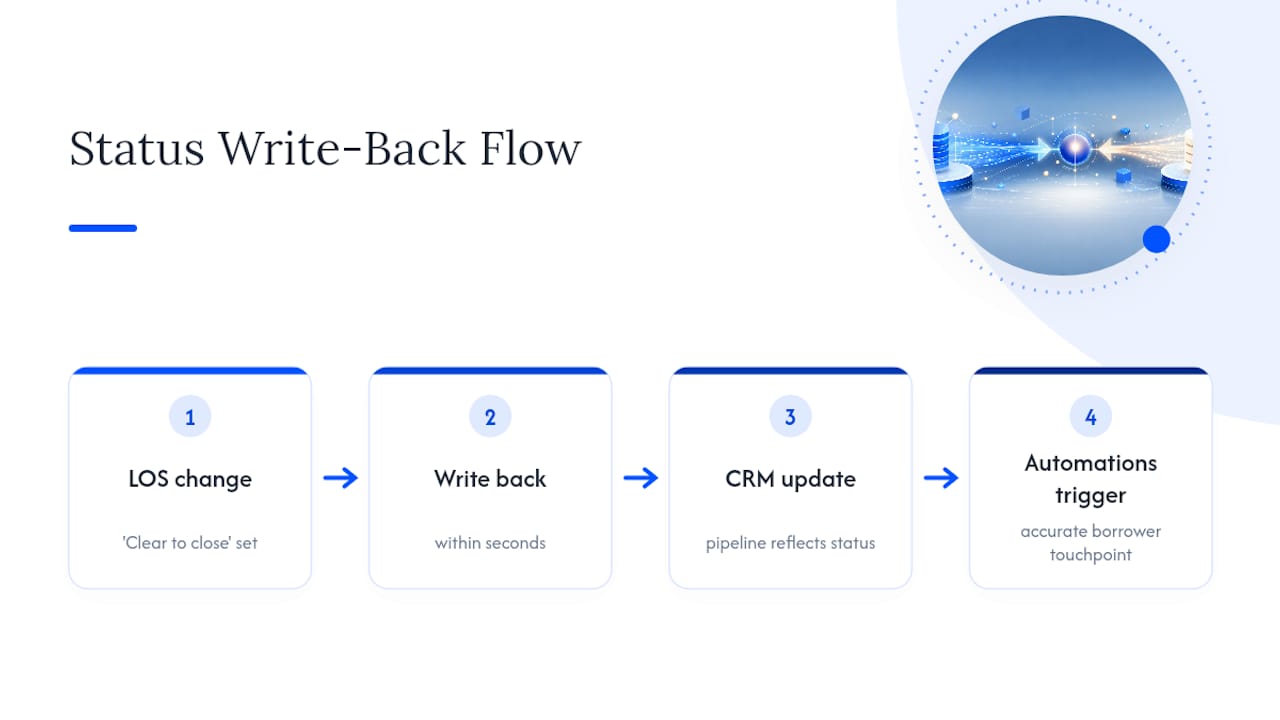
The payoff shows up in three places: data accuracy, borrower communication, and pipeline reliability. When a loan moves from "processing" to "clear to close" inside the LOS, that status should hit the CRM within seconds, not the next morning after someone remembers to update it. Loan officers stop guessing where a file stands, and marketing automation can trigger the right borrower touchpoint at the right moment instead of a generic drip campaign that doesn't know the loan already closed.
The financial case is concrete. Lender case-study data shows integrated Encompass and CRM setups increase profit per loan and cut manual entry, largely because processors stop duplicating work across systems that don't talk to each other. Compliance risk drops too. A borrower disclosure sent from a CRM that doesn't know the loan status changed yesterday is the kind of error that shows up in an audit, not just a customer complaint.
Pro Tip: Before you evaluate any vendor, pull your last 90 days of closed loans and count how many times a processor had to manually re-enter status or contact data between systems. That number is your baseline for measuring integration ROI.
What Disconnected Systems Actually Cost You
Duplicate entry is the visible cost. The invisible one is worse: stale pipeline reporting that makes your forecast wrong. When your CRM shows 40 active loans but 12 of them funded three days ago in the LOS, every pipeline meeting starts from bad numbers.
These costs compound as you grow. A five-loan-officer shop can survive on manual reconciliation because someone catches the errors before they matter. Add a second branch, a new loan product, or a construction-to-perm option, and the same manual process breaks down at scale. Field mapping that worked for a simple purchase loan doesn't automatically extend to a product with draw schedules and inspection milestones.
The failures are specific, not abstract. A borrower gets a "your loan is approved" text after the file actually stalled in underwriting, because the CRM's status field never updated. A processor closes a file in the LOS on Friday, and the CRM still shows it as active the following Wednesday because no one manually closed it out. Multiply either scenario across a full pipeline and you're not looking at inconvenience anymore. You're looking at borrower trust and compliance exposure.
Why Do So Many CRM–LOS Integrations Fail?
Most failures trace back to the same handful of causes, and nearly all of them are preventable with the right prep work before a contract gets signed.
- Legacy SDK dependencies. ICE Mortgage Technology has pushed its Encompass SDK sunset to the end of 2026, which means any integration still built on the older SDK needs a migration plan now, not after the deadline forces it.
- Field mapping complexity. Every new loan product, like a construction draw schedule, adds fields that need mapping. Treat that as ongoing configuration work, not a one-time project, or you accumulate integration debt with every product launch.
- Demos that only show prefill. Watching a CRM auto-fill a borrower's name into an LOS application is easy to demo and easy to fake with a spreadsheet. Watching status changes write back from the LOS to the CRM in real time is the test that actually matters.
- Weak change management. Loan officers who've worked around disconnected systems for years won't trust automated status updates immediately. Budget time for training and a transition period where staff verify the automation before they rely on it.
Pro Tip: Ask every vendor to demo write-back live, not prefill. Move a test loan through three status changes in the LOS during the call and watch whether the CRM updates in real time.
A Tactical Blueprint: Map, Connect, Surface
Treat the integration as three distinct phases, each with its own deliverable. Skipping straight to "connect" without mapping first is the single most common reason projects stall six weeks in.
- Map. Document your full lead-to-funded process, then audit every field that moves between systems. Sort them into two buckets: fields that need bidirectional sync (loan status, milestone dates, assigned processor) and fields that only need to flow one way (initial lead source, borrower contact info entered once at intake). This step alone usually surfaces gaps nobody knew existed, like a status value in your LOS that has no equivalent field in your CRM.
- Connect. Decide whether a native connector, a direct API integration, or middleware fits your stack, then test it hard before rolling it out. Push a test loan through appraisal ordered, appraisal complete, underwriting approved, clear to close, and funded, and confirm the CRM reflects each change immediately. Test what happens when a write fails, too. Does the system retry, alert someone, or silently drop the update?
- Surface. Once data is flowing reliably, build the dashboards, alerts, and borrower messaging triggers that make the integration worth having. This is where loan officers actually see the benefit: a pipeline dashboard that's accurate in real time, automated borrower texts tied to real milestones, and reporting that doesn't require a Friday afternoon reconciliation.
Phase your rollout instead of launching all three steps simultaneously:
- Phase one (MVP): sync contact records and loan status only. Prove write-back works reliably before adding anything else.
- Phase two: layer in notifications and processing checklists once status sync is stable in production.
- Phase three: add full reporting and dashboards once the underlying data has been reliable for a full loan cycle.
This sequencing matches what integration specialists recommend: prove bidirectional write-back in production before expanding scope, because every feature you build on top of unreliable data sync inherits that unreliability.
APIs, MISMO, and the Architecture Decisions That Matter
Standards alignment saves you months of mapping headaches later. MISMO's API Toolkit 1.1, finalized in February 2023, gives developers a standardized data model to work from instead of reverse-engineering field names from scratch. Aligning your mapping to MISMO early reduces rework every time you add a loan product or switch a vendor down the line.
If you're on Encompass, Encompass Developer Connect provides open APIs, an interactive API playground, and documentation for building and testing integrations against the ICE Mortgage Technology Platform. Confirm during any vendor conversation whether their integration depends on the legacy SDK or the current API set, given the 2026 sunset timeline.
Three architectural choices decide how much maintenance you'll do later:
| Consideration | Lower-maintenance choice | Higher-maintenance choice |
|---|---|---|
| Sync timing | Webhook or real-time push | Nightly batch sync |
| Field mapping | Admin-configurable interface | Hardcoded, developer-only connector |
| Data source | Standardized API (MISMO-aligned) | Custom scraping or legacy SDK |
Admin-configurable mapping matters more than it sounds. Industry guidance is consistent on this: choose platforms that let non-developers adjust field mappings rather than filing a support ticket every time a loan product changes. For readers evaluating additional third-party data sources, Fannie Mae's developer portal offers public APIs after free registration and business-partner APIs that require approval, a useful reference point for what a mature API program looks like.
Checklist, Timeline, and What It Actually Costs
Before you sign anything, confirm these items are done: a full field inventory across both systems, API access credentials from your LOS vendor, a security and compliance review of the data flow, a written test plan covering both prefill and write-back, and a rollback plan if the integration needs to be paused mid-rollout.
Timelines vary by scope. An MVP that syncs contacts and status typically takes a few weeks. A full-feature integration with dashboards, checklists, and reporting usually takes longer, potentially several weeks to a few months. Legacy SDK migrations, custom field mapping for niche loan products, and multi-branch rollouts all push those estimates longer.
Cost breaks into four levers: software licensing for the CRM and LOS themselves, development time for the connection (higher if you're building custom rather than using a native connector), any middleware licensing if you route data through a third-party integration platform, and staff training to get loan officers actually using the new workflows instead of falling back on old habits.
When you sit through vendor demos, ask pointed questions:
- Can you show live write-back, not just prefill, with a test loan moving through real status changes?
- Can a non-developer on my team adjust field mappings when we add a new loan product?
- What's the maintenance SLA if the API changes on either side?
Pro Tip: Get the maintenance SLA in writing before you sign. A vendor that can't answer what happens when the LOS pushes an API update is telling you the integration is fragile.
What 20 Years in Mortgage Operations Teaches You About Integration Projects
The integrations that hold up over time share one trait: someone treated field mapping as an ongoing job, not a launch-day checkbox. The ones that fall apart are almost always the ones where a developer hardcoded a connector, moved on to the next project, and left the brokerage stuck filing support tickets every time a loan product changed.

Small brokerages should lean toward an integrated platform where CRM and LOS already share a data model, since a two-person ops team can't absorb custom integration maintenance. Larger lenders with dedicated IT staff have more room to build bespoke connections, but even then, admin-configurable mapping saves real time. Readers building out their broader tech stack can find more context in this guide to mortgage automation tools and this breakdown of loan origination system fundamentals.
Why Most Integration Advice Skips the Part That Actually Breaks
Most integration guides spend their time on prefill because it's the easy, demo-friendly half of the problem. Watching a CRM auto-populate a borrower's name into an LOS application looks impressive and takes ten minutes to build. That's exactly why it dominates the conversation and why so many brokerages sign contracts based on a demo that never shows the hard part.
The conventional advice undersells status write-back because it's harder to demo and harder to sell. A vendor showing you real-time bidirectional sync has to prove the connection holds up under failure conditions, retries, and edge cases like a loan that gets pulled from underwriting and resubmitted. That's a much riskier thing to demo live, so plenty of vendors just don't.
My honest read: prioritize write-back over every other feature on the list, including reporting dashboards and marketing automation triggers. Those features are worthless if the underlying status data is unreliable. Second priority is admin-configurable mapping, because your loan products will change and you shouldn't need a developer every time they do. Everything else, including how polished the CRM interface looks, matters far less than these two fundamentals.
— Omar Khamisa
How 1 Solution Handles CRM and LOS Under One Roof
Some platforms offer integrated CRM and LOS solutions, avoiding the need to manage separate vendor relationships and connections. Because both systems live in one connected ecosystem, built by brokers who spent years on the operations side of this exact problem, there's no separate vendor relationship to manage for status sync, no hardcoded connector waiting to break when a loan product changes, and no support ticket queue between you and a mapping fix.
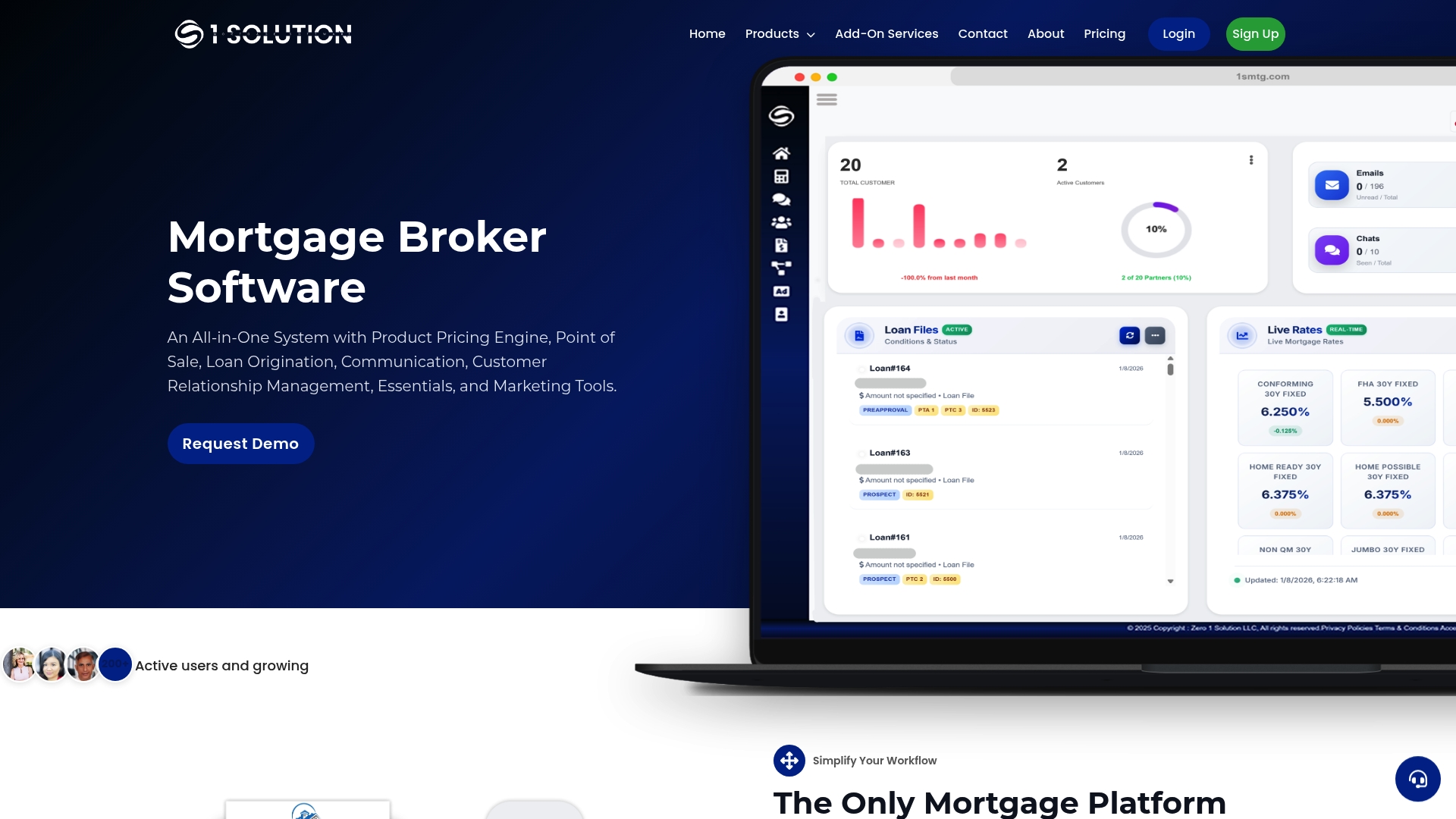
Certain platforms integrate CRM, LOS, pricing, compliance, e-signature, and borrower communication with admin-configurable workflows tailored to how independent brokers operate. If you're weighing a custom integration project against a platform where the pieces already talk to each other, see how the full platform works at 1 Solution and request a demo to see live status sync in action before you commit to either path.
Developer Portals and Standards Worth Bookmarking
Four resources are worth saving before you scope any integration project. MISMO's API Toolkit gives you the standardized data models that reduce mapping guesswork. Encompass Developer Connect covers Encompass-specific API documentation and a live testing playground. Fannie Mae's Developer Portal lists public and partner APIs for lenders working with agency data. For brokerages evaluating CRM platforms that need outside implementation support, agencies like 121 Group's Zoho integration services handle CRM configuration work that smaller teams often lack the bandwidth to do in house.
Sources
- MISMO — API Toolkit 1.1
- Encompass Developer Connect — ICE Mortgage Technology
- CRM and LOS integration for lenders: Why prefill is the easy half and status write-back is where it breaks — LendFoundry
- Integrating LOS and CRM Platforms Without Breaking Your Data Stack — Mortgage Workspace
FAQ
What is CRM integration in the mortgage industry?
CRM integration connects your customer relationship management platform to other systems, most critically your LOS, so borrower data and loan status sync automatically instead of requiring manual re-entry between tools.
What is the difference between LOS and LMS?
An LOS (loan origination system) manages the loan from application through closing, while an LMS (loan management system, sometimes called a servicing system) handles the loan after it funds, including payments and escrow. The two systems serve different stages of the loan lifecycle and typically require separate integrations.
What is the best CRM for mortgage loan officers?
The best choice depends on whether you need a standalone CRM with a separate LOS integration or a platform where CRM and LOS already share data natively. Some software platforms offer the approach of providing CRM, LOS, and pricing tools under one system to avoid managing multiple vendor integrations.
How much commission do loan officers make on a $500,000 loan?
Commission structures vary widely by brokerage, loan program, and compensation model, so there's no single figure that applies across the industry. Loan officers should confirm their specific commission structure with their brokerage rather than relying on industry averages.
Why does status write-back matter more than prefill?
Prefill only populates data one direction, from CRM into LOS, at the start of a loan. Status write-back keeps the CRM updated in real time as the loan moves through underwriting and closing, which is what actually prevents stale pipeline data and missed borrower communications.