


Mortgage broker operations is defined as the structured, end-to-end process brokers use to originate, manage, and close home loans on behalf of borrowers. This process spans multiple stages: initial consultation, borrower fact-finding, lender selection, application submission, underwriting management, condition clearing, and closing coordination. Each stage depends on the right combination of people, workflows, and mortgage broker technology. Brokers who treat operations as a system rather than a series of tasks close more loans with fewer errors and far less stress.
What are the core steps in mortgage broker operations?
Mortgage broker operations cover a defined sequence of phases, each with its own tasks, timelines, and decision points. Understanding the sequence is the foundation of every mortgage brokerage workflow explained clearly to new and experienced professionals alike.
-
Initial consultation and fact-finding. The broker gathers borrower income, assets, liabilities, credit history, and property goals. This session typically runs 30–60 minutes and sets the data foundation for every downstream decision.
-
Borrowing capacity and lender panel shopping. The broker calculates what the borrower qualifies for, then matches the file to the best-fit lender based on rate, product, and credit appetite. This is pure broker judgment. No processor should be making this call.
-
Pre-approval submission. The broker submits the file to the selected lender. Pre-approval typically arrives within 1–3 business days for automated underwriting and longer for manual reviews.
-
Formal application and document collection. Once the borrower identifies a property, the broker submits a full application with all supporting documents. A mortgage broker POS system handles secure document upload and borrower communication at this stage.
-
Underwriting and condition management. The lender reviews the file and issues conditions. The broker and processor work to clear each condition with speed and accuracy. Lender approval typically arrives within 7–14 business days.
-
Commitment and closing coordination. After conditions clear, the lender issues a commitment letter. Closing is scheduled, disclosures are delivered, and the loan funds. The full cycle from fact-finding to closing commonly spans 21–45 days depending on loan type and lender.
Pro Tip: Map your pipeline stages in your mortgage broker CRM to mirror these exact phases. When your CRM stages match your real workflow, reporting becomes accurate and bottlenecks become visible.
How do workflow lanes separate broker judgment from admin tasks?
The workflow lane model is the most underused concept in mortgage broker workflow best practices. It splits every task in the loan process into two parallel tracks: the broker lane and the admin lane.

The broker lane holds all judgment-based decisions. Lender selection, loan structuring, rate strategy, client advice, and final sign-offs belong here. These tasks require experience and accountability. They cannot be delegated without risk.
The admin lane runs continuously alongside the broker, handling repeatable execution tasks. Document follow-up, legibility checking, valuation ordering, condition tracking, and status updates all live here. A trained processor or operations assistant owns this lane.
The practical benefit is significant. When brokers stay in their lane, they can manage more files simultaneously without losing quality control. When processors own the admin lane, documents move faster and fewer items fall through the cracks. The split also makes it easier to identify where delays originate, because each lane has clear ownership.
- Broker lane tasks: Lender selection, rate lock decisions, structuring advice, compliance sign-offs, client strategy calls
- Admin lane tasks: Document collection, condition chasing, valuation coordination, status update emails, checklist management
- Shared touchpoints: File review before submission, condition response review, closing disclosure verification
Strong operational models keep broker judgment centralized while delegating repeatable workflow tasks to processors. This is not about reducing broker involvement. It is about protecting broker time for the work that actually requires a licensed professional.
Pro Tip: Build a written lane definition document for your team. When every person knows exactly which tasks belong to them, handoffs become faster and accountability becomes clear.
What are best practices for mortgage broker CRM workflows?
A mortgage broker CRM built for loan origination operates very differently from a generic contact management tool. Origination-specific CRM systems cover the full borrower lifecycle from lead capture through post-closing follow-up, with pipeline stages, automated reminders, and document tracking built into the core product.
The table below shows how origination-specific mortgage CRM software compares to generic CRM tools across the tasks brokers actually need:
| Feature | Origination-specific CRM | Generic CRM |
|---|---|---|
| Pipeline stage management | Loan-phase stages with aging alerts | Custom fields only |
| Document collection | Secure borrower portal with auto-reminders | Manual email tracking |
| Conditional logic by loan type | VA vs. conventional checklist automation | Not available |
| Compliance tracking | RESPA/TILA disclosure timelines built in | Manual workarounds |
| Post-closing follow-up | Automated referral and review campaigns | Basic email sequences |
The most important CRM workflow feature brokers overlook is conditional logic for loan types. A VA loan file requires different documents than a conventional purchase. When the CRM automatically adjusts the checklist based on loan type and investor overlays, processors stop wasting time on irrelevant tasks and files arrive at underwriting more complete.
Role-based access is equally critical. Processors should see what they need to execute their tasks. Brokers should see the full pipeline. Compliance officers need audit logs. When access is structured by role, data integrity improves and regulatory exposure drops.
- Lead capture: Automated intake forms connected directly to pipeline stages
- Application processing: Borrower portal for document upload with status visibility
- Pipeline management: Stage-based tracking with aging alerts by loan phase
- Post-closing: Automated review requests and referral follow-up sequences
Which KPIs help optimize mortgage broker operations?
Volume alone is a misleading KPI. Brokers who track only loan count miss the operational signals that predict problems before they become losses. The KPIs that actually reveal operational health are conversion rates, average loan cycle time, lock-to-close rate, and fallout rate.
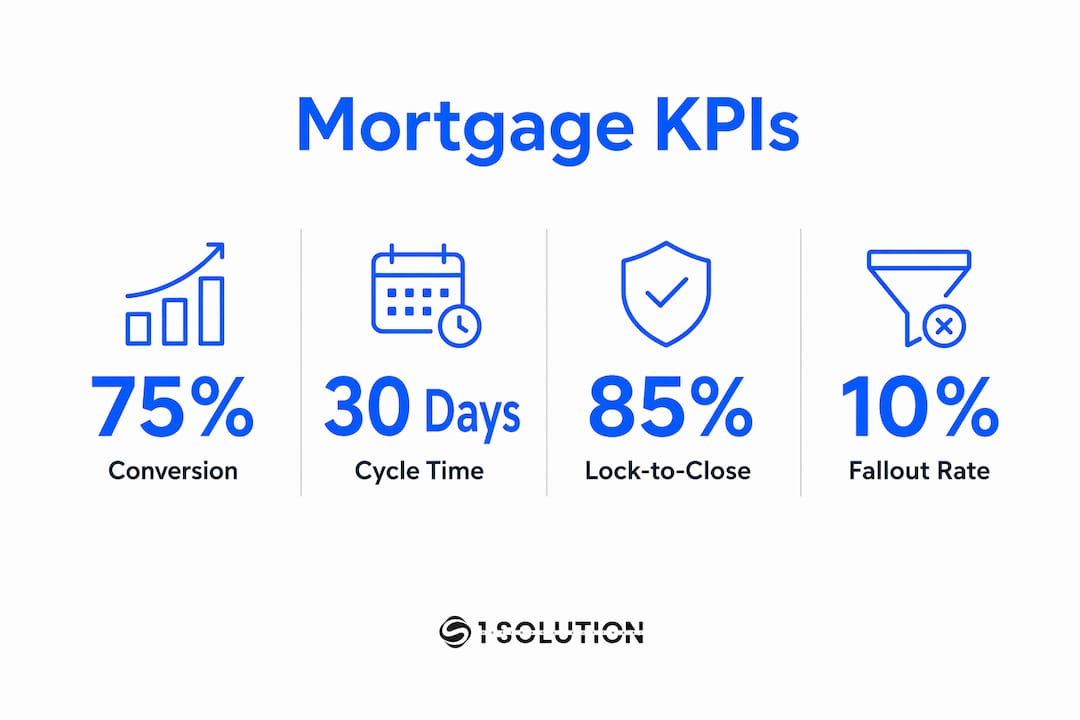
| KPI | What it measures | Why it matters |
|---|---|---|
| Pull-through / conversion rate | Percentage of applications that close | Reveals file quality and lender fit |
| Average loan cycle time | Days from application to closing | Identifies overall process speed |
| Lock-to-close rate | Loans that close within the rate lock period | Signals underwriting and condition efficiency |
| Fallout rate | Percentage of loans that do not close | Flags structuring or qualification problems |
| Stage aging | Days a file sits in each pipeline stage | Pinpoints specific bottlenecks |
Stage aging reports are the most powerful tool in this list. Pipeline stage aging reveals exactly where files stall, whether that is at document collection, underwriting submission, or condition clearing. Without stage-by-stage visibility, brokers address symptoms rather than causes.
Tracking pipeline aging by stage also protects against rate lock risk. When a file sits too long in underwriting, the rate lock window shrinks. Brokers who monitor stage aging can intervene before the lock expires, saving the borrower money and the deal itself.
How do underwriting and condition management affect operational timing?
Underwriting is the single biggest timing choke point in the loan process. Manual underwriting reviews take 3–7 business days, and clearing conditions after the initial review adds another 3–10 days. Incomplete documents at submission are the primary cause of these delays.
The TRID rule adds a hard regulatory deadline to the closing timeline. The Closing Disclosure must reach the borrower at least 3 business days before signing. That deadline is non-negotiable. Brokers who do not build this buffer into their workflow create last-minute scrambles that damage client trust and sometimes kill deals.
Effective condition management treats every outstanding condition as an item in a prioritized queue with clear ownership. Each condition gets assigned to a specific team member with a due date. Freshness discipline matters: a condition response submitted 24 hours after the lender issues it moves the file forward. A response submitted five days later restarts the underwriting clock.
- Assign every condition to one owner. Shared ownership means no ownership.
- Set internal SLAs for condition response. A 24-hour turnaround target is realistic and effective.
- Track condition age in your mortgage broker software. If a condition sits unresolved for more than two days, escalate immediately.
- Verify document legibility before submission. Blurry bank statements and cut-off pay stubs are the most common causes of re-submission delays.
Automation in broker operations can accelerate condition chasing through automated reminders. Those reminders must include built-in compliance review gates. Sending a disclosure-related communication at the wrong time creates regulatory exposure. Speed and compliance are not opposites, but they require deliberate workflow design to coexist.
Pro Tip: Build a condition log directly inside your mortgage CRM software. When every condition has an owner, a due date, and a status field, nothing gets lost and nothing gets forgotten.
Key Takeaways
Effective mortgage broker operations require structured workflow lanes, origination-specific CRM software, and stage-level KPI tracking to close loans faster and with fewer compliance risks.
| Point | Details |
|---|---|
| Workflow lanes improve throughput | Separate broker judgment tasks from admin execution to protect broker time and reduce errors. |
| Origination-specific CRM is non-negotiable | Generic contact tools lack the conditional logic, compliance tracking, and pipeline staging brokers need. |
| Stage aging reveals true bottlenecks | Overall pipeline volume hides delays; stage-by-stage aging reports show exactly where files stall. |
| Condition management needs ownership | Assign every underwriting condition to one person with a due date to cut clearing time significantly. |
| Compliance gates belong inside automation | Automated workflows must include review checkpoints to meet TRID and RESPA timing requirements. |
What I have learned after 20 years in mortgage operations
I have worked every seat in this business: processor, underwriter, loan originator, and systems consultant. The single most consistent problem I have seen across every brokerage I have worked with is not a lack of talent. It is a lack of workflow structure.
Brokers who struggle with volume are almost always brokers who never separated their judgment tasks from their admin tasks. They are personally chasing documents, personally following up on conditions, and personally sending status updates. That is not a business. That is a job with unlimited hours and no ceiling.
The second pattern I see constantly is brokers who track volume and nothing else. They know how many loans are in the pipeline. They do not know how long each file has been sitting in underwriting, which conditions are overdue, or what their actual pull-through rate is. When a deal falls apart, they are surprised. They should not be. The warning signs were in the data the whole time.
The third thing I want to say directly: automation is not a shortcut around compliance. I have seen brokers implement automated communication tools and then get flagged for TRID timing violations because nobody built a review gate into the workflow. Fast is good. Compliant and fast is the only acceptable standard.
The mortgage broker compliance management piece is not optional. It belongs inside your workflow from day one, not bolted on after a regulator asks questions. Build it in, track it by stage, and audit it regularly.
— Omar Khamisa
How 1 Solution Mortgage Software supports your operations
Running a mortgage brokerage without the right technology costs you time, deals, and compliance confidence. 1 Solution Mortgage Software was built from the ground up by brokers who lived these exact operational challenges.
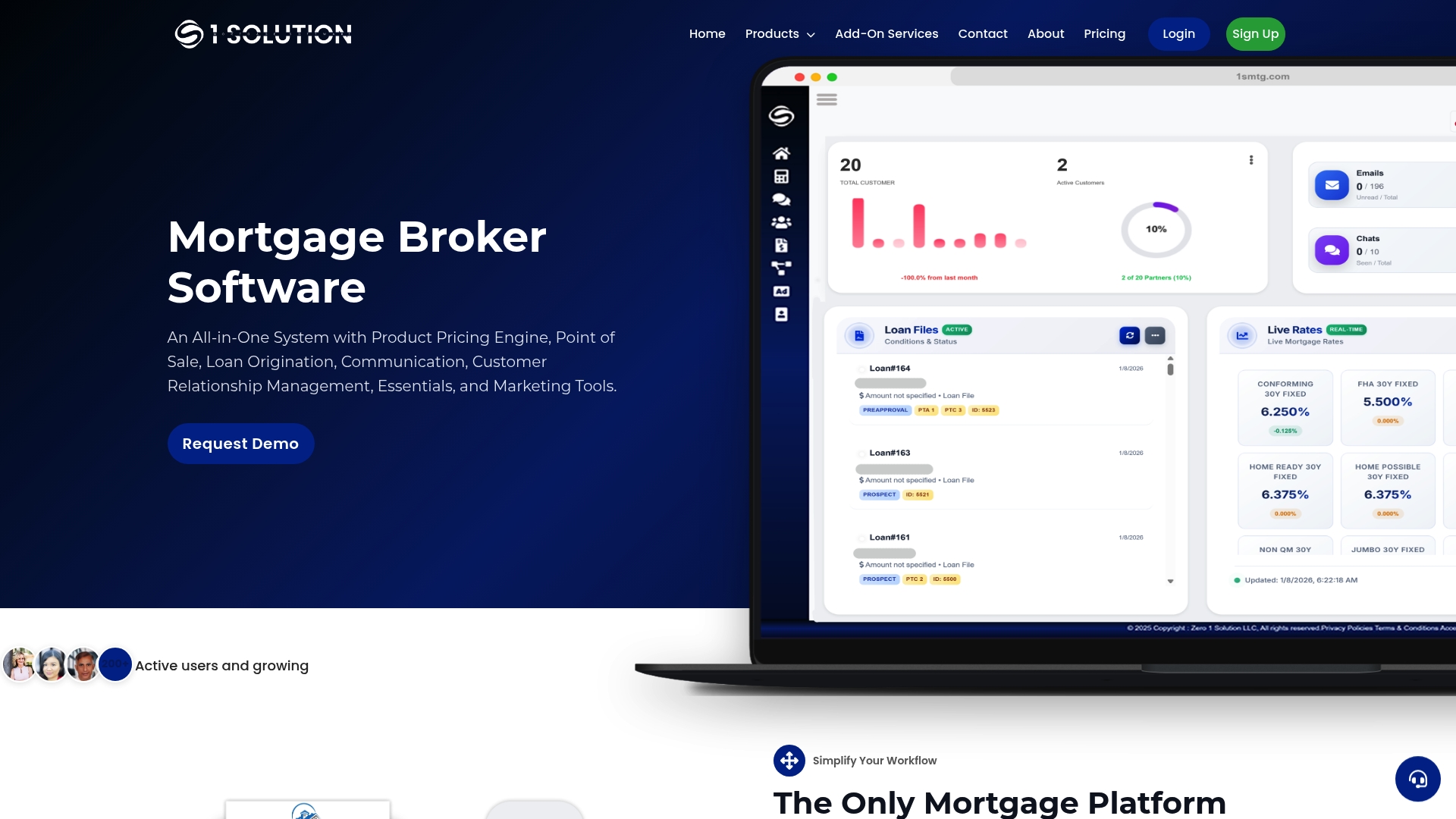
The platform brings together mortgage CRM software, a built-in POS, pipeline management, compliance tracking, and marketing tools in one connected system designed specifically for independent mortgage professionals. You get stage-based pipeline visibility, automated document collection, role-based access, and compliance review gates without stitching together five separate tools. 1 Solution Mortgage Software gives you the operational control that generic platforms were never designed to provide. Visit 1smtg.com to see how the platform fits your workflow.
FAQ
What does mortgage broker operations mean?
Mortgage broker operations refers to the full process brokers use to originate and close loans, covering fact-finding, lender selection, application submission, underwriting management, condition clearing, and closing coordination.
What is a mortgage broker CRM used for?
A mortgage broker CRM manages the full borrower pipeline from lead capture through post-closing follow-up, with stage tracking, automated document collection, and compliance reminders built specifically for loan origination.
How long does the mortgage broker loan process take?
The full cycle from fact-finding to closing typically spans 21–45 days. Underwriting alone takes 3–7 business days for manual reviews, plus 3–10 additional days to clear conditions.
What KPIs should mortgage brokers track?
Brokers should track pull-through rate, average loan cycle time, lock-to-close rate, fallout rate, and stage aging. Volume alone does not reveal where operational problems originate.
Why do workflow lanes matter in mortgage brokerage?
Workflow lanes separate broker judgment tasks from processor admin tasks, protecting broker time for licensed decisions while keeping document and condition work moving without bottlenecks.