

If your loan origination system forces manual workarounds, blocks key integrations, or keeps raising license fees, the fix isn't another workaround. It's a controlled migration. Start with a readiness assessment, budget for parallel running and integration testing, and treat 1 Solution Mortgage Software as one legitimate platform option worth evaluating alongside whatever you're using now.
TL;DR:
- A successful LOS migration requires thorough planning, including readiness assessments, detailed budgeting, and parallel testing to ensure data integrity and compliance.
- Mid-market lenders should budget between $75,000 and $300,000 for migration beyond licensing fees, covering implementation, data cleansing, and integration development.
- Testing core integrations like loan boarding and investor feeds in layered stages helps prevent failures that could lead to regulatory or operational issues during cutover.
- Staff training must be role-specific and ongoing, with designated super-users and a dedicated war room to handle post-go-live issues to minimize productivity dips.
- Maintaining an unbroken audit trail and documenting discrepancies during parallel runs is critical to preventing compliance failures and avoiding costly audits.
Table of Contents
- When Should You Actually Switch Your LOS?
- What Does a Realistic LOS Migration Timeline and Budget Look Like?
- How Do You Migrate Loan Data Without Breaking Compliance?
- Which Integrations Should You Test First?
- How Do You Prevent a Productivity Collapse During Go-Live?
- What Compliance Controls Should You Require During Cutover?
- What I've Learned Watching Brokers Switch Systems
- Get Migration Support Built Into Your New LOS
- Sources
When Should You Actually Switch Your LOS?
Before you call a vendor, run the numbers. So is a licensing bill that's climbed faster than your loan volume, or an application abandonment rate creeping up because your borrower portal feels like it was built a decade ago (because it probably was).
Watch for integration debt too: every time a processor has to export a file, email it, and manually upload it into another system, you're paying a hidden tax on every loan.
A few red flags mean you should pause, not proceed:
- No executive sponsor willing to own the project and defend the budget
- No clean test dataset to validate a new system against
- A core integration (credit, pricing, or investor delivery) with no confirmed replacement path
Before signing anything, loop in compliance, IT, finance, underwriting, and operations. Each group sees a different failure mode, and skipping one is how migrations blow past budget.
What Does a Realistic LOS Migration Timeline and Budget Look Like?
Every LOS switch moves through the same six phases: discovery, mapping and design, migration testing, parallel running, cutover, and stabilization. What changes is duration. A small independent broker can move through all six in six to ten weeks. A mid-market lender with multiple integrations and investor relationships typically needs four to eight months. Enterprise shops with warehouse lines, multiple branches, and legacy custom code should plan for 12 to 18 months.

Budget for more than the subscription line. Consultants who've been through this repeatedly point to five categories worth itemizing separately: implementation fees, data migration work, integration development, training, and a productivity contingency for the inevitable slowdown after cutover.
Migration cost snapshot: Mid-market lenders should expect $75,000 to $300,000 in costs beyond licensing fees, covering implementation, data migration, and integration development.
Build your approval request around these line items:
- Implementation and vendor setup fees
- Data migration and cleansing labor
- Custom integration development
- Training hours across every affected role
- A contingency line for schedule slippage and lost productivity
How Do You Migrate Loan Data Without Breaking Compliance?
Not every historical record needs to move. Loans that closed years ago and are outside your regulatory retention window can often stay archived in the legacy system rather than get forced into the new one. Active pipeline loans, anything still under investigation or audit, and loans within your retention period are different. Those need a validated, documented migration path.
The safest way to prove your new system works before you commit to it: run a parallel period.
- Pull a representative sample of active loans and load them into both systems.
- Reconcile disclosures and fee calculations line by line between the two platforms.
- Process at least one live loan end to end in both systems simultaneously.
- Define rollback criteria in writing before you start, not after something breaks.
- Run this parallel period for 30 to 90 days depending on loan complexity and volume.
The pitfalls that actually derail migrations are rarely the big obvious fields. It's document linkages that silently break, and custom fields your old system used for a workaround nobody documented.
Pro Tip: Assign one person to own reconciliation for the entire parallel period. When five people check different loans, discrepancies fall through the cracks between them.
Skipping this step doesn't just risk a bad borrower experience. It increases compliance risk at the exact moment regulators expect your audit trail to be airtight.
Which Integrations Should You Test First?
Rank your integrations by how badly a failure would hurt, not by how interesting they are to test. Core loan boarding into your servicing or investor delivery pipeline comes first, followed by warehouse and investor feeds, credit report pulls, appraisal and title ordering, and your pricing engine.
Testing needs to happen in layers:
- Unit tests on each integration in isolation, before anything touches a real loan
- Full pipeline end-to-end tests that mimic an actual loan from application to closing
- Reporting reconciliation to confirm your compliance and investor reports match across both systems
- At least two regression cycles after any fix, since patching one integration commonly breaks another
Don't take a vendor's word that integration scope and timelines are covered. Get it in writing, including what happens if a deliverable slips. Verbal assurances don't hold anyone accountable when a credit feed stops working two weeks before cutover.
How Do You Prevent a Productivity Collapse During Go-Live?
Training that happens once, weeks before cutover, doesn't stick. Run a train-the-trainer program instead, build role-based learning paths so underwriters aren't sitting through processor training, and hand out just-in-time job aids people can reference mid-task instead of digging through a manual.
Staff for the dip, because there will be one. A 20 to 40% temporary drop in lending productivity during cutover is common, even with good planning.
- Designate super-users in every department before go-live, not after problems start
- Staff a war room for the first 30 to 60 days post-cutover for rapid issue triage
- Prioritize pipeline loans by closing date so time-sensitive files get support first
- Reduce new loan intake temporarily if your team can't absorb both migration and volume
Pro Tip: Pick super-users who are respected by their peers, not just the fastest learners. People ask questions of colleagues they trust before they open a ticket.
What Compliance Controls Should You Require During Cutover?
Your audit trail can't have a gap where "we were migrating" explains missing history. Legacy timestamps stay untouched, and every parallel-run comparison you conduct needs to land in a documented audit log, not a spreadsheet someone might delete later.
Before you decommission anything, compliance should sign off against a checklist covering:
- Disclosure timing and content matching across both systems
- Fee calculations reconciled loan by loan, not sampled loosely
- Investor pricing consistency for loans in the pipeline during cutover
- Data integrity checks confirming no field silently dropped or corrupted
If a discrepancy shows up, don't rationalize it. Document it, escalate it to whoever owns the migration, and keep the legacy system live until it's resolved. The instinct to push forward because "we're so close" is exactly how migrations create compliance exposure that surfaces months later during an audit.
What I've Learned Watching Brokers Switch Systems
Most brokers don't fail at migration because they picked the wrong LOS. They fail because they underestimated how much risk lives in the seams between systems. Every handoff between your LOS, your pricing engine, your CRM, and your compliance tools is a place where data can get lost or timestamps can get scrambled.

That's the real argument for an integrated platform over a stack of best-in-class point solutions. Fewer seams mean fewer places for something to quietly break during a parallel run. It's also why we built 1 Solution the way we did: pricing, CRM, POS, LOS, and compliance sharing one data layer instead of five vendors each blaming the other when a loan boards wrong.
The mistake I see most often isn't technical. It's treating migration as a lift-and-shift instead of a chance to fix workflows that were broken in the old system too. If you're rebuilding your process anyway, rebuild it right. Our broker's guide to loan origination systems walks through the integration points worth rethinking, not just replicating.
— Omar Khamisa
Get Migration Support Built Into Your New LOS
Most switching pain comes from stitching together an LOS, a CRM, a pricing engine, and a compliance tool from four different vendors and hoping the integrations hold. 1 Solution Mortgage Software skips that problem entirely: LOS, CRM, pricing, POS, e-signature, and compliance run on one connected platform, so there's no third-party integration to break during your parallel run.
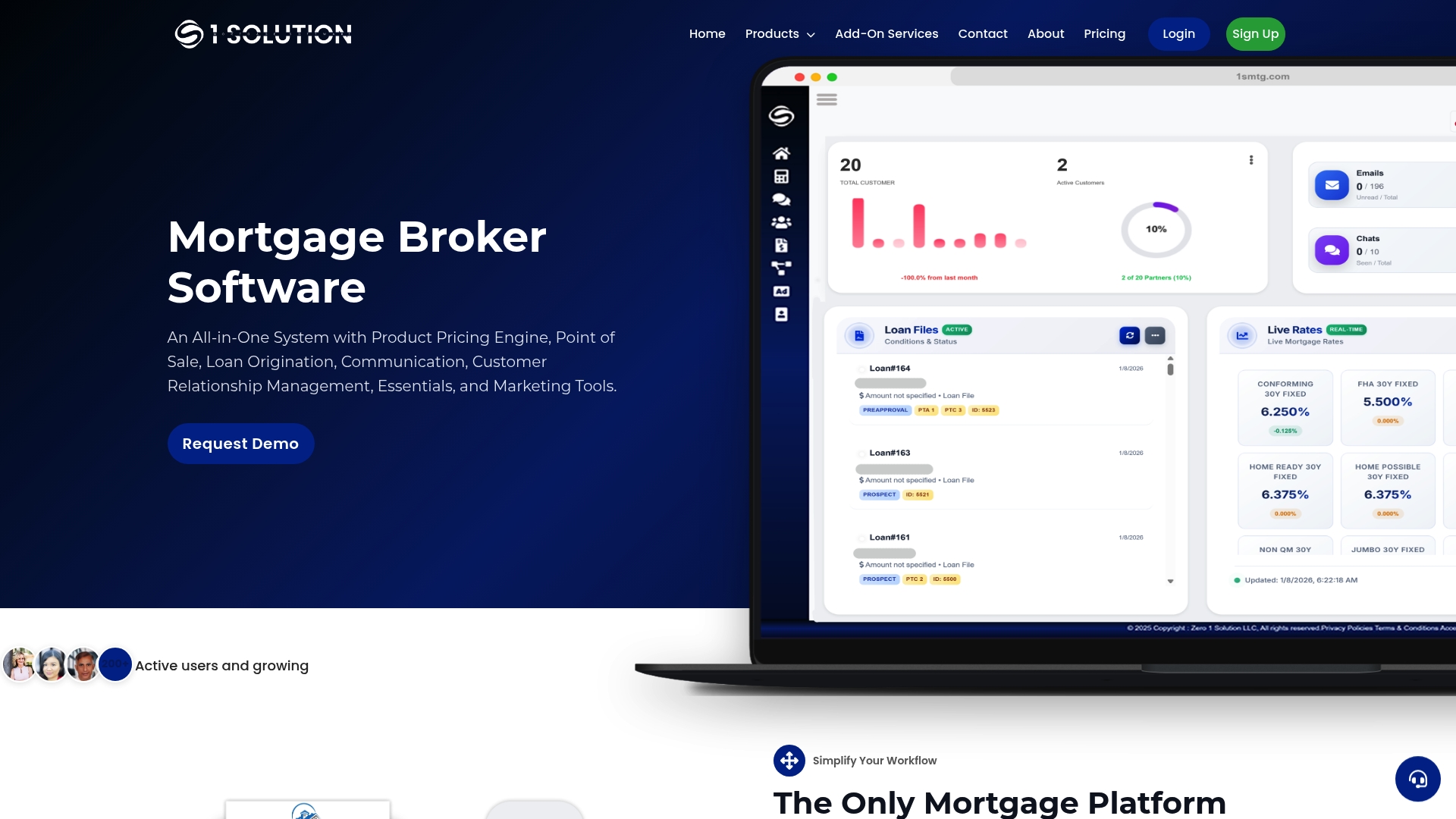
We support brokers through the switch itself, not just the software afterward. That means data migration assistance, help mapping your integration priorities, and rollout support during your first cutover weeks, when your team needs answers fast, not a ticket queue. If you're weighing whether to move, request a migration readiness assessment or schedule a demo of 1 Solution Mortgage Software and see what an integrated system actually removes from your project plan.
Sources
For timeline and cost benchmarking, The LOS Directory's migration guide is worth reading in full. Path Software's piece on breaking free from bad LOS software frames migration as a modernization opportunity. For hands-on checklists, see our data migration guide for brokers and rollout support guide.
- Switching LOS migration guide — The LOS Directory