
A closing coordination system is an LOS-integrated platform that manages every task between clear-to-close and funded loan: document preparation, Closing Disclosure (CD) generation, e-signatures, title and escrow scheduling, borrower communication, and milestone tracking. Platforms like 1 Solution Mortgage Software embed this coordination directly inside the loan origination workflow so nothing falls through the cracks between underwriting and the closing table.
Three reasons broker teams care about this right now:
- On-time close rate: Coordinated milestone tracking and pre-submit checks reduce last-minute reschedules and keep funding timelines predictable.
- Audit-ready workflows: Automated CD generation, timestamped communication logs, and approved templates create the auditable paper trail CFPB examiners expect.
- Staff hours recovered: Replacing manual status calls and ad hoc reminders with structured micro-SLAs frees processors to handle more files without adding headcount.
Key Takeaways
A closing coordination system is the operational layer that turns clear-to-close into funded loan without manual chaos, and file readiness is the single biggest variable in whether it delivers.
| Point | Details |
|---|---|
| Core definition | A closing coordination system integrates with your LOS to manage documents, e-sign, title, and milestones from clear-to-close to funded. |
| File readiness drives speed | Complete files close in 5–7 days; each extra condition round adds 2–5 days to the timeline. |
| Pilot narrow, then expand | Start with one loan product and one lender lane; expand only after KPIs and QA thresholds are met. |
| Compliance is non-negotiable | Least-privilege access, approved templates, and auditable SOPs protect you in CFPB examinations. |
| 1 Solution Mortgage Software | Provides LOS-integrated document prep, e-sign, milestone tracking, and communication tools in one platform. |
Table of Contents
- What a closing coordination system actually does
- Where closing coordination fits in your loan lifecycle
- Measurable benefits and the KPIs worth tracking
- Compliance boundaries and access controls you cannot skip
- How to pilot a closing coordination system in 90 days
- Daily SOPs and micro-SLAs that keep closings predictable
- Common mistakes that stall closing coordination projects
- Why closing coordination is the highest-leverage stage for brokers
- 1 Solution Mortgage Software maps directly to this playbook
- Sources
What a closing coordination system actually does
The system is not a single button. It is a set of connected modules, each reading from and writing back to your LOS so the file stays current across every party involved.
- Document hub and automated CD generation: Pulls loan data from the LOS, populates the Closing Disclosure, and flags any fee changes that require a revised CD and a new three-business-day waiting period. The LOS remains the system of record for all disclosures and conditions, as the LOS Directory explains.
- E-sign and eClosing orchestration: Routes documents to borrowers and settlement agents through a compliant e-signature workflow, tracks completion status, and writes signed-document confirmations back to the LOS file. See how mortgage e-signature platforms fit into this layer.
- Title and escrow scheduling: Sends order requests to title, receives commitment updates, and surfaces exceptions (liens, easements) that require licensed review before funding.
- Borrower communication sequences: Delivers pre-approved, templated messages at defined milestones (CD sent, signing scheduled, funding confirmed) so borrowers stay informed without processors writing individual emails.
- Checklist and milestone tracker: Logs every task with an owner, a due time, and a completion timestamp. Stagnant items trigger escalation after a defined window.
- Exception and escalation manager: Catches document mismatches, outstanding conditions, and title exceptions, then routes them to the licensed staff member responsible for resolution.
The integration flow that makes this work looks like this: LOS event fires (clear-to-close status) → doc-prep engine generates CD → e-sign platform routes for signatures → title system confirms settlement → LOS receives funding confirmation. Mortgage automation guides consistently identify the handoffs between these systems as the primary technical challenge, which is exactly why the coordination layer exists.
Where closing coordination fits in your loan lifecycle
Closing coordination owns stage four: after underwriting issues a clear-to-close and before the investor receives the funded package. It does not replace the LOS. The LOS is the operational backbone that holds disclosures, conditions, and closing data. The coordination system reads those records and orchestrates the parties around them.
Data flows in one direction at a time. The LOS pushes a status change; the coordination layer triggers the next task; the downstream system (doc prep, title, e-sign) completes its piece and writes a confirmation back. Common integration types include:
- API syncs: Real-time bidirectional updates between LOS and title or e-sign platforms.
- Webhook events: LOS fires a notification on status change; the coordination layer catches it and triggers the next workflow step.
- SFTP/EDI file exchanges: Batch document transfers to investors or title companies that do not support API connections.
- RPA fallbacks: Robotic process automation handles legacy systems with no API, scraping screens to move data when no cleaner path exists.
Building an orchestration layer around your existing LOS is almost always the faster, lower-risk path than replacing the LOS outright. An integration abstraction layer also protects your downstream connections if you ever do swap LOS vendors, containing the migration work to a single connector rather than rebuilding every integration from scratch.
Pro Tip: Before you evaluate any coordination platform, map every system your closing team touches today and note which ones have APIs. That gap map becomes your integration priority list and your pilot scope.
Measurable benefits and the KPIs worth tracking
The clearest ROI case comes from file readiness. A complete, well-organized file can close in 5–7 days; each additional condition round typically adds 2–5 days to that timeline. A coordination system that enforces pre-submit checks and batches condition responses attacks that delay directly.
KPIs to establish before your pilot and measure throughout:
- On-time close rate: Percentage of files that fund on or before the original target date.
- Reschedule rate: How often signing appointments or funding dates move after being set.
- Milestone-update adherence: Percentage of LOS status updates completed within the defined SLA window (target: within 60 minutes of a status change).
- Processor hours saved: Track time spent on manual status calls and reminders before and after the pilot.
- Average days-to-fund: From clear-to-close to funded. This is your headline metric.
Automation focused on document intake, data verification, and conditions tracking consistently produces the highest ROI for processing teams. Measure your baseline for four weeks before going live, then compare the same metrics over the first 60 days of the pilot. That comparison is your business case for full rollout. For a broader view of which efficiency metrics matter most to broker teams, the KPI framework there maps directly to what a coordination system moves.
Compliance boundaries and access controls you cannot skip
The rule is simple: keep decision-sensitive actions with licensed staff. The coordination system handles the mechanical tasks. Licensed loan officers and processors own every judgment call.
Specific guardrails to build in from day one:
- Least-privilege access: Processors see their own files; managers see the queue; no one outside the licensed team touches CD data or condition approvals.
- Approved communication templates: All borrower-facing messages go through pre-approved language reviewed by compliance counsel. No ad hoc emails from the coordination layer.
- Auditable SOPs: Every task completion, escalation, and exception must be timestamped and tied to a named user in the LOS.
- RON variability: Remote online notarization rules differ by state. Confirm your state's current authorization before routing any closing through a RON workflow. Oldham Law's Qualia Connect overview is a useful reference for understanding eClosing legal boundaries.
- CD regeneration triggers: Any material change to fees, loan terms, or APR after the CD is issued requires a new CD and a fresh three-business-day waiting period. The system must flag these automatically.
Escalation triggers that require immediate licensed review:
- Document mismatch between the CD and the title commitment.
- Borrower questions that touch legal interpretation or loan terms.
- Title exceptions (open liens, easements, ownership disputes) that could affect funding.
- Any condition that has been submitted and unresolved for more than 48 hours.
How to pilot a closing coordination system in 90 days
Start narrow. One loan product, one lender lane, one processor team. Expand only after KPIs and QA thresholds are met, as closing coordination implementation guides consistently recommend.
30-day setup:
- Map every current closing workflow step, owner, and handoff point.
- Choose the pilot loan type (e.g., conventional purchase) and one lender lane.
- Build task checklists and define KPI baselines.
- Identify integration gaps and assign RPA fallbacks where APIs are unavailable.
- Draft and approve borrower communication templates.
60-day live run:
- Connect LOS webhook events to the coordination layer.
- Run live files through the pilot workflow with daily triage reviews.
- Tighten SLAs based on real-file data (e.g., adjust escalation windows).
- Log every exception and its resolution time.
90-day expansion gate:
- Review QA pass rates and KPI improvements against your baseline.
- If on-time close rate improved and reschedule rate dropped, expand to additional loan types and lender lanes.
- Conduct a formal post-pilot review with the processing team before full rollout.
For a deeper look at workflow redesign considerations that affect rollout success, the structural decisions made before go-live matter as much as the technology itself.
Daily SOPs and micro-SLAs that keep closings predictable
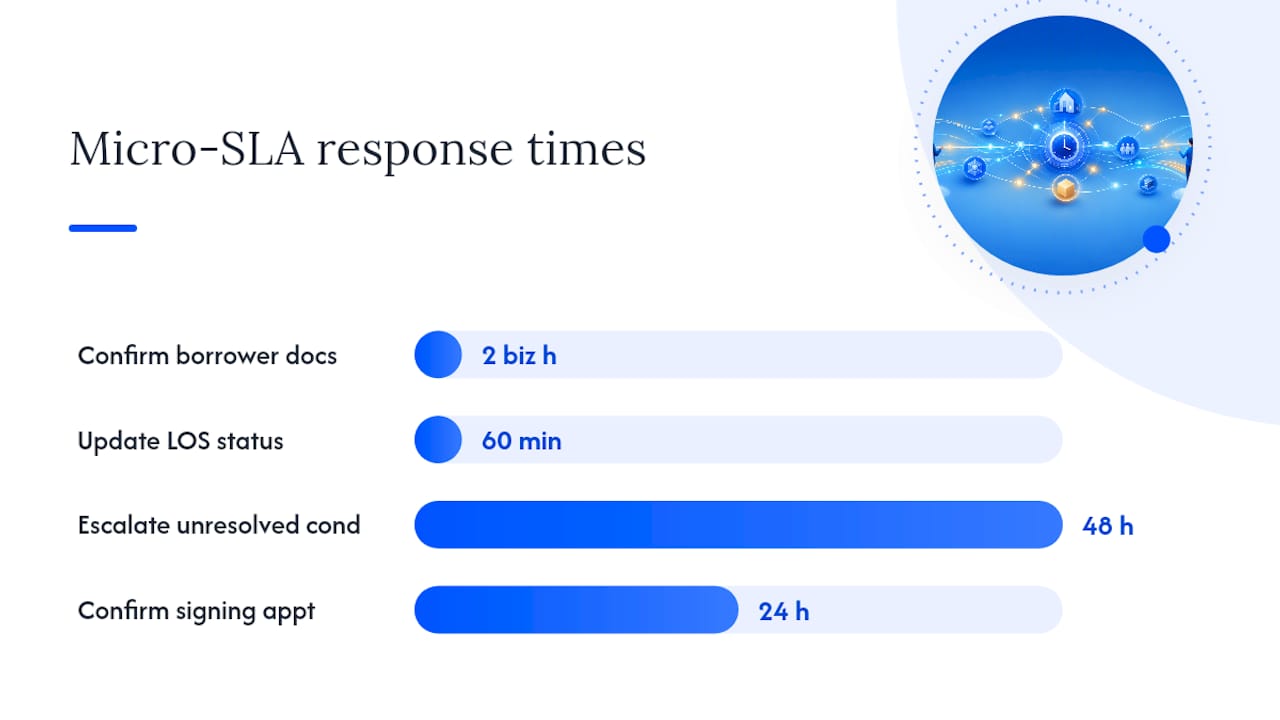
The coordination system replaces ad hoc reminders with defined micro-SLAs and a 72-hour risk digest. Without those structures, even a well-configured platform drifts back into chaos within weeks.
Sample micro-SLAs:
- Confirm borrower document submissions within 2 business hours of receipt.
- Update LOS status within 60 minutes of any milestone change.
- Escalate any submitted condition unresolved after 48 hours to the responsible licensed staff member.
- Confirm signing appointment with all parties at least 24 hours in advance.
Close-readiness score (5 factors): CD issued and acknowledged, title commitment received and clear, all borrower conditions satisfied, signing appointment confirmed, and wire instructions verified. A file that scores 5/5 is ready to fund. Anything below 4 gets a same-day review.
The daily 72-hour close-risk view lists every file scheduled to fund within three business days, its close-readiness score, and any open exceptions. This digest goes to the operations lead each morning. Files with open exceptions get a named owner and a resolution deadline before end of day.
Pro Tip: Build your escalation packet template before you go live. Every escalation should include the file number, the exception type, the last action taken, and the licensed staff member responsible. A blank template filled under pressure produces incomplete packets.
Every tracked file needs at minimum: borrower name, loan number, target funding date, current milestone, open conditions count, and last LOS update timestamp. That is the minimum data set for meaningful triage.
Common mistakes that stall closing coordination projects
The most common failure is automating a broken process. If files arrive at the closing stage with unresolved conditions, no coordination system fixes that. The system surfaces the problem faster, but the root cause is upstream.
- Skipping the pre-submit gate: Build a pre-submission review into the workflow before any file reaches closing. A two-person review (one builds, one audits) catches most condition gaps before they become closing delays.
- Ignoring integration gaps: An unmapped integration point becomes a manual workaround within days. Audit every connection before go-live and assign an RPA fallback for any system without an API.
- Weak escalation rules: Escalation triggers with no named owner and no deadline are ignored. Every rule needs an owner, a response window, and a consequence for missing it.
- Skipping borrower communication templates: Ad hoc messages create compliance exposure. Approve templates before the pilot starts, not after the first complaint.
- No change-management plan for title partners: Title companies and settlement agents need to know how the new workflow affects them. Brief them before go-live, not after the first missed deadline.
Pro Tip: Test your integration points with synthetic files before running live loans. Fail fast on the connections that matter most (LOS to doc prep, doc prep to e-sign) so you find the gaps in a controlled environment.
Why closing coordination is the highest-leverage stage for brokers
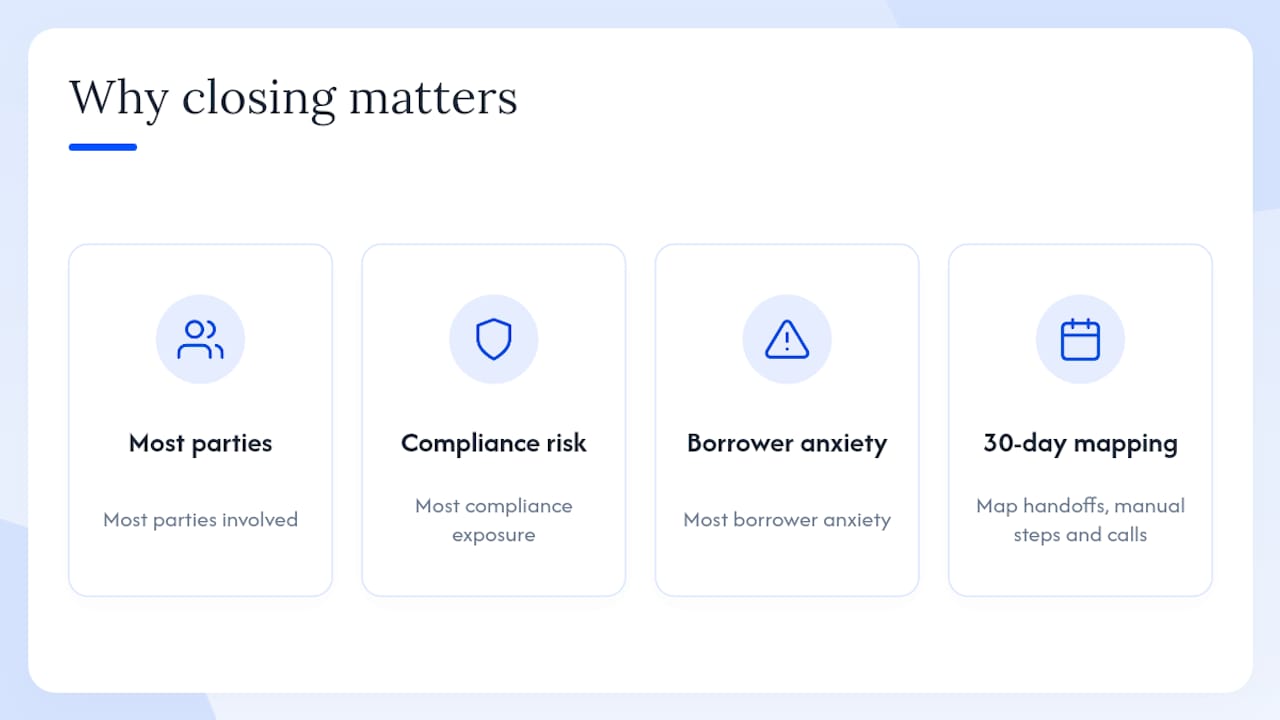
Most brokers spend their improvement energy on lead generation or processing speed. Closing is where the deal actually lives or dies, and it is the stage with the most parties, the most compliance exposure, and the most borrower anxiety. Getting it wrong costs you the referral, not just the file.
The 30-day mapping exercise is the right starting point. Not a demo, not a vendor evaluation. Map your current closing workflow first. Every handoff, every manual step, every place where a processor is making a phone call instead of working a file. That map tells you exactly where a coordination system pays for itself.
1 Solution Mortgage Software maps directly to this playbook
1 Solution Mortgage Software was built from inside mortgage operations, not from a boardroom. The platform's LOS-integrated document prep, e-sign, milestone tracking, and communication tools cover every module in the coordination framework described above. You are not stitching together five separate vendors. The coordination layer is part of the same system that handles your pricing, CRM, and compliance workflows.
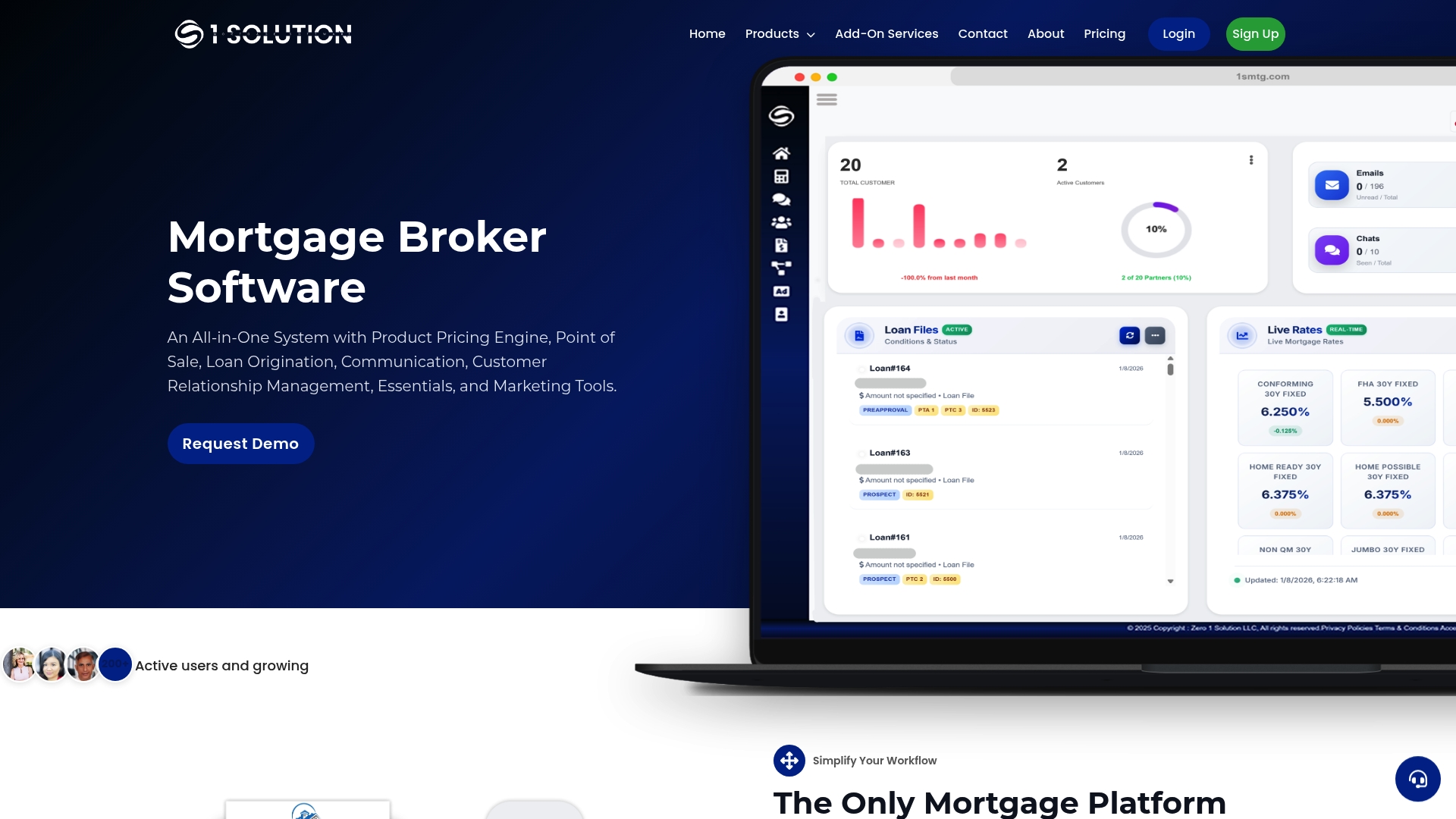
For broker teams ready to run the 90-day pilot, 1 Solution offers onboarding support that maps your existing workflows to the platform's coordination features before you go live. The integration gap map, the SLA templates, and the close-readiness score framework are built into the setup process. No guessing about what connects to what.
The next step is a platform demo where you can walk through the closing coordination workflow against your own loan types and lender lanes. Bring your current SOP and your baseline KPIs. The conversation is more useful when the numbers are on the table.
Sources
- From application to closing: a step-by-step guide to end-to-end mortgage automation in the US
- 5 Ways to Speed Up Loan Closings for Broker Teams | Legions Capital Blog
- Mortgage Closing Coordination Virtual Assistant Guide for US Broker Teams
- Mortgage Workflow Automation (2026) | WisdomStream
- POS vs LOS for Mortgage Lenders | The LOS Directory