
Modern mortgage office workflow design has moved well past rearranging desks or switching LOS platforms. The real shift is architectural: connecting your existing loan origination system to document management, CRM, compliance tools, and borrower portals through a shared data layer, then layering automation on top of that connected foundation. Done right, this approach cuts cycle times, reduces errors, and keeps compliance embedded at every stage rather than bolted on at the end.
The core principles behind efficient mortgage workflows in 2026 look like this:
- Connected workspace architecture links LOS, document platforms, CRM, and compliance tools through a single data layer, eliminating manual re-entry.
- Role-based interface design gives loan officers, processors, underwriters, and compliance staff exactly the screens and actions they need, nothing more.
- Automated routing rules move files forward without human handoffs on routine tasks, flagging exceptions for skilled review.
- Embedded compliance tracks TRID timelines and disclosure deadlines inside the workflow itself, not on a separate spreadsheet.
- Human judgment preserved for exceptions, adverse-action decisions, and any outcome that affects a borrower directly.
Lenders running this architecture report cycle-time reductions of 30% or more within the first two quarters of deployment. One Alberta credit union cut application time from 60 minutes to 15 minutes through interface redesign alone.
Pro Tip: Start your redesign at the single highest-volume bottleneck, usually document intake or conditions tracking. Proving ROI there first gives you the data and the organizational buy-in to expand.

Key enhancements in loan origination and servicing workflows
The biggest gains in loan origination come from eliminating the manual handoffs between systems that cause most delays. When the LOS, document platform, and compliance tools share one data layer, loan officers see verified borrower data without re-keying it, processors see document status without checking a separate system, and underwriters see the complete file without requesting transfers.

Role-based interface design is the mechanism that makes this practical. Each role gets a tailored screen: loan officers see pipeline and borrower status; processors see document checklists and condition queues; underwriters see the full credit package; compliance staff see disclosure timelines and audit flags. Microsoft Power Apps is one tool that delivers per-role screens without requiring a custom development engagement for every change.
Automated routing is where loans either move or stall. A well-designed routing engine advances files based on loan type, complexity, and team capacity, escalating exceptions automatically rather than waiting for someone to notice a file has sat idle. Embedding regulatory requirements directly into the interface, so TRID timing is tracked by the system and required fields block file advancement until complete, is what separates modern workflow design from legacy checklists. Lenders running embedded compliance report 50% fewer audit findings compared with manual review processes.
| Feature category | Legacy approach | Connected workspace approach |
|---|---|---|
| Data entry | Manual re-entry across systems | Single data layer, write once, propagate everywhere |
| Compliance tracking | Spreadsheet or separate tool | Embedded in workflow, blocks advancement on violations |
| Role access | Same view for all staff | Tailored screens by role, reducing cognitive load |
| Routing | Manual handoff or email | Automated rules engine with exception escalation |
| Audit trail | Reconstructed after the fact | Time-stamped log at every workflow stage |

Pro Tip: Map every system your team touches in a single loan cycle before you design anything. You cannot build a connected workspace until you know exactly where the data gaps and duplicate entry points are.
What causes mortgage workflow breakdowns, and how do you prevent them?
The most common failure in mortgage operations is the "swivel-chair" problem: staff toggling between four or five disconnected systems, manually copying data from one to another, and hoping nothing gets lost or mistyped in transit. Disconnected systems requiring manual re-entry cause major operational delays and errors that compound across every file the team touches.
Beyond the swivel-chair problem, three specific bottlenecks account for most workflow failures:
- Incomplete intake — applications submitted without required documents create immediate stalls, forcing processors to chase borrowers before any real work can begin.
- Slow conditions clearing — files sitting at "conditional approval" longer than necessary because condition requests go out manually, responses come back untracked, and no one has a real-time view of what is still outstanding.
- Post-close QC delays — quality control that falls behind during high-volume periods because it is treated as the least urgent stage, until an audit or investor review makes it urgent.
The fix for all three is an orchestration layer that synchronizes data across platforms in real time, routes tasks automatically, and surfaces exceptions before they become delays. This is not about replacing your LOS. It is about wrapping it in a workflow layer that handles the movement of data and tasks while your team handles the judgment calls.
Automation should move data and route tasks, not make lending decisions. Keep judgment, exceptions, and any adverse-action determination with a person, and keep an audit trail of every automated step. In a regulated industry, that is not optional design guidance. It is a compliance requirement.
Exception-based management is the design principle that prevents over-automation from creating its own problems. When AI standardizes data upstream, skilled staff can focus their attention on the files that genuinely need human review, rather than spending their day on routine validation that a rules engine handles faster and more consistently. The right balance between automation and human oversight is what keeps a mortgage operation both fast and compliant.
How automation, AI, and integration actually optimize mortgage workflows
AI-powered autonomous agents have changed what is possible in mortgage processing. Amazon Bedrock agents, for example, orchestrate document processing, validation, and underwriting with minimal human intervention, handling DTI calculation, LTV assessment, employment verification, and compliance checks in a coordinated sequence. The result is processing times that drop from weeks to minutes on qualifying files.
For most small to mid-size mortgage operations, the practical path to this kind of automation runs through three integration patterns:
- Webhook-driven integration: the LOS pushes events to the orchestration layer in near-real time. Latency is measured in seconds, maintenance burden is low, and this is the cleanest pattern when the LOS supports it.
- API-driven bidirectional integration: the orchestration layer queries and writes to the LOS on a schedule or on-demand. Latency is measured in minutes, and this is the standard pattern for full read/write workflows.
- RPA-bridged integration: a fallback when neither webhook nor API access is available. Reliability is lower and maintenance is higher, but it allows AI orchestration even on locked-down LOS environments.
The six-step method for a successful automation project runs in this order: map the current workflow and time each handoff, find the high-friction bottlenecks, decide what to automate versus keep human, choose an orchestration layer, build and integrate, then test on real files and measure. Skipping the mapping step is the most common reason automation projects deliver less than expected.
| Workflow stage | Automation potential | Human review required |
|---|---|---|
| Document intake and classification | High — pattern-driven, high volume | Edge cases, unusual document types |
| Income and asset verification | High — rules-based cross-checks | Discrepancies, self-employed borrowers |
| Conditions tracking and clearing | High — status updates, routing | Judgment calls on condition waivers |
| Underwriting document generation | Medium — AI drafts, human finalizes | All adverse-action decisions |
| Post-close QC | High — rule-based checks, audit packaging | Investor-specific exceptions |
Automating document intake, verification, and conditions tracking yields the highest ROI by reducing repetitive processor hours and preventing last-minute closing delays. Focus automation efforts upstream to avoid the downstream fire drills that push closings past their scheduled dates.
Pro Tip: Set confidence thresholds on every AI extraction step. When the model's confidence falls below your threshold, the file routes to a human reviewer automatically. This is what makes human-in-the-loop design defensible in a regulatory audit.
How customer feedback and real-world use cases shape better workflow design
Borrower-facing interfaces are where workflow design directly affects revenue. Portals that break on mobile, require borrowers to restart after a session timeout, or bury document upload instructions drive application abandonment. Cross-device continuity and intuitive design can reduce application abandonment rates by 25–40%, according to connected workspace research. That is not a UX nicety. It is a measurable impact on pull-through rates.
Operational data from lenders who have redesigned their workflows points to consistent patterns. The teams that see the fastest gains share a few practices:
- They measure cycle time per stage before any redesign, so they have a real baseline to compare against after.
- They track conditions-clearing time separately from overall cycle time, because that is usually where the most recoverable time is hiding.
- They use digital mortgage applications that feed directly into the LOS, eliminating the re-entry step that adds hours to every file.
- They build KPI dashboards that show pipeline view, turn-time by stage and loan officer, and compliance scorecard in one place, so leadership can see whether cycle-time gains are holding two months after a redesign.
Workforce reskilling is where most automation projects either succeed or stall. Technology alone rarely achieves the productivity targets. Combining new workflows with role redesign and upskilling is what actually moves the numbers.
Change management is the part of workflow redesign that operations leaders underestimate most consistently. Staff who understand why a new process exists, and who have been trained on the specific actions their role requires, adopt new workflows faster and with fewer workarounds. Workforce reskilling and role redesign accompanying technology deployment unlock the true productivity gains. Moving processors from data-entry tasks to exception handling and borrower advisory roles is not just a morale improvement. It is a better use of the judgment your team already has.
For independent brokers specifically, the mortgage team structure matters as much as the technology. Role clarity, defined handoff points, and a shared understanding of what the automation handles versus what requires human review are what keep a redesigned workflow running after the initial rollout energy fades. Piloting on a single loan type or a single bottleneck, proving it on real files, and then expanding is the approach that consistently delivers results without overwhelming the team.
A well-designed loan workflow also accounts for the borrower's experience at every touchpoint, not just the internal processing steps. When borrowers receive timely status updates, clear document requests, and consistent communication, they are less likely to go dark mid-process, which is one of the most common causes of file stalls that no amount of internal automation can fix.
Key Takeaways
Effective mortgage office workflow redesign in 2026 requires connecting your existing LOS to an orchestration layer, automating high-volume upstream stages, and preserving human judgment for exceptions and compliance decisions.
| Point | Details |
|---|---|
| Start with the LOS you have | Orchestrating automation around your existing LOS is faster and lower-risk than platform migration. |
| Automate upstream first | Document intake, verification, and conditions tracking deliver the highest ROI and prevent closing-day delays. |
| Embed compliance in the workflow | Systems that enforce TRID timelines and block file advancement on violations report 50% fewer audit findings. |
| Role-based interfaces reduce errors | Tailored screens for each staff role cut cognitive load and speed decision-making across the team. |
| Reskill alongside the technology | Workforce role redesign paired with new workflows is what converts automation investment into lasting productivity gains. |
1 Solution Mortgage Software is built for exactly this kind of work
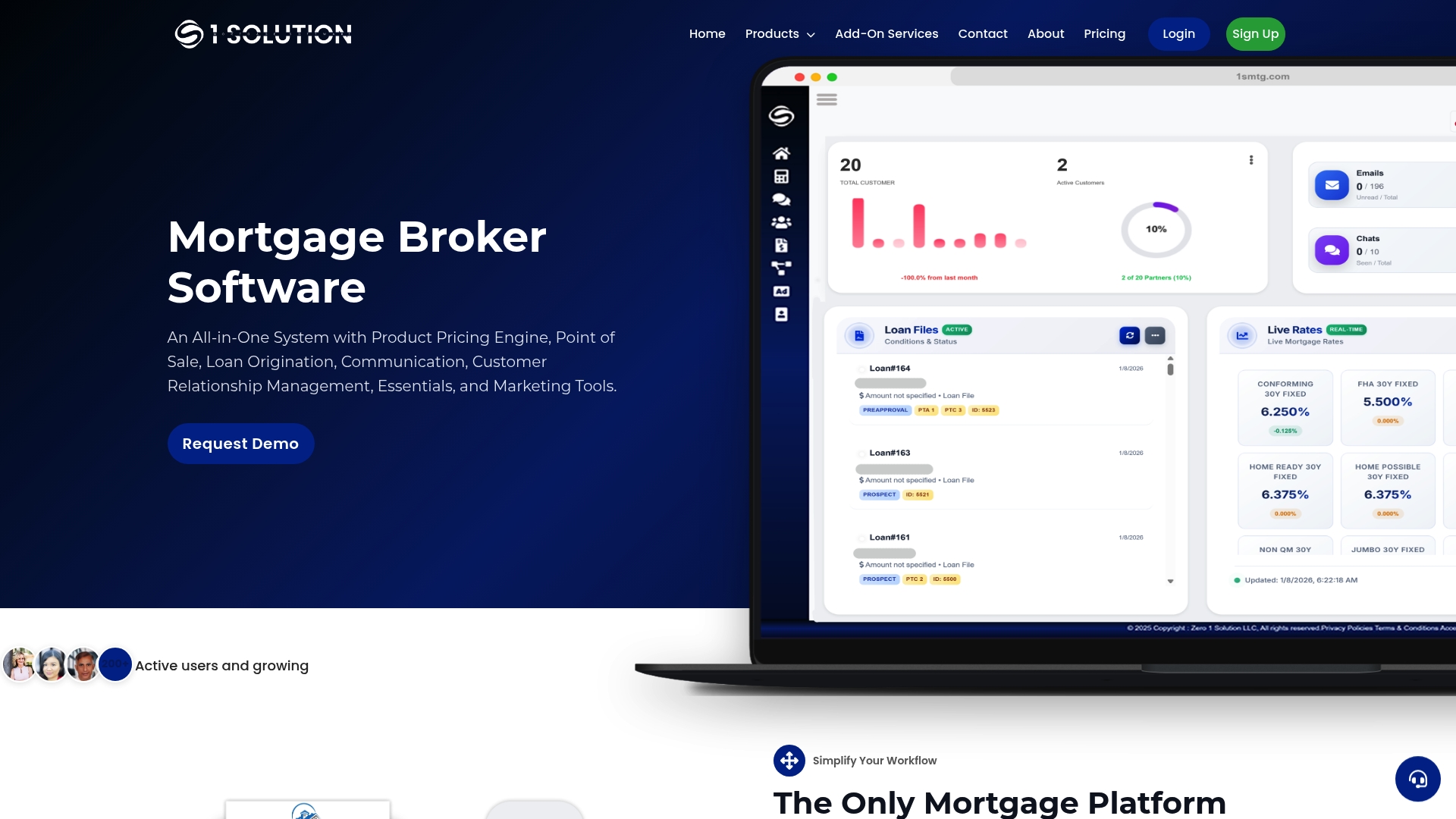
We built 1 Solution Mortgage Software from the inside of mortgage operations, not from a boardroom. Our founder Omar Khamisa spent over 20 years as a processor, underwriter, loan originator, and systems consultant before building a platform that actually reflects how brokers work. The result is an all-in-one connected ecosystem that brings pricing, CRM, POS, LOS, compliance, communication, and operational tools together in one place, purpose-built for independent mortgage professionals.
If your team is still toggling between disconnected systems, chasing conditions manually, or rebuilding compliance checklists from scratch for every file, that is the problem we solve. No outside investors. No hidden agendas. Just technology built from the trenches, for the brokers who work in them every day.
Explore what a genuinely connected mortgage platform looks like for your operation.