
Mortgage company data migration is the secure, structured transfer of loan records, borrower profiles, compliance documents, and system integrations from one platform to another. For loan officers and brokers, this process is not an IT project. It is a business-critical operation that directly affects pipeline continuity, regulatory standing, and long-term operational efficiency. Migrations typically take 4–8 months and cost between $75,000 and $300,000 before platform licensing fees. Understanding what drives those costs, and how to control them, is the difference between a smooth system upgrade and a compliance crisis.
What is a mortgage company data migration, and why does it matter?
Mortgage company data migration is the industry term for moving structured loan data, borrower records, document packages, and system configurations from a legacy loan origination system (LOS) or servicing platform to a new one. The process is also called mortgage data transfer in operational contexts, though the formal discipline falls under data migration in finance.
The stakes are high for three reasons. First, mortgage data is regulated. Regulators require a clear chain of custody for every migrated field, meaning traceability is a primary deliverable, not an afterthought. Second, loan documents are tightly linked to loan records. Break that linkage and you create audit failures and borrower service disruptions. Third, the volume of historical data in most mortgage companies is enormous. A mid-sized broker shop may carry years of closed loans, active pipelines, and compliance archives that all need to move intact.

The importance of data migration becomes clear when you consider what happens without a structured plan. Broken document associations, missing compliance records, and corrupted borrower data are the most common failure outcomes. Getting the process right from the start protects your license, your clients, and your operations.
What are the main steps in a mortgage data migration project?
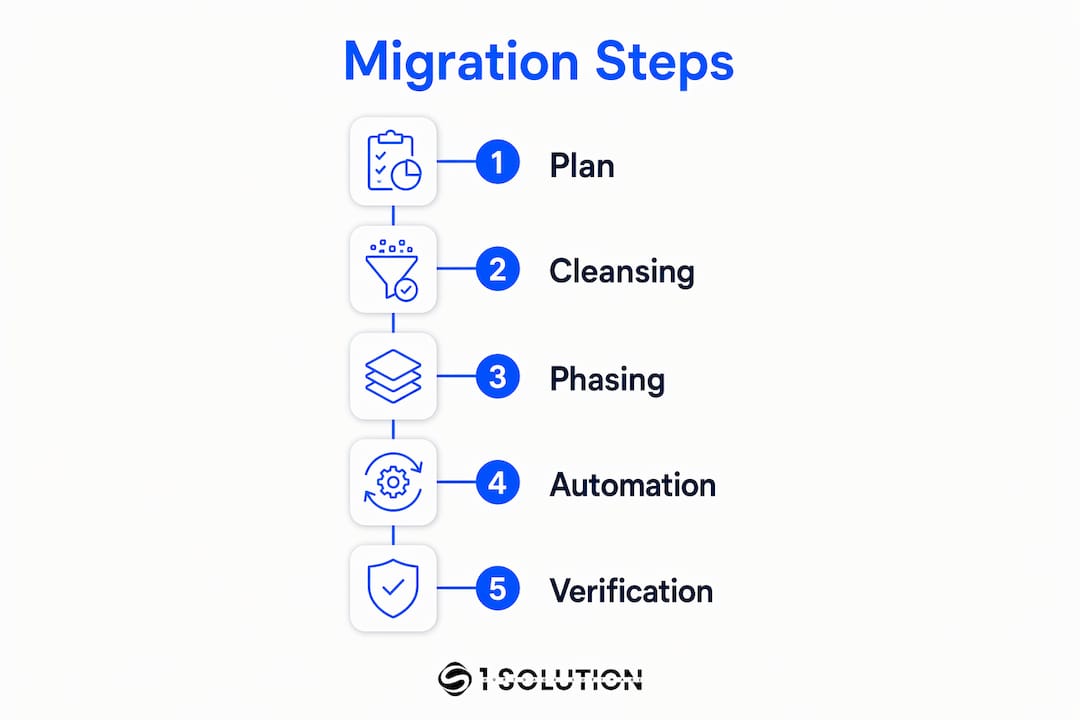
A well-run mortgage data migration follows five distinct phases. Skipping any phase is the fastest route to a failed project.
-
Assessment. Audit every data source, identify compliance obligations, and map all system integrations. This phase reveals data quality problems before they become migration failures. Document which records are active, which are archived, and which can be excluded entirely.
-
Architecture and mapping. Define how fields in the source system correspond to fields in the target system. Set up automation rules for data transformation. This is where tools like MISMO Loan Boarding Data Segment (LBDS) wrapper files add real value by providing a standardized transfer format that reduces manual mapping work.
-
Pilot migration. Move a representative sample of records to the new system and validate every field, document link, and compliance attribute. Resolve issues before scaling. This phase catches the problems that no one anticipated during mapping.
-
Phased execution. Migrate data by product line or customer segment rather than all at once. Phased migration strategies allow real-time reconciliation and reduce the risk of broken document linkage. Run the old and new systems in parallel during this phase to catch discrepancies before full cutover.
-
Final verification and decommissioning. Audit the completed migration at field level, confirm regulatory compliance documentation, and formally retire the legacy system only after sign-off from compliance and operations leadership.
Pro Tip: Never attempt a big bang migration where all data moves at once. The failure rate for all-at-once approaches is significantly higher than phased methods, and recovery from a failed big bang migration can take longer than the original project.
What risks and challenges should mortgage companies anticipate?
Data migration in finance carries specific risks that general IT migrations do not. Mortgage professionals need to understand these before signing a migration contract.
- Data loss and corruption. Records can be truncated, misformatted, or dropped entirely during extraction and transformation. Manual migration failure rates reach up to 60%, making automation a necessity rather than a luxury.
- Broken loan-document associations. Loan files in most LOS platforms link documents by internal ID. When those IDs change during migration, the links break. This is the most frequent failure point in mortgage data transfers.
- Compliance and audit gaps. Missing field-level lineage documentation exposes your company to regulatory action. Audit trail design must be treated as a deliverable, not a post-migration task.
- Legacy data quality problems. Incomplete records, duplicate borrower profiles, and inconsistently formatted fields are common in systems that have been in use for years. Migrating dirty data into a new system does not clean it. It just moves the problem.
- Hidden costs. Implementation costs include migration services, integration development, training, and temporary productivity losses that rarely appear in vendor quotes.
The most effective mitigation strategy combines data cleansing before migration with automation during migration. Removing duplicates and archiving closed loans before the project starts reduces both cost and system performance issues in the new platform. Engage your compliance team during migration design, not after. Regulatory chain of custody requirements mean that audit trail architecture must be built into the migration plan from day one.
Pro Tip: Build a data quality report before you sign any migration contract. Vendors price migrations based on record counts and complexity. A clean dataset gives you negotiating leverage and a faster project.
How do modern technologies improve mortgage data migration in 2026?
Three technology shifts are changing how mortgage companies approach data migration: AI-powered automation, cloud-first infrastructure, and industry data standards.
AI automation and dual-write frameworks
AI-powered migration frameworks reduce project timelines by up to 85% compared to manual approaches. They do this by automating field mapping, running continuous reconciliation checks, and enabling dual-write modes where data writes to both the old and new system simultaneously during cutover. That parallel operation catches discrepancies in real time rather than after the fact.
Cloud-first infrastructure
91% of financial service executives now prioritize cloud-first infrastructure, and the operational cost reduction averages up to 30%. For mortgage companies, cloud migration also enables better compliance analytics, faster audit responses, and the scalability to handle pipeline growth without hardware constraints. Cloud platforms also support mortgage automation tools that integrate directly with migrated data environments.
MISMO LBDS standards and Change Data Capture
The Mortgage Bankers Association and MISMO introduced Loan Boarding Data Segment wrapper files in 2026. MISMO LBDS adoption reduces manual mapping costs by $60–$160 per loan and minimizes the "dark days" where borrowers lose visibility into their loan status during servicer transfers. This standard is now the benchmark for compliant loan boarding data transfers.
Change Data Capture (CDC) is a technical method that captures only the data changes since the last extraction rather than pulling full snapshots of entire databases. CDC reduces migration time and risk significantly on large volumes of historical mortgage data. It is especially valuable for companies with multi-year loan archives where full snapshot loading would be prohibitively slow.
| Approach | Timeline | Risk level | Cost efficiency |
|---|---|---|---|
| Manual migration | Longest | Highest (up to 60% failure rate) | Lowest |
| Phased migration with automation | Moderate | Medium | High |
| AI-powered with CDC and dual-write | Shortest (up to 85% faster) | Lowest | Highest |
| Big bang migration | Short setup, long recovery | Very high | Low |
What best practices help mortgage professionals execute migration successfully?
Successful mortgage data management during a migration comes down to preparation, process discipline, and the right technology choices. These steps apply whether you are a two-person broker shop or a regional lender with hundreds of active loans.
-
Inventory and cleanse your data first. Before any migration begins, audit every record in your current system. Archive closed loans that are past retention requirements. Remove duplicate borrower profiles. Fix formatting inconsistencies. Data cleansing is the most critical phase of the entire project.
-
Engage compliance early. Your compliance team needs to approve the audit trail design before migration starts. Regulators require field-level traceability, and retrofitting that documentation after migration is far more expensive than building it in from the start. Review your compliance setup checklist before finalizing your migration architecture.
-
Use phased migration with validation checkpoints. Migrate by product line or loan segment. Validate document linkages and field accuracy at each checkpoint before moving to the next segment. This approach catches problems while they are still small.
-
Budget for the full cost. The platform license is only part of the expense. Hidden costs include migration services, integration development, staff training, and the temporary productivity drop during cutover. Build a realistic budget that covers all four categories.
-
Leverage automation for mapping and transformation. Manual field mapping is where most errors originate. Automation tools that apply consistent transformation rules across every record dramatically reduce error rates and speed up the project timeline.
-
Communicate across all stakeholders. Loan officers, processors, underwriters, and compliance staff all need to know what is changing, when it is changing, and what their role is during the transition. Unclear communication during migration creates operational gaps that are hard to close after the fact.
Pro Tip: Assign a dedicated migration owner inside your organization, not just a vendor contact. That person owns the validation checkpoints, the compliance sign-offs, and the go/no-go decisions at each phase. Without internal ownership, migrations drift.
Key takeaways
Mortgage company data migration succeeds when it combines thorough data cleansing, phased execution, compliance-first audit trail design, and AI-powered automation tools that reduce both timelines and error rates.
| Point | Details |
|---|---|
| Costs and timelines are significant | Budget $75,000–$300,000 and 4–8 months before platform licensing fees. |
| Phased migration reduces risk | Migrating by product line allows real-time validation and prevents broken document linkages. |
| Compliance is a design requirement | Audit trail and field-level lineage must be built into migration architecture from day one. |
| Automation cuts failure rates | AI-powered frameworks reduce timelines by up to 85% versus manual approaches. |
| Data cleansing comes first | Removing duplicates and archiving closed loans before migration reduces cost and improves new system performance. |
Why I think most mortgage companies approach migration backwards
Most brokers and loan officers I have worked with treat data migration as the last item on the project plan. They spend months evaluating new platforms, negotiating contracts, and planning training programs. Then, two weeks before go-live, someone asks who is handling the data. That sequence is backwards, and it is the root cause of most migration failures I have seen.
The data is the business. Your loan records, borrower histories, compliance documents, and pipeline data represent years of work and legal obligations. Moving that data is not a technical task you hand off to a vendor. It is a strategic decision that requires your compliance team, your operations lead, and your technology partner working together from the first day of the project.
The other misconception I see constantly is that a new platform will fix data quality problems. It will not. A modern LOS with clean architecture will expose your data problems faster and more visibly than your old system did. The brokers who get the most value from a new platform are the ones who did the hard work of cleansing and organizing their data before the migration started.
My honest advice: treat the migration as a data audit opportunity. Use it to understand exactly what you have, what you need, and what you can let go of. The brokers who approach it that way come out of the migration with a cleaner operation than they went in with. The ones who rush it spend the next six months fixing problems that were entirely preventable.
— Omar Khamisa
How 1 Solution Mortgage Software supports your migration
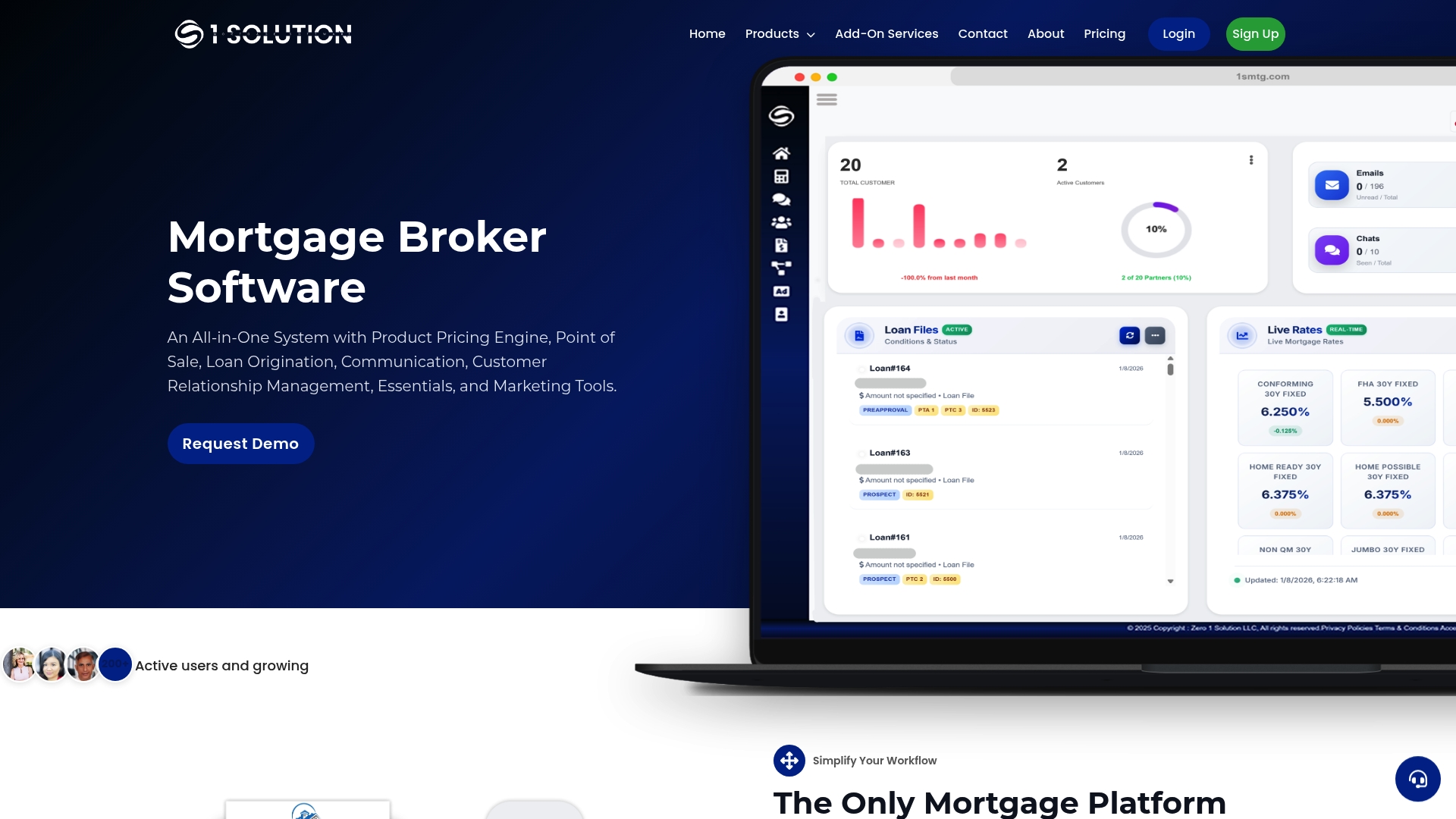
1 Solution Mortgage Software was built by mortgage professionals who have lived through the exact migration challenges described in this article. Our platform brings together LOS, CRM, compliance, POS, and communication tools in one connected environment, which means you are not migrating data between fragmented systems every time you upgrade a single tool. The platform is built on cloud-first infrastructure with compliance and audit trail support designed to meet regulatory chain of custody requirements from day one. If you are planning a system transition or evaluating your current mortgage data management setup, explore 1 Solution Mortgage Software and see how an all-in-one platform built for independent brokers changes what migration looks like.
FAQ
What is a mortgage company data migration?
Mortgage company data migration is the structured transfer of loan records, borrower data, compliance documents, and system configurations from a legacy platform to a new one. The process requires field-level traceability and audit trail documentation to meet regulatory requirements.
How long does a mortgage data migration take?
Most mortgage migrations take 4–8 months from assessment to final verification, depending on data volume, system complexity, and the level of data cleansing required before migration begins.
What is the biggest risk in mortgage data transfer?
Broken loan-document associations are the most frequent failure point in mortgage data transfers. Phased migration by product segment, combined with validation checkpoints, is the most reliable way to catch and fix these breaks before full cutover.
How does MISMO LBDS improve loan data migration?
MISMO Loan Boarding Data Segment wrapper files provide a standardized format for loan data transfers that reduces manual mapping costs by $60–$160 per loan and minimizes borrower service disruptions during servicer transitions.
Why is data cleansing required before migration?
Migrating duplicate records, incomplete files, and outdated borrower profiles into a new system increases cost and degrades performance. Cleansing data before migration by removing duplicates and archiving closed loans reduces both project cost and post-migration system issues.