

Most new mortgage brokerages fail not because of bad loan officers but because of bad systems. The most common new mortgage business mistakes fall into three categories: running the business like a personal production role, relying on a single revenue stream, and stitching together disconnected tools that create compliance gaps. The fix starts with one shift: replace personal-production metrics with team and process KPIs, consolidate your tech into a single platform, and document every client touchpoint before you hire your second MLO. HMDA reporting errors, fragmented LOS/CRM stacks, and missing SOPs are the specific failure points regulators and auditors find first.
Top 10 mistakes and one-line fixes:
- Owner-operator mindset → Track team pipeline health, not your personal closings.
- PT/fee income dependence → Add specialist lending channels and advisory fee lines.
- Fragmented tech stack → Consolidate LOS, CRM, PPE, and POS into one platform.
- Weak compliance documentation → Embed timestamped audit trails in every workflow.
- AI misuse without oversight → Require human sign-off on all formal advice records.
- CRM neglect → Update the CRM daily; automate follow-up sequences.
- Missing SOPs → Document the full client journey before scaling headcount.
- Underpriced services and short runway → Model best, base, and downside scenarios before launch.
- Poor onboarding and QA → Integrate automated compliance checks into your LOS closing workflow.
- Insecure data practices → Enforce role-based access and a written data-privacy policy from day one.
Pro Tip: Print this list and review it in your first leadership meeting each quarter. The mistakes that kill new brokerages rarely appear suddenly; they compound quietly over six months.
Table of Contents
- 1. Running your business like a personal production role
- 2. Over-relying on product transfers and a narrow product mix
- 3. Stitching together disconnected tools that cost you more than money
- 4. Automating compliance without maintaining human oversight
- 5. Scaling headcount before documenting your processes
- 6. Underestimating costs and overestimating early revenue
- 7. A practical 30/60/90-day plan to fix the highest-risk mistakes first
- Key Takeaways
- What the industry keeps getting wrong about building broker businesses
- Why an integrated platform is the most direct fix for these mistakes
- Useful sources and references
1. Running your business like a personal production role
Owners who keep personal-production KPIs rarely build scalable firms. When your dashboard shows only your own closings, you are measuring the wrong thing entirely.

The owner-operator trap is straightforward: you built the book, you know every client, and every deal runs through you. That works at $2M in annual volume. It breaks at $10M. Fast-growing firms succeed through process investment and platform development, not by adding more top producers who replicate the same dependency.
Track these team KPIs weekly instead:
- Leads in (by source)
- First appointments booked vs. completed
- Applications in progress (AIPs)
- Cases banked and pipeline value
- Protection attach rate per MLO
- Average days from application to close
| KPI | Target signal | Action if off-track |
|---|---|---|
| Leads in | Consistent weekly volume | Review lead source spend |
| AIP conversion rate | Above 60% | Audit intake scripts and pre-qual process |
| Pipeline value | 3x monthly revenue target | Accelerate follow-up cadence |
| Protection attach rate | Per-MLO benchmark | Add training and CRM nudges |
Pro Tip: Review broker efficiency metrics weekly as a leadership team, not monthly. Problems visible at 30 days are already expensive.
2. Over-relying on product transfers and a narrow product mix
PT dependence creates fragile revenue. When lenders cut procuration fees or launch direct client portals, a brokerage built on PTs has no floor.
Run a simple stress test before the cut happens:
- Calculate what 20% of your PT volume disappearing does to monthly cash flow.
- Model a 15-basis-point procuration fee reduction across your top three lenders.
- Identify which revenue lines survive both shocks simultaneously.
If the answer is "not many," diversification is urgent. Three practical moves:
- Carve a specialist lending niche. Complex income, near-prime, or bridge lending commands higher fees and faces less direct-lender competition. Firms like Prosper Home Loans demonstrate how a specialist focus protects margin when mainstream volume softens.
- Add advisory fee lines. Charge for formal advice hours on complex cases rather than absorbing the cost into procuration.
- Strengthen protection and ancillary revenue. Tag every pipeline file with protection status in your CRM and automate follow-up for unprotected clients.
| Revenue line | PT-dependent? | Resilience to fee cuts |
|---|---|---|
| Standard residential PTs | Yes | Low |
| Specialist/complex lending | No | High |
| Advisory fee services | No | High |
| Protection and ancillary | Partial | Medium-high |
Pro Tip: Use pipeline tagging in your CRM to segment files by product type. You cannot diversify what you cannot measure.
3. Stitching together disconnected tools that cost you more than money
Disconnected LOS, CRM, PPE, and POS stacks waste time and create errors that kill margins. A processor re-keying borrower data from a POS into a separate LOS is not just slow; it is a compliance exposure every time a field is entered incorrectly.
A fragmented workflow looks like this: borrower submits docs via email, processor uploads to a shared drive, LO manually enters data into the LOS, compliance checks happen in a spreadsheet, and status updates go out by personal text. Every handoff is a potential error.
An integrated workflow eliminates those handoffs. Borrower data flows from the POS directly into the LOS. Document parsing tools reduce manual doc-review time significantly. Status updates trigger automatically. Automation and RPA can materially reduce origination cost per file when properly implemented.
Integration readiness checklist:
- Single source of truth for all borrower data (no duplicate records)
- API connections between LOS, CRM, PPE, and POS
- Automated disclosure generation tied to loan data
- Full audit trail with timestamps on every file action
- Vendor management portal with documented due diligence records
Pro Tip: Prioritize integrations that remove manual handoffs in your first 90 days. Start with the mortgage business software setup that connects your POS to your LOS before anything else.
4. Automating compliance without maintaining human oversight
Automation helps, but it cannot replace human judgment for suitability determinations and formal advice records. Using AI without human oversight for suitability reports creates direct liability exposure.
HMDA reporting errors and finance-charge miscalculations are among the highest-risk compliance failures for brokers, capable of triggering regulatory scrutiny and significant penalties. These are not edge cases; they are the errors auditors find most often.
Compliance checklist to embed in your tech:
- Document templates with required fields locked
- Timestamped audit trails on every file action
- Indexed suitability reports with human sign-off required before close
- Automated HMDA data validation at application and at close
- Vendor management log with periodic review dates
| Compliance risk | Manual approach | Integrated approach |
|---|---|---|
| HMDA data errors | Spreadsheet review post-close | Automated validation at intake |
| Suitability documentation | Advisor notes in email | Timestamped, indexed records in LOS |
| Vendor oversight | Ad-hoc calls | Documented due diligence portal |
| AI-generated advice records | No policy | Written AI usage policy + human sign-off |
Pro Tip: Assign one person as the regulatory monitoring owner. Outdated compliance policies leave firms exposed; even a two-year-old policy manual is often obsolete. Use the compliance setup checklist to build a monthly review cadence.
5. Scaling headcount before documenting your processes
Scaling needs documented SOPs, clear role definitions, and a repeatable client journey. Without them, every new hire learns a different version of your process from whoever trained them.
Manual spot-check QA creates blind spots. Auditors expect documented processes and automated checks, not a senior MLO who "reviews files when something looks off." A documented, tested client journey is the single most important operational asset for scaling; it allows less-experienced staff to deliver consistent outcomes and is inspection-ready for regulators.
SOP template outline:
- Intake: Pre-qual checklist, document request list, CRM record creation
- Evidence collection: Document checklist by loan type, upload verification
- Underwriting handoff: File completeness check, condition log, LOS status update
- File close: Compliance sign-off, HMDA data validation, post-close follow-up trigger
Daily CRM updates and automated follow-ups are low-effort, high-impact habits that prevent the "CRM graveyard" and materially increase referral and recontact rates. Set a non-negotiable rule: every client interaction gets logged in the CRM the same day.
Key stat: Firms that integrate automated compliance checks into their LOS closing workflow reduce audit findings significantly compared to those relying on manual QC alone.
Pro Tip: Build your mortgage office workflow before your first hire. A new MLO who follows a documented process is more valuable than an experienced one who improvises.
6. Underestimating costs and overestimating early revenue
Most new brokerages undercount fixed operating costs and overestimate early commissions. Model multiple scenarios before you commit to overhead.
Cost lines new brokerages commonly miss:
- Software subscriptions (LOS, CRM, PPE, POS, e-signature, compliance tools)
- Licensing fees and state-specific renewal costs
- Errors and omissions insurance
- Compliance support and legal review
- Marketing and lead generation spend
- Payroll burden (benefits, employer taxes, training time)
- Office and technology infrastructure
Run three scenarios before launch:
| Scenario | Monthly closings | Revenue assumption | Runway implication |
|---|---|---|---|
| Best case | — | Full procuration + fees | 6+ months comfortable |
| Base case | 7 | Procuration only | 4 months; watch spend |
| Downside | 3 | Partial procuration | 2 months; cut variable costs |
Pricing blindspots compound the problem. Undercutting on fee splits to win early clients sets a margin floor you cannot raise later. Price advisory hours explicitly from day one, even if you discount them initially.
7. A practical 30/60/90-day plan to fix the highest-risk mistakes first
The highest-risk mistakes need a time-bound fix, not a general intention to improve.
Days 1–30: Compliance triage and data consolidation
- Audit current file documentation for HMDA completeness
- Identify all disconnected tools and map data handoffs
- Assign a regulatory monitoring owner
- Review and update your AI usage policy and data-privacy documentation
- Check mortgage startup requirements for any licensing gaps
Days 31–60: SOP rollout and QA integration
- Document the full client journey from intake to post-close
- Build role definitions and delegation rules for each stage
- Integrate automated compliance checks into your LOS closing workflow
- Set daily CRM update rules and automate follow-up sequences
- Run the revenue stress test and identify diversification priorities
Days 61–90: KPI dashboard and scaling readiness
- Launch a weekly team KPI review (leads, AIPs, pipeline value, protection attach)
- Finalize integration between LOS, CRM, PPE, and POS
- Complete onboarding documentation for next hire
- Run a mock compliance audit against your updated SOPs
- Review mortgage broker scaling tips to set 6-month growth targets
Pro Tip: Quick wins (CRM rules, daily update habits, HMDA audit) take days. Platform integration and SOP documentation take weeks. Start the quick wins on day one so momentum builds while the larger projects run in parallel.
Key Takeaways
The single most important correction for a new mortgage brokerage is replacing personal-production metrics with team and process KPIs, backed by an integrated platform that enforces compliance and documents every client touchpoint automatically.
| Point | Details |
|---|---|
| Measure team KPIs, not personal closings | Track leads, AIPs, pipeline value, and protection attach rate weekly as a leadership team. |
| Diversify revenue before fee cuts hit | Add specialist lending and advisory fee lines; stress-test PT dependence with a 20% volume shock. |
| Consolidate your tech stack | A single LOS/CRM/PPE/POS platform removes manual handoffs and closes compliance gaps. |
| Embed compliance, don't bolt it on | Timestamped audit trails, HMDA validation, and human sign-off on AI-assisted records must live inside your workflow. |
| 1 Solution Mortgage Software | An all-in-one platform built for independent brokers that connects LOS, CRM, PPE, POS, compliance, and KPI dashboards in one place. |
What the industry keeps getting wrong about building broker businesses
Most of the advice new brokers receive focuses on production: close more loans, hire more originators, add more lenders. That advice is not wrong, but it addresses the symptom rather than the structure.
The brokerages that struggle most are not short on talent. They are short on architecture. They have skilled MLOs operating inside a system that was never designed to scale, where compliance is a post-close scramble, where the CRM holds half the pipeline and the other half lives in someone's inbox, and where the owner is still the most productive person in the building two years in.
The shift that actually changes outcomes is architectural: document the client journey, build the compliance infrastructure before you need it, and measure the business the way a business owner measures it, not the way a top producer does. That transition is uncomfortable because it means investing time in systems that do not immediately close loans. But every month you delay it, the cost of fixing it compounds.
The underwriting process is a useful analogy here. No underwriter approves a file based on instinct alone; every decision is documented, timestamped, and defensible. Your business operations deserve the same standard.
Why an integrated platform is the most direct fix for these mistakes
Every mistake in this article has a process root and a technology root. Fixing the process without fixing the technology means the same errors resurface with the next hire.
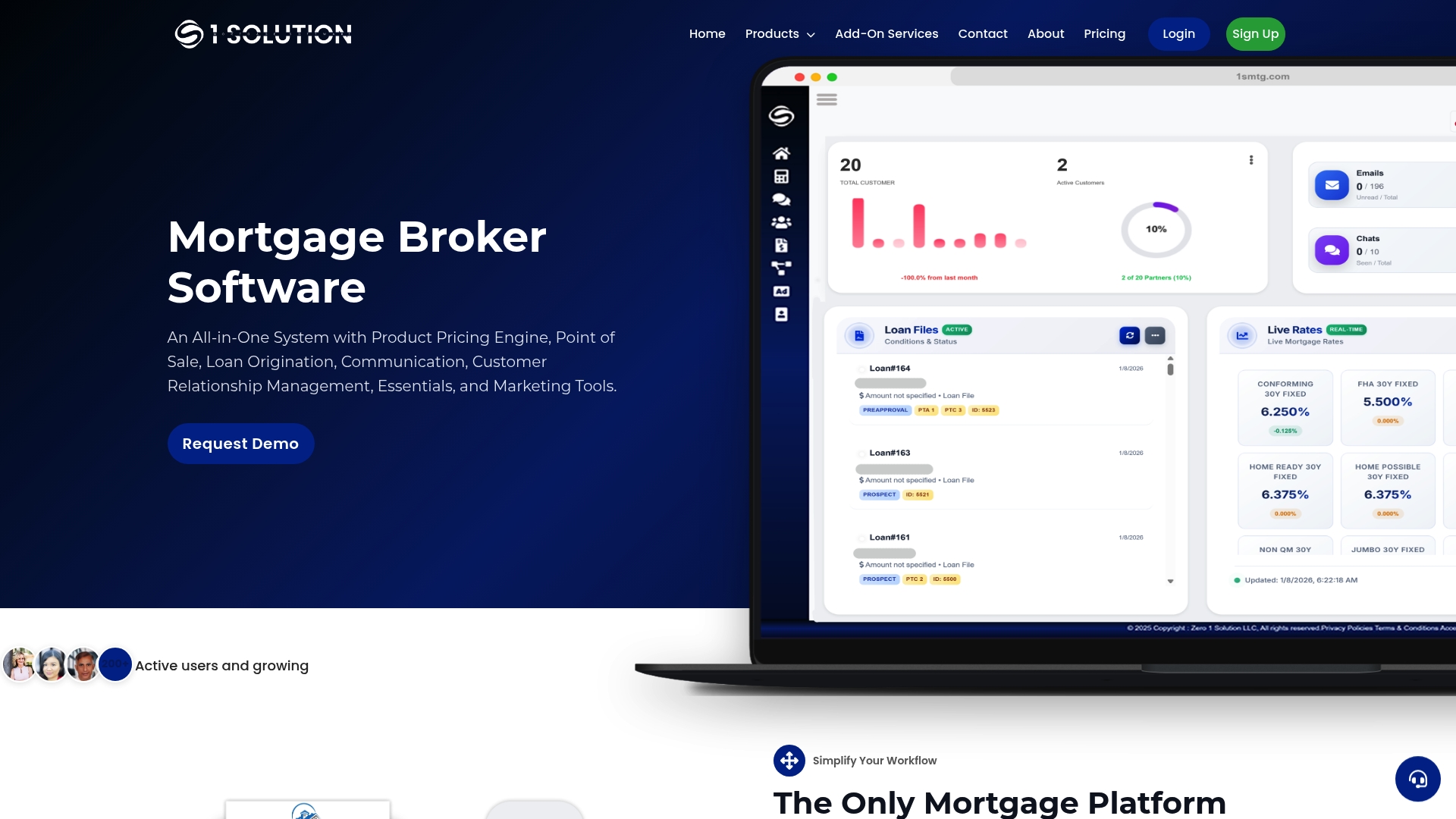
1 Solution Mortgage Software was built from the ground up for independent brokers who are tired of stitching together five tools that were never designed to work together. The platform combines LOS, CRM, PPE, borrower POS portal, compliance documentation, KPI dashboards, automated follow-up, and vendor management in one connected system. That means no re-keying borrower data, no compliance checks happening in a spreadsheet after the fact, and no pipeline living in someone's personal CRM that leaves with them when they go.
The practical result: your team follows the same documented workflow on every file, your audit trail is built automatically, and your leadership dashboard shows the team KPIs that actually predict revenue, not just last month's closings. Request a demo at 1smtg.com and see how the platform maps to the specific mistakes your brokerage is working to fix.
Useful sources and references
- Top Mortgage Compliance Risks for Brokers | Mortgage Defense Solutions — Covers HMDA errors, vendor oversight failures, manual QC weaknesses, and outdated policy risks; directly relevant to U.S. broker compliance audits.
- You don't own a mortgage business, you own a job | Mortgage Solutions — Explains the owner-operator trap and the four essentials for building a scalable firm.
- The product transfer trap | Mortgage Solutions — Analysis of PT dependence and the case for specialist lending diversification.
- Loan Broker Mistakes That Torch Your Pipeline | Distilled Funding — Practical CRM and automation guidance for new loan brokers.
- Three key liability risks facing mortgage brokers | Mortgage Strategy — Covers AI usage policy, data protection, and human oversight requirements for formal advice records.
- Mortgage Regulatory Compliance Explained for Brokers | 1 Solution Blog — U.S.-focused compliance basics and what examiners look for in broker audits.
- Compliance in New Mortgage Businesses: 2026 Guide | 1 Solution Blog — Documentation templates and compliance checklists for new U.S. brokerages.
This article is general information for independent mortgage professionals and does not constitute legal, financial, or compliance advice. Confirm current regulatory requirements with the CFPB, your state regulator, or a qualified compliance professional for your specific situation.