
AI mortgage automation cuts cycle times and reduces cost per loan by targeting specific, high-friction tasks: document extraction, income and asset verification, and appraisal alternatives. Tools like Loan Product Advisor with its AIM and ACE capabilities, alongside newer agentic workflows, now handle much of this work. None of it replaces underwriters. It replaces the manual parts of their job, as long as human review and governance stay in place.
TL;DR:
- AI automation is most effective when focusing on high-volume, low-judgment tasks like document extraction, verification, and appraisal alternatives, saving lenders up to $1,500 per loan.
- Automated workflows must incorporate strict exception routing and layered fraud checks to ensure human underwriters only review files requiring judgment, maintaining governance and compliance standards.
- Integration challenges mainly stem from outdated loan origination systems and inconsistent vendor data formats, requiring thorough mapping, testing, and monitoring before going live.
- Regulatory frameworks demand comprehensive documentation, ongoing monitoring, and explainability for AI models, especially when automating credit decisions or adverse action reasons.
- Independent brokers benefit from unified platforms that integrate core tools and emphasize governance, data security, and support, reducing operational risks associated with piecemeal automation.
Table of Contents
- 1. High-impact use cases and bottom-line benefits
- 2. How AI-driven automation fits into core workflows
- 3. Risk, governance, and regulatory controls lenders must build
- 4. From pilot to platform: an adoption roadmap and common pitfalls
- 5. Author perspective: practitioner lessons from Omar Khamisa and 1 Solution
- 6. Impact of AI automation on mortgage underwriting accuracy and risk assessment
- 7. Data privacy and security considerations in AI mortgage automation
- 8. Future trends and innovations in AI mortgage automation, such as generative AI and advanced NLP techniques
- 9. Stakeholder adoption and change management strategies for AI mortgage systems
- 10. Integration challenges with legacy mortgage systems and third-party services
- 11. What lenders get wrong about AI mortgage automation
- How 1 Solution helps brokers adopt governed AI automation
- Sources
- FAQ
1. High-impact use cases and bottom-line benefits
Not every part of origination deserves automation, and lenders who chase full automation everywhere waste money. The tasks worth automating first are the ones with high volume, low judgment, and clear rules.
Document ingestion is the obvious starting point. Optical character recognition paired with named-entity recognition can pull figures from paystubs, W-2s, and bank statements far faster than a processor typing them into a loan origination system by hand. From there, AIM-style verification checks income, assets, and employment against third-party data sources, while Loan Product Advisor's Automated Collateral Evaluation offers an appraisal alternative for eligible transactions, cutting both time and cost when a full appraisal isn't required.
The tasks that should not be automated end to end are the ones that need triage. Exception routing keeps human underwriters focused on the loans that actually need judgment, rather than burning hours on files that sail through standard checks. Fraud screening and data-consistency checks run underneath all of this, flagging mismatches before they become bigger problems downstream.
The high-value automation targets look like this:
- Document extraction from paystubs, W-2s, tax transcripts, and bank statements
- Income, asset, and employment verification through AIM-style automated checks
- Appraisal alternatives through ACE for eligible collateral evaluations
- Exception routing that sends only ambiguous or high-risk files to underwriters
- Fraud and data-consistency checks layered across every automated step
Freddie Mac reports that lenders using machine-learning-enhanced automated underwriting can save up to $1,500 per loan while shortening production cycle times, a meaningful number for any lender running thin margins on high volume.
2. How AI-driven automation fits into core workflows
The workflow itself follows a predictable sequence, and understanding where each technology belongs in that sequence matters more than picking a vendor.
- Intake: Borrower documents and application data enter the system through a portal or upload.
- Extraction: OCR and NER pull structured data from unstructured documents.
- Validation: Extracted data gets checked against third-party sources and internal rules.
- AUS and rule checks: Deterministic systems like LPA, AIM, and ACE apply eligibility rules and produce a recommendation.
- Exception routing: Files that fail a rule, carry ambiguous data, or fall outside standard parameters go to a human underwriter.
The distinction that trips up a lot of lenders is the difference between deterministic automated underwriting systems and probabilistic generative AI. LPA, AIM, and ACE apply fixed, auditable rules to produce a consistent eligibility answer every time. Generative AI and agentic workflows are useful for a different job: summarizing documents, drafting borrower communications, or coordinating tasks across systems. Eligibility and final credit decisions belong with the deterministic layer, not the generative one.
The AWS reference architecture for agentic mortgage processing illustrates this well. A supervisor agent coordinates sub-agents for extraction, verification, validation, and compliance checks, while routing anything unresolved to a human underwriter. It's a useful blueprint for how a mortgage operation might structure automation without collapsing every decision into a single opaque model.
Integration with your loan origination system is where most of the real engineering effort goes. Field mapping between extracted data and LOS fields has to be exact, or the automation just moves errors downstream faster. Readers building out this kind of infrastructure may find our guide to mortgage automation tool types useful for mapping categories to specific origination tasks.
Pro Tip: Map your LOS fields before you evaluate any automation vendor. Knowing exactly which fields need to sync will save you weeks of integration work later.
3. Risk, governance, and regulatory controls lenders must build
Governance isn't a checkbox you add after the pilot works. It's the thing that determines whether the pilot is allowed to become production.
FHFA's Advisory Bulletin AB-2022-02 treats AI and machine learning as evolving, risk-bearing processes that need enterprise-wide strategy, ongoing monitoring, documentation, and controls proportionate to the risk involved. That means a document-extraction tool doesn't need the same scrutiny as a model influencing credit decisions, but both need a governance record.
The CFPB's guidance on adverse action adds a separate obligation. Under ECOA and Regulation B, creditors must give specific principal reasons for a denial, and using a complex algorithm or AI model doesn't remove that requirement. If your automation can't produce a traceable, specific reason code for every adverse action, it isn't ready for production, no matter how accurate it tests.
Practical controls worth building before scaling anything:
- Define key risk indicators and key performance indicators before deployment, not after
- Version every model and log changes with dates and rationale
- Test against production-realistic data, not clean sample sets
- Keep a manual override path available at every automated decision point
- Write vendor contracts that specify audit rights and explainability requirements
FHFA's bulletin details governance, risk identification, monitoring, and documentation expectations for AI and machine-learning models, and that framework is the baseline regulators expect lenders to meet regardless of size. Brokers building out compliance programs alongside automation may want to review our compliance setup checklist for a more detailed walkthrough.
4. From pilot to platform: an adoption roadmap and common pitfalls
Most AI mortgage pilots don't fail because the technology is bad. They fail because the plan for scaling it was never built.
- Pick a bounded use case. Start with something narrow, like paystub extraction, rather than trying to automate an entire file at once.
- Baseline your current metrics. Measure existing cycle time and cost per loan before you introduce any automation, so you can prove the improvement later.
- Pilot with production data. Clean test sets hide the problems that matter. Overlays, inconsistent LOS fields, and messy borrower documents are where automation actually breaks.
- Build governance and monitoring in parallel. Don't wait until the pilot succeeds to think about documentation and oversight.
- Scale deliberately. Expand to adjacent use cases only after the first one is stable and monitored.
The most common failure modes show up in a familiar pattern: a pilot performs well on curated data, then falls apart against real production files with investor overlays and inconsistent field formatting. Missing exception workflows compound the problem, because a system with no clear path for ambiguous files either stalls or forces a bad automated decision through.
Before anything goes live, run through a short checklist: confirm data lineage from source to LOS, confirm the system can explain any decision it influences, confirm every LOS field mapping is tested, and confirm security and service-level agreements are documented. Our workflow design guide covers the practical side of restructuring office processes around this kind of rollout.
Pro Tip: Run your pilot for at least one full month on production data before touching your governance documentation. You need real edge cases to write real controls.
5. Author perspective: practitioner lessons from Omar Khamisa and 1 Solution
Building a broker-focused platform teaches you fast where automation actually saves time versus where it just moves the bottleneck. POS, LOS, pricing, and compliance tools have to talk to each other cleanly, or automation just creates a faster way to generate errors.
Smaller brokerages should prioritize differently than enterprise lenders. A five-person shop doesn't need a governance committee. It needs one or two automated tasks, done well, with a clear human checkpoint. Enterprise lenders can afford dedicated model-risk teams; independent brokers need automation that's already governed by the platform they subscribe to, not something they build themselves.
That's the gap that shaped how we approach automation at 1 Solution: brokers deserve tools built from real operational experience, not adapted from bank-scale infrastructure.
6. Impact of AI automation on mortgage underwriting accuracy and risk assessment
Automation changes underwriting accuracy in two directions at once, and lenders need to understand both.
On the upside, deterministic tools like AIM and ACE apply the same rules to every file, every time, which removes the inconsistency that creeps in when different underwriters interpret guidelines slightly differently. Automated income and asset verification also pulls from third-party data sources directly, cutting the risk of transcription errors that happen when someone keys numbers in by hand.
The risk side is less discussed but just as real. A model trained on historical lending patterns can carry forward the biases in that history if nobody checks for it. That's exactly why FHFA's AVM rule requires nondiscrimination testing and confidence metrics for automated valuation models rather than treating them as a simple plug-in. The same caution applies to any model touching credit decisions.
The practical takeaway is that automation improves consistency but doesn't eliminate the need for oversight. A deterministic AUS applying fixed rules is auditable in a way a black-box model is not, which is part of why regulators keep drawing a line between the two. Lenders who blur that line, letting a generative model influence eligibility without a deterministic backstop, are taking on risk they likely haven't measured.
7. Data privacy and security considerations in AI mortgage automation
Mortgage applications carry some of the most sensitive personal data a consumer will ever hand over: Social Security numbers, bank statements, tax transcripts, and income history. Any automation touching that data inherits a serious security obligation.
The first consideration is where data physically goes. Cloud-based extraction and verification tools often send documents through third-party processing layers, so lenders need to know exactly where that data is stored, how long it's retained, and who has access. Vendor contracts should specify this explicitly rather than leaving it implied.
Encryption in transit and at rest is table stakes at this point, but access control matters just as much. Not every employee needs to see every borrower's full financial picture, and role-based access limits exposure if credentials get compromised.
Third-party integrations multiply the risk surface. Every additional vendor connected to income verification, credit pulls, or document storage is another point where a breach could happen. Lenders should treat vendor security audits as a recurring task, not a one-time checkbox during onboarding.
Finally, any AI system touching personally identifiable information needs a clear data-minimization policy: collect what's needed for the decision, retain it only as long as required, and build deletion into the process rather than treating it as an afterthought.

8. Future trends and innovations in AI mortgage automation, such as generative AI and advanced NLP techniques
Generative AI is moving from a novelty in mortgage operations to a working layer that sits alongside deterministic underwriting systems, and that shift is likely to accelerate.
Advanced natural language processing is getting better at handling the messy, unstructured documents that have always slowed down manual review: handwritten letters of explanation, inconsistent bank statement formats, and multilingual documentation. As those models improve, the extraction step at the front of the workflow gets faster and more accurate, which shortens everything downstream.
Agentic workflows, like the supervisor-and-sub-agent architecture AWS has demonstrated, point toward a future where a single coordinating system manages extraction, verification, compliance checks, and underwriter handoff without a human manually shepherding a file between separate tools. That's a meaningful shift from today's more siloed automation, where each tool handles one task and a person still stitches the results together.
The caution here is the same one that applies across the industry: generative AI is well suited to summarization, drafting, and coordination, not to final eligibility or credit decisions. As these tools mature, expect the deterministic AUS layer to stay firmly in place for anything that determines whether a borrower qualifies, with generative AI expanding its role in everything around that decision.
9. Stakeholder adoption and change management strategies for AI mortgage systems
Technology rarely fails on the technical side. It fails when the people expected to use it weren't part of the plan.
Underwriters and processors need to understand what the automation is actually doing, not just that it exists. A system that quietly reroutes files or applies verification checks without explanation breeds distrust fast, and staff will find workarounds if they don't trust the tool.
Training matters more than most rollout plans account for. Give staff hands-on time with the new workflow before it goes live, and build a feedback loop where they can flag files the automation handled poorly. That feedback is often the fastest way to catch a broken rule or a mismapped field before it causes real damage.
Leadership buy-in has to be visible, not just budgetary. When management treats automation as something imposed from above rather than a tool built with input from the people using it daily, adoption stalls regardless of how good the technology is.
KPMG's research on mortgage executives points to platform modernization and automation as a clear investment priority, with human-in-the-loop validation staying central even as adoption grows. That pairing, more automation alongside more deliberate human oversight, is the direction the whole industry is heading, not a contradiction to work around.
10. Integration challenges with legacy mortgage systems and third-party services
Most of the friction in AI mortgage automation isn't the AI. It's connecting new tools to loan origination systems that were never designed for this kind of data flow.
Legacy LOS platforms often store data in rigid field structures built years before automated extraction or agentic workflows existed. Mapping extracted data from a paystub or bank statement into the correct LOS field sounds simple until you hit inconsistent naming conventions, missing fields, or systems that only accept data through narrow, outdated APIs.
Third-party services add another layer. Credit bureaus, verification providers, and appraisal management companies each have their own data formats and update schedules, and a single mismatch between one vendor's output and your system's expected input can silently corrupt a file.
The lenders who navigate this well tend to invest heavily in the mapping and testing phase before any automation touches a live file. That means testing against a wide range of real, messy production documents, not a handful of clean samples, and building monitoring that flags mismatches immediately rather than letting them surface weeks later during underwriting. Readers weighing a broader platform overhaul against a piecemeal integration might find our piece on mortgage technology adoption useful for framing that decision.
11. What lenders get wrong about AI mortgage automation
The conventional wisdom treats AI mortgage automation as a single decision: adopt it or don't. That framing misses the point entirely. The real decision is narrower and more specific: which three or four tasks are worth automating this year, and what governance has to exist before any of them touch a live file.
Lenders who chase full end-to-end automation almost always underestimate how much of the value sits in the boring parts, document extraction and verification, rather than in flashy agentic demos. The demos are useful for understanding architecture, not as a template to copy wholesale.
The bigger blind spot is treating compliance as a follow-up step. FHFA and CFPB expectations aren't obstacles to bolt on after a pilot succeeds. They're the design constraints that determine whether a pilot can ever become production. Build the reason-code lineage and the monitoring plan alongside the pilot, not after it.
If you take one thing from this, prioritize measurable operational outcomes over technical sophistication. A dull tool that reliably shaves two days off cycle time beats an impressive one nobody can explain to a regulator.
— Omar Khamisa
How 1 Solution helps brokers adopt governed AI automation
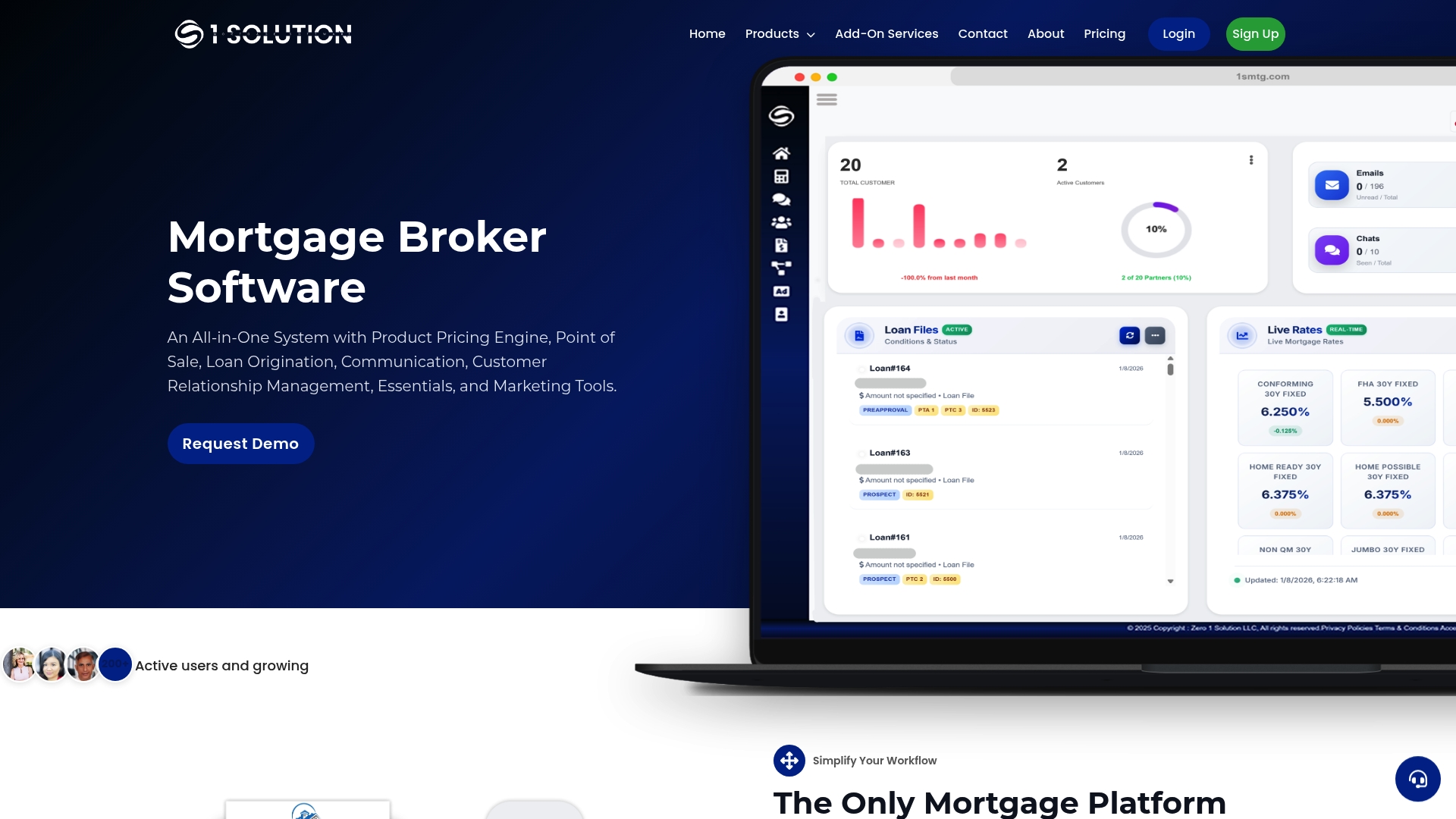
Independent brokers don't need a dozen disconnected tools to get the benefits described here. Our platform brings pricing, CRM, borrower POS, LOS, e-signature, and compliance tools into one platform, so automation doesn't mean stitching together multiple vendors and hoping the field mappings hold.
Before choosing any automation partner, ask direct questions: how is data lineage tracked, what monitoring exists after go-live, what does onboarding actually look like week to week, what support is available when something breaks, and how is borrower data secured. These are the questions that separate a governed rollout from a risky one.
- Ask about data lineage from intake through final decision
- Ask about ongoing monitoring, not just initial testing
- Ask about onboarding timeline and hands-on support
- Ask about security certifications and data retention policy
1 Solution was built by mortgage professionals who dealt with these exact questions from the operations side, not from a boardroom. If you want to see how a unified platform handles this in practice, explore a subscription account and talk to our team directly.
This article is general information, not a substitute for advice from a qualified financial advisor. Consult a qualified financial professional about your own circumstances before acting on anything here.
Sources
- Loan Product Advisor® - Freddie Mac Single-Family
- Advisory Bulletin 2022-02
- Autonomous mortgage processing using Amazon Bedrock Data Automation and Amazon Bedrock Agents
- Consumer Financial Protection Circular 2022-03: Adverse action notification requirements
FAQ
What is AI mortgage automation used for today?
AI mortgage automation is mainly used for document extraction, income and asset verification, and appraisal alternatives like ACE. Freddie Mac's Loan Product Advisor applies these through its AIM and ACE capabilities, reducing documentation and manual review.
Does AI replace mortgage underwriters?
No. Deterministic systems handle rule-based eligibility checks, while generative AI assists with summarization and coordination, but final credit decisions and adverse-action reasoning still require human oversight under CFPB guidance. Human-in-the-loop review remains a regulatory and practical necessity.
How much can AI automation save per loan?
Freddie Mac reports that lenders using machine-learning-enhanced automated underwriting can save up to $1,500 per loan while shortening cycle times. Actual savings depend on which tasks are automated and how well they integrate with existing systems.
What regulatory guidance applies to AI in mortgage lending?
FHFA's Advisory Bulletin AB-2022-02 sets governance expectations for AI and machine-learning models, while the CFPB requires specific, traceable reasons for adverse actions under ECOA and Regulation B. Both apply regardless of how complex the underlying model is.
Can 1 Solution help brokers automate origination tasks?
1 Solution brings pricing, POS, LOS, CRM, and compliance tools into one platform built specifically for independent brokers, which supports a more governed approach to automation than piecing together separate vendors. Details on plans are available through a subscription account.