
The five tool categories that deliver the fastest growth for mortgage brokers and small lenders right now are: POS/LOS integration, CRM sync with pipeline automation, AI for lead intake and document intelligence, pricing and rate-quote automation, and compliance and audit automation. If you adopt nothing else this year, start there.
Three things you can do this week:
- Connect your POS directly to your LOS and eliminate manual file handoffs.
- Enable instant lead response, whether through an AI chatbot, automated text, or a triggered email sequence.
- Run an integration audit to find where files stall between systems.
Do those three things and you will see measurable results within 30 days:
- Faster borrower response times (often same-minute contact on new leads)
- Fewer stalled files sitting in manual handoff queues
- A visible reduction in cost-per-funded-loan as rework drops
Pro Tip: Before you buy anything new, map your current workflow on paper. Most brokers discover their biggest bottleneck is not a missing tool but a broken handoff between two tools they already own.
Table of Contents
- Why the 2026 market makes tool adoption urgent for lenders
- Which tool categories actually drive mortgage growth?
- How to pick and prioritize the right tools now
- A phased implementation roadmap that actually works
- Building referral channels that produce consistent volume
- Marketing and lead-generation tactics that scale for brokers
- Operational scale: what to automate, what to measure, and how to build your dashboard
- Key Takeaways
- What I've learned building mortgage tech from the trenches
- Why brokers choose 1 Solution Mortgage Software to scale
- Useful sources and further reading
Why the 2026 market makes tool adoption urgent for lenders
The mortgage market in 2026 is not forgiving of slow operations. Rising refinance activity, shifting equity usage patterns, and rising default rates are all reshaping lender strategy at the same time. Borrowers shop multiple lenders before committing, which means your speed-to-contact and pricing accuracy are competitive weapons, not back-office details.
The core levers you actually control:
- Lead capture and speed-to-contact. The broker who responds first wins the relationship more often than not.
- File velocity. Days-in-stage is a KPI that directly predicts pull-through rate. Slow files die.
- Pricing accuracy. Rate-quote errors erode trust and create compliance exposure.
- Partner referrals. Real estate agents and financial advisors remain the highest-conversion referral channel for purchase loans.
- Compliance automation. Manual compliance checks slow every file and create audit risk.
That figure, drawn from Freddie Mac data, is the clearest argument for treating technology adoption as a revenue decision, not an IT project.
Which tool categories actually drive mortgage growth?
Not every piece of software moves the needle. These eight categories have a direct, documented impact on funded-loan volume and cost-per-origination.
Point-of-sale and document collection
A POS system gives borrowers a self-service portal to upload documents, sign disclosures, and track their loan status. The business impact is immediate: fewer inbound status calls, faster initial document collection, and a professional borrower experience that builds confidence early. A typical workflow sends the borrower a branded link at application, collects all required docs through the portal, and routes them automatically to the LOS.

LOS integration
Your loan origination system is the operational core. When it connects natively to your POS and CRM, data flows without re-entry. When it does not, processors spend hours copying fields and chasing confirmations. LOS integration is the single highest-leverage technical project for most independent brokers.
CRM sync and pipeline automation
A CRM that is not synchronized with your LOS in real time is just a contact list. Real-time CRM–LOS sync turns your CRM into a revenue engine: automated follow-up sequences trigger on loan milestones, pipeline reports reflect actual file status, and no lead falls through because a status update never arrived. The most common gap brokers overlook is field mapping — if loan fields are not mapped back to the CRM, leadership cannot see real-time pipeline status, and the CRM never becomes a single source of truth.
AI for lead intake and document intelligence
AI tools at the intake stage qualify leads instantly, respond after hours, and route files to the right processor without human intervention. On the document side, OCR classification and AI-driven document review reduce manual handling time significantly per loan and cut underwriting delays. Payback timelines are among the fastest in the stack: lead intake value appears in 2–4 weeks, and document automation typically pays back in 1–2 months.
Pricing and rate-quote automation
Manual rate quotes are slow, error-prone, and create fair-lending exposure when they are inconsistent. A pricing engine pulls live investor pricing, applies eligibility rules, and returns accurate quotes in seconds. For brokers managing multiple wholesale relationships, this is not optional — it is the difference between winning and losing a rate-sensitive borrower.
Compliance and audit automation
Compliance automation handles TRID timing, disclosure tracking, and audit-log generation without a processor manually checking boxes. The business case is dual: you reduce regulatory exposure and you free up processor time for file-moving work.
Analytics and Mortgage BI
Role-based dashboards built on a governed data layer surface cost-to-originate, days-in-stage, and pipeline conversion rates so managers can act on outliers before they become funded-loan losses. Tools like Power BI connected to a clean LOS data export give leadership visibility they cannot get from a spreadsheet.
Referral partner enablement
Co-branded portals, automated referral tracking in the CRM, and agent-facing status updates turn real estate agent relationships into a repeatable volume channel. Without a system behind it, partner relationships depend entirely on personal rapport and are fragile when a loan officer leaves.
Pro Tip: The most common deployment mistake is attempting a full platform replacement at once. A phased approach that connects the origination platform to the processing engine first, then layers document intelligence and CRM integration, delivers faster ROI and far less disruption.
| Tool Category | Primary Business Impact | Fastest Win? |
|---|---|---|
| POS / document collection | Faster intake, fewer status calls | Yes |
| LOS integration | Eliminates re-entry, speeds processing | Yes |
| CRM sync + automation | Higher pull-through, no lost leads | Yes |
| AI lead intake + doc intelligence | After-hours capture, reduced rework | Yes |
| Pricing / rate-quote engine | Accuracy, speed, fair-lending safety | Yes |
| Compliance / audit automation | Reduced exposure, faster file movement | Medium |
| Mortgage BI / analytics | Pipeline visibility, cost control | Medium |
| Referral partner enablement | Scalable volume channel | Longer-term |
How to pick and prioritize the right tools now
The broker who buys the wrong tool in the wrong order wastes money and demoralizes their team. Use this framework before you sign anything.
Selection criteria checklist:
- Integration method. Does it connect via native API or brittle middleware? Prefer native API connections with explicit error logging. Middleware that silently drops failed syncs is an audit liability.
- Mortgage fluency. Was the tool built for mortgage, or adapted from a generic CRM or document platform? Mortgage-specific field structures matter.
- Audit trail. Every action, status change, and document touch should be logged with a timestamp and user ID.
- Security and data handling. SOC 2 compliance, encryption at rest and in transit, and role-based access controls are non-negotiable.
- Implementation support. Who configures the field mapping? Who trains your team? Vendors who hand you a PDF and disappear cost more in the long run.
- Scalability. Can the tool handle 3x your current volume without a pricing cliff or a re-implementation?
Vendor red flags to watch for:
- No sandbox or trial environment before you commit
- Pricing that scales by loan volume with no cap
- Integration described as "coming soon" or handled entirely by a third-party connector
- No mortgage-specific references or case studies
| Tool Type | Typical Cost Shape | Timeline to Value |
|---|---|---|
| AI lead intake | Low monthly SaaS | 2–4 weeks |
| Document automation | Per-loan or flat SaaS | 1–2 months |
| POS / LOS native connection | Implementation fee + SaaS | 4–8 weeks |
| CRM–LOS sync | Integration + configuration | 6–12 weeks |
| Mortgage BI dashboards | BI license + data layer build | 10–16 weeks |
| Compliance automation | Module or platform add-on | 4–8 weeks |
Pro Tip: Before vendor demos, run a 1–2 week integration audit to map exactly where files stall. Walk in knowing your three biggest bottlenecks — vendors who cannot address those specifically are the wrong fit.
A phased implementation roadmap that actually works
The fastest path to ROI is not the most ambitious rollout. It is the most disciplined sequence. Here is the order that consistently delivers results with the least disruption.
Phase 1: Connect POS to LOS (Weeks 1–4) Get borrower-submitted data flowing directly into your LOS without manual re-entry. Milestone: zero re-keying of application data. KPI trigger to advance: time-to-accept drops below 24 hours.

Phase 2: Deploy document intelligence (Weeks 4–8) Layer OCR classification and automated document routing on top of the POS connection. Milestone: documents classified and routed automatically on receipt. KPI trigger: manual document handling time reduced measurably per file.
Phase 3: Automate verification and compliance (Weeks 6–12) Add automated income/asset verification, TRID tracking, and audit-log generation. Milestone: compliance checklist runs without processor intervention. KPI trigger: rework rate drops below your baseline.
Phase 4: CRM sync and Mortgage BI dashboards (Weeks 10–16) Connect CRM to LOS with full field mapping. Build role-based dashboards for loan officers, processors, and leadership. Milestone: pipeline status visible in real time without a status call. KPI trigger: pipeline conversion rate visible and trending.
Phase 5: Optimize pricing and referral channels (Ongoing) Tune pricing engine rules, activate co-branded agent portals, and build referral attribution into the CRM. This phase never fully closes — it is the continuous improvement layer.
| Phase | Milestone | KPI to Watch | Go/No-Go Criteria |
|---|---|---|---|
| 1: POS → LOS | Zero re-keying | Time-to-accept | Under 24 hours |
| 2: Document intelligence | Auto-routing live | Manual handling time | Measurable reduction per file |
| 3: Verification + compliance | Checklist automated | Rework rate | Below baseline |
| 4: CRM sync + BI | Real-time pipeline | Conversion rate | Visible and trending up |
| 5: Pricing + referrals | Agent portals live | Referral volume | Month-over-month growth |
The ROI case for this sequence is concrete. High automation adopters save approximately $1,500 per loan, leading to substantial monthly savings for brokers with typical loan volumes — enough to fund the entire technology stack several times over.
Pro Tip: Build your technology adoption plan around your team's capacity, not the vendor's implementation timeline. A tool your team does not use is worth exactly nothing.
Building referral channels that produce consistent volume
Technology does not replace relationships with real estate agents and financial advisors. It makes those relationships scalable and measurable. Without a system behind them, referral partnerships depend on personal rapport and collapse when a loan officer changes jobs.
Tactics that work:
- Co-branded content. Rate update emails, market commentary, and buyer guides sent under both your name and the agent's name keep you visible without requiring the agent to do any work.
- Automated agent portals. A simple web portal where agents can check loan status without calling you is one of the highest-value relationship tools you can deploy. Agents refer to brokers who make their lives easier.
- Referral tracking in CRM. Every referral source should be tagged at lead entry. Without this, you cannot measure which agent relationships are actually producing volume.
How to measure partner performance:
- Referral source conversion rate (leads from Agent X → funded loans)
- Time-to-close by referral source
- Lifetime loan value by referral source
- Referral volume trend month-over-month
Understanding your finance tech stack architecture matters here: referral attribution only works if your CRM, LOS, and marketing tools share a common lead ID from first touch to funding.
Pro Tip: Automate the referral thank-you and status update sequence. Agents who receive automatic updates at key milestones (application received, conditional approval, clear to close) refer more frequently because they trust the process, not just the person.
| Metric | What It Tells You |
|---|---|
| Referral conversion rate | Which partners send closeable leads |
| Time-to-close by source | Where partner-referred files stall |
| Referral volume trend | Whether the relationship is growing |
| Lifetime loan value by source | Which channels produce the best borrowers |
Marketing and lead-generation tactics that scale for brokers
Most brokers underinvest in marketing because they cannot see a direct line from content to closed loans. The fix is not more content — it is better attribution and a tighter nurture sequence.
High-ROI channels for independent brokers:
- Organic content (rate commentary, buyer guides, refinance calculators) that ranks in search and positions you as the local expert
- Targeted paid search on purchase and refinance intent keywords in your market
- Video messaging for personalized follow-up that outperforms plain email on reply rates
- Social proof (Google reviews, testimonials, funded-loan milestones) shared consistently on social platforms
- Agent co-marketing (joint open house flyers, co-branded rate sheets)
A four-step email nurture flow for a new purchase lead:
- Day 0: Instant automated response confirming receipt, setting expectations for next contact, and linking to your digital application.
- Day 2: Educational email on the pre-approval process and what documents to gather.
- Day 5: Rate update or market insight relevant to their purchase timeline.
- Day 10: Personal video message from the loan officer with a direct call to schedule a consultation.
Metric targets to aim for: open rates above 35% for the first email, reply rates above 8% by Day 10, and conversion to application within 14 days for engaged leads.
Social media remains a significant channel for marketers globally, and mortgage brokers who combine organic content with paid retargeting consistently outperform those relying on referrals alone. The CRM–LOS data layer is what makes these tactics scale: when a lead moves from nurture to application, the sequence stops automatically and the loan officer gets a task to call.
Operational scale: what to automate, what to measure, and how to build your dashboard
Scaling without breaking compliance requires knowing exactly which tasks to automate and which KPIs to watch. The brokers who grow fastest are not the ones with the most tools — they are the ones who can see their pipeline clearly and act on what they see.
KPIs every broker should monitor:
- Cost per origination (total operating cost / funded loans)
- Cycle time from application to funding (in calendar days)
- Days-in-stage for each pipeline milestone
- Error and rework rate (files that require re-submission or correction)
- Pipeline conversion rate (leads → applications → approvals → funded)
Automation checklist for operational scale:
- Document classification and routing on receipt
- Income and asset verification triggers
- Milestone-based task routing to processors and underwriters
- Automated disclosure delivery and TRID tracking
- Audit log generation for every file action
Native API connections with explicit error logging are the foundation of a reliable automation layer. Middleware that silently drops failed syncs creates audit gaps that surface at the worst possible time — during an exam or a buyback dispute.
Example dashboard layout:
| Role | KPI Tiles to Display |
|---|---|
| Loan officer | Active pipeline, days-in-stage, lead response time |
| Processor | Documents outstanding, rework rate, milestone completion |
| Branch manager | Cost per origination, pull-through rate, cycle time |
| Compliance officer | TRID timing, audit log completeness, exception count |
Mortgage BI dashboards built on a governed data layer give each role exactly what they need without overwhelming them with every metric in the system. The goal is fewer decisions made on gut feel and more decisions made on data that updates in real time.
Key Takeaways
The fastest path to mortgage business growth in 2026 runs through POS–LOS integration first, then AI-assisted intake and document intelligence, then CRM sync — in that order, with KPIs at every phase gate.
| Point | Details |
|---|---|
| Start with POS → LOS | Eliminating manual re-entry is the single highest-leverage first step; target time-to-accept under 24 hours. |
| AI intake pays back fast | Lead intake AI shows value in 2–4 weeks; document automation typically pays back in 1–2 months. |
| CRM sync requires field mapping | Real-time LOS–CRM sync only works if loan fields are mapped back; without it, the CRM stays a contact list. |
| Automate saves significant amounts per loan | High automation adopters save approximately $1,500 per loan, per Freddie Mac data cited in lending tech research. |
| 1 Solution Mortgage Software | Combines POS, LOS, CRM sync, pricing, compliance, and Mortgage BI in one broker-built platform for independent brokers. |
What I've learned building mortgage tech from the trenches
The conventional wisdom in mortgage technology says that brokers need to "pick the best tool for each job" and integrate them later. After two decades working as a processor, underwriter, loan originator, and systems consultant, I think that advice is exactly backwards — and it is costing brokers real money.
The brokers I have watched struggle with technology adoption almost always made the same mistake: they bought point solutions for individual problems without asking how those tools would talk to each other. A great POS that does not connect to the LOS. A CRM that does not know a loan closed. A compliance tool that logs actions in a silo no one reads. Each tool works fine in isolation. Together, they create a fragmented operation that is harder to manage than the spreadsheets they replaced.
Three hard lessons from watching these rollouts:
Change management is the real implementation project. The technology is rarely the problem. Getting processors to stop emailing documents and start using the portal — that is where rollouts fail. Budget time for training, not just configuration.
Field mapping is not a detail. If your LOS fields do not map cleanly to your CRM, your pipeline reports are fiction. This is the step vendors rush through and brokers regret. Insist on a field-mapping review before go-live.
Audit trails protect you. The brokers who treat audit logging as a compliance checkbox are the ones who get caught flat-footed during an exam. Every file action should be logged, timestamped, and retrievable. Build that requirement into your vendor selection criteria from day one.
The one deployment pitfall I see most often: a brokerage goes live with a new integration, discovers that failed syncs are dropping silently, and only finds out three months later when a file is missing documents that were "definitely uploaded." The fix is always the same — require explicit error logging in the vendor contract, not as an afterthought.
Why brokers choose 1 Solution Mortgage Software to scale
Independent brokers do not need another tool to manage. They need one platform where everything connects. 1 Solution Mortgage Software was built by mortgage professionals who got tired of stitching together five different systems and paying for the privilege.
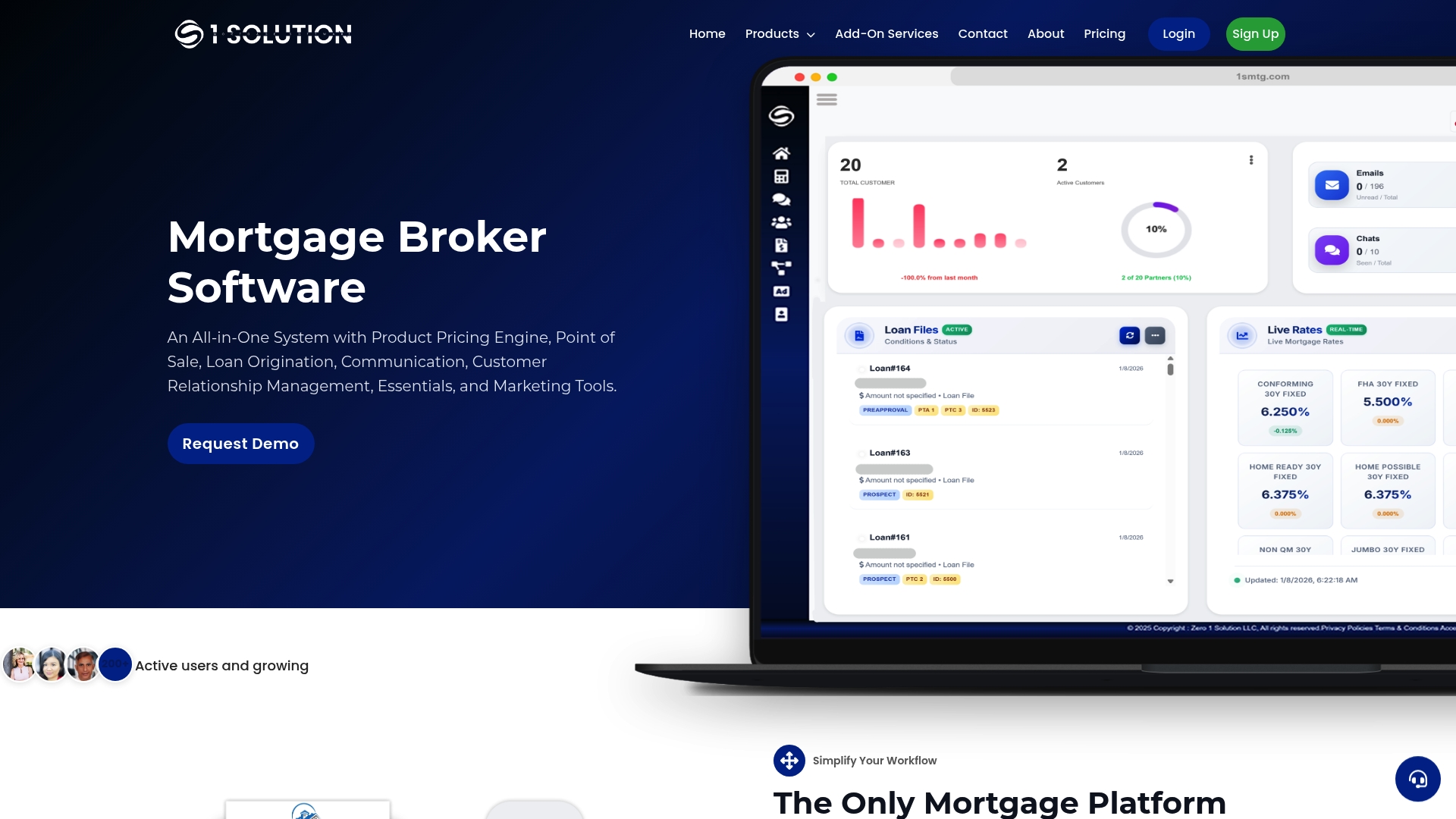
The platform maps directly to the growth problems this article covers: POS to LOS integration with no middleware fragility, real-time CRM sync with full field mapping, a built-in pricing engine, compliance automation with complete audit trails, Mortgage BI dashboards for role-based pipeline visibility, and referral partner tracking. It is the all-in-one mortgage platform built specifically for independent brokers and small brokerages that need integrated control without enterprise-level complexity or cost.
Who benefits most: independent mortgage brokers and small brokerages that are currently managing three or more disconnected systems and losing time to manual handoffs, status calls, and rework.
To see how 1 Solution Mortgage Software fits your current workflow, visit 1smtg.com and schedule a demo. Bring your three biggest bottlenecks — the platform was built to solve exactly those.
Useful sources and further reading
These sources informed the research and recommendations throughout this article. Each one is worth reading in full if you are planning a technology rollout or evaluating vendors.
- Lending Tech Ecosystem Playbook — The most comprehensive publicly available guide to phased mortgage tech integration, ROI benchmarks, and Mortgage BI architecture. Essential reading before any integration project.
- Breaking Down Barriers: Mortgage Software Integration — Practical guidance on running a pre-deployment integration audit and identifying file-stall points. Use this before you buy anything.
- AI for Mortgage Brokers: Lead Intake, Docs & Pipeline — Covers AI use cases with realistic payback timelines. Good for brokers evaluating AI intake and document tools.
- HubSpot + Encompass Integration: Scalable Mortgage Growth — A detailed case study on CRM–LOS synchronization and the revenue impact of real-time field mapping.
- Mortgage Shifts in 2026: ICE Mortgage Technology — Market context on 2026 refinance trends, default patterns, and equity usage shifts from ICE Mortgage Technology.
- CFPB RESPA Compliance Resources — Primary source for RESPA compliance requirements relevant to referral partner programs and co-marketing arrangements.
- Mortgage Regulatory Compliance Explained for Brokers — A practical compliance guide for independent brokers covering TRID, audit trails, and automation.
- Loan Origination System: A 2026 Broker's Guide — Covers LOS selection criteria and integration best practices for brokers evaluating their core system.
- Types of Mortgage Automation Tools: 2026 Guide — Categorized overview of automation tools with use-case examples for each category.
- Mortgage Broker Business Scaling Tips for 2026 — Practical scaling tactics and digital solutions for independent brokers.
- Finance Tech Stack: A Practical Guide for 2026 — External perspective on assembling a finance technology architecture, including integration patterns relevant to mortgage operations.
This article is general information for mortgage professionals and does not constitute legal, compliance, or financial advice. Confirm current regulatory requirements with the CFPB or a qualified compliance professional for your specific situation.