
The goal is one client record that links every email, SMS, call log, document, calendar event, task, and CRM note — so anyone on your team can open a single timeline and see the full story without switching apps. Here is the minimum viable plan to get there:
- Inventory every channel and tool your team currently uses to communicate with clients
- Choose an integration-first platform with open APIs, searchable history, and role-based access
- Map your existing data fields to the new system's schema and clean duplicates before migration
- Migrate in phases, starting with active clients before touching archived records
- Run a pilot with a representative cohort, measure accuracy and adoption, then roll out fully
The system you choose must have: native integrations or open APIs for every channel you use, a searchable unified timeline, role-based access control (RBAC), immutable audit logs, and configurable retention policies. Without all five, you have not centralized — you have just added another tool.
Key Takeaways
Centralizing client correspondence into a single system is the highest-leverage operational change an independent mortgage brokerage can make, and the migration succeeds when you phase it, pilot it, and measure it before full cutover.
| Point | Details |
|---|---|
| Start with a full channel inventory | List every tool receiving client messages before choosing a platform — missing one channel means the fragmentation persists. |
| Five non-negotiable system capabilities | Your platform must have APIs, a searchable timeline, RBAC, immutable audit logs, and configurable retention policies. |
| Pilot before full rollout | Test with 15–20 active files; require 98% data accuracy and 80% adoption before proceeding to full cutover. |
| Security controls are compliance controls | Encryption, MFA, RBAC, and exportable audit logs directly support GLBA requirements for U.S. mortgage brokers. |
| 1 Solution Mortgage Software | Combines CRM, communications, LOS, POS, compliance, and document storage in one platform built for independent brokers. |
Table of Contents
- What fragmented client correspondence is actually costing you
- The business case for a centralized messaging system
- What you actually need to centralize
- How to run the migration without losing data or your team's trust
- Security, retention, and compliance for U.S. mortgage brokers
- How a single system changes daily work across your team
- Why mortgage brokers get disproportionate ROI from this approach
- What we have learned from teams making this transition
- 1 Solution Mortgage Software brings all of this together for brokers
- Sources
What fragmented client correspondence is actually costing you
Fragmented communication is not just inconvenient. It creates measurable operational damage that compounds over time.
The symptoms are familiar: a loan officer replies to a borrower's email without knowing a processor already answered the same question by text. A compliance question surfaces during an audit and nobody can find the original disclosure acknowledgment because it lives in a personal inbox. A client calls to follow up on a document request that was buried under 200 unread messages in a shared Gmail account. These are not edge cases — they are daily friction for most independent brokerages running three or more disconnected tools.
The operational costs show up in specific, trackable ways:
- Lost message threads when staff changes, a personal inbox gets archived, or a tool subscription lapses
- Duplicated replies that confuse borrowers and waste processor time
- Missed SLAs because no one has a single view of open requests across channels
- Compliance gaps when disclosures, consent records, or adverse action notices cannot be retrieved quickly
- Billing errors when payment communications are scattered across email, text, and phone notes
The clearest sign you have a fragmentation problem: your team regularly asks "did we already send that?" or "which app did they message us on?" If those questions come up more than once a week, the cost is real and growing.
Platforms like Client Hub flag exactly this pattern: client requests buried across inboxes with no shared visibility mean work gets repeated and nothing gets resolved on the first contact.
The business case for a centralized messaging system
Centralizing client correspondence into a single system produces gains across three dimensions: efficiency, risk reduction, and revenue.
Efficiency is the most immediate win. When every channel feeds one timeline, your team stops switching between apps to reconstruct context. Unified Inbox describes this as the core usability benefit: a searchable, single-timeline view removes the need to remember which app held a conversation. Response times drop because the context is already there. Duplicated tasks disappear because the system shows what is already in progress.
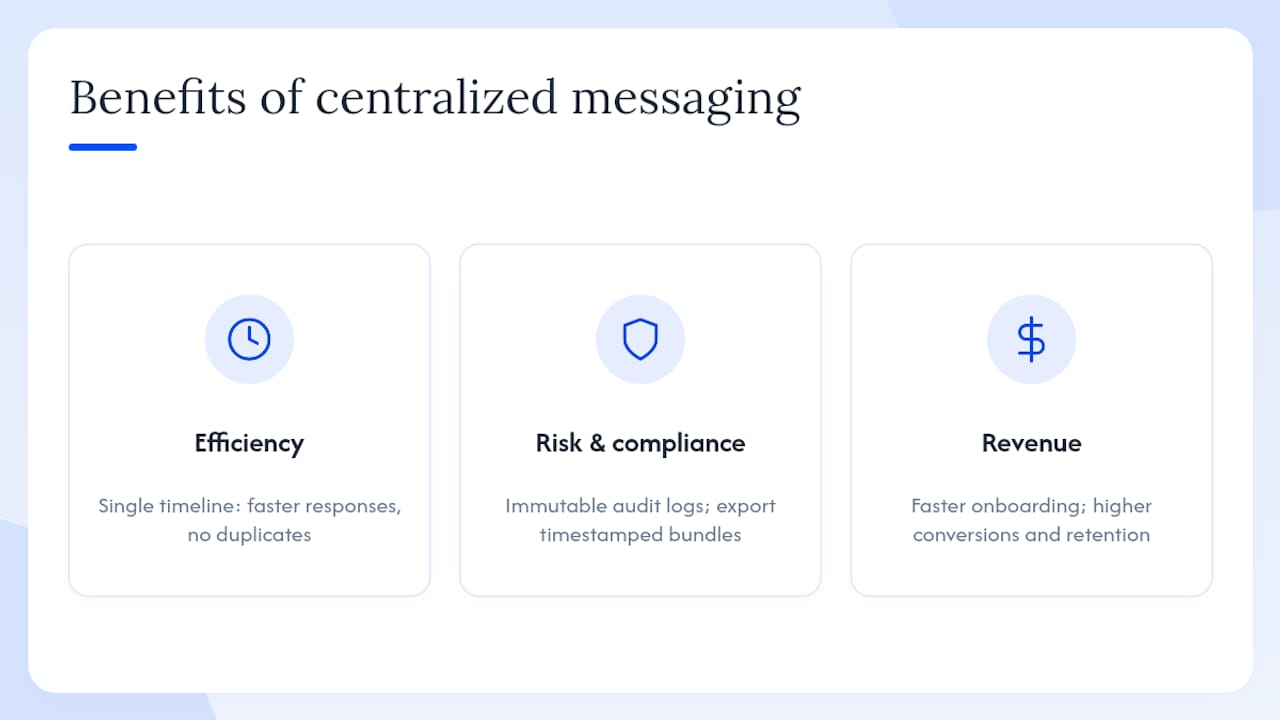
Risk and compliance benefits are equally concrete. A centralized system with immutable audit logs and configurable retention policies means you can respond to a regulatory inquiry by exporting a complete, timestamped communication bundle rather than manually reconstructing a file from five different tools. Canopy positions client messaging and document requests inside the client record precisely for this reason: teams see full conversation history and avoid lost threads.
Revenue and service quality follow from the first two. When a loan officer picks up a call and can see every prior interaction in one place, the conversation is more personal and more efficient. Onboarding moves faster when document requests, e-sign events, and status updates all live in one portal the borrower can access. Higher conversion rates and better client retention are the downstream result of a system that makes every touchpoint feel coordinated.
What you actually need to centralize
Before you pick a platform, build a complete inventory of what needs to move. Missing a channel during migration means you still have a fragmented system on day one.
Communication channels:
- Inbound and outbound email (all team accounts, not just shared inboxes)
- SMS and text threads
- WhatsApp Business messages
- Live chat transcripts from your website or borrower portal
- Phone call logs and, where permitted, call recordings
- Video call notes and summaries
- Social messaging (LinkedIn DMs, Facebook Messenger if used for client contact)
Documents and artifacts:
- Loan applications and supporting financial documents
- Disclosures, consent records, and adverse action notices
- ID verification records and scanned documents
- E-sign records with timestamps and IP provenance
- Closing packages and post-close correspondence
CRM and workflow data:
- Contact notes and task assignments
- Tickets and open requests
- Payment notices and billing communications
- Calendar events and scheduled follow-ups
- Audit logs from prior systems
Metadata to preserve for every record:
- Sender and recipient identifiers
- Timestamps (sent, delivered, read where available)
- Channel source
- Message status and attachment references
- Tags or topic labels (e.g., "rate lock," "condition clear," "closing disclosure")
A unified timeline for a single borrower should read like a narrative: first inquiry via web chat, followed by an email with the loan application link, then SMS confirmations, a video call note, document uploads through the borrower portal, e-sign events, and a closing disclosure acknowledgment — all in chronological order, all tied to one contact record. Teloz describes this as a single thread per customer across voice, SMS, chat, and social so context follows the contact when a conversation switches channels.
How to run the migration without losing data or your team's trust
The migration itself is where most centralization projects stall. Here is a phased path that works.
Phase 0: Audit and align (Week 1–2)
List every tool currently used for client communication. Assign an owner to each. Identify which integrations are non-negotiable (your LOS, your email provider, your SMS platform). Define what "done" looks like: a single searchable timeline per client, with no orphaned records.
Phase 1: Choose the right platform (Week 2–3)
Evaluate platforms against this checklist:
- Native API connections to your existing LOS, email, and SMS tools
- Searchable message history across all channels
- Role-based access control with granular permissions
- Immutable audit logs with export capability
- Configurable retention policies that match your compliance requirements
- Document storage with version history and e-sign integration
- Automation templates for common workflows (rate lock confirmations, condition requests, closing reminders)
Karbon demonstrates what this looks like in practice: combining email, notes, tasks, and workflows into one collaborative workspace turns emails into trackable tasks and gives the whole team visibility. That same principle applies directly to mortgage operations.
Phase 2: Map and clean your data (Week 3–5)
Map every field from your existing tools to the new system's schema. Deduplicate contact records before migration — two entries for the same borrower will corrupt your timeline. Apply retention policy labels during this stage, not after.
Phase 3: Pilot migration (Week 5–8)
Migrate a representative cohort of 15–20 active client files. Measure three things: data accuracy (are all records present and correctly attributed?), team adoption (are staff using the new system for all communications?), and response time (has first-response time improved or stayed flat?).
Pro Tip: Run the pilot with your most active, highest-complexity files — not your easiest ones. If the system handles a mid-process refinance with 40 documents and 6 communication channels cleanly, it will handle everything else.
Phase 4: Full rollout and training (Week 8–12)
Identify two or three power users per team who become internal champions. Build short playbooks for the most common workflows: new lead intake, condition request, rate lock confirmation, closing communication bundle. Schedule weekly check-ins for the first 30 days post-launch. Adoption incentives do not need to be financial — recognition and reduced manual work are usually enough.
A 30/60/90-day sample timeline: by day 30, all active clients are in the new system and the old tools are read-only. By day 60, automation templates are live and response time metrics are being tracked. By day 90, the old tools are decommissioned and the team is operating from a single timeline.
Security, retention, and compliance for U.S. mortgage brokers
Centralizing correspondence creates a single point of control — which is a security advantage, not a liability, when the controls are right.
Minimum security controls your platform must have:
- Encryption at rest (AES-256 or equivalent) and in transit (TLS 1.2 or higher)
- Role-based access control so processors see only what they need, and loan officers cannot access other officers' client files
- Multi-factor authentication for all user accounts
- Session timeout and device management policies
Retention and audit requirements:
- Configurable retention policies that can be set per document type (e.g., loan files held for the period your state requires, general correspondence held separately)
- Immutable audit logs that record every access, edit, and export event
- E-sign records with IP address, timestamp, and document version provenance
- Exportable evidence bundles for compliance inquiries
For U.S. mortgage brokers, the Gramm-Leach-Bliley Act (GLBA) requires safeguarding nonpublic personal information. A centralized system with proper RBAC and encryption directly supports GLBA compliance by limiting who can access sensitive borrower data and logging every interaction. State-level record retention requirements vary, so confirm the specific retention period with your compliance counsel. Our mortgage broker compliance management guide covers these requirements in more detail.
Backup and disaster recovery:
- Offsite or cloud-redundant backups running at least daily
- Point-in-time restore capability so you can recover to a specific date if data is corrupted
- Quarterly restore tests — not just backup verification, but an actual restore to a test environment
- A documented recovery time objective (RTO) and recovery point objective (RPO) from your vendor
Pro Tip: Before any audit, run a test export of a single client's complete communication bundle — every message, document, and log entry. If the export takes more than five minutes or is missing any channel, your system is not audit-ready.
Unified Inbox surfaces attachments and version history from all channels in one place, which eliminates "I sent the file" disputes and speeds retrieval during compliance reviews. Teloz also supports consistent message templates across channels, which helps maintain compliance with disclosure requirements when communicating via WhatsApp or SMS.
How a single system changes daily work across your team
The operational shift is different for each function, and the KPIs to track reflect that.
Sales and loan origination:
- Lead-to-first-contact time drops because new inquiries surface in one place rather than across three inboxes
- The full contact timeline is visible before every call, so conversations start with context
- Track: lead-to-contact time (target: under 5 minutes for web leads), and pipeline conversion rate at the 30-day mark
Operations and bookkeeping:
- Reconciliation errors fall when billing communications, payment confirmations, and condition notices all live in the same record
- Audit-ready records mean compliance reviews take hours instead of days
- Track: reconciliation exceptions per month, and time to produce a complete loan file on request
Client service:
- Borrowers stop repeating themselves because every team member sees the same history
- First-contact resolution improves because the agent has full context before responding
- Track: first-contact resolution rate and client satisfaction scores at 30 and 90 days post-close
The mortgage touchpoint strategy guide covers how to structure these interactions across the loan lifecycle — useful when designing the communication templates your team will use inside the new system.
Why mortgage brokers get disproportionate ROI from this approach
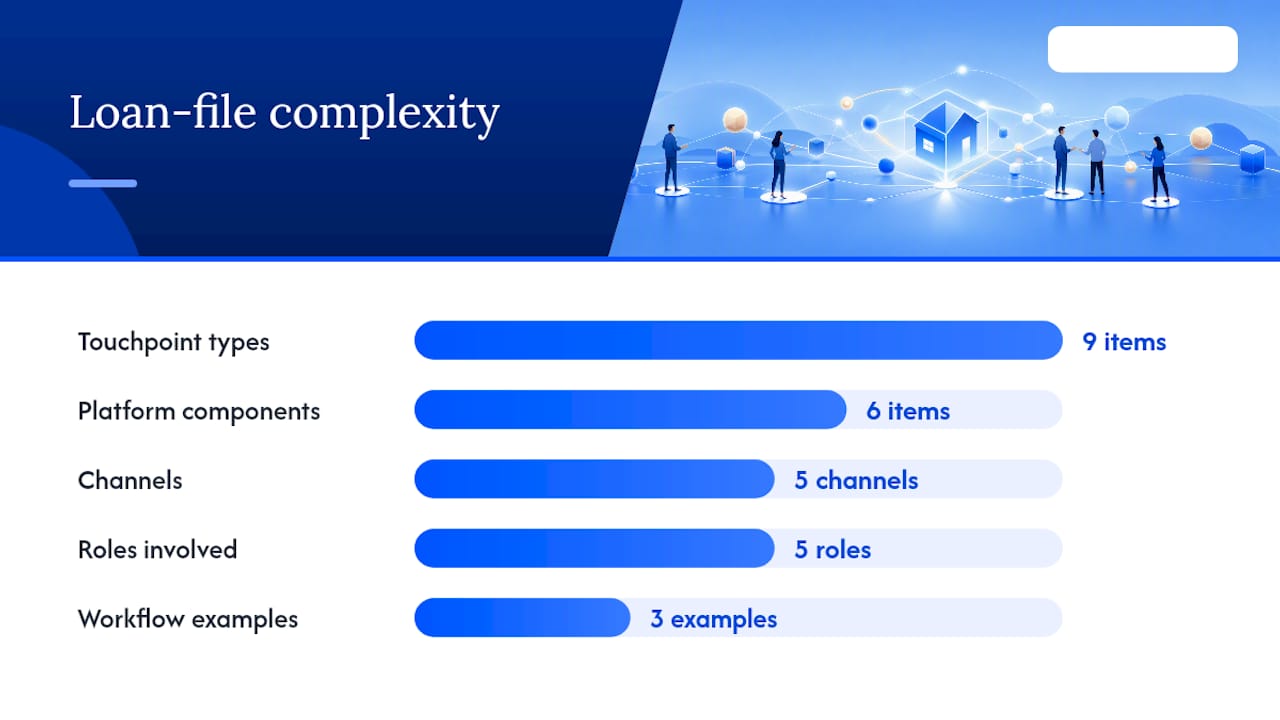
Mortgage operations are communication-intensive by design. A single loan file can generate hundreds of touchpoints: initial inquiry, pre-qualification, rate pricing, application submission, condition requests, appraisal coordination, title communication, closing disclosure, and post-close follow-up. Each of those touchpoints crosses multiple channels and involves multiple parties — borrower, processor, underwriter, title agent, and realtor.
That complexity is exactly why fragmented tools cost mortgage brokers more than they cost a typical professional services firm. A missed condition request delays a closing. A lost disclosure acknowledgment creates a compliance exposure. A borrower who has to repeat their situation to three different people does not refer their friends.
Omar Khamisa built 1 Solution Mortgage Software after 20+ years working as a processor, underwriter, loan originator, and systems consultant. The platform was designed from the inside out to solve the tool-sprawl problem that independent brokers face: a combined LOS, CRM, communications suite (email, SMS, chat, voice, and video), borrower POS portal, compliance tools, and document storage in one connected ecosystem. Embedding document requests, e-sign events, and message threads in the client record produces audit-ready bundles that speed responses to compliance inquiries and loan file reconstructions.
Concrete mortgage workflow examples where a single system pays off immediately:
- Loan pricing threads: rate comparison, lock confirmation, and change-of-circumstance notices all tied to the same client record
- Borrower portal messages: document upload requests, status updates, and e-sign events visible to the entire team in real time
- Closing communication bundles: every disclosure, acknowledgment, and final instruction exportable as a single, timestamped package for audit or dispute resolution
For a deeper look at mortgage regulatory compliance and what record-keeping requirements apply to your brokerage, that guide covers the specifics without the legal jargon.
What we have learned from teams making this transition
The teams that succeed with centralization share one trait: they treat the migration as a process change, not a software installation. Here are the four lessons that come up every time.
Scope creep is the first killer. Teams start with "let's centralize email and CRM" and by week three they are trying to integrate every tool in the building. Lock the scope before you start. Add channels in phase two after the core is stable.
Integration testing cannot be rushed. A field that maps correctly in a demo environment often breaks when real data volumes hit. Test with actual client records, not sample data, during the pilot phase.
Training needs to be role-specific. A processor's workflow is not a loan officer's workflow. Generic training sessions produce generic adoption. Build short, role-specific playbooks and let power users run the sessions.
Timelines are almost always optimistic. Data cleanup takes longer than expected.
Quick wins your team can act on this week: audit how many tools currently receive client messages (most teams find five or more), identify which tool holds the most complete client history, and start routing all new client communication through that one tool while the migration plan is built. That single constraint — new messages go to one place — reduces fragmentation immediately without requiring a full migration.
1 Solution Mortgage Software brings all of this together for brokers
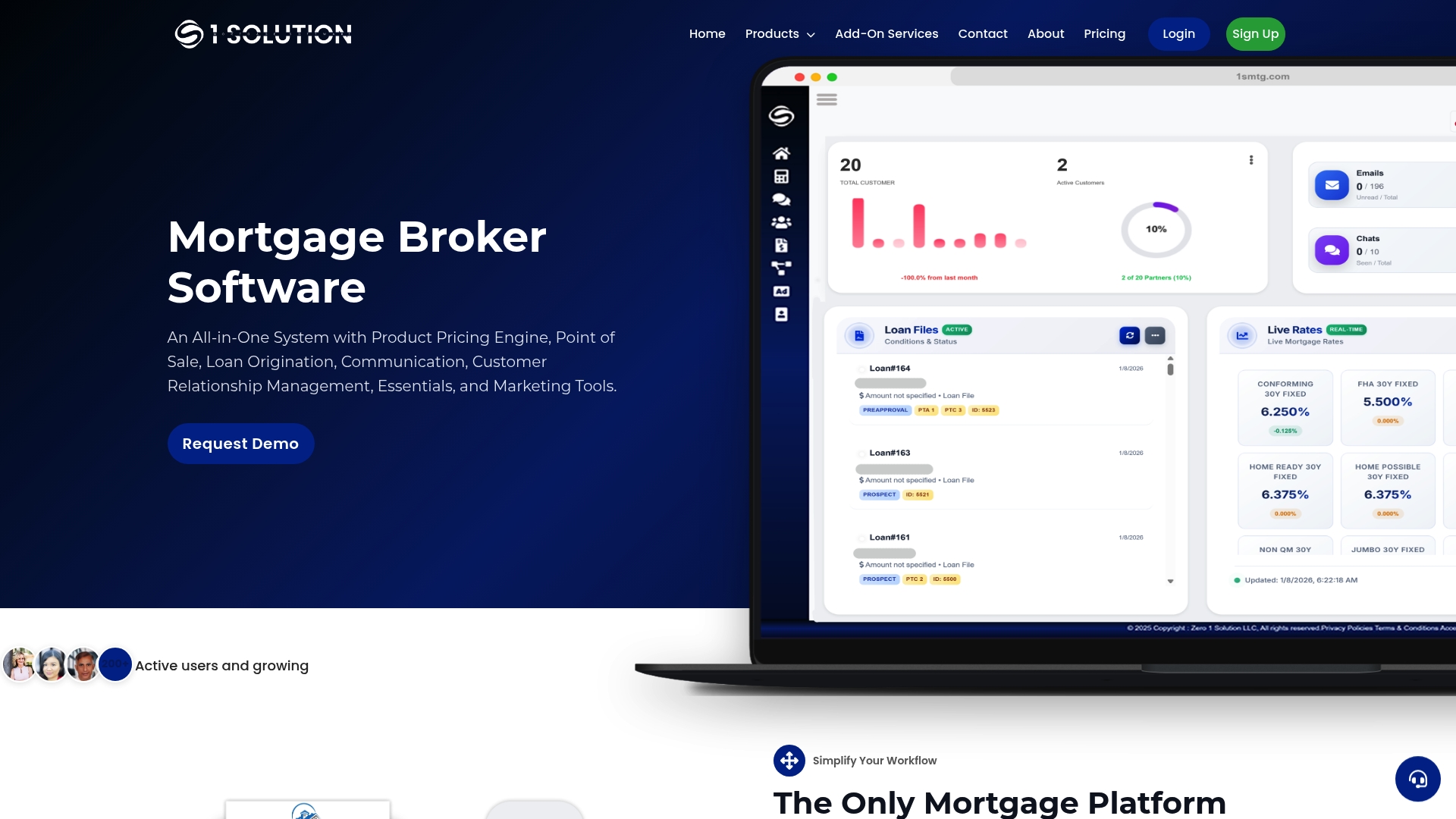
Independent mortgage brokers do not need another point solution. They need one platform where the loan file, the client conversation, the compliance record, and the team workflow are the same record — not four separate systems that require manual reconciliation.
1 Solution Mortgage Software was built specifically for that reality. The platform combines a full CRM, integrated communications (email, SMS, chat, voice, and video), document storage, a borrower POS portal, LOS, compliance tools, audit logs, and automation templates in one connected system. Every feature maps directly to the migration checklist above: the CRM handles contact records and notes, the communications suite handles channel consolidation, the document storage handles artifact centralization, and the audit logs handle compliance readiness.
Because it was built by people who ran mortgage operations, not by a product team guessing at broker workflows.
1smtg and see how the migration checklist maps to the platform in a live environment.
Sources
The following resources support the recommendations in this guide and are worth bookmarking as you plan your migration.
- Client Communication for Accounting Firms | Canopy
- Client Management for Accounting Firms | Karbon
- Home - Unified