

To meet document storage compliance requirements, follow the federal retention baseline for your industry, extend it where your state or sector demands more, and keep every electronic copy reproducible and audit ready. Inventory what you hold, map each document type to a retention deadline, and confirm your systems generate access logs that prove nothing was altered.
TL;DR:
- Federal retention rules generally require keeping compliance evidence for at least two years, but specific disclosures may demand longer periods, up to five years.
- State and industry regulations can extend retention times significantly, making it essential to build a jurisdiction matrix mapping each document type to the longest applicable requirement.
- Digital copies are acceptable for compliance if they are reconstructed accurately and protected by controls like immutability, encryption, and audit logs, not just scanned PDFs.
- Retention policies must be operationally active, with clear ownership, automated scheduling, and procedures for suspending deletion during legal holds, supported by thorough documentation.
- Secure destruction of records should be provable, using certified shredding for physical files or cryptographic deletion for electronic data, with detailed logs during any legal hold.
Table of Contents
- What Federal Rules Set the Retention Baseline?
- How Do State and Industry Rules Change Your Obligations?
- How Long Should You Keep Common Business Documents?
- Are Digital Copies Legally Acceptable for Compliance?
- What Belongs in a Defensible Retention Policy?
- How Should You Securely Dispose of Expired Records?
- How Do You Prove Compliance During an Audit?
- Why Omar Khamisa's Background Shapes This Guidance
- How 1 Solution Keeps Your Documents Audit Ready
- What Compliance Officers Should Prioritize This Year
- Sources
What Federal Rules Set the Retention Baseline?
Most retention questions start with the Consumer Financial Protection Bureau's record retention rule, and for good reason. Under 12 CFR §1026.25, creditors must retain evidence of compliance for at least two years as a general rule, but several disclosure obligations may extend that window to longer periods depending on the specific subsection. The exact subsection matters. A lender relying on the two-year default when a disclosure actually falls under a five-year provision is exposed the moment an examiner asks for records that no longer exist. The e-CFR text at 12 CFR §1026.25 mirrors this language and spells out regulators' inspection rights, which is worth quoting directly if you're drafting internal policy language auditors will actually read.
Tax recordkeeping runs on a separate clock. The IRS recommends keeping supporting documents for three to seven years depending on the situation, such as claims for a loss from worthless securities or bad debt deduction, and holding certain records like filed returns permanently. Payroll adds another layer: Department of Labor recordkeeping guidance under the FLSA requires employers to preserve time and pay records for set periods, and OSHA and the EEOC impose their own timelines for safety and employment records. If you handle securities activity, SEC and FINRA rules layer on top of all of it, and healthcare-adjacent businesses need to check HHS guidance under HIPAA. None of these federal floors override each other. You have to satisfy the longest applicable one.
How Do State and Industry Rules Change Your Obligations?
Federal law sets the floor, not the ceiling. States routinely require longer retention for specific document types, and industry regulators often go further still. The only reliable way to find these obligations is to check your state's business or financial regulator's statutes directly, and to subscribe to update notices from any regulator that licenses your business, since these rules change without much public fanfare.
Certain industries carry well-known extensions worth flagging up front:
- Healthcare organizations fall under HIPAA retention expectations layered on top of state medical record laws.
- Financial services firms answer to SEC, FINRA, and, for mortgage-specific files, Fannie Mae's servicing requirements.
- Educational institutions manage student records under FERPA, which sets its own access and retention logic.
The practical fix is building a jurisdiction matrix: a simple table mapping each document type to every state, federal, and industry rule that touches it, with the longest applicable period as the controlling deadline. Once built, that matrix becomes the backbone of your entire document retention policy.
How Long Should You Keep Common Business Documents?

Retention periods vary by document type, and guessing wrong in either direction creates risk. Keep records too briefly and you can't defend a decision when questioned years later. Keep them too long, especially personal data, and you increase breach exposure and violate data minimization principles.
A practical set of rules of thumb, drawn from IRS guidance and standard business practice:
- Payroll records: retain roughly 4 years to satisfy overlapping tax and labor requirements.
- Tax return support documents: 3 to 7 years, per IRS guidance, depending on whether the filing involves a loss claim or standard deduction support.
- Filed tax returns themselves: keep permanently.
- Loan origination files: 3 to 7 years at minimum, though Fannie Mae's guide requires longer retention for specific itemized records tied to sold loans.
- Deeds, incorporation papers, and original signed notes: keep permanently. These documents establish legal ownership and can't be reconstructed from a summary.
- Monthly account statements and routine correspondence: Bank of America's Better Money Habits guidance suggests these can generally be shredded after a year once reconciled, though mortgage-specific files often carry longer regulatory holds.
Mortgage originators face a sharper set of specifics. Fannie Mae's selling guide requires servicers and sellers to maintain loan records with several itemized items retained 4 to 7 years, and some permanent elements of the loan file that must survive for the life of the loan and beyond. Loan officer compensation records and disclosure evidence deserve particular attention, since these are exactly what examiners and buyers request first. Reviewing your TRID disclosure timing obligations alongside your retention schedule closes a gap many brokerages don't notice until an audit forces the question.
Are Digital Copies Legally Acceptable for Compliance?
Yes, with conditions. The CFPB has clarified that evidence of compliance does not require retaining physical paper. Reproduced electronic records satisfy the retention rule as long as your system can accurately reconstruct the required disclosure content on demand. That single word, reconstructable, is the entire test examiners apply.
Meeting it requires specific technical controls, not just a scanned PDF sitting in a folder. Immutable object storage, sometimes called object lock, prevents records from being altered or deleted before their retention period expires, and technical guidance on immutability controls describes this as the practical mechanism for meeting non-rewriteable, non-erasable recordkeeping standards like SEC Rule 17a-4(f). Pair that with encryption at rest and in transit, role-based access control, and tamper-evident audit logs that record every view, edit, and export.

On the operational side, scan documents at a resolution that preserves legibility of signatures and fine print, generate checksums to verify files haven't degraded or been altered, and maintain redundant backups across separate physical locations to ensure training backups are audit ready. Build a migration plan before your storage vendor changes formats or shuts down, since losing access counts the same as never having retained the record at all. Document, in writing, that your electronic copies are functionally equivalent to the originals. That written attestation is what turns a scanned archive into audit-proof evidence.
What Belongs in a Defensible Retention Policy?
A retention policy that only exists as a PDF nobody reads isn't defensible. It has to run as a living workflow.
Start with these core components:
- Scope — which document types and business units the policy covers.
- Ownership — a named person or role accountable for policy updates.
- Retention schedules — specific timeframes per document category, pulled from your jurisdiction matrix.
- Legal-hold process — a documented procedure for suspending scheduled deletion during litigation or investigation.
- Disposal rules — how and when records are destroyed once their retention period lapses.
- Review cadence — a set interval, typically annual, for confirming the schedule still matches current law.
On the operational side, classify documents automatically at intake rather than relying on someone remembering to tag them months later. Assign retention dates programmatically based on document type, build in exception handling for documents under active dispute, and give compliance staff the ability to place a legal hold that overrides scheduled deletion instantly.
Pro Tip: Document every disposition event the moment it happens, and keep the certificate of destruction with it. An auditor who asks "prove you deleted this on schedule" wants to see a timestamped record, not your word for it.
How Should You Securely Dispose of Expired Records?
Destruction has to be provable, not just performed. For physical records, use a certified shredding vendor and keep the signed certificate of destruction on file, tied directly to the retention schedule entry it satisfies. For electronic records, secure overwrite or crypto-shredding, destroying the encryption key rather than the data itself, both work, but either way, preserve the deletion log showing what was destroyed and when.
One condition halts all of this: litigation hold. If a document becomes relevant to a dispute, investigation, or subpoena, scheduled destruction must pause immediately, and that pause needs its own written record showing who issued the hold and why.
How Do You Prove Compliance During an Audit?
The CFPB's own language centers on "evidence of compliance," and reconstructability is how examiners test it. Can your system produce the exact disclosure, or rebuild the underlying data, within a reasonable window? That question drives everything auditors check.
Systems that pass this test share common features:
- Time-stamped audit logs showing every access, edit, and export event.
- Version history that shows what changed and when, not just the current state.
- Exports in readable, standard formats rather than proprietary files nobody outside your vendor can open.
- Defined retrieval service-level windows so you know exactly how fast you can respond.
When a records request arrives, follow a fixed sequence: notify the compliance owner immediately, pull the export using your documented retrieval process, package it with a chain-of-custody log showing who touched the file and when, and confirm the package matches what your compliance audit checklist requires before it leaves your building.
Why Omar Khamisa's Background Shapes This Guidance
Omar Khamisa built 1 Solution Mortgage Software after more than 20 years working across mortgage operations as a processor, underwriter, loan originator, and systems consultant. That background is why this guidance leans on Fannie Mae's actual servicing language rather than generic retention advice. For deeper reading, see our breakdown of regulatory compliance for brokers and the 2026 compliance setup checklist.
How 1 Solution Keeps Your Documents Audit Ready
A comprehensive mortgage software platform can replace the need to stitch together spreadsheets, shared drives, and a shredding vendor to manage retention manually. The platform maps directly to the compliance checklist covered above: secure document storage with encryption and access controls, retention schedules that tag records automatically at intake, and audit exports you can generate in minutes instead of days when a buyer or examiner comes calling.
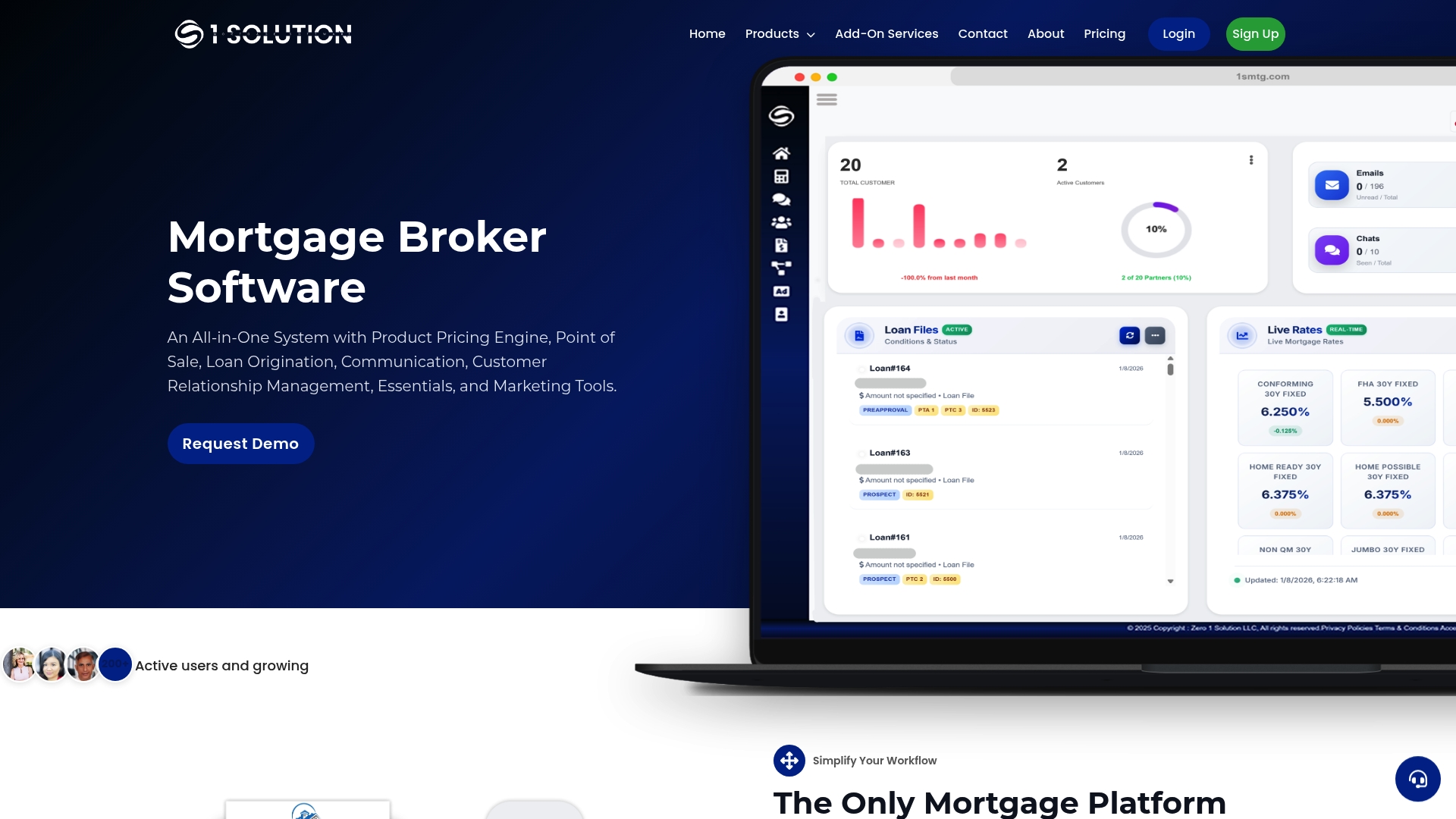
All capabilities reside within a connected system used for pricing, CRM, and loan origination, allowing retention rules to apply consistently across files without requiring a separate compliance tool. If your current setup makes you dread the phrase "we need this by Friday," it's worth seeing how 1 Solution Mortgage Software handles that request instead. Request a demo and walk through your own document set with the team before your next audit cycle arrives.
What Compliance Officers Should Prioritize This Year
The biggest mistake I see compliance teams make is treating retention as a hoarding problem: keep everything forever, just in case. That instinct backfires. Reconstructability matters more than volume. An examiner doesn't care how much you stored. They care whether you can produce the exact disclosure they're asking about, fast, with a log proving nobody touched it. Invest in immutable storage and a real legal-hold workflow before you invest in more storage capacity, and review your jurisdiction matrix at least annually against actual business risk, not just habit.
— Omar Khamisa
This article is general information, not a substitute for advice from a qualified financial advisor. Consult a qualified financial professional about your own circumstances before acting on anything here.
Sources
- § 1026.25 Record retention | Consumer Financial Protection Bureau
- 12 CFR § 1026.25 - Record retention | LII / e-CFR
- How long should I keep records? | IRS