
The fastest path to funded deals as a new independent mortgage brokerage is not a long lender directory. Pick 1–2 product niches, build deep working relationships with 3–5 lenders, and deploy a connected tech stack (POS, LOS, CRM, and direct portal access) so lenders see you as an operational partner, not a one-off submission source.
TL;DR — Days 0–30 priorities:
- Choose your product focus: purchase/new construction, conventional/FHA, or investor/non-QM.
- Shortlist 3–5 lenders whose underwriting appetite, portal access, and AE responsiveness match that niche.
- Stand up your intake baseline: POS, LOS, and CRM connected before your first submission.
The brokers who grow fast are not the ones with the most lender contacts. According to Intrepid Finance, the most common early mistake is onboarding too many lenders, which prevents brokers from learning specific underwriting guidelines and causes dead submissions. Depth beats breadth, every time. Platforms like 1 Solution Mortgage Software are built around exactly this reality.
Table of Contents
- How new brokerages should choose their first lenders
- What operational standards to negotiate before your first submission
- Which tech integrations make lenders trust your brokerage
- How to prove your value to builders and established lender contacts
- Onboarding checklist for new lender partners
- KPIs and review cadence to keep lender relationships healthy
- Your 30–90 day plan for building lender relationships from scratch
- Key Takeaways
- Why depth over breadth is the only strategy that actually works
- How 1 Solution Mortgage Software maps to this playbook
- Useful sources and further reading
How new brokerages should choose their first lenders
Start with your niche, not the lender list. If you focus on purchase transactions and new construction, you need lenders with fast lock-to-disclosure windows and builder-friendly programs. If you work conventional and FHA, you need lenders with consistent underwriting guidelines and clear exception processes. Investor and non-QM deals require lenders who can articulate their own credit box before you submit.
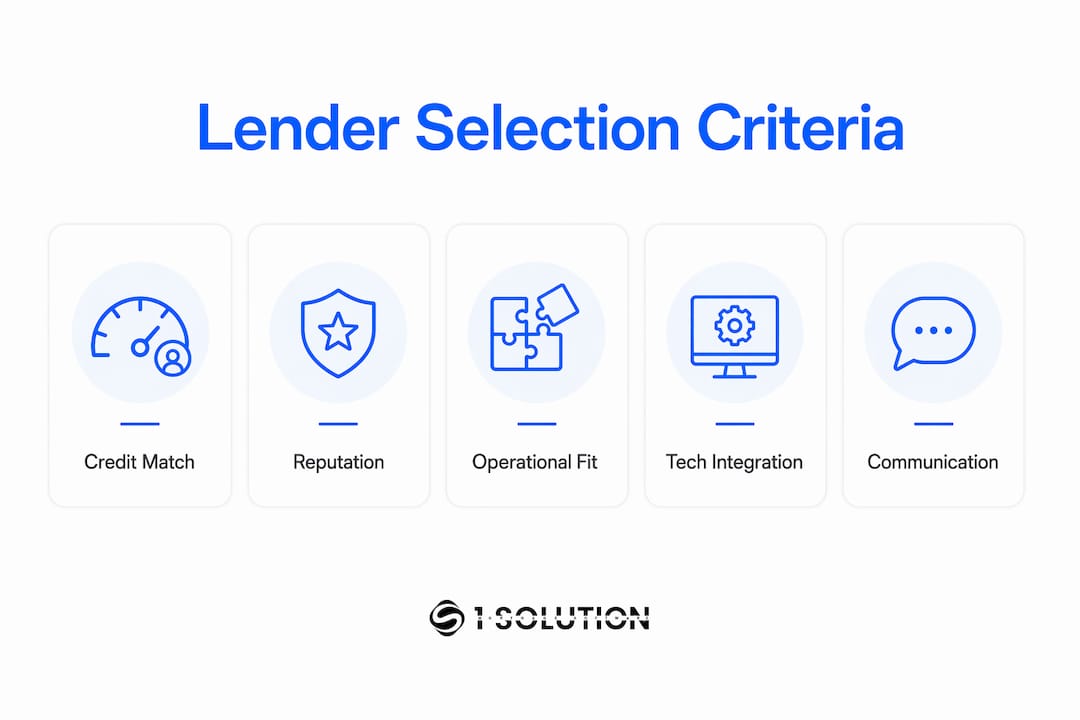
Once your niche is clear, evaluate each candidate lender on these dimensions:
| Dimension | What to look for |
|---|---|
| Product focus / lender appetite | Does their credit box match your niche? Do they actively want broker volume? |
| Integration level | Direct portal access, API availability, LOS compatibility |
| Turnaround time / SLA | Documented milestone targets (lock to disclosure, docs to UW, UW to CTC) |
| Communication paths | Named AE, direct underwriter access, escalation contact |
| Pricing / comp structure | Wholesale pricing transparency, buy-up/buy-down grids, fee caps |
| Training / onboarding support | Dedicated onboarding rep, scenario training, cheat sheets |
Produce a ranked list of 6–8 candidates, then commit to the top 3–5 for deep onboarding. Reputation matters as much as rate sheets. Ask other brokers in your network which lenders actually perform under pressure, not just which ones have the best marketing.
What operational standards to negotiate before your first submission
Lenders expect the first few loans from a new broker to be bumpy. The highest-performing brokers convert that phase by building direct AE and underwriter lines and using early files to create cheat sheets that speed future submissions. The goal is to negotiate the framework before that first loan, not after.
Core SLA elements to put in writing:
- Lock to initial disclosure: target 24 hours or less
- Docs received to underwriting assignment: target within two business days
- Underwriting to conditional approval: target within a few business days
- Conditions cleared to clear-to-close: target within two business days
- AE response window for questions: same business day
Portal and data expectations:
- Full pipeline visibility in the lender portal
- Secure file exchange or API connection to your LOS
- Push notifications for status changes and condition requests
- Joint pipeline review cadence (weekly for first 90 days)
Process ownership map:
- Broker submits complete file via portal.
- Lender assigns processor and acknowledges receipt within 24 hours.
- Underwriter reviews; conditions issued within SLA window.
- Broker clears conditions; lender confirms CTC within agreed timeframe.
- Closing docs ordered; funding confirmed.
Pro Tip: After your first two or three loans with a new lender, schedule a 30-minute debrief with the AE. Bring a short list of friction points and ask the underwriter to walk through what a "perfect file" looks like for their box. That single conversation can cut your condition count in half on future submissions.
Consistent turnaround times and proactive communication matter more to long-term partnerships than headline pricing. Build the SLA first, then compete on rate.

Which tech integrations make lenders trust your brokerage
Direct portal access and automated digital workflows are what shift broker-lender partnerships from transactional to collaborative. Your minimum tech baseline before your first submission:
- POS (point of sale): borrower-facing application and document upload
- LOS (loan origination system): file management, milestones, and compliance
- CRM: referral tracking, pipeline visibility, and follow-up automation
- Pricing engine: real-time rate comparisons and lock capabilities
- eSign and document intake: compliant, auditable file assembly
- Secure portal access: direct connection to each lender's system
Integration priorities by timeline:
- Days 1–30: LOS connected to each lender portal or API; pricing engine live; eSign and document intake operational.
- Days 30–60: CRM linked to LOS for referral source tracking; milestone alerts configured; pipeline dashboard visible to your team.
- Days 60–90: Accounting and commission tracking integrated; compliance and audit log review process established.
Lenders prize reliable pricing integration, instant lock capabilities, and transparent pipeline visibility. Before sharing pipeline data with any lender, confirm encryption at rest and in transit, role-based access controls, and your platform's security posture. 1 Solution Mortgage Software brings all of these layers into one connected platform built specifically for independent brokers, which removes the integration guesswork that slows most new shops down.
How to prove your value to builders and established lender contacts
Asking for a spot on a preferred-lender list rarely works. Delivering a flawless transaction does. The proof-of-value approach is straightforward: pick one or two early deals and treat them as pilots.
High-impact tactics:
- Over-communicate with builder sales teams at every milestone, not just at closing.
- Present creative financing options (buydowns, construction-to-perm) before the builder asks.
- Send a brief status update email every 48 hours during the pilot transaction.
Pilot structure:
- Select one deal with a builder or referral partner where speed and clarity matter most.
- Document every milestone, condition, and communication touchpoint.
- After closing, share a one-page summary: days from application to CTC, conditions count, and any friction resolved.
- Use that summary as your case study for the next builder conversation.
For outreach, a subject line like "Quick question about [specific loan program] for your buyers" outperforms a generic introduction every time. Lead with a specific deal scenario, not a credentials pitch. Education and co-created content such as scenario training sessions also accelerate trust with both builders and AEs.
Onboarding checklist for new lender partners
Standardized intake and CRM discipline are what make pipeline scaling possible without reinventing the process every quarter. Complete these steps before submitting your first file.
Pre-onboarding items:
- NMLS license and state credentials verified
- E&O insurance certificate on file with lender
- Broker agreement and rep/warranty documents signed
- Sample client file prepared for lender review
- Compliance evidence (AML policy, privacy notice) submitted
Technical onboarding:
- Portal login and credentials confirmed
- API or secure file exchange tested with a dummy file
- LOS fields mapped to lender portal fields
- Pricing engine connected and rate sheet validated
Training and relationship building:
- Schedule an AE orientation call within the first week.
- Walk through one sample scenario with the underwriter.
- Co-create a one-page cheat sheet covering the lender's top five underwriting nuances.
- Confirm escalation contacts for conditions, appraisal disputes, and closing delays.
Pilot test plan: Submit your first three loans with the explicit goal of surfacing process gaps, not just closing deals. After each one, log what slowed the file and what the lender flagged. By loan three, your submission quality should be measurably cleaner.
Pro Tip: Use mortgage video messaging to record a short walkthrough of your first submission package. Send it to the AE before the file arrives. It signals professionalism and gives the underwriter context before they open the file.
KPIs and review cadence to keep lender relationships healthy
Track these metrics weekly for the first 90 days, then monthly:
| KPI | Target benchmark |
|---|---|
| Application to disclosure | 24 hours or less |
| Docs to underwriting assignment | 24–48 hours |
| Underwriting to conditional approval | 3–5 business days |
| Pull-through rate | 80%+ of locked loans funded |
| Exception / condition error rate | Declining each month |
| Time to fund from CTC | 2–3 business days |
Review cadence:
- Weekly (days 1–90): Operational check-in with AE; review open conditions and pipeline status.
- Monthly: Performance review covering turn times, pull-through rate, and top exception causes.
- Quarterly: Strategic alignment meeting tied to SLA benchmarks; decide whether to expand the lender list.
Use KPIs defensively. If pull-through drops below 80% or turn times stretch past SLA, address it with the AE before it becomes a pattern. If a lender consistently misses their own commitments, that is the signal to diversify. Broker-lender partnerships built on operational alignment outlast those built on rate alone.
Your 30–90 day plan for building lender relationships from scratch
Days 1–30:
- Declare your product niche (purchase/new construction, conventional/FHA, or non-QM/investor).
- Shortlist several lenders; commit to the top 3–5 for deep onboarding.
- Stand up POS, LOS, pricing engine, and eSign before your first submission.
- Send one personalized outreach to each target lender's AE or BDO with a specific deal scenario.
Days 31–60:
- Complete full technical onboarding with your top 3 lenders (portal, API, LOS mapping).
- Submit 1–2 pilot loans per lender; document every friction point.
- Begin weekly metric tracking (turn times, conditions, pull-through).
- Schedule AE debrief after each pilot loan.
Days 61–90:
- Formalize SLAs in writing with each active lender.
- Review 90-day KPIs against benchmarks.
- If pull-through exceeds 80% and turn times are within SLA, add 1–2 additional lenders.
- Present your pilot case study to one builder or referral partner.
Decision gates: Before expanding beyond your core lender group, confirm your pull-through rate is above 80% and your average application-to-CTC time is within your documented SLA. Scaling before those thresholds are met spreads your attention and erodes the depth that makes lenders prioritize your files.
Key Takeaways
New brokerages that focus on depth over breadth, backed by a connected tech stack, build lender relationships that produce consistent funding within 90 days.
| Point | Details |
|---|---|
| Start with 3–5 lenders | Depth beats breadth; master a small group before expanding your lender network. |
| Negotiate SLAs in writing | Document milestone turn times and escalation paths before your first submission. |
| Tech baseline first | POS, LOS, CRM, and portal access must be live before you submit loan one. |
| Prove value with pilot loans | A documented, flawless pilot transaction opens doors that cold outreach cannot. |
| 1 Solution Mortgage Software | Combines POS, LOS, CRM, pricing, and compliance in one platform built for independent brokers. |
Why depth over breadth is the only strategy that actually works
Most new brokerages make the same mistake: they chase access instead of mastery. They onboard a dozen lenders in month one, submit thin files to all of them, and wonder why nothing funds cleanly. The math is simple. A lender who receives three well-structured files from you in 60 days will prioritize your fourth. A lender who receives one scattered file every few months will not remember your name.
The playbook in this guide is not theoretical. It reflects what operators who have spent years inside mortgage processing, underwriting, and origination have learned the hard way. Technology does not replace that judgment, but it does remove the friction that makes good judgment hard to execute consistently. When your LOS is mapped to the lender portal, your pricing engine is live, and your pipeline dashboard is visible to your AE, you stop looking like a new shop. You look like a partner.
The brokers who build durable lender relationships are not the ones with the best pitch. They are the ones whose files arrive clean, whose milestones are tracked, and whose AEs actually pick up the phone.
How 1 Solution Mortgage Software maps to this playbook
Independent brokers who follow this playbook need one thing above all else: a platform that does not require three separate vendors to cover intake, LOS, and pipeline visibility. Fragmented tools create the exact gaps that make lenders deprioritize your files.
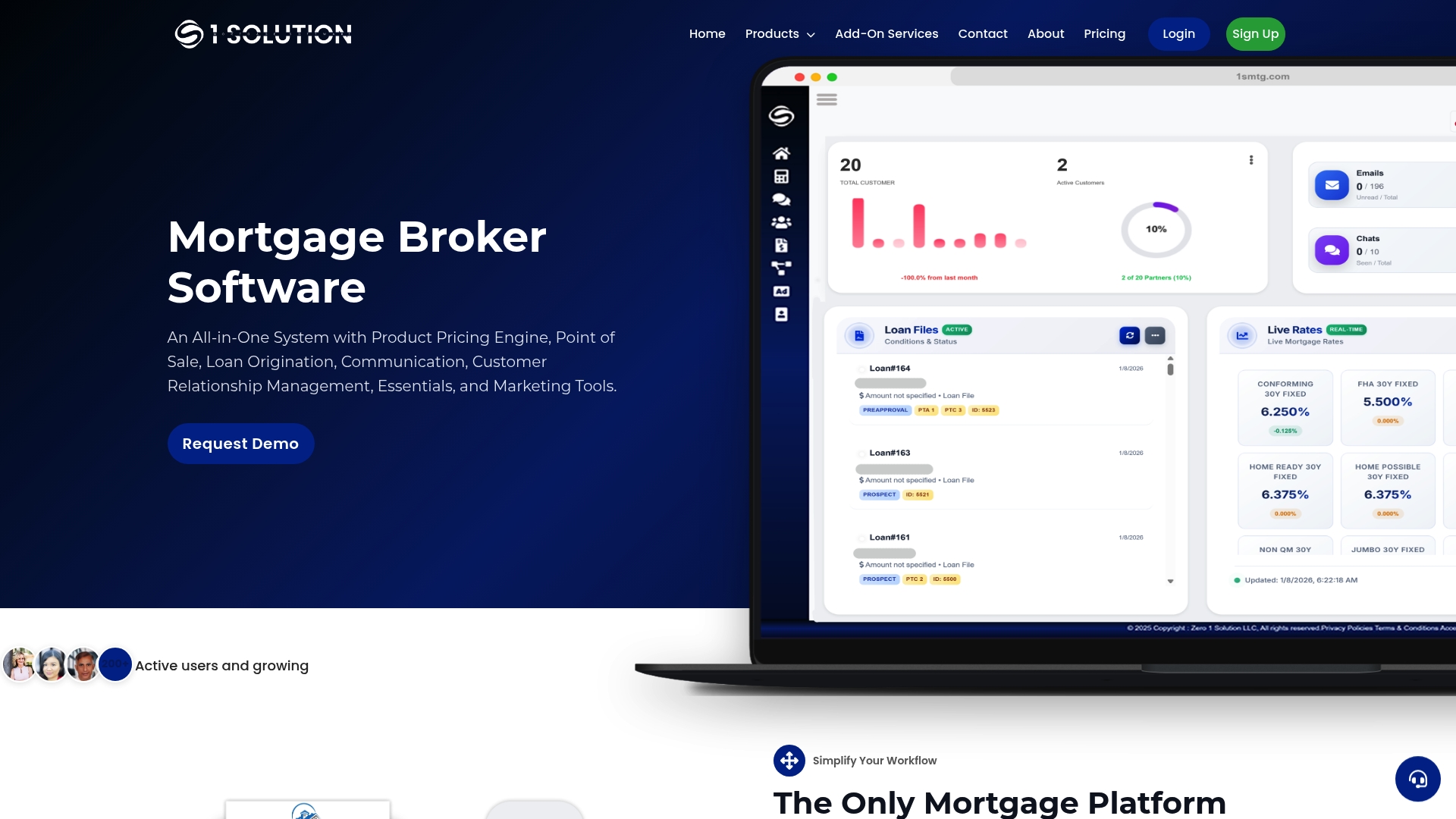
1 Solution Mortgage Software was built by mortgage professionals who lived this problem. Pricing, CRM, POS, LOS, compliance, and communication tools sit in one connected platform, purpose-built for independent brokers, not adapted from bank software. That means your LOS-to-portal mapping, your milestone alerts, and your pipeline dashboards are all in one place from day one, not assembled across vendors over 90 days.
If you are standing up a new brokerage and want a tech foundation that supports the SLA commitments and lender trust this guide describes, see what 1 Solution offers and request a demo to walk through how the platform maps to your specific lender onboarding workflow.
Useful sources and further reading
- From First Deal to Full Pipeline: Build a Scalable Loan Brokerage — Intrepid Finance
- Broker-Lender Relationships: Building Speed, Trust, and Alignment — Mortgage Professional America
- Broker-lender partnerships are no longer transactional but defined by speed and execution — Mortgage Professional America
- From bumpy starts to seamless closings: How brokers build stronger lender partnerships — Mortgage Professional America
- Breaking into builder relationships — The Loan Atlas
- Broker-lender relationships: What actually drives performance in today's market — Mortgage Professional America
- Building Broker-Lender Partnerships That Actually Work — Mortgage Professional America
- Best Software to Manage Multiple Lender Relationships — 1 Solution Mortgage Software Blog
- How Broker-Lender Relationships Work for Mortgage Pros — 1 Solution Mortgage Software Blog