
Mortgage lead scoring means giving every inquiry a number that tells you how likely it is to become a funded loan and how fast you need to call. A broker who works fifty new leads a week cannot treat them all alike. The score decides who gets a call in five minutes, who gets a nurture sequence, and who waits. The model only works when it lives where your leads, calls, texts, documents and pricing already sit, so the score updates itself instead of living in a spreadsheet. That is how we built the CRM inside 1 Solution.
TL;DR
- Lead scoring ranks prospects by likelihood to close. It is not a credit score and it does not decide who qualifies for a loan.
- Combine two kinds of signals: fit (purpose, timeline, property, rough numbers) and engagement (replies, opened emails, returned calls, documents uploaded).
- Start with a simple 100-point model, set clear thresholds for hot, warm and cold, and tie each band to a specific follow-up.
- Measure results by lead source and time period, and revise the weights every quarter.
- Keep the score for internal prioritization, and keep it away from any lending decision, so fair-lending rules are never in play.
Table of Contents
- Lead score, credit score, loan qualification: three different things
- Which signals to score
- How to build a scoring model, step by step
- Turn the score into follow-up priorities
- Measure whether the score works
- Keep scoring clean: fair lending and adverse action
- Perspective
- Put scoring to work in one platform
- FAQ
- Sources
Lead score, credit score, loan qualification: three different things
These get mixed up, so separate them first.
A credit score is a numerical summary of a consumer's apparent creditworthiness drawn from the credit report. The CFPB describes it as reflecting the relative likelihood of default, built mainly from payment history, balances, credit utilization, public records, length of history and new inquiries.
Loan qualification is the lender's decision. The CFPB explains that the credit score is one component, alongside the credit report, existing debt, savings, assets and income, and that most lenders use the middle of three bureau scores to set the rate.
A lead score is your own internal ranking of sales priority. It answers one question: where should my next hour go? It says nothing about whether the borrower should be approved, and it should never be used to decide that. Keeping this line clear protects you and keeps your process clean.

Which signals to score
Good models mix two groups of signals. Fit tells you whether the person can realistically become a loan. Engagement tells you whether they are acting like it.
Fit signals
Collect these at intake, on the application form or in the first call:
- Loan purpose. Purchase with a contract or an active search usually outranks a vague refinance inquiry.
- Timeline. Closing in 30 days is worth far more than "sometime next year."
- Property and location. Is the property in a state where you are licensed, and in a type you can place?
- Self-reported numbers. A rough credit range, down payment or equity, and income type. Use ranges to sort priority, not to judge eligibility.
- Source. Referrals from real estate agents or past clients tend to behave differently from purchased leads, which is why you track source (more below).
Engagement signals
These show intent after the lead enters your pipeline:
- Answered or returned a call, or replied to a text
- Opened or clicked a rate email or a proposal
- Started the online application or logged into the borrower portal
- Uploaded documents such as pay stubs or bank statements
- Booked a call or asked for a pre-approval letter
- Went silent for 7, 14 or 30 days (a negative signal)
Engagement is the part spreadsheets miss. When texts, email, calls and the portal all report into one record, the score can react the moment a borrower uploads a W-2 at 9 p.m.
How to build a scoring model, step by step
1. Define what "good" means. Pick one outcome: a completed application, a pre-approval, or a funded loan. Funded loans are the truest target, but they come slowly. Many teams start with completed applications and move up later.
2. Look at your last 6 to 12 months of closed and lost files. Which sources, timelines and behaviors showed up in the loans that funded? Even 50 to 100 files give you a direction. Don't borrow a generic model from another industry.
3. Assign points. Use a 100-point scale so the weights are easy to read. A starting example:
| Signal | Points |
|---|---|
| Purchase contract or active house hunting | +25 |
| Timeline under 60 days | +20 |
| Referral from agent or past client | +15 |
| Started application or uploaded documents | +20 |
| Replied to a call, text or email | +10 |
| Licensed state and eligible property type | +10 |
| No response in 14 days | -15 |
| Outside your lending area | -30 |
These weights are an illustration of the method, not a benchmark. Your own files should replace every number.
4. Set thresholds. For example, 70 and above is hot, 40 to 69 is warm, below 40 is cold. Three bands are enough. More than that and nobody remembers what each one means.
5. Attach an action to every band. A score with no action is just decoration (see the next section).
6. Let scores decay. A lead who engaged three weeks ago and has been silent since should drop. Build in time decay or a negative rule for inactivity.
7. Review quarterly. Compare the scores of leads that funded with the scores of leads that did not. If cold leads are closing, your weights are wrong. Adjust a few at a time so you can see what moved the results.
Turn the score into follow-up priorities
The point of scoring is a different response for each band.
- Hot (70+): Instant alert to the loan officer, a call within minutes, and a text if there is no answer. Speed matters most here, so route the lead to whoever is available, not to a queue.
- Warm (40 to 69): A same-day call attempt, then an automated sequence: a rate comparison, a pre-approval proposal, a reminder to upload documents.
- Cold (under 40): Long-term nurture. Monthly market updates, rate-change notes and anniversary touches keep you present without eating loan officer time.
Routing
In a team, route by score and by fit. Experienced originators take the hot purchase leads. Newer loan officers or processors can work the warm refinance pool. Out-of-area leads can go to a referral process. Routing rules that run automatically remove the "who owns this lead?" argument.
Automation
Triggers do the repetitive work. When a lead crosses 70, create a task and send an alert. When a borrower opens a proposal twice, bump the score and notify the officer. When no activity happens for 14 days, move the lead to a re-engagement sequence. This only works smoothly when the CRM, the pricing engine, the borrower portal and the messaging tools share data. In 1 Solution, CRM, product pricing engine, POS, communication tools (email, SMS, chat, voice, video) and marketing automation sit in one connected platform, so the activity that raises a score is already in the same record.
Communications carry rules. The FTC's Telemarketing Sales Rule bars calling numbers on the national Do Not Call registry unless the seller has express written agreement or an established business relationship, and consent records need the person's name, number, purpose, a copy of the consent and the date. Store consent on the lead record and let your automation check it before any outreach. Your compliance officer or attorney should confirm how this applies to your own calling and texting.

Measure whether the score works
A score is a hypothesis. Test it.
- Conversion by band. What share of hot, warm and cold leads reach an application, a pre-approval and a funded loan? Hot should clearly beat cold. If it doesn't, the model needs work.
- Define the rate precisely. A workable definition is eligible records that reach a measurement event, divided by eligible records from the same source and time period. Fix the event and the window before you compare anything.
- Compare by source. A score can hide that one vendor sends poor leads. Break results out by source and cohort.
- Speed to contact. Track minutes from lead creation to first attempt for hot leads.
- Time to application. Faster movement of high scorers confirms the model; slow movement means signals are missing.
- Loan officer hours. The practical win is time. If your team stops chasing cold leads, calls per funded loan should fall.
Compare a period before and after you introduced scoring, and keep the cohorts the same size and mix where you can.
Keep scoring clean: fair lending and adverse action
Lead scoring is for sales prioritization. Credit decisions are a separate process governed by the Equal Credit Opportunity Act and Regulation B, and the two should not bleed together.
Two points are worth knowing. First, Regulation B defines an empirically derived credit scoring system as one built on a comparison of creditworthy and non-creditworthy applicants, developed with accepted statistical principles and periodically revalidated. That is a standard for credit decisions, and it shows how regulators think about models: documented, tested and kept current. Second, when a creditor takes adverse action, the stated reasons must be specific. Reasons such as failing a qualifying score on the creditor's scoring system are not sufficient. The CFPB has also reminded lenders in Circular 2023-03 that reasons must be accurate and cannot come from a checklist that does not reflect the actual reason, particularly as algorithms spread in underwriting.
Practical habits that follow:
- Build your score only from business-relevant signals like timeline, engagement and source. Do not score on protected characteristics or on inputs that could stand in for them, such as neighborhood.
- Do not let a low lead score cause a loan to be declined, discouraged or steered. A cold lead still gets an honest answer if they apply.
- Document how the model works and when you revised it.
- Watch the regulatory calendar. The CFPB's 2024 fair lending work focused on mortgage origination and on automated systems and models, including testing for variables that may proxy for prohibited characteristics. Teams that train or test models can read about privacy and testing practices for AI-driven tools to build good review habits.
If you are unsure whether a particular scoring input is permissible, ask your compliance counsel before it goes live.
Perspective
We spent over 20 years in mortgage operations as processors, underwriters, originators and systems consultants, and we saw the same pattern everywhere. A broker pays for a CRM, a separate pricing tool, a separate POS, a texting app and an e-signature service. Then nothing agrees with anything else. A lead scoring model in that environment is a manual exercise: someone exports a list, someone guesses.
Scoring is only as good as the data feeding it. When the borrower's call, text, email click, portal login and uploaded document all land on one record, the score can move on real behavior. That is why we built 1 Solution as one connected platform for independent brokers, not a stack of tools designed for banks and direct lenders.
We are self-funded and independent, with no outside investors setting our roadmap. The platform is built around what brokers ask for: control over their own process, transparency, and real people when they need support. Start with a simple model, tie it to action, and let your own closed files tell you what to change.
Omar Khamisa
Put scoring to work in one platform
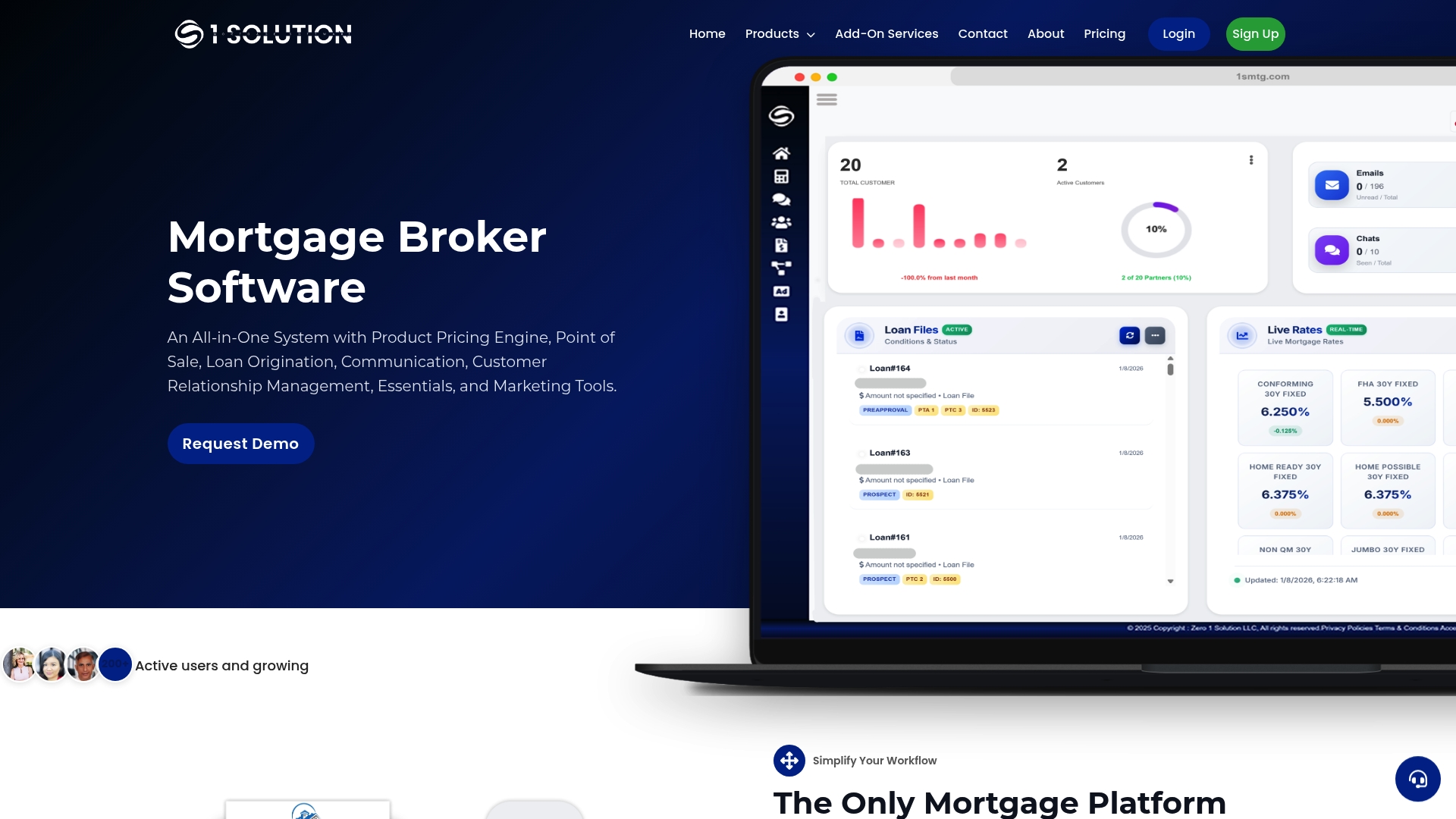
1 Solution is a cloud-based mortgage platform that brings LOS, CRM, product pricing engine, borrower POS portal, e-signature, compliance tools, marketing automation and communication tools (email, SMS, chat, voice and video) together, with lead and recruitment tracking, rate comparison, and proposal and pre-approval generation. For a broker building a scoring routine, that means the signals you score and the follow-up you trigger sit in the same system.
Usage fees are published: phone system minutes, text messages and fax are each $0.10 per minute or per message sent or received. Subscription pricing is not listed, so see the 1 Solution platform for a demo and plan details.
FAQ
What is a lead scoring system?
It is a set of rules that assigns points to each lead based on fit and behavior, then sorts leads into priority bands. In mortgage, it helps a loan officer decide who to call first and which leads belong in a slower nurture sequence.
How many points should each signal get?
There is no universal weighting. Start with a rough scale of 100 points, give the most weight to timeline, purpose and source, and then revise using your own funded and lost files. Change a few weights each quarter so you can see the effect.
Can a lead score replace qualifying a borrower?
No. A lead score ranks sales priority. Qualification depends on the credit report, income, debt, assets and other underwriting factors, as the CFPB explains. Keep the two processes separate.
How often should I update the model?
Review it every quarter, and sooner when you add a new lead source, change your products or see hot leads failing to convert. Scores for individual leads should also decay with inactivity.
Sources
- CFPB: Does my credit score affect my ability to get a mortgage loan or the rate I pay?
- CFPB: The impact of differences between consumer- and creditor-purchased credit scores (2011)
- eCFR: 12 CFR Part 1002, Regulation B
- CFPB Fair Lending Report, FY2023
- CFPB Fair Lending Report, 2024
- FTC Telemarketing Sales Rule, 16 CFR 310.4
- Privacy in AI Training: What Teams Need to Know