
Conversion-focused mortgage sites capture far more visitor information than generic, template-built pages, and the gap comes down to two moves: giving visitors something of value before asking for contact details, and following up fast once they hand it over. Pair a calculator or rate estimate with lead routing that reaches a prospect within minutes, and you address both the UX and the operational side of the funnel. Compliance under the Telemarketing Sales Rule is not optional, it is the framework that makes every other tactic usable without legal exposure.
TL;DR:
- Show a calculator or rate estimate before requesting contact details, then ask for email before phone or financial information.
- Limit mobile forms to two or three fields, name the widget's result in the call to action, and promise a response time you can meet.
- Route every submission automatically to an available loan officer and target first contact within five to ten minutes, with a fallback for after hours.
- Before asking for details, disclose how many entities may contact borrowers and through which channels, then retain consent language, timestamp, IP address, and terms version.
- Connect rate widgets to the point of sale and loan origination systems, and register texting before automation to avoid inaccurate quotes and filtered messages.
Table of Contents
- High-Impact Lead Capture Elements and the Value Exchange
- Website Features and Design Elements That Lift Conversion
- Tools and Integrations: What to Connect and Why
- Compliance and Consent Best Practices for Mortgage Lead Capture
- Optimization, Testing, and Operations That Raise Conversion
- Implementation Checklist: A Prioritized Roadmap Brokers Can Follow
- Lessons From Mortgage Operations
- How 1 Solution Brings This Checklist Together
- FAQ
- Sources
High-Impact Lead Capture Elements and the Value Exchange
Visitors rarely fill out a form just because it exists on your site. They fill it out because it gets them something: a number, an estimate, a sense of where they stand. That is the value exchange, and it is the single biggest lever in mortgage website lead capture. Ask for too much too soon, and most visitors bounce before they see what you are offering.
Progressive profiling solves this by spreading data collection across several small steps instead of one long form. Each step earns the next ask because the visitor has already received something: a ballpark rate, a savings estimate, a pre-approval signal. This structure, often called progressive disclosure, respects the visitor's attention and matches the natural buying journey a borrower goes through before they are ready to talk to a loan officer.
The widgets that do this well share a common trait: they produce a result the visitor can see immediately.
- A refinance or payment calculator that shows monthly savings before requesting an email address
- An instant rate estimate tied to a short quiz about loan purpose, credit range, and property type
- A pre-approval checker that gives a qualitative readiness signal in exchange for basic financial inputs
- A short, branching quiz funnel that segments purchase versus refinance intent early, routing each path to a tailored next question
Sequencing matters as much as the widgets themselves. Ask for an email address first, once the visitor has seen a calculated result. Ask for a phone number only after they have engaged with a second micro-conversion, such as viewing a personalized rate range. Save income, employment, and other financial details for the point where the visitor is requesting a pre-approval letter or a callback, not before. Each stage should feel like a natural continuation of the value already delivered, never a cold ask.
UX details decide whether this structure actually works. Inline validation, meaning error messages that appear next to the specific field that needs fixing, reduces abandonment far more effectively than a generic error summary at the top of the form, a finding well documented by the Baymard Institute. Microcopy under the submit button matters too: a line as simple as "a loan officer will call within 10 minutes" sets an expectation that reduces hesitation and, when honored, becomes a trust signal in itself.
Pro Tip: Keep the first form field to a single input, usually email or phone, and resist the urge to add "just one more" field until the visitor has completed at least one micro-conversion.
Getting this sequence right is less about clever design and more about discipline: resist the instinct to front-load every question a loan officer eventually needs. The website's job is to start the conversation, not finish the application.
Website Features and Design Elements That Lift Conversion
Once the value-exchange logic is in place, the surrounding site has to support it without creating friction. Mobile behavior is the first place this shows up. A majority of mortgage site traffic now arrives on a phone, and a form built for a desktop screen, with six or eight visible fields, performs worse on mobile than a stripped-down version with two or three. Reducing fields for mobile visitors specifically, rather than applying one form design to every screen size, is one of the more reliable ways to lift completion rates.
Placement of the primary call to action matters just as much as its design. A context-aware CTA above the fold, tied directly to the value-exchange widget rather than a generic "Contact Us" button, gives the visitor an immediate reason to engage. "See your rate in 30 seconds" converts differently than "Get in touch," because it names the outcome instead of the action.
Micro-engagements extend this logic throughout the page. Sliders that let a visitor adjust loan amount or down payment, calculators that update a payment estimate in real time, and short interactive quizzes all create small commitments that make the eventual form feel like a continuation rather than a cold ask. Each of these micro-conversions is also a measurement point: tracking how far visitors get through a slider or calculator tells you exactly where the funnel loses people.
- Build the primary CTA around the specific value the widget delivers, not a generic phrase
- Cut mobile forms to the fewest fields that still produce a usable lead
- Use real-time sliders or calculators so visitors see the payoff before committing to a form
- Publish a specific response-time commitment near the submit button and keep it
Trust signals round out the picture. Secure-connection badges, a visible privacy statement, and a plainly stated response-time commitment near the form all reduce the hesitation that keeps visitors from submitting their information in the first place. None of these signals needs to be elaborate: a short line stating how quickly a licensed loan officer will respond, placed where the visitor is about to click submit, does more work than a paragraph of legal boilerplate buried in a footer.
A value-exchange widget, a mobile-first form, and a visible response-time promise each do a small amount of work that adds up.
Tools and Integrations: What to Connect and Why
A website that captures a lead is only half the job. What happens in the next few minutes decides whether that lead turns into an application or goes cold. The integration layer, meaning how your site talks to your CRM, your point-of-sale system, and your communication tools, is where most of that value is won or lost.
- CRM integration with automatic lead routing. A lead that sits in an inbox for an hour is a lead a competitor already called. Routing rules that assign a new lead to the next available loan officer the moment a form submits, paired with a notification by text or app alert, directly determine whether your speed-to-lead process actually holds up under real volume.
- POS and LOS connections for accurate numbers. A rate estimate or pre-approval signal is only useful if it reflects what your loan origination system can actually deliver. Disconnected widgets that quote numbers your POS cannot honor create friction later in the process, not less of it.
- Texting with A2P/10DLC compliance built in. SMS converts well for mortgage follow-up, but carriers now require registered, compliant messaging paths. Setting up A2P/10DLC and TCPA compliance before you turn on automated texting avoids messages getting filtered or, worse, exposing your brokerage to penalty risk.
- Email deliverability through a dedicated SMTP domain. Lead notifications and nurture emails sent from a properly authenticated domain land in inboxes instead of spam folders, which matters as much for the lead's first confirmation email as it does for your ongoing nurture sequence.
- PBX and call routing with recording and retention policies that match compliance requirements. A unified phone system that routes inbound calls to the right originator, while keeping call recordings retained correctly, closes the loop between a web lead and an actual phone conversation.
Each of these pieces can be bought separately, and many brokerages do exactly that, stitching together a CRM, a texting platform, and a phone system from different vendors. The tradeoff is integration work: every connection between separate tools is a place where a lead can get lost or a compliance record can go missing. For a deeper look at how lead distribution and routing should work end to end, the mechanics matter more than the brand names behind them.
Compliance and Consent Best Practices for Mortgage Lead Capture
Every tactic above depends on one assumption: that the consent behind each lead will hold up if it is ever questioned. The Federal Trade Commission settled with a lead generator in January 2024 over deceptive websites that harvested consumer data for sale under the guise of legitimate consent, a case that underscores how much scrutiny lead-generation practices now draw.
FTC staff guidance on the Telemarketing Sales Rule adds a more specific warning for mortgage lead capture: a lender receiving contact information from a lead generator generally does not have an established business relationship with that consumer unless the lead generator made full, conspicuous disclosures beforehand. Staff specifically recommend disclosing, before any contact information is collected, the possibility of telemarketing calls and the identity or number of entities that might reach out. Skipping that disclosure does not just create risk for the lead generator, it can leave the receiving lender without the legal basis it assumed it had.
Consistent, auditable consent records should include the consent language shown to the user, a timestamp, the IP address, and the user agent string used at the moment of submission.
Practically, that means your form submissions need to log more than just the lead's name and phone number. A defensible consent record captures the exact checkbox copy displayed, the page or modal where it appeared, a timestamp, the submitter's IP address, and a reference to which version of your terms was live at that moment. If a dispute ever arises, that level of detail is what separates a compliant disclosure from an assumption you cannot prove.
- State clearly, before the contact field, how many entities might reach out and in what form (call, text, email)
- Use plain, visible consent language rather than text buried in a footer or pre-checked box
- Store consent metadata separately from marketing data so it survives CRM migrations
- Audit your own forms periodically against current FTC guidance rather than assuming a setup from years ago still holds
Avoiding what regulators call consent farming, meaning collecting broad, vague consent and then reselling or over-distributing the lead, comes down to limiting how many parties a single form submission authorizes. A form that quietly grants contact rights to five unnamed "partners" is the exact pattern the FTC flagged in its 2024 settlement. Naming the entity or entities clearly, and keeping that number small, protects both the borrower's trust and your own compliance position. For a closer look at consent requirements on the texting and calling side specifically, the express written consent playbook from RevRing walks through the documentation standard regulators expect for high-risk channels like SMS and phone.
Optimization, Testing, and Operations That Raise Conversion
Speed-to-lead is the metric that determines whether everything built so far actually pays off. A lead contacted within minutes converts at meaningfully higher rates than one contacted hours later, and CRM-driven routing exists specifically to close that gap between submission and first contact. Set a target, five to ten minutes for an initial text or call, and build your routing rules around hitting it consistently rather than only when staffing allows.
Testing should follow a fixed order rather than a scattershot approach:
- Form field count. Remove one non-essential field at a time and measure completion rate before touching anything else.
- CTA wording. Test outcome-specific phrasing against generic phrasing on the same button, same placement.
- Response-time microcopy. Add or change the promised response time under the submit button and watch for a shift in submission rate.
- Widget placement. Move the calculator or rate estimate above versus below the fold and compare engagement.
- Follow-up channel order. Test text-first versus call-first sequencing for initial contact.
Each test isolates one variable so the lift you measure is attributable to the change you made, not to seasonal traffic shifts or unrelated site updates running at the same time.
Inline validation deserves its own attention inside this testing program. Baymard Institute's usability research shows that error messages placed directly next to the offending field, combined with color and text together rather than color alone, reduce abandonment more reliably than a summary of errors at the top of the form. Just as important: never force a visitor to re-enter a field that was already correct because one other field failed validation. That single fix is often a bigger lift than a full page redesign.
Pro Tip: Run your form-field and response-time tests before touching design elements like color or layout. The data entry experience moves conversion more than visual polish does.
None of this works without dashboards that show where leads actually drop off. Three views matter most: a funnel broken down by traffic source, so you know whether paid search leads behave differently than organic leads; micro-conversion tracking through each calculator or quiz step, so you can see exactly where engagement stalls; and cost-per-lead alongside lead quality, since a cheaper lead that never converts is not actually cheaper. Reviewing these weekly, rather than only at month end, catches a broken form or a routing failure before it costs you a month of traffic.

Implementation Checklist: A Prioritized Roadmap Brokers Can Follow
Rolling all of this out at once is unrealistic for most brokerages, and trying to do so usually means nothing gets finished well. A phased plan works better, starting with the changes that take days, not months.
- Week 1 to 2: mobile form simplification. Cut mobile forms to two or three fields and add a response-time line under the submit button.
- Week 1 to 2: add one calculator widget. A refinance or payment calculator above the fold is the fastest value-exchange win available.
- Month 1 to 3: CRM routing setup. Connect form submissions to automatic lead assignment and notification rules.
- Month 1 to 3: SMTP domain and texting compliance. Authenticate your sending domain and complete A2P/10DLC registration before automating any SMS follow-up.
- Month 1 to 3: PBX and call routing. Connect inbound calls to the right originator with recording and retention policies documented from day one.
- Quarterly: structured A/B testing program. Run the field-count, CTA, and response-time tests from the previous section on a recurring schedule.
- Quarterly: progressive profiling rollout. Expand single-step forms into the multi-stage structure once routing and follow-up can support the added volume.
- Quarterly: analytics maturity. Build the funnel, micro-conversion, and CPL dashboards and review them on a fixed cadence.
Ownership matters as much as sequence. Someone specific, not "the team," needs to own lead response time, and that person's targets should be written down: first contact within ten minutes during business hours, a documented fallback for after-hours leads, and a weekly review of missed-SLA leads.
| Phase | Primary action | Expected outcome |
|---|---|---|
| Week 1 to 2 | Simplify mobile forms, add response-time copy | Fewer abandoned forms on mobile |
| Week 1 to 2 | Add one value-exchange calculator | Higher visitor engagement before contact ask |
| Month 1 to 3 | Connect CRM routing and SMS/SMTP compliance | Faster, compliant first contact |
| Quarterly | Run structured A/B tests and expand dashboards | Steady, measurable conversion gains |
Lessons From Mortgage Operations
Twenty years across processing, underwriting, origination, and systems consulting taught me one consistent lesson: the website rarely fails because of a design flaw. It fails because the backend cannot keep the promise the front end makes. I have watched brokerages roll out a sharp-looking pre-approval widget only to have it generate leads that sat untouched for a day because nobody had set up routing to match the new volume.
The fix that mattered most, more than any form redesign, was tightening the gap between submission and first contact. When routing and notification were set up correctly, the same website, same forms, same calculator, converted noticeably better simply because someone called within minutes instead of hours.
If you can only fix one thing first, fix that. A calculator or quiz funnel is worth building, but it only pays off once the lead it generates reaches a human fast enough to matter.
— Omar Khamisa
How 1 Solution Brings This Checklist Together
Everything on this checklist, the mobile-first forms, the CRM routing, the compliant texting, the authenticated email domain, the call recording policy, works better when it lives in one connected system instead of five separate vendor logins. That is the gap we built 1 Solution to close for independent brokers.
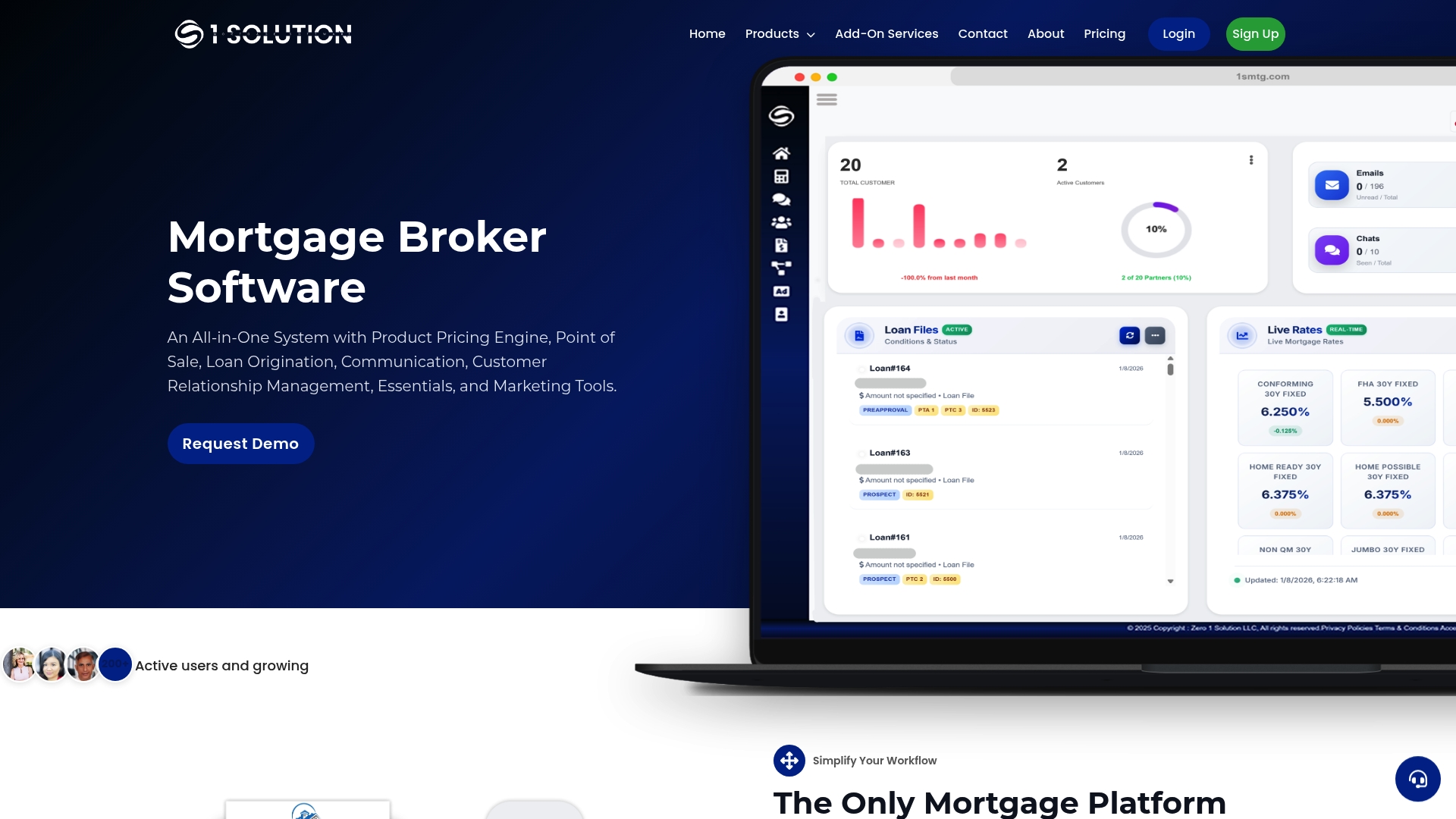
Our platform pairs a mortgage website builder with the CRM, point-of-sale, and LOS connections that make a rate-estimate widget trustworthy instead of just decorative, because the number it shows comes from the same engine processing the loan. A few ways this maps directly onto the roadmap above:
- A dedicated SMTP DOMAIN setup so lead-confirmation emails and nurture sequences land in inboxes instead of spam folders
- PBX Solutions for call routing, recording, and retention that match the compliance standards your consent records already promise
- Built-in CRM routing so a web lead reaches a loan officer faster rather than sitting in a shared inbox
- Phone, text, and fax usage billed at a fixed per-minute or per-message rate to help keep communication costs predictable as volume grows
We built this as independent, self-funded mortgage professionals who got tired of stitching together tools designed primarily for banks and direct lenders rather than brokers. There is no outside investor steering the roadmap, just the day-to-day problems brokers actually deal with.
If your current setup has you juggling a website vendor, a separate CRM, and a third tool for texting, our Subscription Account brings those pieces into one dashboard. Visit 1smtg to see a demo and find the plan that fits your team's volume.
FAQ
What is the best website for real estate lead generation?
No single platform is universally "best," since the right fit depends on your lead volume, your CRM, and how your rate-quoting engine connects to your point-of-sale system. The strongest-performing mortgage sites share common traits: a value-exchange widget like a calculator or rate estimate, mobile-first forms, and fast, CRM-routed follow-up, as outlined by Salesforce's mortgage lead-generation guidance.
Are mortgage trigger leads illegal now?
Trigger leads themselves are not illegal, but the rules around contacting consumers from any purchased lead list, trigger leads included, require clear, documented consent under the Telemarketing Sales Rule. The FTC's 2024 settlement with a deceptive lead generator shows regulators actively pursuing cases where consent disclosures were inadequate, so the legality hinges on how the lead was obtained and disclosed, not the lead type itself.
How much commission do loan officers make on a $500,000 loan?
Commission structures vary widely by brokerage, loan type, and compensation plan, and no single published figure applies across the industry. Loan officers and brokers should check their own compensation agreement for the specific percentage or flat-fee structure that applies to their situation.
What is the best CRM software for mortgage professionals?
The right CRM for a mortgage professional is one that connects directly to lead routing, your point-of-sale system, and compliant texting and calling, since a disconnected CRM creates the exact lead-loss problems that hurt conversion. Platforms built specifically for mortgage brokers, rather than generalized sales CRMs, tend to handle loan-specific fields and compliance logging more directly out of the box.
Sources
- Hudson Cook advisory opinion on TSR and internet lead generation (FTC staff opinion)
- Baymard Institute — inline form validation
- Mortgage Lead Generation: Proven Strategies for Loan Officers — Salesforce