
A modern mortgage lead distribution system routes every qualified lead to the right licensed loan officer in seconds, not minutes, and protects that lead's value with escalation timers, capacity caps, and a full consent audit trail. The right architecture layers geographic and licensing filters first, then applies performance-weighted routing, with automated reassignment as the backstop.
Three things every broker-focused distribution system must do:
- Enforce state-license and NMLS checks before delivery, cap active leads per officer, and trigger automated reassignment when no response arrives within a defined window
- Track speed-to-lead at the median and 90th percentile, contact rate by routing method, and cost per funded loan by source
- Capture per-buyer consent with a full timestamp, IP address, consent text, and buyer list on every lead record, stored for immediate production during audits
Key Takeaways
A compliance-first, layered distribution system, with geographic and licensing filters first, performance weighting second, and escalation rules as the backstop, is the most defensible and highest-converting architecture for U.S. mortgage brokers.
| Point | Details |
|---|---|
| Layer your routing logic | Apply geographic and licensing filters before performance weighting to prevent out-of-license delivery. |
| Set escalation timers from day one | Automatic reassignment after 3–15 minutes prevents leads from aging out with unresponsive officers. |
| Track median and 90th percentile | Averages mask slow tail cases; the 90th percentile is where lead value actually dies. |
| Capture consent metadata on every lead | Timestamp, IP, consent text, and buyer list must be stored and retrievable for TCPA defense. |
| 1 Solution Mortgage Software | Delivers state-license enforcement, consent capture, escalation rules, and LOS/CRM integrations in one broker-focused platform. |
Table of Contents
- What Is Mortgage Lead Distribution and Why Does It Matter?
- Which Routing Methods Should You Use for Mortgage Leads?
- Exclusive vs. Shared Leads: How Distribution Rules Change
- Speed-to-Lead Benchmarks and the KPIs That Drive Distribution Performance
- Automation Rules That Keep Leads from Falling Through the Cracks
- Compliance and Consent: TCPA, State Licensing, and Audit Trails
- What Integrations Does Your Distribution Platform Actually Need?
- How to Choose a Distribution System and Roll It Out
- Real-World Lessons from Mortgage Operations
- How Do You Handle Third-Party Lead Sources and Aggregators?
- How to Get Your Sales Team to Actually Use the New System
- 1 Solution Mortgage Software Gives Brokers Distribution Built for Real Operations
- Sources
What Is Mortgage Lead Distribution and Why Does It Matter?
Mortgage lead distribution is the automated routing of incoming leads to specific loan officers, branches, or buyer contracts using predefined rules. A well-configured platform evaluates each lead in real time and assigns it by geography, product type, officer capacity, performance history, and licensing, collapsing response windows from hours to seconds.
The commercial case is straightforward. A shared inbox or spreadsheet routing system loses lead value the moment a lead sits uncontacted. Harvard Business Review's analysis shows that online leads decay rapidly, with response speed directly affecting conversion probability. That finding is the operational justification for sub-minute response targets.
Beyond speed, automated distribution protects exclusive-lead ROI by preventing duplicate delivery, enforces licensing compliance before a loan officer ever sees a lead, and matches borrowers to officers with the right product expertise. For a multi-branch brokerage buying leads across several states, the difference between a rules-based system and a shared inbox is the difference between a scalable operation and a compliance liability.
Which Routing Methods Should You Use for Mortgage Leads?
Routing strategy is where distribution systems earn their cost. Each method has a distinct trade-off between fairness, conversion optimization, and operational complexity.
Round-robin routing
Every incoming lead cycles to the next available officer in sequence. It is fair, simple to configure, and works well for small teams where skill levels are roughly equal. The downside: it ignores performance data entirely. A top-closing officer gets the same volume as a new hire, which leaves conversion on the table.
Weighted routing
Leads are distributed proportionally based on assigned weights, typically close rate, average response time, or product experience. A loan officer with a higher close rate on FHA leads might receive more FHA volume than a colleague with a lower rate. The trade-off is administrative overhead: weights need regular recalibration as performance data updates, and officers who fall behind can feel penalized. Done well, weighted routing is the highest-conversion method for mature teams with reliable performance data.
Geographic and territory-based routing
State licensing constraints make geographic routing a mandatory first filter in any multi-state operation. A lead from Texas cannot go to an officer licensed only in California. Beyond compliance, territory routing supports local-market relationships and referral networks. Use it as the outermost layer of your routing logic, before any performance or capacity rules apply.
Ping-post and auction models
In a ping-post model, the lead generator sends a partial data "ping" to multiple buyers simultaneously. Buyers bid, and only the winning buyer receives the full PII record. This is the dominant model among aggregators selling shared leads because it maximizes revenue per lead. For brokers buying through aggregators, it means speed-to-response on the ping determines whether you receive the lead at all. Direct routing bypasses the auction entirely and is the standard for exclusive lead programs.
AI scoring and pre-delivery filtering
Scoring engines evaluate leads against credit range, LTV, loan type, and behavioral signals before delivery. Low-fit leads can be blocked, downgraded to a nurture queue, or routed to a junior officer rather than consuming a senior officer's capacity. Pre-delivery scoring is most valuable when lead quality from a source is inconsistent.
Layering the methods
The most effective architecture sequences these methods:
- Geographic/licensing check (block out-of-license delivery)
- Product and credit filter (match loan type and credit band to officer expertise)
- Performance-weighted assignment (route to the officer most likely to close)
- Capacity cap check (skip officers at their active-lead ceiling)
- Escalation/backup reassign (if no acceptance within X minutes, route to the next eligible officer)
Pro Tip: Start with geographic and licensing filters alone for the first two weeks of a new system. Add performance weighting only after you have enough response-time and contact-rate data to set weights with confidence.
Exclusive vs. Shared Leads: How Distribution Rules Change
The distinction between exclusive and shared leads is not just a pricing question. It fundamentally changes how your distribution system should behave.
An exclusive lead is sold to one buyer. You paid a premium for it, and the borrower has not been contacted by five other loan officers. That gives you time for a consultative first call rather than a race. Your distribution rules should prioritize immediate routing to your best-fit officer, but the urgency of sub-second delivery is lower than with shared leads.
A shared lead goes to multiple buyers simultaneously. The borrower is already being called. Your system must deliver the lead, trigger an automated intro SMS or email, and connect the officer promptly. Automated first-touch outreach materially improves contact rates in shared-lead environments because it establishes presence before competitors do.
The ROI math reflects this. Exclusive leads cost more per unit but convert at higher rates when protected by proper routing and escalation rules. A shared lead bought cheaply and contacted in five minutes is worth less than a shared lead bought at the same price and contacted in 30 seconds. Distribution quality is where the economics of your lead program are actually decided.
Speed-to-Lead Benchmarks and the KPIs That Drive Distribution Performance
Response time is the single most measurable output of a distribution system. Use these as operational targets, not aspirational goals.
| KPI | Target | Why It Matters |
|---|---|---|
| Speed-to-lead (median) | Under 60 seconds | Reflects typical system performance across all leads |
| Speed-to-lead (90th percentile) | Under 5 minutes | Exposes slow tail cases where leads age out |
| Contact rate | Track by routing method | Reveals which method actually reaches borrowers |
| Lead acceptance rate | Track per officer | Identifies hoarding or capacity mismatches |
| Conversion rate by routing method | Track monthly | Validates whether weighting logic is working |
| Cost per funded loan by source | Track quarterly | Measures true ROI of each lead source |
Pro Tip: Track median and 90th-percentile response times rather than averages. A fast median can mask a slow tail where 10% of leads sit for 20 minutes. That tail is where lead value dies.
To measure these metrics, capture the lead arrival timestamp, first assignment timestamp, first officer action timestamp, and first live-contact timestamp on every record. Pre/post comparison of these fields before and after a system change gives you clean evidence of improvement.
Automation Rules That Keep Leads from Falling Through the Cracks
Routing logic gets leads to the right officer. Automation rules keep them from dying there.
-
Escalation timers. If an officer does not accept or contact a lead within a defined window (typically 3–5 minutes for shared leads, 10–15 minutes for exclusive leads), the system automatically reassigns to the next eligible officer. Without this rule, unresponsive officers become a black hole for lead volume.
-
Capacity caps. Set a manageable limit on active leads per officer. When an officer hits their cap, new leads skip them entirely until they work down their queue. This prevents hoarding and protects officers from burnout on high-volume days.
-
Schedule-aware routing. Route leads only during an officer's configured working hours and resolve timezone differences automatically. After-hours leads should route to an on-call officer or an automated intro sequence, not sit unassigned until morning.
-
Source-based priority rules. Referral leads and partner-sourced leads typically carry higher intent. Configure your system to treat them with higher priority, bypassing standard queue position and routing directly to a senior officer or a dedicated referral team.
-
Progressive automation. Start with escalation timers and capacity caps. Add schedule-aware routing in week two. Introduce source-based priority rules only after you have enough data to validate that the priority classification is accurate.
Pro Tip: Set your first escalation timer conservatively at 10 minutes, then tighten it to 3–5 minutes once officers are trained on the new system. Aggressive timers before training creates friction and resistance.
Compliance and Consent: TCPA, State Licensing, and Audit Trails
Compliance is not a feature you add to a distribution system. It is the foundation the system is built on.
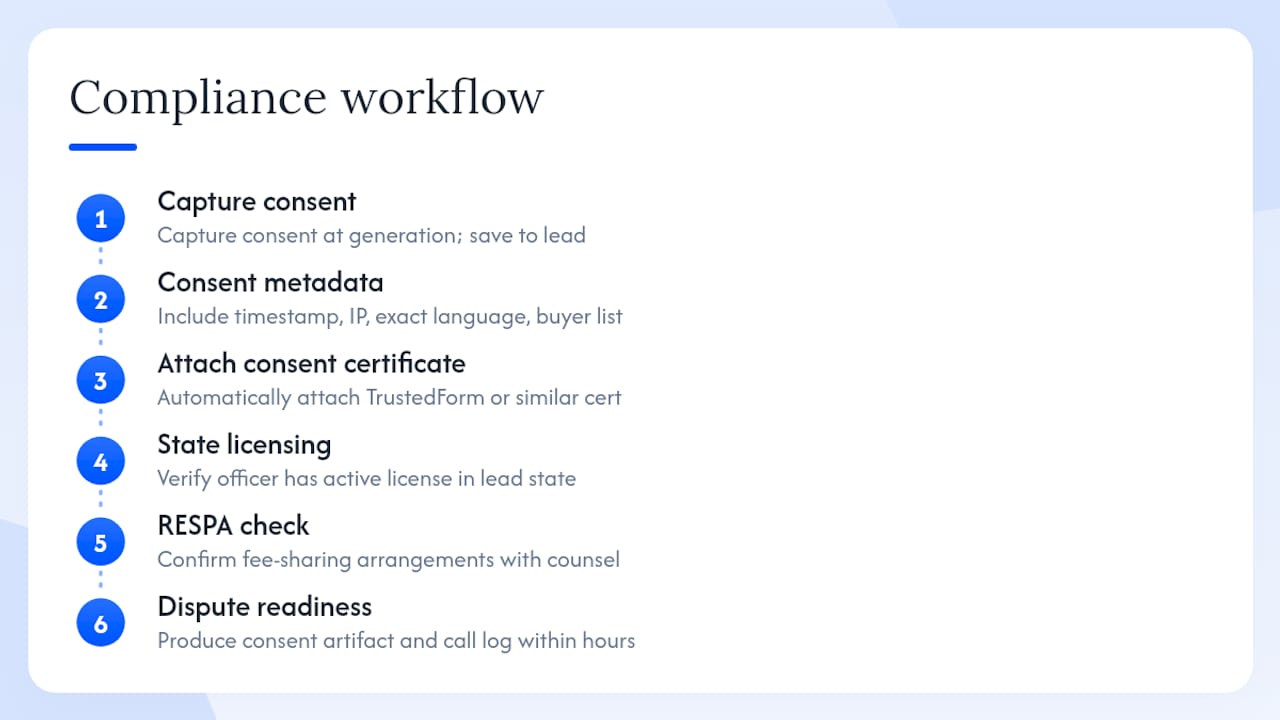
The Telephone Consumer Protection Act (47 U.S.C. §227) creates statutory exposure for unsolicited calls and texts. Every lead your system routes to an officer for outreach must carry documented prior express written consent. That means the consent must be captured at the point of lead generation, stored with the lead record, and producible on demand.
State licensing and NMLS constraints add a second layer. Your routing logic must verify that the assigned officer holds an active license in the lead's state before delivery. This is not optional in multi-state operations. Industry guidance consistently identifies out-of-license routing as one of the most common and costly compliance failures in mortgage lead programs.
Consent metadata on every lead record should include: timestamp of consent, IP address, the exact consent language displayed, and the buyer list at the time of consent. TrustedForm and similar certificate-based tools generate a tamper-evident consent artifact that can be produced during disputes. Integrate consent certificate retrieval into your posting workflow so the certificate is attached to the lead record automatically.
RESPA is relevant where lead fees involve referral arrangements between settlement service providers. If your lead program involves any fee-sharing with real estate agents or other settlement service providers, confirm the arrangement with counsel before routing begins.
Pro Tip: Store the full posting log and consent metadata on every lead record. When a TCPA dispute arrives, you need to produce the consent artifact, the timestamp, the buyer list, and the call log within hours, not days. Build that retrieval into your system before you need it.
For a deeper look at TCPA and state licensing obligations, the mortgage regulatory compliance guide covers the key obligations brokers face.
What Integrations Does Your Distribution Platform Actually Need?
A distribution platform that cannot talk to your LOS, CRM, and telephony stack is a routing engine with no operational context. These are the integrations that matter.
| Integration | Purpose | Quality Markers |
|---|---|---|
| LOS (loan origination system) | Push accepted leads into loan pipeline | Bidirectional sync, field mapping, error logs |
| CRM | Create/update contact records on delivery | Deduplication logic, webhook delivery, retry on failure |
| Telephony / call tracking | Trigger click-to-call, log call outcomes | Call disposition sync, recording links, caller ID compliance |
| SMS / email automation | Send automated intro messages on delivery | Template variables, delivery receipts, opt-out handling |
| Consent certificate vendor | Attach TrustedForm or equivalent to lead record | Auto-retrieval on post, certificate storage, expiry alerts |
| Scoring engine | Pre-score leads before routing | Real-time API, configurable thresholds, score passthrough |
| Posting / ping-post endpoints | Receive leads from aggregators | REST/webhook, retry/ack logic, payload normalization |
Delivery patterns matter as much as the integrations themselves. Require webhook or REST delivery with acknowledgment, exponential backoff on failures, and record-level error logging. A system that silently drops a failed delivery is worse than one that fails loudly. Standardized field mapping prevents the scenario where a lead arrives with a state code your LOS does not recognize.
For a broader view of mortgage automation tools that complement a distribution platform, including CRM and LOS options, that guide covers the full stack.
Pro Tip: Require a sandbox test endpoint and a replayable posting log before go-live. Run 50 test leads through the full integration chain in UAT. If a vendor cannot provide a sandbox, that is a red flag about their operational maturity.
AI-powered lead response tools like Astreaux AI can handle automated first-touch outreach and consultation booking, which pairs well with a distribution system's routing logic to ensure no lead goes uncontacted while an officer is occupied.
How to Choose a Distribution System and Roll It Out
Selection criteria should be weighted toward compliance support and delivery reliability first, routing flexibility second.
Vendor questions to ask in every demo:
- How does your system enforce state-license and NMLS checks at the point of routing?
- Where is consent metadata stored, and how is it retrieved during a dispute?
- What are your delivery latency SLAs, and how do you handle failed deliveries?
- Can you demonstrate escalation timer configuration and capacity cap enforcement?
- What does your posting log look like, and can I export it on demand?
- How do you handle duplicate leads from multiple sources?
Red flags to walk away from:
- Opaque posting logs with no per-lead delivery timestamps
- No per-buyer consent metadata on lead records
- Inability to enforce state-license blocks at the routing layer
- No escalation rules or manual-only reassignment
- Single-point-of-failure delivery with no retry logic
Rollout steps
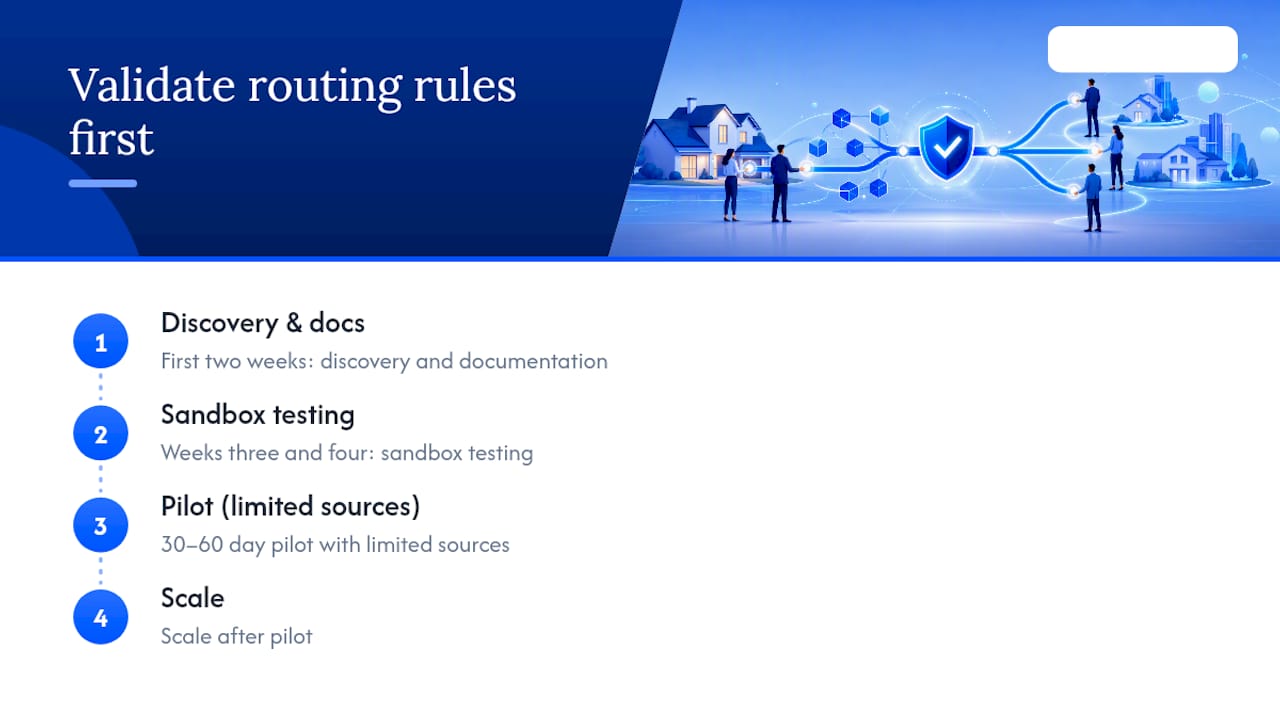
- Discovery (weeks 1–2). Map current lead sources, volume by state, officer license matrix, and existing CRM/LOS fields. Establish pre-implementation KPI baselines.
- Sandbox and UAT (weeks 3–4). Configure routing rules in a test environment. Run test leads through every routing scenario, including escalation and cap triggers.
- Pilot (days 30–60). Go live with one or two lead sources and a subset of officers. Measure speed-to-lead median, 90th percentile, and contact rate daily.
- Scale (days 90–180). Add remaining sources, tune performance weights with real data, and expand to full officer roster.
- Ongoing optimization. Review KPIs monthly. Recalibrate weights quarterly. Audit consent metadata and posting logs on a rolling basis.
For compliance-specific checklist items during rollout, the compliance guide for new mortgage businesses is a practical reference.
Real-World Lessons from Mortgage Operations
The most common failure mode in distribution implementations is not a technology problem. It is a configuration problem caused by going live before the routing rules are validated.
A high-level timeline that works in practice: spend the first two weeks in discovery and documentation, weeks three and four in sandbox testing, then run a 30–60 day pilot with limited sources before scaling. That pilot phase is where you find the edge cases: the officer who accepts leads but never contacts them, the state filter that is misconfigured for a license that expired, the escalation timer that fires too aggressively and creates officer friction.
Three specific lessons from mortgage operations implementations:
Hoarded leads are invisible without caps. Officers who accept leads and sit on them do not show up as a problem in a simple volume report. Capacity caps and acceptance-rate tracking make the problem visible.
Consent capture gaps surface late. Brokerages often discover incomplete consent metadata only when a dispute arrives. Instrument consent certificate retrieval from day one, not as a retrofit.
Start with state-license enforcement and escalation timers. These two rules prevent the two most costly failure modes: out-of-license routing and leads that age out uncontacted. Everything else is optimization.
Note: Proprietary case study data and client performance metrics are available from 1 Solution Mortgage Software directly and can be inserted here by the publisher.
How Do You Handle Third-Party Lead Sources and Aggregators?
Third-party lead sources introduce variability that internal routing rules alone cannot manage. Each aggregator delivers leads in a different format, with different consent documentation, and at different quality levels.
The first step is normalization. Every external lead source needs a field-mapping layer that translates the aggregator's payload into your system's standard schema before routing rules apply. A lead that arrives with "CA" in a state field and your system expects "California" should not require manual intervention.
Per-source quality tracking is the second requirement. Track contact rate, conversion rate, and cost per funded loan separately for each aggregator. Sources that consistently underperform on contact rate often have consent quality issues or are selling the same lead to too many buyers. That data should feed directly into your source-based routing priority rules and your vendor renewal decisions.
For ping-post aggregators, confirm that the consent artifact covers your specific buyer entity by name. A consent that names a different buyer is not valid consent for your outreach. This is a common gap in aggregator-sourced lead programs and a direct TCPA exposure.
Friendly Financial Group is an example of a partner-sourced lead relationship where the consent and quality standards are established upfront, which simplifies the routing and compliance workflow compared to open-market aggregator buys.
How to Get Your Sales Team to Actually Use the New System
Technology adoption fails when loan officers do not trust the system or do not understand why it changed. Change management for a distribution system rollout has three components.
Training before go-live. Officers need to understand how leads arrive, what triggers an escalation, and what happens when they hit their capacity cap. A 30-minute walkthrough before the pilot launch prevents most of the friction. Focus on the officer's daily workflow, not the system's architecture.
Transparency about routing logic. Officers who do not understand why they received fewer leads than a colleague will assume the system is unfair. Publish the routing rules and the performance weights. When officers can see that close rate and response time drive their share of volume, the system becomes a motivator rather than a source of resentment.
Feedback loops during the pilot. Create a simple channel for officers to flag leads they believe were misrouted or escalated too quickly. Most of that feedback will be noise, but some will surface genuine configuration errors. A pilot that incorporates officer feedback produces a better-configured system at scale.
For workflow design guidance that supports team adoption, the mortgage office workflow design guide covers the operational side of rolling out new systems to a brokerage team.
The editorial perspective on distribution systems
Most brokerages we have worked with came to us after a bad experience with a fragmented stack: one tool for lead capture, a separate CRM that did not sync reliably, and a manual process for routing that depended on whoever was watching the inbox. The compliance exposure from that setup is real, and it compounds over time.
The architecture we built prioritizes auditability and broker control because those are the two things that protect you when something goes wrong. A system that routes fast but cannot produce a consent record is a liability. A system that logs everything but cannot reassign a lead automatically is just an expensive spreadsheet.
The trade-off we made deliberately: we built the compliance layer into the routing engine rather than treating it as a separate module. That means slightly more configuration upfront and a cleaner audit trail for the life of the program.
1 Solution Mortgage Software Gives Brokers Distribution Built for Real Operations
Independent brokers do not need a platform designed for bank call centers. They need a system that enforces state-license routing, captures consent metadata automatically, fires escalation timers without manual intervention, and connects to the LOS and CRM they already use. That is exactly what 1 Solution Mortgage Software delivers.
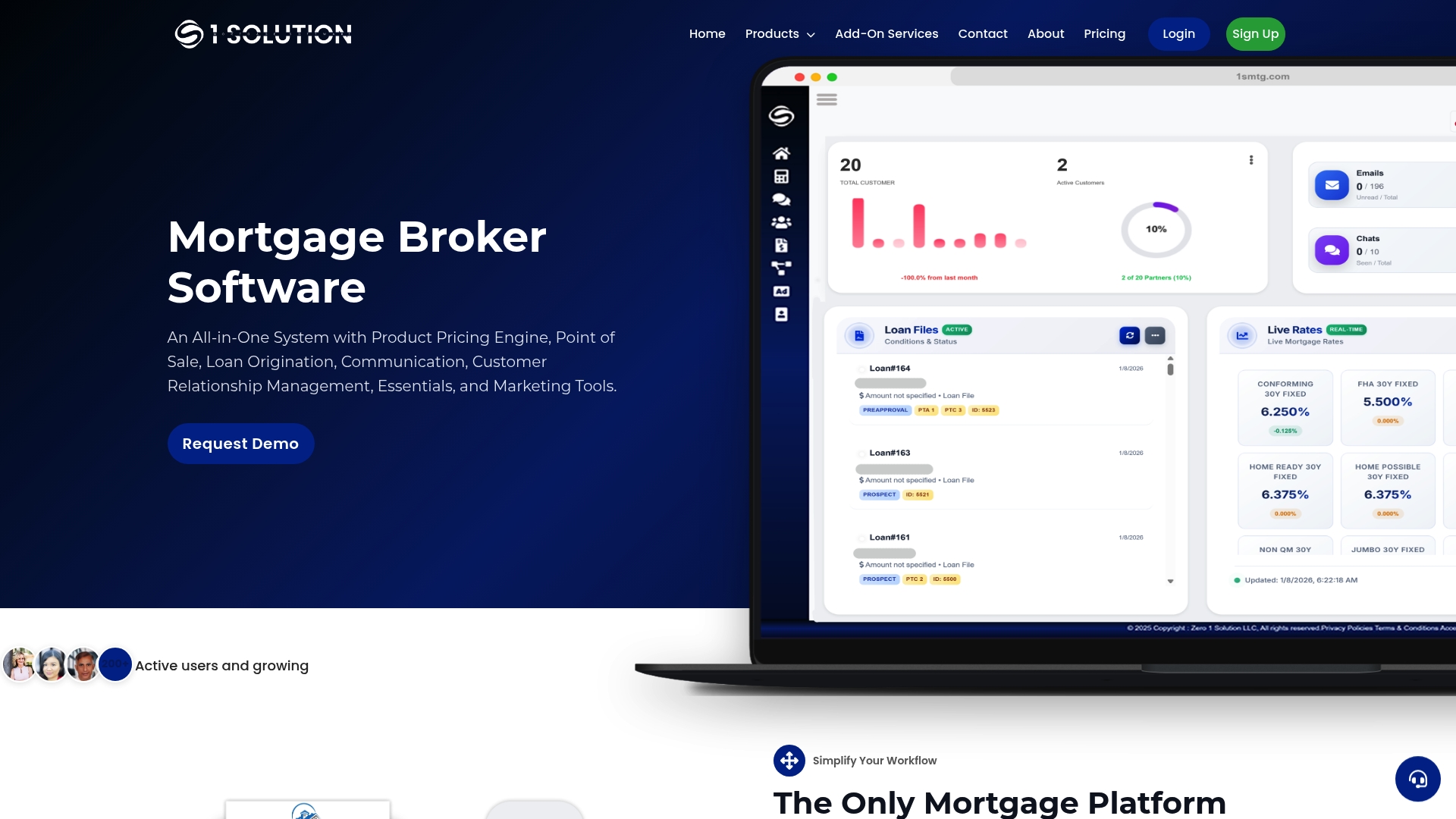
The platform handles state-license and NMLS enforcement at the routing layer, stores consent metadata on every lead record, supports configurable escalation timers and capacity caps, and delivers leads via webhook with full posting logs. CRM, LOS, SMS, email, and telephony integrations are built in, not bolted on. Brokers who pilot the platform typically run a 30–60 day test with one or two lead sources and measure speed-to-lead and contact rate against their pre-implementation baseline before scaling.
Built by mortgage professionals who have worked every role in the operation, from processor to underwriter to loan originator, 1 Solution was designed to solve the problems brokers actually face: disconnected systems, compliance gaps, and tools built for someone else's business model. Start your trial or request a demo and see how the platform performs against your current setup.
Sources
- 47 U.S. Code § 227 - Restrictions on the use of telephone equipment
- The Short Life of Online Sales Leads — Harvard Business Review
- Mortgage Lead Distribution: How Top Lenders Route Leads — Halo Programs
- Thepma
This article is general information, not a substitute for advice from a qualified financial advisor. Consult a qualified financial professional about your own circumstances before acting on anything here.