

Under Regulation Z (12 CFR 1026.36), loan originators may not be paid based on loan terms or on a proxy for loan terms, and dual compensation and steering are prohibited. Compliant pay structures rely on fixed percentages, flat fees, or qualifying profit plans instead. Creditors and loan originator organizations must keep compensation records for three years under §1026.25, with narrow exceptions carved out for certain retirement and profit-based plans.
TL;DR:
- Treat a factor as a prohibited proxy if it tracks loan terms across enough transactions and originators can change it; test both conditions.
- Save snapshots and qualification notes showing borrowers received the lowest rate option, the lowest rate option without risky features, and the lowest total fee option.
- Retain agreements, payment ledgers, proxy analyses, and steering evidence for three years after payment, with every record tied to its loan file ID.
- Use flat fees, hourly wages, or fixed percentage pay with a dollar floor or cap; profit based bonuses qualify only under narrow plan rules.
Table of Contents
- Why the Rule Exists and Who It Covers
- What Counts as Prohibited Pay Based on Loan Terms
- The Proxy Test: Spotting Hidden Term-Based Pay
- Dual Compensation and the Anti-Steering Safe Harbor
- Compensation Methods That Stay Inside the Rule
- What Records Examiners Expect to See
- A Working Playbook for Compensation Compliance
- Where Enforcement Risk Actually Shows Up
- What Actually Keeps Brokerages Out of Trouble
- How the Right Technology Takes the Manual Work Out of Compliance
- FAQ
- Sources
Why the Rule Exists and Who It Covers
The loan originator compensation rule grew out of the Dodd-Frank amendments to the Truth in Lending Act, written to stop the practice of paying originators more for steering borrowers into higher-rate or riskier loans. The core goal is simple: pay should reflect the work of originating a loan, not the profitability of its terms to the lender.
The rule applies to closed-end residential mortgage transactions secured by a dwelling. "Loan originator" covers anyone who takes an application, offers or negotiates terms, or receives compensation contingent on originating a covered loan, including brokers, loan officers at retail lenders, and the companies that employ them. Table-funded transactions, where a broker closes in its own name but a third party funds the loan at or before closing, are treated as broker transactions rather than creditor transactions for compensation purposes. Certain seller financers are excluded if they meet narrow statutory conditions.
Before relying on any compensation plan, confirm these scope basics internally:
- Which employees and contractors meet the legal definition of loan originator.
- Whether any origination channel involves table funding and how that changes compensation treatment.
- Whether state licensing rules add requirements beyond Regulation Z.
What Counts as Prohibited Pay Based on Loan Terms
Section 1026.36(d)(1) prohibits paying or receiving compensation based on a transaction's terms, and the restriction is broader than it first appears. A term includes interest rate, annual percentage rate, prepayment penalty, loan-to-value ratio, or the presence of specific product features. Basing pay on any of these, directly or indirectly, violates the rule even when the amount seems small.
The Regulation Z text specifies that compensation tied to a transaction term, or a proxy for one, is prohibited regardless of how the payment is labeled, which is why examiners look past bonus names and titles to the underlying math.
The rule does permit one practical structure: a fixed percentage of the loan amount, with a defined minimum or maximum dollar cap. That structure doesn't vary with rate or fees, so it stays inside the rule.
Common prohibited bases to flag during a compensation review:
- Bonuses or commission tiers that increase with a loan's interest rate or APR.
- Pay that changes based on whether a loan carries a prepayment penalty.
- Different commission rates for different loan products without a neutral, documented justification.
The Proxy Test: Spotting Hidden Term-Based Pay
A factor doesn't have to mention "interest rate" to violate the rule. The CFPB compliance guide lays out a two-part proxy test: a factor is a proxy for a transaction term when it consistently varies with that term across a meaningful number of transactions, and the originator has the ability to add, drop, or change that factor while originating the loan.
A few quick examples:
- Paying more for loans from one lead source is likely a proxy if that source consistently produces higher-rate loans and the originator chooses which leads to work.
- Paying more for jumbo loans is usually not a proxy, since loan size itself is a permitted basis, not a disguised rate factor.
- Geographic pay differentials can become proxies if certain territories correlate tightly with particular loan terms and originators can select their territory.
Run every new compensation factor through this checklist: does it correlate with a loan term over time, and can the originator influence it? Two yeses mean the factor needs rework or removal.
Pro Tip: Document the business reason for any factor that shows partial correlation but gets retained, since that memo is often the difference between a flagged finding and a closed exam item.
Dual Compensation and the Anti-Steering Safe Harbor
The rule bars collecting compensation from both the consumer and another party, such as the creditor, on the same transaction. Payments made from loan proceeds count as consumer-paid, so an originator can't take a borrower-funded fee and a lender-paid commission on the same loan.

Anti-steering protections go further: originators must present loan options that let a borrower compare true alternatives, not just the one that pays the most. The CFPB compliance guide describes a safe harbor built around presenting the lowest-rate option, the lowest-rate option without risky features like prepayment penalties, and the lowest total-fee option where applicable.
Proving the safe harbor was followed takes evidence, not memory:
- Saved snapshots of the loan options presented to each borrower at the time of origination.
- Notes showing qualification criteria used to narrow the option set.
- A timestamped record tying the presentation to the specific loan file.
Compensation Methods That Stay Inside the Rule
Several pay structures work cleanly under the rule because they don't move with loan terms:
- A fixed percentage of loan amount, with a dollar floor or ceiling.
- A flat fee per loan, regardless of the product or rate.
- Hourly pay for originator work.
- Pay tied to long-term loan performance or overall loan volume across a period.
- Pay tied to measured service quality rather than pricing outcomes.
Two narrow exceptions allow more flexibility. Designated tax-advantaged retirement plans can receive contributions based on compensation that would otherwise be restricted, within normal retirement-plan limits. Non-deferred profits-based compensation plans, like year-end bonus pools funded by company profits, are allowed only when the individual originator's share stays below a specified small percentage of total compensation, or when the plan covers originators who closed a limited number of transactions during the measurement period.
Bona fide third-party charges, like appraisal or credit report fees passed through at cost, don't count as compensation at all since no markup or incentive sits inside them.
What Records Examiners Expect to See
Creditors and loan originator organizations must retain compensation records for three years after payment or receipt under §1026.25, and that window applies whether the payment went to an individual or a company.
Build a retained-records list that includes:
- Signed compensation agreements, with version history when terms change.
- Payment ledgers tied to specific loan files.
- Proxy-test analyses and the business-justification memos behind them.
- Loan-option presentation evidence supporting the anti-steering safe harbor.
Tie every record to a loan file ID and keep them in one searchable repository. A broker who scrambles across spreadsheets, e-mail threads, and paper files when a request comes in loses credibility before the substance of the exam even starts; our compliance audit guide walks through what that readiness looks like in practice.
A Working Playbook for Compensation Compliance
Getting ahead of the rule rather than reacting to it comes down to a repeatable process:
- Draft or revise your compensation policy with legal or compliance review, naming the exact pay method for each role.
- Run a historical proxy analysis across the past 12 to 24 months of originations to check for correlation between pay and loan terms.
- Standardize the loan-option presentation shown to borrowers and capture it automatically at origination.
- Centralize every compensation record in one system tied to loan IDs, not scattered spreadsheets.
- Schedule internal audits on a fixed calendar and document corrective action whenever something drifts.
Practical controls that make this stick include integrated LOS and CRM audit trails, standardized intake and presentation forms, automated compensation ledgers, and versioned compensation agreements that show exactly what terms applied at origination. Our compliance management guide covers how brokers structure that kind of program.
Pro Tip: Keep a short, dated proxy-test checklist on file for every compensation plan review, since examiners respond well to evidence that testing happened on a schedule, not just after a complaint.
Where Enforcement Risk Actually Shows Up
Statutory remedies for loan originator compensation violations include civil liability under 15 U.S.C. §1639b, and recent industry coverage shows firms still tripping on informal pay practices tied to product mix or lead source rather than deliberate rule-breaking, according to reporting on recurring compensation violations.
Examiners typically focus on product-based pay gaps, thin or missing proxy testing, dual compensation instances, and incomplete records. If a problem surfaces internally first, stop the practice immediately, preserve every related record, run a root-cause review, and loop in counsel before making changes to the compensation plan.
What Actually Keeps Brokerages Out of Trouble
The compensation rule rewards boring consistency over clever plan design. In practice, brokerages that avoid escalation are the ones that test their pay structures on a calendar, not just when a regulator asks, and that keep loan-option evidence tied to the file instead of to someone's memory.
We've seen documentation gaps, not pay structure itself, turn a routine exam question into a drawn-out finding. A standardized presentation workflow and a centralized compensation ledger tend to resolve more exam friction than any amount of legal language in the policy itself.
— Omar Khamisa
How the Right Technology Takes the Manual Work Out of Compliance
We built a platform because brokers shouldn't have to stitch together multiple systems to prove a loan was priced and presented correctly. Integrated POS and LOS systems keep an audit trail on every loan file, so compensation records, loan-option snapshots, and proxy-test documentation can live in one searchable place instead of scattered folders.
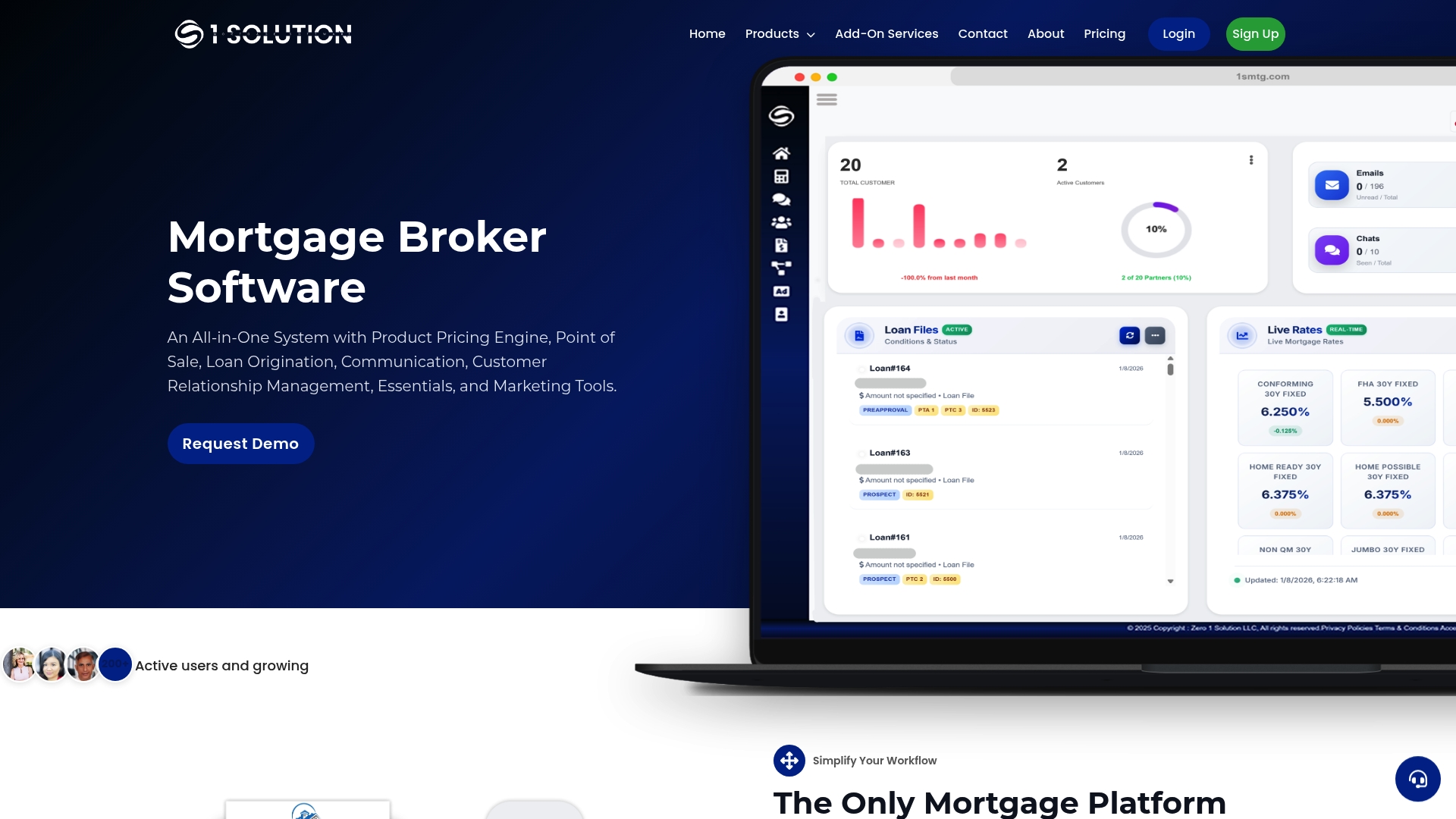
Beyond the core platform, there are additional services such as Mortgage Website, SMTP Domain setup, and PBX Solutions for brokerages that want their communications and borrower-facing tools under one roof:
- A subscription account platform with integrated CRM, POS, LOS, and compliance tools built for independent brokers.
- Mortgage Website and SMTP Domain services available for consistent, branded borrower communication.
- PBX Solutions for call and messaging infrastructure that can tie back into the same system of record.
Reducing manual reconciliation between systems means fewer gaps when it's time to pull records for an exam. Visit 1 Solution to see the platform or request a demo.
This article is general information, not a substitute for advice from a qualified financial advisor. Consult a qualified financial professional about your own circumstances before acting on anything here.
FAQ
How much commission do loan officers make on a $500,000 loan?
Commission structures vary by brokerage and compensation plan, and the loan originator compensation rule requires that pay be based on a fixed percentage of loan amount or a flat fee rather than on the loan's rate or terms. Because actual commission rates aren't standardized or publicly set, a specific dollar figure for any loan amount depends on the individual compensation agreement in place.
How are mortgage loan originators usually compensated?
Loan originators are typically paid through a fixed percentage of the loan amount, a flat per-loan fee, hourly wages, or pay tied to long-term loan performance, all structures permitted under Regulation Z. Pay cannot vary based on interest rate, APR, or other transaction terms, and an originator generally cannot collect compensation from both the consumer and another party on the same loan.
What is the $100,000 loophole for family loans?
This question refers to informal lending between family members rather than to the loan originator compensation rule, and it falls outside the scope of Regulation Z's originator pay restrictions. Questions about intra-family loan structuring are a tax and lending law matter separate from mortgage origination compensation rules, and they're best directed to a tax professional or attorney.
What is the 3-7-3 rule for a mortgage?
The "3-7-3 rule" is informal mortgage industry shorthand related to disclosure timing under older Truth in Lending Act requirements, not a provision of the loan originator compensation rule itself. It isn't an official term defined in Regulation Z's compensation provisions, so definitions of it vary and it shouldn't be confused with the compensation or proxy rules covered here.
Sources
- § 1026.36 Prohibited acts or practices and certain requirements for credit secured by a dwelling
- Loan originator compensation: CFPB compliance guide (2013)