
Pricing exceptions are allowed under federal law, and most lenders grant them regularly to win competitive deals. But an exception only holds up in an exam if it comes with a written policy, numeric caps and approval tiers, and documentation timed to the decision. Without those three controls, the CFPB and other regulators treat pattern exceptions as evidence of disparate treatment, not business judgment.
TL;DR:
- Policies must specify allowed exception types, set clear numeric caps, and require documented approval from designated authority levels.
- Exception records should include timing, reason, actual rate or fee change, and approval details, stored directly in the loan file with borrower initiation evidence.
- Regular statistical testing of exception incidence and value, broken down by demographics and individual officers, helps detect disparate impact patterns.
- Automated, integrated mortgage platforms improve exception tracking, approval transparency, and documentation compliance, reducing regulator risk.
- Proper training tailored to roles and routine audits are essential to keep exception practices consistent, defensible, and aligned with fair-lending expectations.
Table of Contents
- Why Loan Pricing Exceptions Create Fair-Lending Risk
- Building a Policy That Actually Governs Loan Pricing Rules
- Setting Approval Tiers That Limit Discretion
- Testing for Disparate Impact Across the Loan Pricing Rules Book
- Training and Audit Controls That Keep Exceptions Defensible
- Practice Note: Making Exception Controls Operational
- Balancing Commercial Pressure and Compliance
- Reducing Exception Risk With an Integrated Mortgage Platform
- Where to Verify the Rules on Loan Pricing Exceptions
- Sources
- FAQ
Why Loan Pricing Exceptions Create Fair-Lending Risk
A pricing exception happens whenever a borrower gets terms outside the rate sheet: a rate buydown to match a competitor's quote, a lender credit toward closing costs, a fee waiver, or a discretionary discount a loan officer extends to close a deal. Every one of these is legal on its own. The risk shows up in the pattern, not the individual transaction.
Three forces tend to drive exception volume in retail origination. Loan officers face constant competitive shopping pressure from borrowers holding a competing quote. Compensation structures that reward volume can push officers toward discretionary discounts on deals they want to protect. And variable comp plans sometimes create inconsistent incentives across branches, so two borrowers with near-identical files end up with different final pricing depending on which desk they walked into.
Regulators have been explicit about what they see when they pull the data. Common exception categories include:
- Rate buydowns to match or beat a competitor's offer
- Lender credits applied to reduce closing costs
- Origination or underwriting fee waivers
- Loan officer discretionary discounts with no formal trigger
CFPB supervisory highlights have documented disparate treatment tied directly to pricing exceptions where policies were vague and documentation was thin. Industry reporting backs this up: pricing exceptions are common practice, and lenders often permit 50 to 100 basis points of discretion before a deal has to escalate to a manager. That threshold matters, because it is exactly where examiners start asking who approved the exception and why.
Building a Policy That Actually Governs Loan Pricing Rules
A policy that just says "exceptions require manager approval" will not survive an exam. Examiners want to see specificity, and specificity is what makes a policy enforceable rather than decorative.
A workable policy needs these elements, in order:
- A closed list of permitted exception types. Name the categories (buydown, credit, fee waiver) rather than leaving the door open to "other."
- Numeric caps tied to each type. A flat basis-point ceiling per exception category, with anything above it requiring a named higher-level approver.
- An authorization matrix. Spell out who can approve what dollar or bps amount, from loan officer up through branch manager to secondary marketing or pricing desk.
- Customer-initiation rules. The policy should state explicitly that exceptions tied to competitive matching require evidence the borrower, not the loan officer, raised the competing offer.
- Documentation requirements and retention timing. Require the exception form to be completed and filed at the time of the pricing decision, not reconstructed later during underwriting or after an audit request.
The timing point deserves emphasis. A rationale written the day the exception is granted reads as a business record. The same rationale written three weeks later, after a compliance officer asks questions, reads as an after-the-fact justification. Examiners can tell the difference, and so can plaintiffs' counsel.
Pro Tip: Build your exception form so the "reason" field is a dropdown of approved categories rather than a free-text box. Free-text rationale fields are where inconsistent, defensible language turns into a pattern of vague, indefensible language across hundreds of files.
Setting Approval Tiers That Limit Discretion
An approval matrix only works if the thresholds are tight enough to force real review. A common structure looks like this: exceptions up to roughly 25 basis points sit with the loan officer and require only the standard exception form. From 25 to 75 basis points, a branch or sales manager has to sign off, with written rationale attached. Anything beyond that, or any exception involving a fee waiver above a set dollar threshold, escalates to a pricing or secondary marketing desk that sits outside the sales chain.
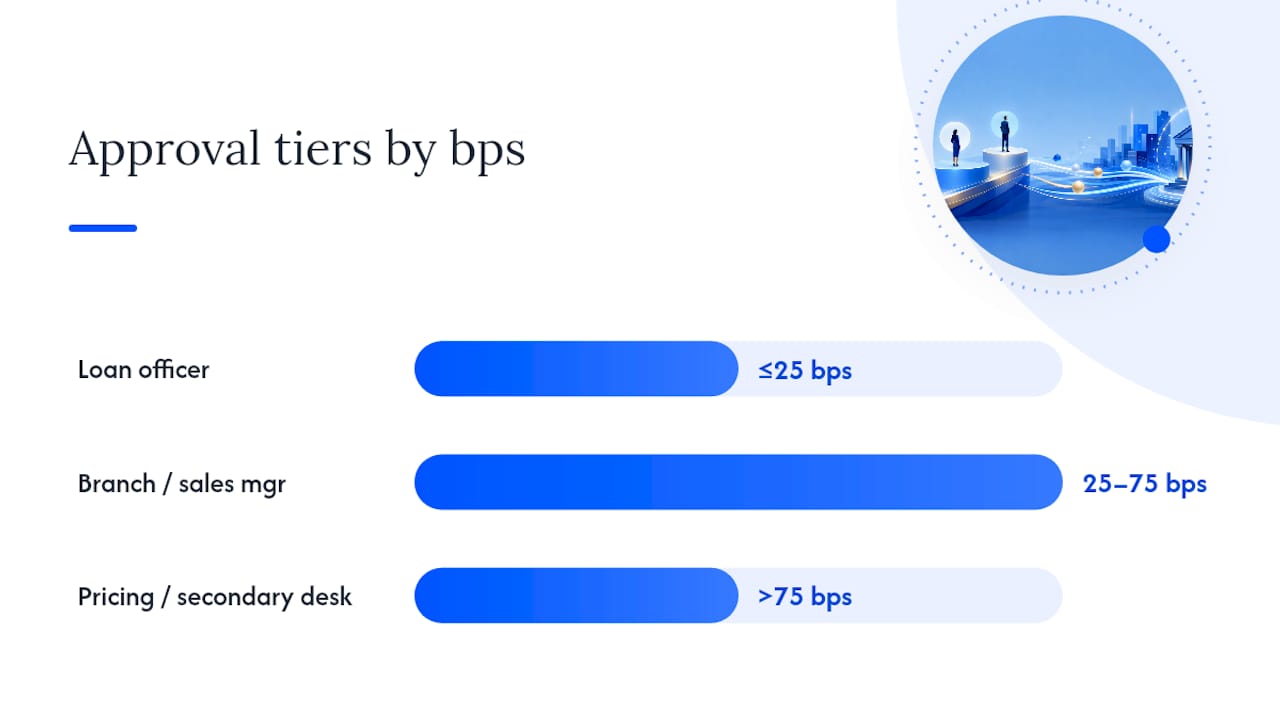
That last point matters more than any specific number: the final approver should never report to the person requesting the exception.
Every exception record needs to capture:
- Who requested the exception and on what date
- Who approved it and at what authority level
- What specific evidence supports a competitive-match claim, such as a saved copy of the competing loan estimate
- The exact rate, credit, or fee change and its dollar impact
That record has to live inside the loan file, not in a separate spreadsheet an LO manager keeps on a shared drive. It should also cross-reference the loan officer's compensation record, so an auditor can immediately see whether the officer who benefited from the exception was also the one who approved it.
Testing for Disparate Impact Across the Loan Pricing Rules Book
Written policy prevents chaos. Testing catches what policy alone misses, which is the pattern that only shows up in aggregate data. FFIEC's interagency fair-lending examination procedures call out exception monitoring as one of the principal areas examiners probe, and they expect institutions to run both incidence and value testing.
Incidence testing asks a simple question: are members of a protected class receiving exceptions at a different rate than everyone else? Value testing asks a harder one: when they do get an exception, is the average basis-point benefit smaller? Examiner guidance also recommends separating high-side and low-side overrides during testing, since a loan officer padding a rate and one discounting it below the rate sheet represent different risk patterns that get lost if you average them together.
A functional monitoring program tracks:
- Exception incidence broken out by demographic group, branch, and individual loan officer
- Average basis-point value of exceptions granted, by the same groupings
- Total dollar exposure from exceptions over a rolling period
- Frequency ranked by loan officer, to flag outliers fast
Run this monthly at minimum, quarterly at the board level. Best-practice guidance recommends sampling files for documentation adequacy on top of the statistical testing, since a clean incidence rate can still hide files where the rationale was never actually written down. When a disparity crosses your internal threshold, the remediation sequence is retraining the branch or officer involved, tightening that unit's approval tier, and, in confirmed cases, pricing corrections for affected borrowers.
Training and Audit Controls That Keep Exceptions Defensible
A policy nobody understands is not a policy. Fair-lending training has to go beyond a general annual module and cover exception mechanics specifically, because that is where examiners expect dedicated training beyond the basics.
- Train by role, not by title alone. Loan officers need to know the caps and the initiation-evidence rule; managers need to know what makes a rationale defensible; secondary marketing needs to understand how exceptions roll up into pricing risk.
- Retrain on a fixed cadence. Annual refreshers plus targeted retraining any time monitoring flags an outlier branch or officer.
- Sample exception files during internal audit, checking specifically for missing initiation evidence, missing approver signatures, and rationale language that repeats verbatim across unrelated files, a red flag for boilerplate justification.
- Escalate remediation findings to management, since OCC governance guidance expects exception volumes and outcomes to reach the board, not stop at the compliance department.
Practice Note: Making Exception Controls Operational
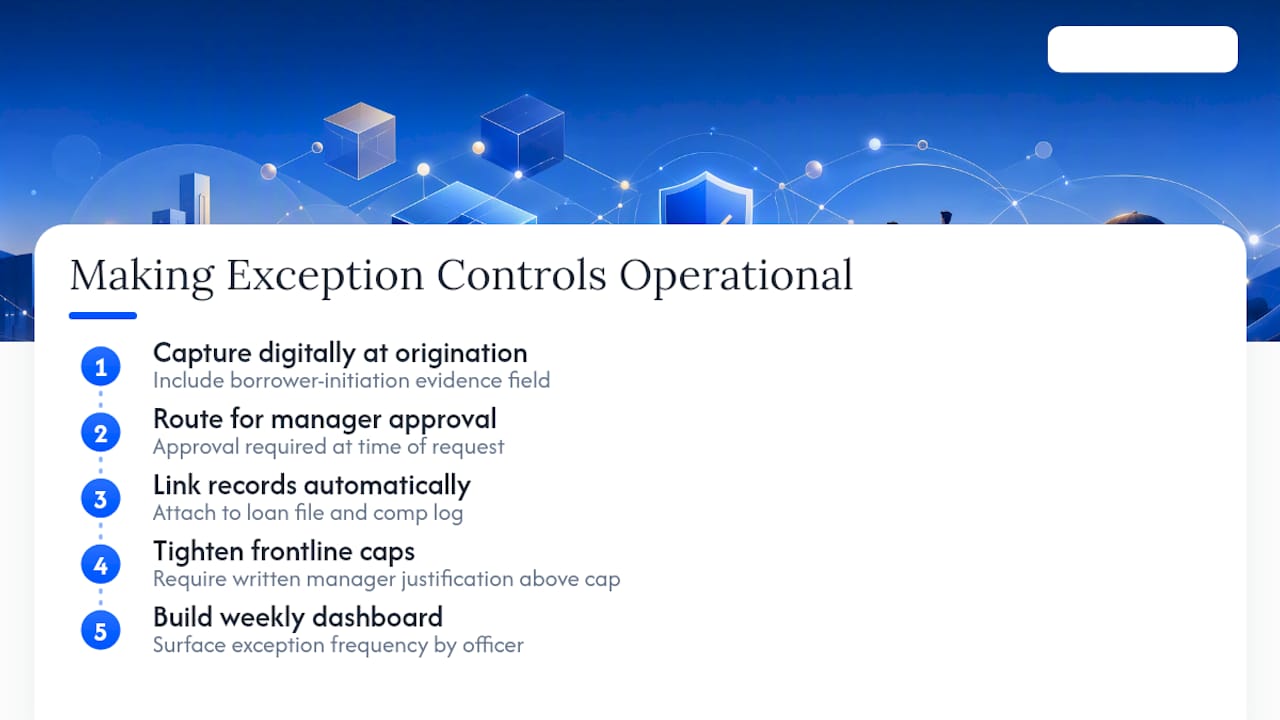
Most exception programs fail not because the policy is wrong, but because it lives in a document nobody checks against actual loan files without an automated AML/CTF compliance workflow to ensure timely and proper documentation. The fix is structural, not cultural.
Capture the exception request digitally, at origination, with a required field for borrower-initiation evidence and a routed manager approval. That single change closes the timing gap examiners flag most often. Link the exception record automatically to the loan file and to the originating officer's compensation log, so nobody can classify a discretionary discount as something else after the fact. Then keep frontline caps tight, require written manager justification for anything above that cap, and build a weekly dashboard that surfaces exception frequency by officer before it becomes a quarterly surprise.
Balancing Commercial Pressure and Compliance
Pricing exceptions exist because mortgage lending is genuinely competitive, and pretending otherwise helps nobody. Loan officers who cannot match a serious competing offer lose deals, and that reality is not going away. The mistake is treating exception management as a compliance checkbox instead of an operational discipline.
Culture matters less than measurable controls, and I would rather see a lender with a mediocre training program and airtight caps and monitoring than one with excellent training and no numbers to check it against. When your own dashboards show a disparity, act on it before an examiner finds it for you.
— Omar Khamisa
Reducing Exception Risk With an Integrated Mortgage Platform
Most exception problems trace back to fragmentation: pricing lives in one system, approvals happen over email, and documentation sits in a folder nobody audits until an exam forces the issue. A mortgage software platform built by industry professionals can close that gap by unifying pricing, CRM, point-of-sale, loan origination, compliance, and document storage in one connected system, so an exception request, its approval, and its supporting documentation live in the same file instead of three disconnected systems.
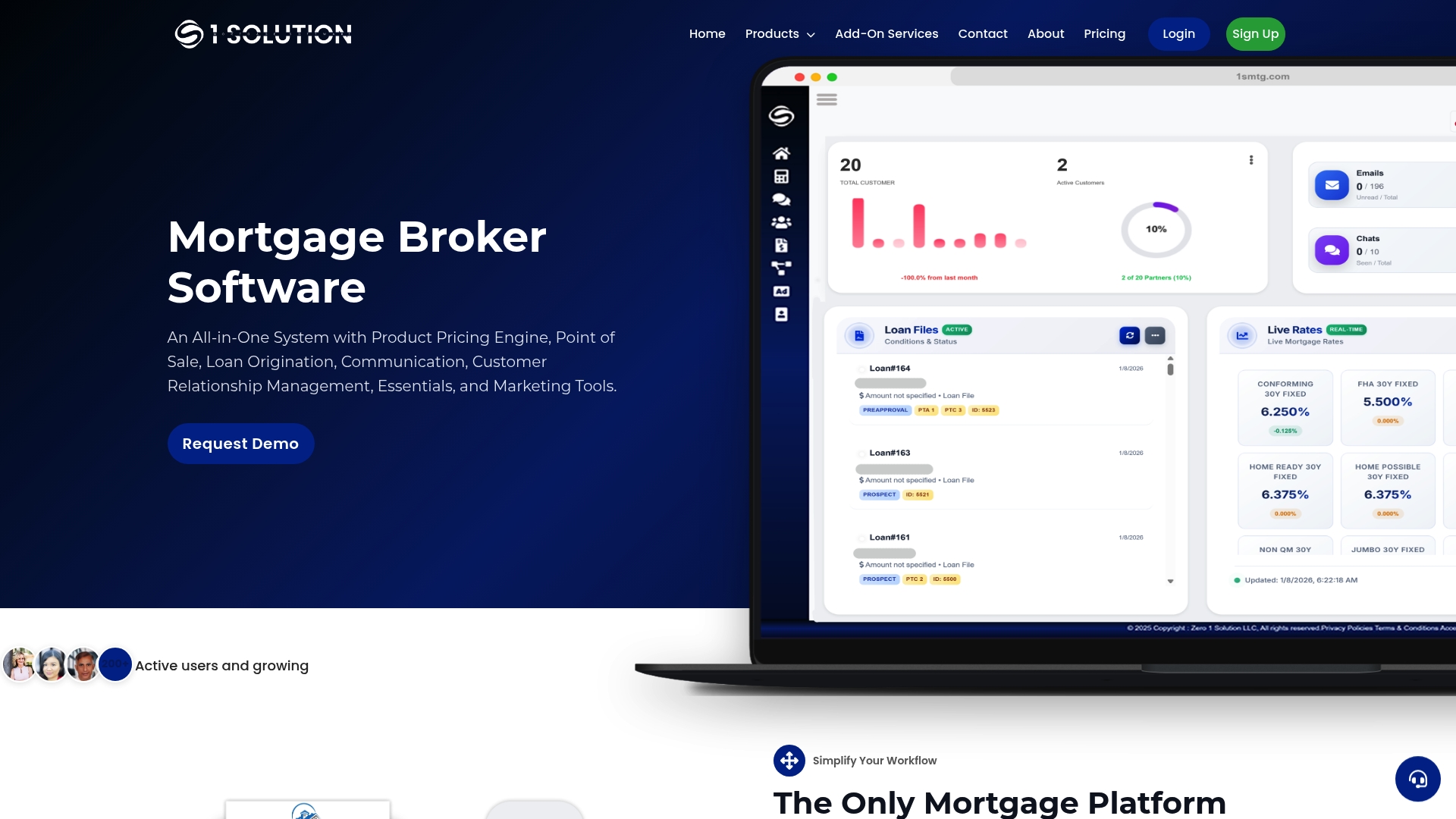
Because certain mortgage platforms are designed for independent brokers rather than banks, these systems focus on broker workflows: a pricing engine with built-in caps, digital exception request forms that capture who initiated the ask, and audit-ready logging tied to compensation records. That combination gives compliance teams a defensible trail without adding a separate system to manage. If your current setup can't show an examiner who approved last month's exceptions and why in under five minutes, it's worth reviewing what an integrated platform looks like, and worth pairing it with a clear internal compliance framework that governs how those tools get used. Current pricing details are available directly on the site.
Where to Verify the Rules on Loan Pricing Exceptions
For primary-source detail beyond this guide, start with CFPB supervisory highlights and the Equal Credit Opportunity Act and Regulation B, which set the statutory basis for exam testing. FFIEC and OCC fair-lending examination manuals lay out the procedures examiners actually follow, and trade press coverage like HousingWire's reporting on pricing exceptions tracks how enforcement priorities shift year to year.
Sources
- Pricing exceptions are widespread in mortgage — and so are the regulatory risks
- CFPB supervisory highlights (example repository)
- FFIEC Interagency Fair Lending Examination Procedures
- Comptroller's Handbook: Fair Lending
FAQ
What Does a Price Exception Mean in Mortgage Lending?
A price exception is any deviation from a lender's published rate sheet, such as a rate buydown, lender credit, or fee waiver, granted to a specific borrower rather than applied through the standard pricing engine.
What Is the $100,000 Loophole for Family Loans?
That figure refers to a federal tax provision letting individuals lend to a family member without triggering imputed-interest rules on below-market loans; it is a tax concept, not a mortgage pricing exception rule, and does not apply to broker or lender pricing exceptions covered here.
What Does Loan Pricing Mean?
Loan pricing is the process of setting a borrower's interest rate and fees based on factors like credit profile, loan-to-value ratio, loan type, and market conditions, typically generated through a product and pricing engine before any exception is applied.
What Is the 3-7-3 Rule for a Mortgage?
The "3-7-3" rule refers to Truth in Lending Act timing requirements: lenders must provide a Loan Estimate within a few business days of application, wait a specified period before closing on a first disclosure, and redisclose just before closing if terms change materially; it is a disclosure timing rule, not a pricing exception rule.
How Common Are Loan Pricing Exceptions in the Mortgage Industry?
Pricing exceptions are widespread across retail mortgage lending, with many lenders permitting 50 to 100 basis points of frontline discretion before a request must escalate for higher-level approval.