
Loan origination is the end-to-end process that begins the moment a borrower applies for credit and ends when funds are disbursed. It covers every step in between: pre-qualification, application, document collection, processing, underwriting, approval, and closing. Once the money moves, origination is done. What follows is loan servicing, which is a separate lifecycle phase entirely.
A few boundaries worth knowing upfront:
- Origination ends at funding. Servicing, which covers payment collection, escrow management, and account maintenance, begins after disbursal.
- Regulatory oversight applies throughout. Title XIV of the Dodd-Frank Act and FDIC expectations shape the disclosures, verification steps, and fair-lending checks lenders must complete during origination.
- Technology matters. Platforms like 1 Solution Mortgage Software exist specifically to connect the origination workflow so brokers can manage every phase without switching between fragmented tools.
Table of Contents
- What does loan origination actually cover?
- How the loan origination process works, step by step
- Who does what: loan originator roles explained
- Loan origination versus underwriting: what's the difference?
- What origination fees actually cost you
- How long does loan origination take?
- Why loan applications get denied and how to avoid it
- How integrated technology changes origination outcomes
- Key Takeaways
- A practitioner's perspective on what actually slows origination down
- Useful sources and further reading
What does loan origination actually cover?
The standard definition captures the mechanics, but the scope is worth spelling out. Loan origination is the full acquisition and risk-management workflow a lender runs before committing capital: finding the borrower, verifying their identity and repayment capacity, assessing the collateral, and producing a compliant credit decision. It is not just the application form.
What origination includes:
- Pre-qualification and pre-approval
- Formal loan application submission
- Document collection and verification (income, assets, employment, property)
- Loan processing and file assembly
- Underwriting and credit decisioning
- Closing and fund disbursal
What origination does not include:
- Post-closing payment collection
- Escrow account management
- Loan modifications or forbearance after funding
- Secondary-market servicing tasks
The regulatory layer is real and consequential. FDIC oversight and fair-lending rules require lenders to document their verification steps, provide standardized disclosures, and run compliance checks at multiple points in the workflow. For brokers, that means mortgage regulatory compliance is not a back-office concern. It is woven into every stage of origination.
How the loan origination process works, step by step
Understanding the sequence helps borrowers prepare and helps originators set accurate expectations. Here is how a standard mortgage origination moves from inquiry to funding.
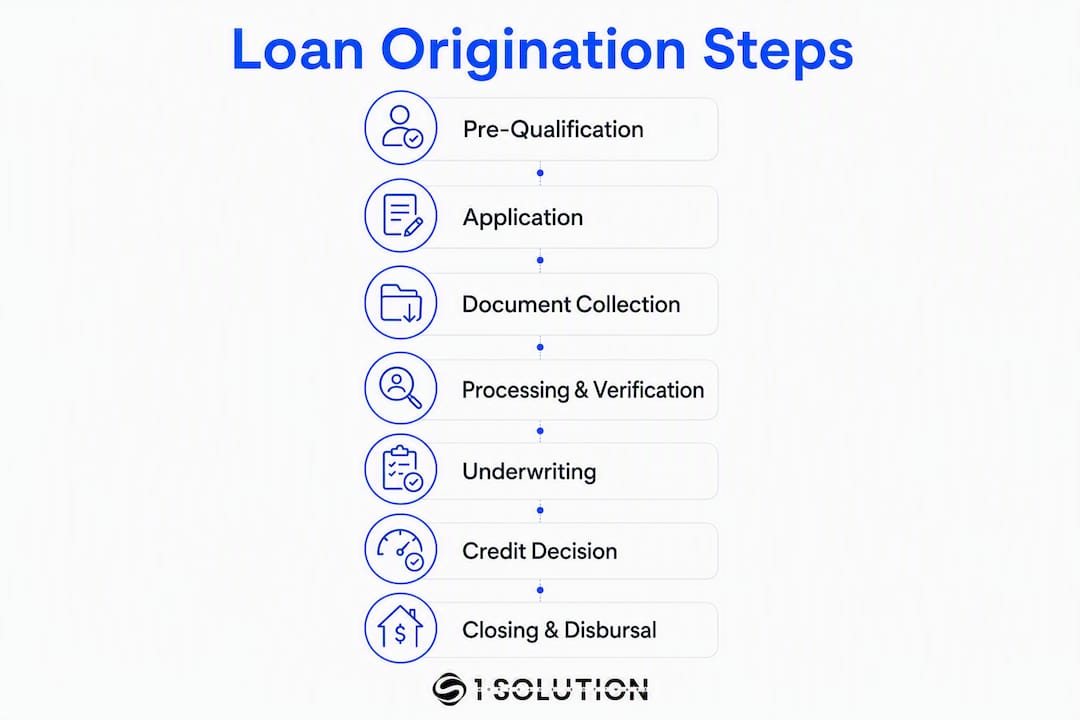
1. Pre-qualification / pre-approval The borrower provides basic financial information: income, assets, debts, and credit range. The loan officer gives a preliminary assessment of borrowing capacity. Pre-approval goes further, with a formal credit pull and conditional commitment. Owner: loan officer. Documents: pay stubs, bank statements, government-issued ID.

2. Formal application submission The borrower completes a Uniform Residential Loan Application (Form 1003). This locks in the loan amount, property address, and loan type. Owner: borrower and loan officer. Documents: completed 1003, Social Security number, employment history.
3. Document collection The processor requests and organizes the full file. Standard documents include W-2s, two years of federal tax returns, 30 days of pay stubs, two months of bank statements, and a signed purchase agreement for purchase loans. Owner: processor. Documents: all of the above plus gift letters, divorce decrees, or business returns where applicable.
4. Processing and verification The processor verifies every data point: income against tax transcripts, employment via Verification of Employment (VOE), assets against bank statements, and property via a third-party appraisal. Lenders verify identity and repayment ability before any credit decision is made. Owner: processor, third-party appraisers.

5. Underwriting The underwriter reviews the complete file against the lender's guidelines and investor requirements. They assess credit score, debt-to-income ratio (DTI), loan-to-value ratio (LTV), and property condition. Automated underwriting systems can return a decision in minutes for clean files; complex files go to manual review. Owner: underwriter.
6. Credit decision The underwriter issues one of three outcomes: approved, approved with conditions (the most common), or denied. Conditions typically require additional documentation before a clear-to-close is issued. Owner: underwriter, loan officer.
7. Closing and disbursal The borrower signs final loan documents, pays closing costs, and the lender funds the loan. Title transfers (for purchase loans), and the origination phase is complete. Owner: closing agent, title company, lender. Documents: Closing Disclosure, promissory note, deed of trust.
Pro Tip: Gather all documents before you apply. Incomplete files are the single biggest cause of underwriting delays. A complete mortgage file submission from day one can cut weeks off your timeline.
Who does what: loan originator roles explained
The term "loan originator" gets used loosely, which creates real confusion about who to call and when. Here is how the roles actually break down.
- Mortgage broker: — An independent originator who works on behalf of the borrower, shopping multiple lenders to find the best fit. Brokers do not fund loans themselves.
- Loan servicer: Takes over after funding. The servicer collects payments, manages escrow, and handles account issues. Originators and servicers are distinct roles; confusing them leads borrowers to contact the wrong party after closing.
When a broker acts as originator, they represent the borrower's interests in finding the right product. When a loan officer originates, they represent the lender. That distinction matters for rate negotiation and product access. For a deeper look at the competencies each role requires, the mortgage origination training overview covers what licensed originators are expected to know.
Loan origination versus underwriting: what's the difference?
Origination is the whole process. Underwriting is one phase within it. That distinction gets blurred constantly, so here is a direct comparison.
| Dimension | Loan Origination | Underwriting |
|---|---|---|
| Scope | Full lifecycle: application to disbursal | Risk assessment and credit decision only |
| Timing | Begins at borrower inquiry; ends at funding | Occurs after processing; before closing |
| Primary goal | Acquire, verify, and fund the loan | Determine whether the risk meets guidelines |
| Owner | Loan officer, processor, underwriter, closer | Underwriter (with processor support) |
| Borrower contact | High (loan officer, broker) | None (file-based review) |
Two scenarios that show the difference clearly:
-
Scenario A (clean file): A W-2 borrower with a 760 credit score and 28% DTI submits a complete file. The automated underwriting system (Fannie Mae's Desktop Underwriter or Freddie Mac's Loan Product Advisor) returns an "Approve/Eligible" finding in minutes. The underwriter confirms conditions, issues a clear-to-close, and the loan funds within days. Origination was fast because underwriting was straightforward.
-
Scenario B (manual review): A self-employed borrower with variable income and a recent large bank deposit triggers manual underwriting. The underwriter requests 24 months of business returns, a letter of explanation for the deposit, and a year-to-date profit-and-loss statement. Each round of conditions adds days. Origination stretches because underwriting requires judgment, not just data matching.
Underwriting decisions directly control the origination timeline. A conditional approval with five outstanding items can add two to three weeks to closing if the borrower is slow to respond.
What origination fees actually cost you
Origination fees compensate the lender for the work of processing and funding the loan. They are charged as a percentage of the loan amount, and typical origination fees are charged as a percentage of the loan amount and often fall within a common range; though the exact amount varies by lender and loan type.
| Fee Type | Typical Range | Notes |
|---|---|---|
| Origination fee | 0.5%–1% of loan amount | Covers lender's processing work |
| Discount points | 1% of loan amount per point | Paid to buy down the interest rate |
| Appraisal fee | $300 | Third-party; not negotiable with lender |
| Credit report fee | $30 | Pulled at application |
| Title and settlement | Varies by state | Third-party; shop separately |
Example calculation: On a $300,000 mortgage, a 1% origination fee equals $3,000 paid at closing. One discount point on the same loan also costs $3,000 and typically reduces the interest rate by roughly 0.25%. Whether buying points makes sense depends on how long you plan to hold the loan.
A few practical points on fees:
- The Loan Estimate (required by the CFPB within three business days of application) itemizes every origination charge. Review it carefully.
- Final mortgage costs cannot increase beyond tolerance limits set by federal rules. If numbers jump between the Loan Estimate and the Closing Disclosure, ask for an explanation.
- Some lenders allow origination fees to be rolled into the loan balance, which reduces upfront cash but increases the amount you finance.
- Origination fees are negotiable on some loan products, particularly when you have strong credit or are bringing a large down payment.
How long does loan origination take?
Timeline estimates vary by loan type, lender capacity, and market conditions. For conventional purchase mortgages, closing typically takes several weeks from application to funding. Refinances can move faster when the property and borrower file are straightforward. Government-backed loans (FHA, VA, USDA) often run slightly longer due to additional documentation and appraisal requirements.
The factors that stretch timelines most:
- Incomplete documentation at application. Missing a single tax transcript can pause underwriting for days.
- Appraisal scheduling. In high-volume markets, appraisers are backlogged. Order the appraisal as early as possible.
- Underwriting complexity. Self-employment, multiple income sources, recent credit events, or unusual property types all require manual review.
- Title issues. Liens, ownership disputes, or missing chain-of-title documents can delay closing by weeks.
- Borrower response time. Underwriters issue conditions; borrowers who respond within 24 hours keep the file moving.
Fragmented workflows are the hidden timeline killer. When documents live in email threads, task ownership is unclear, and status updates require manual follow-up, days disappear without progress. Integrated systems that route tasks automatically and store documents in a single location cut that waste directly.
For borrowers, the highest-impact actions are simple: submit a complete file on day one, respond to conditions the same day you receive them, and agree to e-signature and digital verification wherever the lender offers it.
Why loan applications get denied and how to avoid it
Denial is not random. Most applications fail for predictable, preventable reasons.
- Insufficient income or high DTI. Most conventional loans require a DTI at or below a typical maximum threshold. Fix: pay down revolving debt before applying, or apply for a lower loan amount.
- Low credit score. Conventional loans typically require a minimum credit score commonly required by many lenders; FHA allows lower, but with trade-offs. Fix: dispute errors on your credit report, pay down balances, and avoid new credit inquiries for 6 months before applying.
- Unverifiable employment. Gaps in employment history or recent job changes raise flags. Fix: document any gaps with a letter of explanation and supporting evidence.
- Undisclosed debts. A new car loan or credit card opened after application can change your DTI and trigger a denial at closing. Fix: make no new credit moves from application through funding.
- Property appraisal problems. If the appraised value comes in below the purchase price, the lender will not fund the full amount. Fix: negotiate the purchase price down, increase your down payment, or challenge the appraisal with comparable sales data.
- Incomplete documentation. Missing pages, unsigned forms, or outdated bank statements stall the file. Fix: provide complete, current documents and number every page.
- Title defects. Unresolved liens or ownership issues on the property block closing. Fix: order a preliminary title search early in the process.
If your application is denied, the lender is required to provide an adverse action notice explaining the reasons. Use that notice to address the specific issues before reapplying. Waiting 6–12 months to rebuild credit or reduce debt is often the right move. A mortgage broker can also help you identify lenders whose guidelines better match your profile.
Pro Tip: Before you apply, pull your own credit report at AnnualCreditReport.com and review it for errors. Disputing inaccuracies costs nothing and can move your score meaningfully in 30–60 days.
How integrated technology changes origination outcomes
The operational reality of loan origination is that most delays are not caused by borrower problems. They are caused by fragmented workflows: missing documentation, unclear task ownership, and outdated information moving between disconnected systems. That is the problem integrated technology solves.
Eliminating data silos by integrating CRM, POS, and LOS significantly reduces time-to-close and improves borrower transparency. Top originators use technology not only to speed processing but to proactively communicate status updates, which reduces abandoned applications and improves borrower satisfaction.
When a borrower submits documents through a connected POS portal, those documents flow directly into the LOS without manual re-entry. When the processor completes a task, the next task routes automatically to the underwriter. When the underwriter issues a condition, the borrower gets an automated status update. Every handoff that used to require an email chain or a phone call happens in the background.
Concrete process improvements that reduce time-to-close:
- Structured task routing: Each stage of origination has a defined owner and a trigger that moves the file forward automatically.
- Unified document storage: All borrower documents live in one place, accessible to every team member with the right permissions. No more "I didn't get that file" delays.
- Automated verification pulls: Credit reports, employment verifications, and tax transcripts pulled directly into the LOS eliminate manual data entry errors.
- Borrower-facing status updates: Automated notifications keep borrowers informed without requiring the loan officer to make individual calls.
The LOS capabilities guide covers what a modern loan origination system should do for independent brokers specifically. For a broader look at how workflow design affects throughput, the mortgage office workflow guide walks through how to restructure origination tasks to cut bottlenecks.
1 Solution Mortgage Software was built from the ground up to connect these pieces. The platform combines LOS, CRM, POS, compliance, and communication tools in one place, designed specifically for independent mortgage professionals who cannot afford the inefficiencies that come with fragmented systems.
Pro Tip: If your team is still routing files by email, calculate how many hours per file go to status updates and document chasing. That number, multiplied across your monthly volume, is the cost of not having an integrated platform.
Key Takeaways
Loan origination is the complete process from borrower application to fund disbursal, and understanding each phase gives borrowers and originators a real advantage in managing timelines, costs, and approval odds.
| Point | Details |
|---|---|
| Origination ends at funding | Servicing is a separate phase that begins after disbursal; contact your servicer for post-closing issues. |
| Seven steps, clear owners | Pre-qualification through closing each has a defined owner; knowing who does what prevents confusion and delays. |
| Fees typically represent a percentage of the loan amount, usually ranging from 0.5% to 1% for most loans | On a $300,000 loan, a 0.5%–1% origination fee means $1,500–$3,000; review the Loan Estimate within three days of application. |
| Complete files close faster | Incomplete documentation is the leading cause of underwriting delays; submit everything on day one. |
| Integrated tech cuts time-to-close | Connecting LOS, POS, and CRM eliminates manual handoffs and reduces the delays that fragment workflows create. |
A practitioner's perspective on what actually slows origination down
Most origination problems are not credit problems. They are handoff problems. A file stalls not because the borrower is unqualified but because a document sat in someone's inbox for three days, or because the processor and underwriter were working from different versions of the same bank statement. That kind of friction compounds across every file, every month.
The fix is not more staff. It is cleaner systems. When every team member works from the same file, with clear task ownership and automated triggers, the file moves because the process moves it, not because someone remembered to follow up. That is what we built 1 Solution Mortgage Software to do: give independent brokers the same operational control that large lenders have, without the enterprise price tag or the investor agenda.
If you want to see how an integrated platform handles origination from application to close, explore 1 Solution Mortgage Software and what it was built to solve.
Useful sources and further reading
These are the authoritative references used throughout this article, plus vetted resources for borrowers and professionals who want to go deeper.
- CFPB: What are mortgage origination services and what is an origination fee? The Consumer Financial Protection Bureau's plain-language explanation of origination services and how fees are disclosed.
- CFPB: Can my final mortgage costs increase from the Loan Estimate? Explains tolerance limits on fee changes between the Loan Estimate and Closing Disclosure.
- Investopedia: Origination — Definition in Finance, Loan Process, and Requirements Detailed definition of origination, fee structures, and regulatory context.
- LoanPro: Understanding loan origination and how to improve efficiency and compliance Practitioner-focused glossary entry covering verification goals and process variation across creditors.
- Wikipedia: Loan origination Broad overview of origination mechanics, including the originator-servicer distinction and automated vs. manual underwriting.
- Marketopia: Loan Origination — Step-by-Step Process, Types and Technology Guide Technology-focused walkthrough of origination stages and how integrated workflows improve borrower experience.
- Platinum Capital Advisors: What Is Loan Origination? A Clear Guide for Borrowers A borrower-facing explainer on origination steps from a mortgage advisory perspective.
- 1 Solution Mortgage Software: Loan Origination System (LOS) — A 2026 Broker's Guide Covers LOS capabilities and how independent brokers can use integrated technology to manage origination end-to-end.
This article is general information, not legal or financial advice. Loan requirements, fees, and timelines vary by lender, loan type, and market conditions. Confirm current rules and disclosures with your lender or a licensed mortgage professional.