

Centralize your margins and rule sets as a single source of truth, then wire that source directly into your LOS and lock desk. Success looks like this: every borrower quote, whether pulled from a POS, a loan officer's rate sheet, or an LOS screen, traces back to the same rule logic and margin table, with a version history behind it. Get three things right first: rule configuration, integration mapping, and a testing plan that catches drift before it hits production.
TL;DR:
- Centralizing the margin and rule tables with a designated owner significantly reduces rate inaccuracies caused by stale data or ad-hoc overrides.
- Proper mapping of investor feeds and testing rule sets in staging environments prevent errors and ensure alignment before going live.
- Integrating pricing logic through middleware and avoiding direct LOS-to-investor API calls safeguard against field mismatches and latency issues.
- Regular reconciliation, scenario testing against historical data, and formal sign-offs are essential to maintain pricing accuracy and compliance.
- Assigning clear ownership for margin management, API credentials, and lock desk policies helps prevent drift and ensures ongoing governance.
Table of Contents
- How Do You Set Up a Mortgage Pricing Engine?
- What Are the Core Components of a Pricing Engine?
- How Do You Integrate a Pricing Engine With Your LOS?
- How Do You Test a Mortgage Pricing Engine Before Launch?
- Who Should Own Pricing Engine Governance?
- What Do Experienced Operators Get Wrong About Pricing Setup?
- LOS-Native Pricing or a Standalone Engine?
- Get Your Pricing Engine Running Without the Integration Headache
- Sources
- FAQ
How Do You Set Up a Mortgage Pricing Engine?
A working configuration doesn't happen by flipping one switch. It happens in a sequence, and skipping steps is where most brokers introduce the errors that surface three weeks later as an angry loan officer asking why the rate sheet doesn't match what the borrower was quoted.
Here's the order that actually holds up:
- Map your investor feeds first. Confirm which investors deliver rate sheets on what schedule, and set ingestion timing that matches your busiest origination hours, not limited to once a day
- Centralize margin and markup tables. One location, one owner, no spreadsheet copies floating around branch offices. BankingBridge's setup notes flag stale margins as a leading cause of rate inaccuracies once data starts flowing to partner embeds.
- Build initial rule sets in staging before production. Test loan-level scenarios there and require a sign-off step before any rule set goes live.
- Define lock desk workflows. Set worst-case pricing rules and relock policies now, not after the first borrower disputes a lock extension fee.
- Assign API credential ownership. Someone specific owns scopes, rotation schedules, and who gets access.
Pro Tip: Assign a single named owner to the margin table before you configure a single rule. Committees don't catch pricing errors. One accountable person does.
What Are the Core Components of a Pricing Engine?
Five components decide whether your pricing is accurate, auditable, and fast enough to trust. Misconfigure any one of them and the symptoms show up as revenue leakage or borrower complaints, usually both.
- Rules engine. This is where eligibility filters live: loan-to-value bands, FICO tiers, occupancy type, property type, state licensing restrictions. Real example: a 680 FICO, 80% LTV, non-owner-occupied condo in a state with extra investor overlays needs a rule stack that checks four conditions before it returns a single price.
- Margin management. Central tables should be the only path to a live margin change. Ad-hoc overrides at the branch or loan officer level are the number one source of inconsistent quotes, and they're nearly impossible to audit after the fact.
- Version control and historical pricing. Every rate change needs a timestamp and an author. Quantaprice's pricing engine documentation describes modeling this as a pricelist hierarchy with rule-based derivation, so a change to a base price propagates automatically instead of requiring manual updates across a dozen rule variants.
- Best-execution logic. Define a clear priority order across investors and products, plus fallback rules for when a preferred investor's feed is delayed or unavailable.
Centralizing it is the single highest-leverage fix available to a pricing team.
How Do You Integrate a Pricing Engine With Your LOS?
Integration is where clean pricing logic either survives contact with your loan origination system or gets corrupted by field mismatches and latency. The pattern that consistently works separates pricing logic from the LOS itself.
- Map pricing fields explicitly in the LOS, don't rely on default field matching. Loan program codes, lock periods, and rate lock dates need one-to-one field mapping, verified manually at least once.
- Use a middleware or BFF (backend-for-frontend) layer between your LOS and external pricing services. Emporix's developer documentation shows this pattern clearly: an
enableExternalPricesconfiguration paired with a scoped API key lets a middle layer supply pricing without the LOS needing direct knowledge of every investor feed. - Scope API credentials narrowly and rotate them on a fixed schedule, not "when someone remembers."
- Cache selectively. Fabric's real-time pricing documentation notes that cached pricing delivers the low latency borrowers expect at point of sale, but it requires event-driven invalidation when investor feeds update intraday. A stale cache during a rate move is worse than a slightly slower live query. This kind of pricing engine integration pattern is worth studying before you commit to an architecture.
Pro Tip: Never let your LOS call an investor API directly. Route everything through middleware so you can swap a pricing provider without touching LOS configuration.
How Do You Test a Mortgage Pricing Engine Before Launch?
A pricing engine that hasn't been stress-tested against real historical data is a liability wearing a demo-ready interface. The test plan needs to prove accuracy, not just confirm the software boots.
- Build a scenario library. Cover common loan-level combinations (FICO tiers, LTV bands, property types) as unit tests against your rules engine.
- Run regression against historical pricing days, especially volatile rate weeks, to confirm worst-case pricing logic holds. Quantaprice and similar platforms retain effective-dated pricing and changelogs specifically so teams can reconstruct exactly what a rate sheet looked like on a given day and re-run scenarios against it.
- Automate daily reconciliation. Compare quotes generated across your POS, LOS, and any partner embed. Set alerts for any divergence above your tolerance threshold, checked daily rather than discovered by a borrower complaint.
- Require formal sign-off from both pricing and compliance before any rule set moves to production, with a documented go/no-go checklist.
Teams that skip step three are the ones who find out about a margin discrepancy from an unhappy borrower instead of a dashboard alert.
Who Should Own Pricing Engine Governance?
Pricing accuracy degrades quietly when ownership is fuzzy. A clear role matrix prevents the slow drift that turns into a compliance headache six months later.
- Pricing owner: approves margin changes and maintains the central margin table.
- Integration owner: manages API credentials, scope changes, and feed health monitoring.
- Lock desk owner: manages relock policy, worst-case pricing rules, and extension fee logic.
- Compliance reviewer: signs off on rule set changes before production release.
Set fixed change windows, ideally outside peak origination hours, and keep audit logs with a defined retention period so any past quote can be reconstructed. Schedule a recurring cadence, monthly at minimum, to review investor list accuracy, margin currency, and feed uptime. Treat this like a maintenance contract, not a one-time launch task.
What Do Experienced Operators Get Wrong About Pricing Setup?
Omar Khamisa built 1 Solution Mortgage Software after two decades working mortgage operations as a processor, underwriter, originator, and systems consultant, which means he's seen the same setup mistakes repeat across brokerages of every size. The most common one: teams treat margin tables as a launch task instead of an ongoing discipline, so a correct configuration on day one drifts within a quarter. The second: entry-level vendor credentials sometimes lack full investor visibility or write access, and brokers don't discover the gap until a rate feed silently stops updating. Fix both by assigning named owners and auditing access tiers before go-live, not after.
— Omar Khamisa
LOS-Native Pricing or a Standalone Engine?
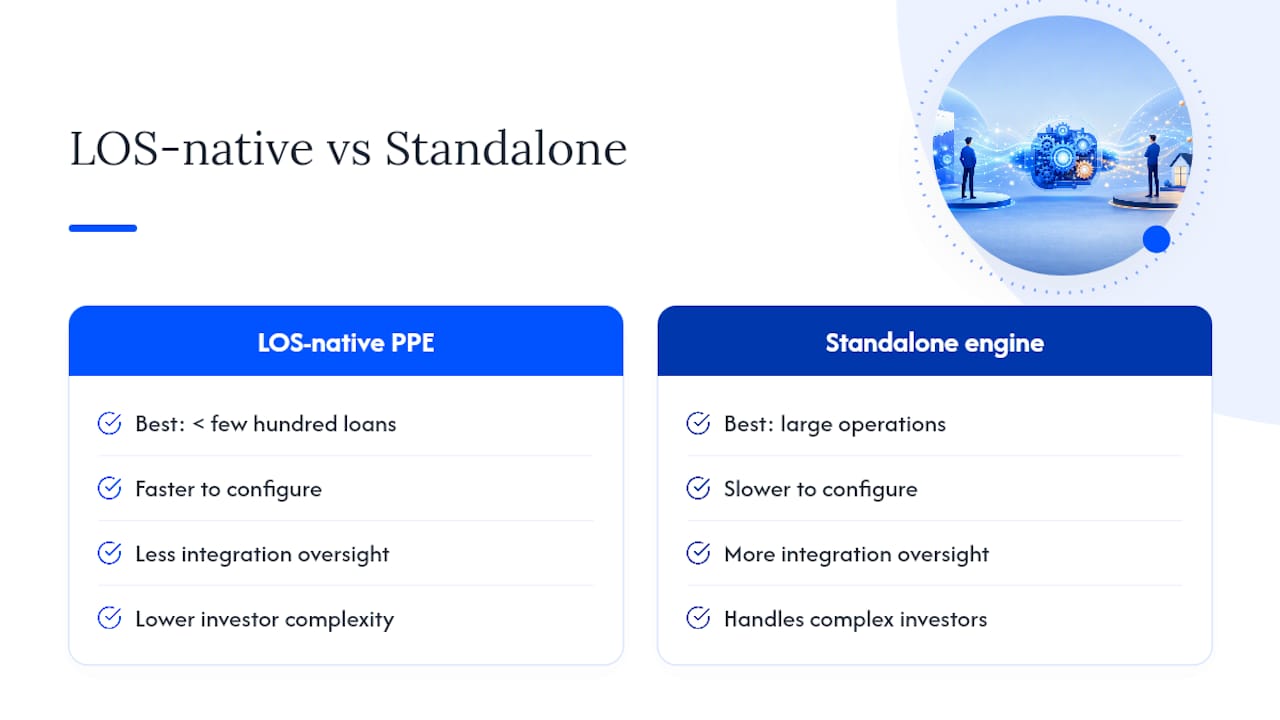
Smaller teams with under a few hundred monthly loans usually do better with an LOS-native PPE. It's faster to configure and needs less integration oversight. Larger operations with complex investor relationships and multiple channels benefit from a standalone engine with more rule flexibility. Before choosing either, confirm your team has a named owner ready for margin governance. Without that, the tool doesn't matter.
Get Your Pricing Engine Running Without the Integration Headache
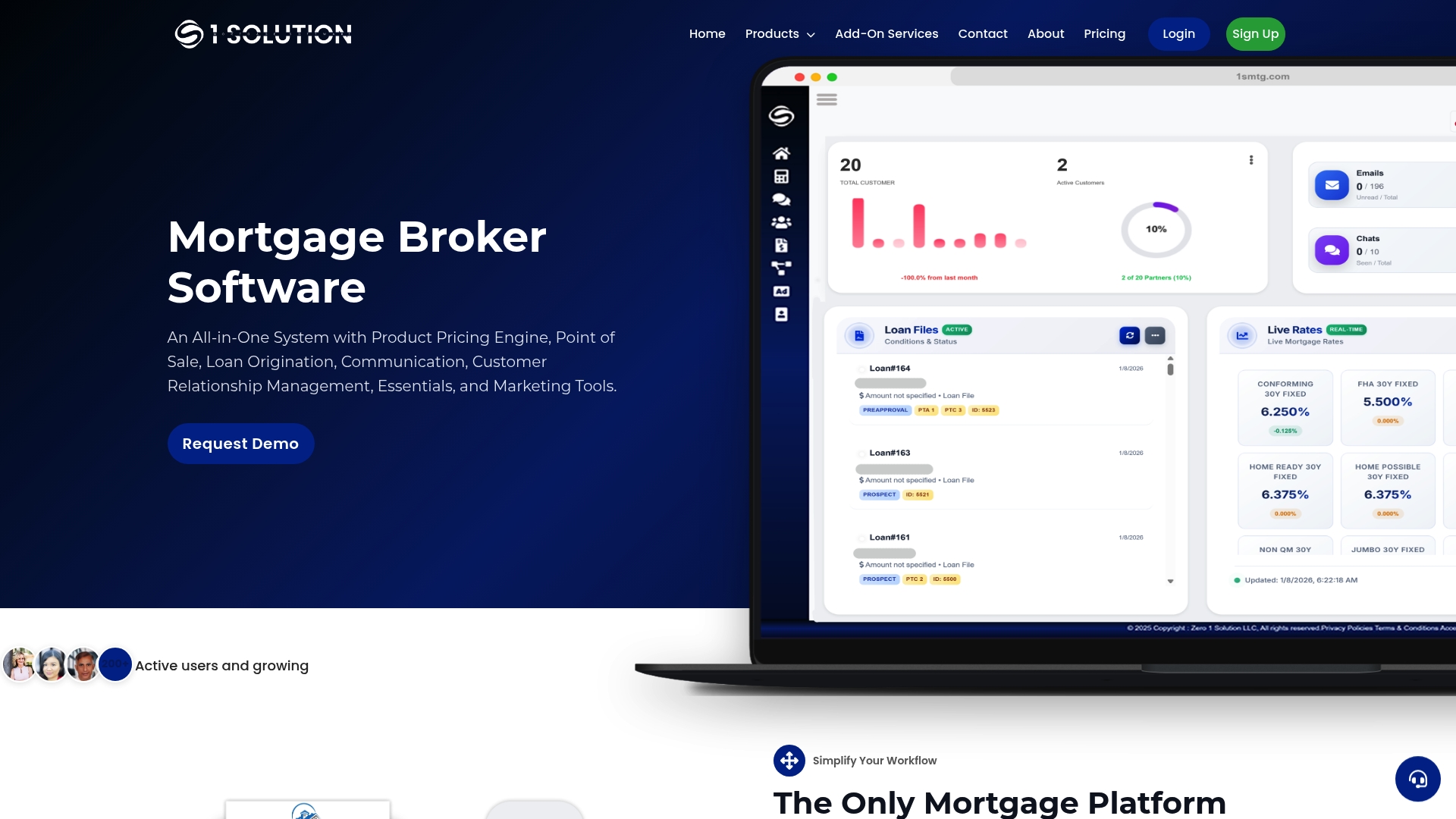
Most of the checklist above (centralized margins, rule staging, lock desk automation, LOS field mapping) is exactly what a connected mortgage platform can handle in one system instead of stitching together across separate vendors. Users get a product pricing engine tied directly into LOS, POS, and CRM tools, so margin changes and rule updates don't require juggling three different systems and hoping the field mappings held.
When you sit in a vendor demo, ask pointed questions: who owns the margin table, how are rule set changes staged before release, what does the audit trail look like six months later, and how are relock and worst-case pricing handled at the lock desk. Those answers separate a platform built for brokers from one bolted on as an afterthought. If you're evaluating your options for a mortgage pricing engine setup that connects pricing, LOS, and lock desk workflows without three separate vendor contracts, schedule a demo and walk through your actual investor list and margin structure with the team.
Sources
For implementers wiring up external pricing services, these developer docs show the actual configuration patterns referenced above:
- Emporix developer documentation — external pricing and products
- Fabric developer docs — Real-time Pricing Engine
- Quantaprice — Pricing engine overview and API patterns
FAQ
What Are the Top Mortgage Pricing Engines?
The market includes a mix of standalone product pricing engines and LOS-native modules, ranging from marketplace-style rate comparison tools to fully integrated platforms like 1 Solution Mortgage Software that combine pricing with LOS, CRM, and POS in one system. The right fit depends on your loan volume and how much rule flexibility your investor mix requires.
What Is the 3-7-3 Rule for a Mortgage?
The 3-7-3 rule refers to timing requirements under the TILA-RESPA Integrated Disclosure framework: lenders must provide the Loan Estimate within three business days of application, wait the required period before closing, and issue a revised disclosure at least three days before closing if certain terms change.
How Much Commission Do Loan Officers Make on a $500,000 Loan?
Commission varies widely by shop and compensation plan, typically expressed as basis points on loan amount rather than a fixed dollar figure. Since pay structures differ by brokerage and state, check your specific compensation agreement rather than relying on a general industry average.
What Are the 3 C's in a Mortgage?
The 3 C's are Credit, Capacity, and Collateral: the borrower's credit history, their ability to repay based on income and debt, and the property's value backing the loan. Underwriters weigh all three together, and a pricing engine's rule logic often reflects these same factors through FICO tiers, debt-to-income filters, and LTV bands.
Does a Pricing Engine Replace Manual Rate Sheet Review?
No. A properly configured pricing engine automates rule application and margin math, but pricing and compliance owners still need to review rule set changes before release and reconcile quotes daily to catch drift early.