
Expect to pay roughly $500–$2,000/month for an independent broker platform, $2,000–$8,000/month for a small mortgage shop, $50,000–$200,000/year for a community bank or credit union, and $300,000–$1,000,000+/year at the enterprise level. Those are recurring licensing figures only. Add one-time implementation, data migration, integrations, and training, and your true first-year spend can be significantly higher than the headline subscription number. The right immediate move: request a bundled first-year total cost of ownership (TCO) from every vendor you're evaluating, then run a volume-based crossover calculation to determine whether a per-loan or subscription model saves you more money at your actual production pace.
Key cost categories to hold in your head from the start:
- Monthly or annual licensing (per-seat, per-loan, or flat subscription)
- One-time implementation and data migration (often $10,000–$75,000 for migration alone, per LOS Directory benchmarks)
- Per-loan transaction fees (typically $25–$150/loan, depending on the model)
- Third-party and integration costs (credit pulls, e-sign, core banking, investor delivery)
Freddie Mac's 2025 cost-to-originate study puts the average retail-only origination cost at approximately $11,800 per loan, with up to $1,700 in per-loan savings available to lenders who fully use digital capabilities. That context matters: the right platform isn't a cost center, it's a margin lever.
Key Takeaways
Mortgage software cost is almost always understated at the quote stage; first-year TCO including implementation, migration, and integrations routinely runs two to three times the headline subscription figure.
| Point | Details |
|---|---|
| Run crossover math first | Calculate the per-loan vs. flat subscription break-even at your slowest, average, and peak monthly volumes before comparing vendors. |
| Require all-in first-year TCO | Demand itemized quotes covering licensing, implementation phases, data migration, integrations, training, and parallel-run support. |
| Watch for annual escalators | Contract escalators of 3–7% per year compound significantly; negotiate a cap before signing. |
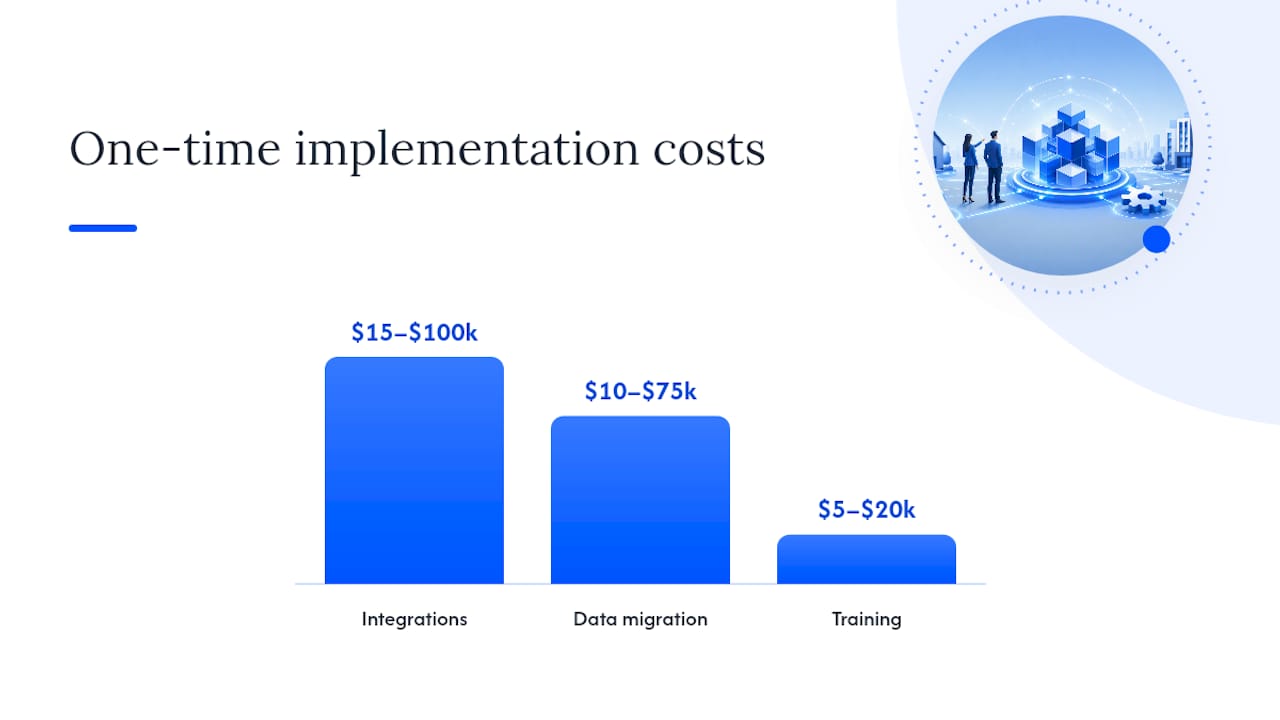
| Budget for migration and integrations | Data migration typically runs $10,000–$75,000; custom integrations run $15,000–$100,000 depending on complexity. |
| 1 Solution Mortgage Software | Built for independent brokers with transparent subscription pricing, no mandatory third-party licenses, and defined implementation deliverables. |
Table of Contents
- What are the main mortgage software pricing models?
- What does mortgage software cost by lender type?
- What actually drives mortgage software cost up?
- How do you calculate all-in TCO for mortgage software?
- What questions should you ask vendors before signing?
- What does a realistic implementation timeline look like?
- What lenders routinely miss when budgeting for LOS
- 1 Solution Mortgage Software: transparent pricing built for brokers
- Sources
What are the main mortgage software pricing models?
Vendors price loan origination software (LOS) and mortgage platforms in four primary structures. Understanding the math behind each one is the fastest way to avoid paying for a model that doesn't fit your production volume.
Per-seat (per-user) pricing charges a fixed monthly fee for each licensed user, regardless of how many loans that user closes. The LOS Directory documents typical per-seat rates of $200–$1,500/user/month. This model rewards high-volume teams because the per-loan cost drops as production rises. It punishes shops that carry licensed seats for part-time or seasonal staff who aren't closing loans every month.
Per-loan (per-transaction) pricing charges $25–$150 per funded or submitted loan. The appeal is obvious: you pay only when you produce. The risk is equally clear: in a high-volume month, your bill spikes. For a 200-loan/month operation at $75/loan, that's $15,000/month in transaction fees alone, which frequently exceeds what a flat subscription would cost.
Flat subscription pricing runs $500–$10,000+/month depending on institution size and feature set. Costs are predictable, which simplifies budgeting. The crossover point where flat beats per-loan is usually somewhere between 50 and 150 loans per month, depending on the per-loan rate you're quoted.
Hybrid pricing combines a base subscription with per-transaction fees. ABT's 2026 analysis identifies hybrid models as the most common structure for mid-market lenders with seasonal volume swings because the base fee covers fixed overhead while the variable component scales with production. Many enterprise platforms use this structure.
- Independent brokers closing fewer than 20 loans/month typically benefit from per-loan or low-tier flat subscriptions.
- Small shops at 30–80 loans/month usually find flat or hybrid pricing more predictable.
- Mid-market lenders at 100+ loans/month almost always save money under a negotiated flat or hybrid deal.
Pro Tip: When comparing models, don't model your average monthly volume. Model your slowest month and your peak month separately. A per-loan model that looks affordable at your average can become your most expensive month during a slow winter quarter when you're still paying for licensed seats but closing half the usual loans.
What does mortgage software cost by lender type?
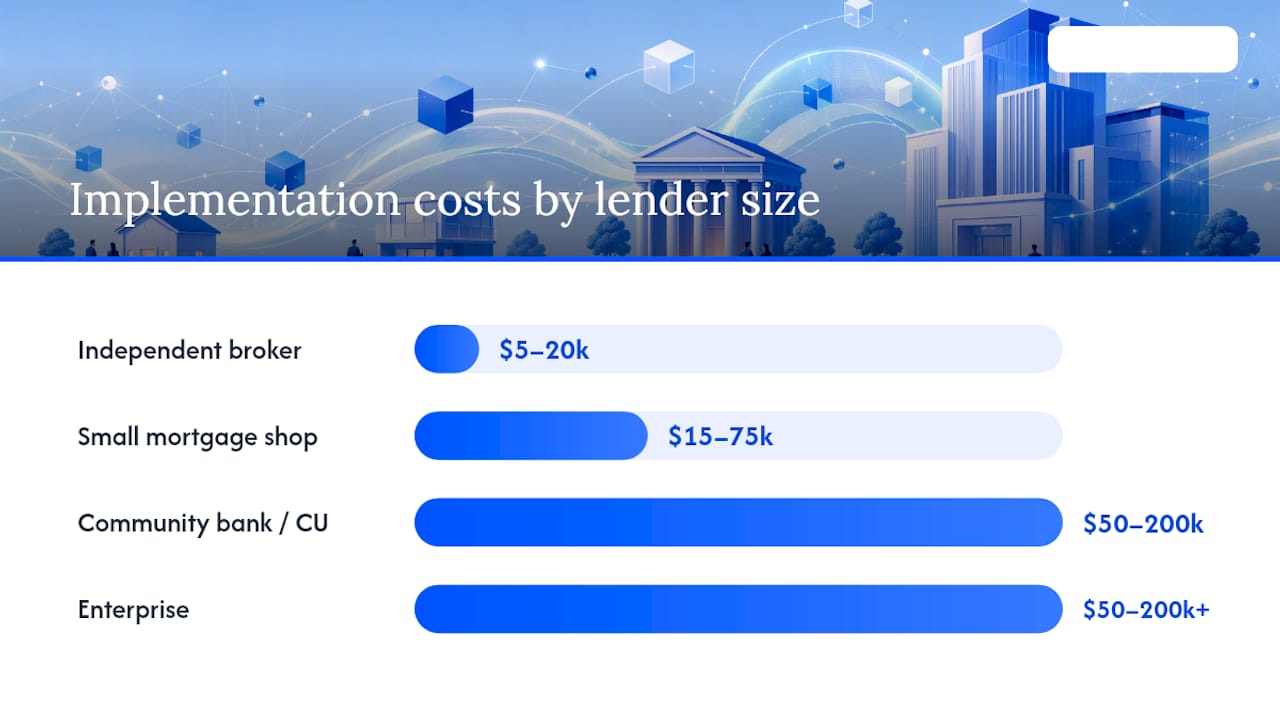
Realistic cost bands vary significantly by institution size, and most vendor quotes omit enough line items that the ranges below should be treated as floors, not ceilings. The figures draw from LOS Directory benchmarks and market data.
| Cost Component | Independent Broker | Small Mortgage Shop | Community Bank / Credit Union | Enterprise |
|---|---|---|---|---|
| Monthly/annual licensing | $500–$2,000/mo | $2,000–$8,000/mo | $50K–$200K/yr | $300K–$1M+/yr |
| Per-loan fees (range) | $25–$75/loan | $25–$100/loan | $50–$150/loan | Negotiated |
| One-time implementation/migration | $5,000–$20,000 | $15,000–$75,000 | $50,000–$200,000 | $50,000–$200,000+ |
A 50-loan/month independent broker on a flat subscription at $1,200/month pays $14,400/year in licensing. Add a $10,000 implementation and $5,000 in integrations, and first-year TCO lands near $29,400, or roughly $49 per loan originated.
A 200-loan/month mid-market shop on a hybrid model at $3,500/month base plus $40/loan pays $42,000/month at peak, but averages closer to $11,500/month when volume normalizes. First-year TCO including a $50,000 implementation and $25,000 in integrations runs approximately $213,000, or about $89 per loan.
Enterprise deals are a different category entirely. Platforms like Encompass typically combine per-seat subscription with per-loan transaction fees, with per-user rates of $500–$1,500/month and implementation costs frequently running $50,000–$200,000+, sometimes stretching to 12 months of project time. MeridianLink Mortgage often runs $50,000–$200,000/year for mid-size depositories, with bundled pricing available for institutions already using other MeridianLink products. Neither platform is designed with the independent broker in mind.
What actually drives mortgage software cost up?
The headline subscription number is rarely where the money goes. These are the line items that move TCO most significantly, and the ones vendors most often leave out of initial quotes.
Primary cost drivers:
- Seat licensing: Every licensed user adds to your monthly bill. Shops that over-provision seats for future growth pay for capacity they're not using.
- Per-loan transaction fees: At scale, these compound fast. A $50/loan fee on 150 loans/month is $7,500/month, or $90,000/year, before any other cost.
- Third-party services: Credit pulls, e-signature platforms, flood certifications, and automated valuation models (AVMs) are almost always billed separately. Budget $15–$50 per loan for these depending on your workflow.
- Integrations: Connecting to a core banking system, investor delivery channels, or a product pricing engine (PPE) typically runs $15,000–$100,000 in custom development, depending on complexity. Off-the-shelf connectors cost less; custom API work costs more.
- Data migration: Moving loan history, borrower records, and pipeline data from a legacy system typically runs $10,000–$75,000. Vendors who quote low on migration often scope it narrowly and bill overages.
- Training: Formal training for a team of 10–20 users can run $5,000–$20,000 depending on whether it's self-serve, live virtual, or on-site.
- Custom reports and compliance outputs: Regulatory reporting, HMDA data exports, and custom pipeline dashboards are frequently quoted as add-ons.
Hidden fees to watch for:
- Annual escalators: Many contracts include 3–7% annual price increases. Over a five-year term, that compounds into a material cost difference from year one.
- Mandatory maintenance fees: Some vendors charge 15–20% of the implementation cost annually as a "maintenance" line item.
- Required third-party licenses: Certain platforms require you to license a separate CRM, middleware layer, or document management tool to access full functionality. That cost belongs in your TCO.
- Per-document charges: Some platforms bill per document generated, per disclosure sent, or per e-sign envelope. These add up fast in a compliant origination workflow.
Vendors that separate "One-Time Setup" from "Monthly Platform Pricing" in their published pricing, as Nortridge does, make TCO modeling significantly easier. When a vendor bundles everything into a single opaque quote, that's your first signal to push for itemization.
Mitigation tactics: Negotiate per-loan fee caps in writing. Require itemized implementation quotes broken into named deliverables. Ask for escalator language in the contract before signing, not after.
How do you calculate all-in TCO for mortgage software?
A repeatable TCO model turns vendor quotes into comparable numbers. Here's the procedure, followed by a worked example.
- Collect every cost line item. Request the vendor's itemized quote covering: monthly licensing, per-loan fees, one-time implementation (broken into phases), data migration, integration development, training, and parallel-run support. If a vendor won't itemize, treat the gap as a risk.
- Define three volume scenarios. Use your slowest month, your average month, and your peak month. Calculate annualized cost for each scenario under both the vendor's model and an alternative model (e.g., flat vs. per-loan).
- Add one-time costs to year one only. Implementation, migration, and initial training are first-year expenses. Spread them across year-one loan volume to get a true per-loan cost for year one versus years two and beyond.
- Project years two through five. Apply the contract's escalator rate to licensing. Estimate volume growth. Recalculate per-loan cost annually to find where the model breaks down.
- Compare against the cost of not automating. Freddie Mac's data shows up to $1,700 in per-loan savings from full digital capability adoption. At 100 loans/month, that's $170,000/year in potential savings, a figure that should appear in your ROI case alongside the platform cost. Automation features that reduce per-loan labor time are where that savings actually materializes.
Worked example: three scenarios for a 75-loan/month broker
At 75 loans/month, the flat subscription (Scenario B) wins on first-year TCO by roughly $12,000 over the hybrid and $25,500 over pure per-loan. The crossover between per-loan and flat in this example sits at approximately 47 loans/month: below that, per-loan is cheaper; above it, flat wins.
Simple spreadsheet layout to copy:
- Row 1: Monthly licensing fee
- Row 2: Per-loan fee × average monthly volume
- Row 3: Monthly total (Row 1 + Row 2)
- Row 4: Annual licensing (Row 3 × 12)
- Row 5: One-time implementation cost
- Row 6: Data migration cost
- Row 7: Integration development cost
- Row 8: Training cost
- Row 9: Year-1 TCO (Row 4 + Rows 5–8)
- Row 10: Year-2 TCO (Row 4 × escalator rate)
ABT's 2026 analysis recommends modeling total first-year costs including implementation and parallel-run expenses specifically because the subscription headline number routinely understates what buyers actually spend in year one.
What questions should you ask vendors before signing?
A structured evaluation process prevents the most common procurement mistakes. Use this checklist before and during vendor demos.
Pre-demo internal preparation:
- Identify every internal stakeholder who needs a seat or integration: loan officers, processors, underwriters, compliance, IT, and secondary market.
- Audit your current data: loan history format, active pipeline records, document storage location, and integration dependencies.
- Assign an integration owner for each system the new platform must connect to (core banking, PPE, investor portals, credit bureaus).
- Confirm your compliance and security requirements: SOC 2 Type II, data residency, audit logging, and role-based access controls.
Questions to require in every vendor quote:
- What are the itemized implementation phases, and what deliverables mark each phase complete?
- What is the SLA for uptime, and what remedies apply if it's missed?
- Does the contract include annual price escalators? What is the cap?
- Are per-loan fees capped at any monthly maximum?
- What does custom reporting cost, and is it included in the base subscription?
- Which third-party licenses are required to access full functionality?
Red flags:
- A quote that bundles implementation into a single line item with no phase breakdown
- Mandatory long-term contracts (three or more years) with no performance milestones or exit provisions
- Required third-party licenses not disclosed until contract review
- Vague SLA language ("commercially reasonable efforts" instead of defined uptime percentages)
Negotiation levers: Per-loan fee caps, phased implementation payment tied to deliverables, training credits, and a 90-day performance review clause are all negotiable in most mid-market deals. Mortgage software rollout support commitments should be spelled out in the contract, not left to a verbal assurance during the sales process. For shops evaluating AI-powered lead response tools as add-ons, Astreaux AI's mortgage broker integration is worth including in your third-party cost modeling.
What does a realistic implementation timeline look like?
Most buyers underestimate how long implementation takes and how much internal time it consumes. Here's what a realistic phased timeline looks like for a small-to-mid-market mortgage operation.
Phased timeline:
- Discovery and scoping (weeks 1–3): Define requirements, map integrations, and confirm data migration scope. Internal time commitment: 10–20 hours from project manager, IT lead, and compliance officer.
- Configuration (weeks 3–8): Build out workflows, user roles, compliance rules, and document templates. Requires active participation from operations lead and at least two super-users.
- Integration development (weeks 6–14): Connect to core banking, credit bureaus, investor portals, and PPE. Timeline depends heavily on vendor API quality and your IT team's availability. Custom integrations can add four to eight weeks.
- Data migration (weeks 8–14): Extract, clean, transform, and load historical loan data. Data quality issues discovered mid-migration are the single most common cause of timeline slippage.
- Training (weeks 12–16): Role-specific training for loan officers, processors, and compliance staff. Budget 8–16 hours per user group.
- Parallel run (weeks 14–18): Run old and new systems simultaneously to validate output accuracy. This phase is frequently skipped to save time and almost always regretted.
- Go-live and stabilization (week 18+): Cutover with vendor support on standby. Expect two to four weeks of elevated support volume.
Common delay points and how to mitigate them:
- Data quality failures: Gate migration start on a completed data audit. Don't begin migration until source data is cleaned and mapped.
- Integration dependencies: Identify every integration owner in week one. A single unresponsive third-party vendor can stall the entire project.
- Stakeholder sign-offs: Build approval checkpoints into the project plan with named decision-makers and deadlines. Unsigned approvals are the second most common delay cause.
Enterprise platforms with hybrid pricing structures, like those referenced earlier, often require 6–12 months for full implementation. For independent brokers and small shops, a well-scoped project on a purpose-built platform can go live in 60–90 days. The difference is almost always scope clarity and data readiness, not platform complexity.
What lenders routinely miss when budgeting for LOS
The most expensive mistake I see in LOS procurement isn't choosing the wrong vendor. It's accepting a headline subscription quote and treating it as the budget.
Procurement teams consistently underestimate three things. First, training. Not the formal kickoff session, but the ongoing cost of getting a 15-person team to actually use the system the way it was designed. Adoption gaps translate directly into rework, compliance risk, and the slow erosion of the ROI case you built to justify the purchase. Second, parallel-run costs. Running two systems simultaneously for four to six weeks means double the licensing, double the data entry in some workflows, and real staff time that doesn't show up in any vendor quote. Third, integrations. Buyers routinely scope integrations as "connect to X" without specifying data flows, error handling, or reconciliation logic. That vagueness is where $15,000 integration estimates become $60,000 actuals.
The fix is straightforward but requires discipline: insist on an all-in first-year TCO quote with named deliverables before any contract discussion. Not a range, not an estimate, a line-item commitment. Vendors who resist that request are telling you something important about how they operate.
Having spent over 20 years across mortgage operations as a processor, underwriter, loan originator, and systems consultant, I've watched good shops make bad technology decisions not because they chose the wrong platform, but because they didn't know what they were actually buying until the invoice arrived. The digital mortgage application and automation gains are real, but only if the implementation is scoped honestly from day one.
1 Solution Mortgage Software: transparent pricing built for brokers
Independent brokers and small mortgage shops have been underserved by platforms built for banks and priced for enterprise budgets. 1 Solution Mortgage Software was built specifically to fix that, with a subscription SaaS model that surfaces implementation and add-on costs upfront rather than burying them in contract addenda.
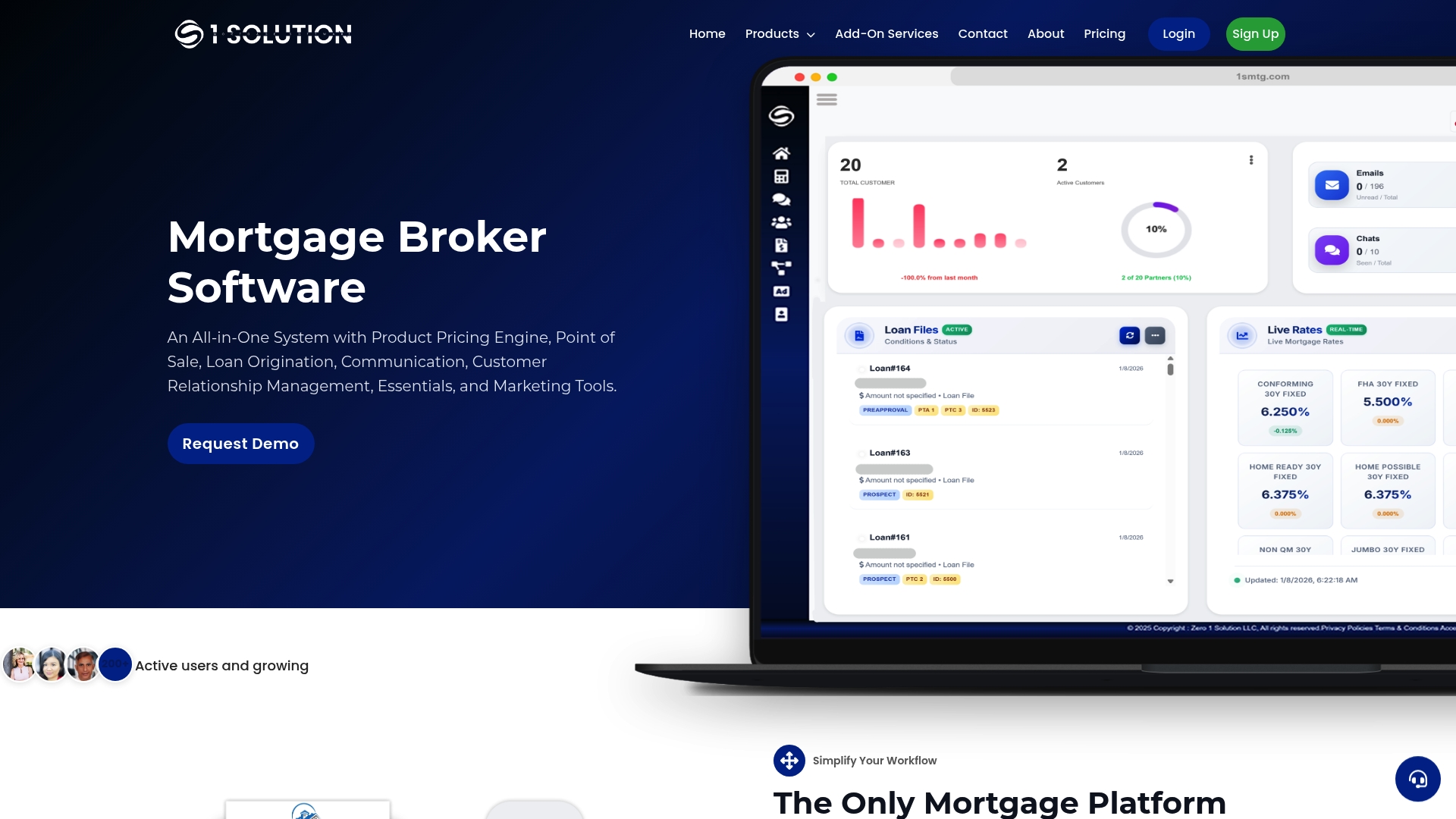
The platform brings LOS, CRM, product pricing engine, borrower POS portal, e-signature, compliance, marketing automation, and communication tools into one connected system. What's included in the base subscription versus optional add-ons (website development, branded email, PBX solutions) is stated clearly, so your TCO worksheet reflects reality from the first conversation. There are no mandatory third-party licenses required to access core functionality, and implementation is scoped with defined deliverables, not a single opaque line item.
If you're running the crossover math from this guide and want to see where 1 Solution fits your volume and setup, request a demo and a bundled first-year TCO worksheet tailored to your operation. Bring your loan volume, your current system list, and your integration requirements. We'll build the numbers with you, not for you.
Sources
These are the primary references used to build the cost bands and TCO framework in this guide.
- Loan Platform Pricing for Financial Institutions: Subscription, Transaction, and Hybrid Models in 2026
- 2025 updates to the cost to originate study
- What Does an LOS Really Cost? Pricing Breakdown by Lender Type | The LOS Directory