
Mortgage brokers in the United States work inside one of the most regulated, document-heavy industries in finance. The right brokerage management tools can mean the difference between a smooth pipeline and a compliance nightmare. There are six primary types of broker management software: standalone CRM/lead management, point-of-sale and loan origination systems (POS/LOS), back-office and commission accounting, compliance and document management, all-in-one brokerage platforms, and AI/automation add-ons. CFPB reporting requirements and NMLS licensing obligations make compliance and audit-trail features non-negotiable for U.S. mortgage brokers. 1 Solution Mortgage Software is one of the few platforms built specifically to address all six categories in a single, broker-focused ecosystem.
Quick reference by type:
- CRM/lead management: Solo originators and small teams focused on pipeline visibility
- POS/LOS: Any brokerage processing loan applications end-to-end
- Back-office/commission accounting: Teams with complex split structures or multi-agent payroll
- Compliance/document management: Brokerages with heavy audit exposure or multi-state licensing
- All-in-one brokerage platforms: Growing brokerages that need every function connected
- AI/automation add-ons: High-volume shops looking to reduce manual touchpoints
Table of Contents
- What are the main types of broker management software?
- How does disconnected software hurt your brokerage?
- How do you choose the right broker software for your team?
- What does a mortgage software implementation actually involve?
- Why integrated platforms and AI matter for brokers in 2026
- Key Takeaways
- Why the "best" platform is the one built for how brokers actually work
- 1 Solution Mortgage Software: built by brokers, for brokers
- Useful sources
What are the main types of broker management software?
Brokerage software ranges from standalone CRMs to full platform ecosystems that connect sales, finance, and operations under one architecture. Here is how each type works in a mortgage context, and what trade-offs come with each.
Standalone CRM and lead management
A mortgage CRM tracks leads, manages borrower communication, and moves contacts through pipeline stages. CRMs optimize lead-to-close workflows and support remote collaboration, but most require integration with commission and back-office tools for complete brokerage operations. Good for solo originators or small teams. Weak on financial reporting.

Pros: Fast to deploy, low cost, easy adoption. Cons: No LOS, no commission tracking, no compliance audit trail.
POS/LOS (point of sale and loan origination systems)
The POS is the borrower-facing portal where applications are submitted. The LOS is the engine that processes those applications through underwriting, conditions, and closing. Together, they form the operational backbone of any mortgage brokerage. Without a solid LOS, loan files live in email threads and spreadsheets, which creates both errors and CFPB exposure. For managing multiple lender relationships, a capable LOS with integrated pricing feeds is essential.
Pros: Purpose-built for loan processing; supports TRID timelines and disclosure tracking. Cons: Often sold separately from CRM and back-office tools, requiring additional integrations.
Back-office and commission accounting
Back-office and transaction software focuses on financial reporting, commission tracking, and compliance. Commission splits, clawbacks, and agent payroll are genuinely complex in a multi-originator shop. These systems handle the math that CRMs and LOS platforms ignore. Some transaction management systems offer limited brokerage features, but dedicated commission accounting tools go deeper on split logic and financial reconciliation.
Pros: Accurate commission payouts, clean financial reporting, audit-ready records. Cons: Rarely includes borrower-facing tools; needs integration with LOS and CRM.
Compliance and document management
Compliance and audit trails are the highest-value features in regulated sectors like mortgage. These systems store loan documents, enforce retention schedules, and generate audit-ready reports. For brokerages operating across multiple states, automated compliance enforcement reduces liability during CFPB or state regulator examinations, as detailed in the TOPA, DOB & DC Investor Compliance Guide. See the mortgage regulatory compliance guide for a breakdown of what these platforms must cover.
Pros: Minimizes audit liability; enforces document retention automatically. Cons: Narrow in scope; must connect to LOS and CRM to be useful.
All-in-one brokerage platforms
Comprehensive systems connect sales, financial management, and operational workflows under a single digital architecture, reducing manual handoffs. For a growing mortgage brokerage, this is the category that eliminates the integration tax paid when running five separate tools. The trade-off is higher upfront configuration, but the long-term operational gain is significant.
Pros: Single source of truth; fewer integration points; unified compliance reporting. Cons: Higher implementation complexity; requires a dedicated internal champion during rollout.
AI and automation add-ons
AI tools in mortgage operations handle document classification, rate alert triggers, borrower communication sequences, and pipeline anomaly detection. They layer on top of existing platforms rather than replacing them. Evaluate them carefully: mortgage automation tools vary widely in data ownership terms and explainability.
Pros: Reduces manual touchpoints at scale; speeds borrower response times. Cons: Data ownership and model transparency are real risks if not vetted.
Comparison of broker software types
| Software Type | Primary Function | Best For | Integration Complexity | Pricing Model | Deployment | Compliance Readiness |
|---|---|---|---|---|---|---|
| CRM/Lead Management | Pipeline and borrower communication | Solo originators, small teams | Low | Per user/month | Cloud | Low |
| POS/LOS | Application intake through closing | All brokerage sizes | Medium | Subscription or per-loan | Cloud or hosted | High |
| Back-office/Commission | Commission splits, financial reporting | Multi-agent brokerages | Medium | Subscription | Cloud or on-prem | Medium |
| Compliance/Document Mgmt | Document storage, audit trails | Multi-state, audit-exposed brokerages | Medium | Subscription | Cloud | Very High |
| All-in-One Platform | Full brokerage operations | Growing and scaling brokerages | Low (internal) | Subscription + add-ons | Cloud | High |
| AI/Automation Add-ons | Workflow automation, anomaly detection | High-volume brokerages | High | Usage-based or add-on fee | Cloud | Varies |
How does disconnected software hurt your brokerage?
The primary differentiator between average and high-performing brokerages is whether their front-office and back-office systems actually talk to each other. Disconnected systems create manual errors and compliance exposure that compound over time.
Common failure modes include:
- Manual data re-entry between POS and LOS causes funding delays and introduces errors into loan files
- Orphaned documents stored outside the LOS break audit trails and create CFPB exposure
- Commission miscalculations when LOS funding data does not flow automatically to the commission engine
- Broken disclosure timelines when TRID-sensitive dates are tracked in spreadsheets instead of a connected system
The integration points that matter most for mortgage compliance management are: POS to LOS, LOS to commission engine, document storage to audit logs, and pricing engine to live rate feeds. Prioritize loan file metadata, funding dates, commission splits, and document audit trails. These are the fields most likely to break when systems are disconnected.
Pro Tip: Before signing any software contract, ask the vendor to demonstrate a live data flow from a submitted application through to a funded loan and a commission payout. If they cannot show it in one system, you will be building that bridge yourself.
How do you choose the right broker software for your team?
Match your operational complexity to the platform type. A solo originator does not need an enterprise all-in-one platform. A 20-person brokerage processing 80 loans a month absolutely does.
Decision checklist:
- Compliance and audit trail depth (ask for a sample audit report during the demo)
- Native LOS capabilities vs. third-party LOS integration
- Commission automation and split logic
- API openness and documented integration endpoints
- Reporting and analytics tied to NMLS-reportable metrics
- Implementation support and dedicated onboarding services
- Total cost: subscription fee plus migration effort plus downtime
Red flags to watch for:
- Opaque or undocumented APIs
- No native audit trail; compliance is an add-on
- Per-user pricing that penalizes growth
- No implementation services; you are handed a manual
- Platform built for banks or direct lenders, not brokers
Pro Tip: During a demo, request a live compliance report and ask the vendor to show you how an audit trail is generated for a specific loan file. If they need to schedule a follow-up to show you that, the feature is not production-ready.
For loan officer time-saving features that hold up in real workflows, look for automated disclosure tracking, borrower status notifications, and integrated e-signature.
What does a mortgage software implementation actually involve?
The most expensive part of adopting a new platform is operational downtime and data migration effort, not the subscription fee. Treat implementation as a multi-week project with a dedicated internal champion.
Implementation steps:
- Plan and scope: Define which loan files, contact records, and commission schedules must migrate; set a go-live date with buffer weeks
- Data audit and export: Pull clean exports from every current system; identify gaps and duplicates before import
- Pilot: Run a subset of users or a single branch on the new platform for two to four weeks
- Full migration: Move remaining data and users; keep the old system in read-only mode for 30 days
- Staff training: Schedule dedicated training weeks by role (originators, processors, compliance staff)
- Go-live support: Confirm vendor support availability during the first two weeks post-launch
- Post-launch audit: Review KPIs at 30 and 60 days
KPIs to track:
- Time-to-fund (days from application to closing)
- Data entry time per loan file
- Compliance exception count per audit cycle
For workflow design guidance specific to new or restructuring brokerages, map every manual handoff before you configure the new system.
Why integrated platforms and AI matter for brokers in 2026
Industry analysts report that brokerage leaders are moving away from dozens of disconnected point solutions toward integrated platforms that act as a central operational hub, adding lean AI tools as needed rather than buying AI-first products that require heavy configuration.
The shift is driven by compliance pressure and margin compression. When every tool is separate, compliance reporting requires manual assembly. When the platform is integrated, audit reports generate automatically.
Hyper-automation and AI now prioritize digitizing workflows and reducing manual effort without the heavy costs of legacy enterprise systems. For mortgage brokers, the practical applications are document classification, rate alert automation, and borrower follow-up sequences.
Pro Tip: When evaluating any AI add-on, require the vendor to disclose data ownership terms, model training data sources, and how automated decisions affecting borrower pricing or eligibility are explained. If they cannot answer those three questions, do not sign.
Key Takeaways
Mortgage brokerages that pick for integration first and compliance second consistently outperform those that optimize for price alone, because disconnected systems create the manual errors and audit exposure that cost far more to fix than a better platform would have cost upfront.
| Point | Details |
|---|---|
| Pick integration first | Systems that connect POS, LOS, and back-office eliminate the manual handoffs that cause compliance failures. |
| Compliance and audit trails are non-negotiable | Automated audit trail generation is the highest-value feature for CFPB- and NMLS-regulated brokerages. |
| Budget for migration, not just subscription | Operational downtime and data migration effort are the real cost drivers of any platform switch. |
| Pilot before full rollout | Running a subset of users for two to four weeks surfaces data gaps and training needs before they affect live loans. |
| 1 Solution Mortgage Software | Combines POS, LOS, CRM, compliance, and back-office tools in one cloud platform built specifically for independent mortgage brokers. |
Why the "best" platform is the one built for how brokers actually work
The conventional wisdom says to buy the platform with the longest feature list. That is the wrong frame. Feature lists are written by marketing teams. The question that actually matters is: was this platform designed by someone who has sat in the seat you are sitting in?
Most mortgage technology is built for banks and direct lenders, then retrofitted for brokers as an afterthought. The compliance workflows assume a different regulatory posture. The commission logic does not account for broker-specific split structures. The LOS was designed for in-house underwriting, not wholesale channel submissions. Brokers end up customizing around the tool instead of the tool working for them.
Platforms built by practitioners who understand mortgage operations from the inside reduce customization costs and reach time-to-value faster than boardroom-built enterprise systems. Integration and automated audit trails consistently rank above interface design when practitioners select systems for regulated mortgage operations. That is not an opinion. It is what experienced MLOs and compliance officers report when they evaluate platforms under real conditions.
The right question to bring to every vendor demo is not "what can your platform do?" It is "show me how a loan moves from application to funded and how the audit trail is generated automatically." The answer tells you everything.
1 Solution Mortgage Software: built by brokers, for brokers
Every category covered in this guide, from CRM and POS to LOS, compliance, and back-office tools, exists inside 1 Solution Mortgage Software as a single connected platform. There is no integration tax. No separate vendor for commission accounting. No bolt-on compliance module that requires a second login.
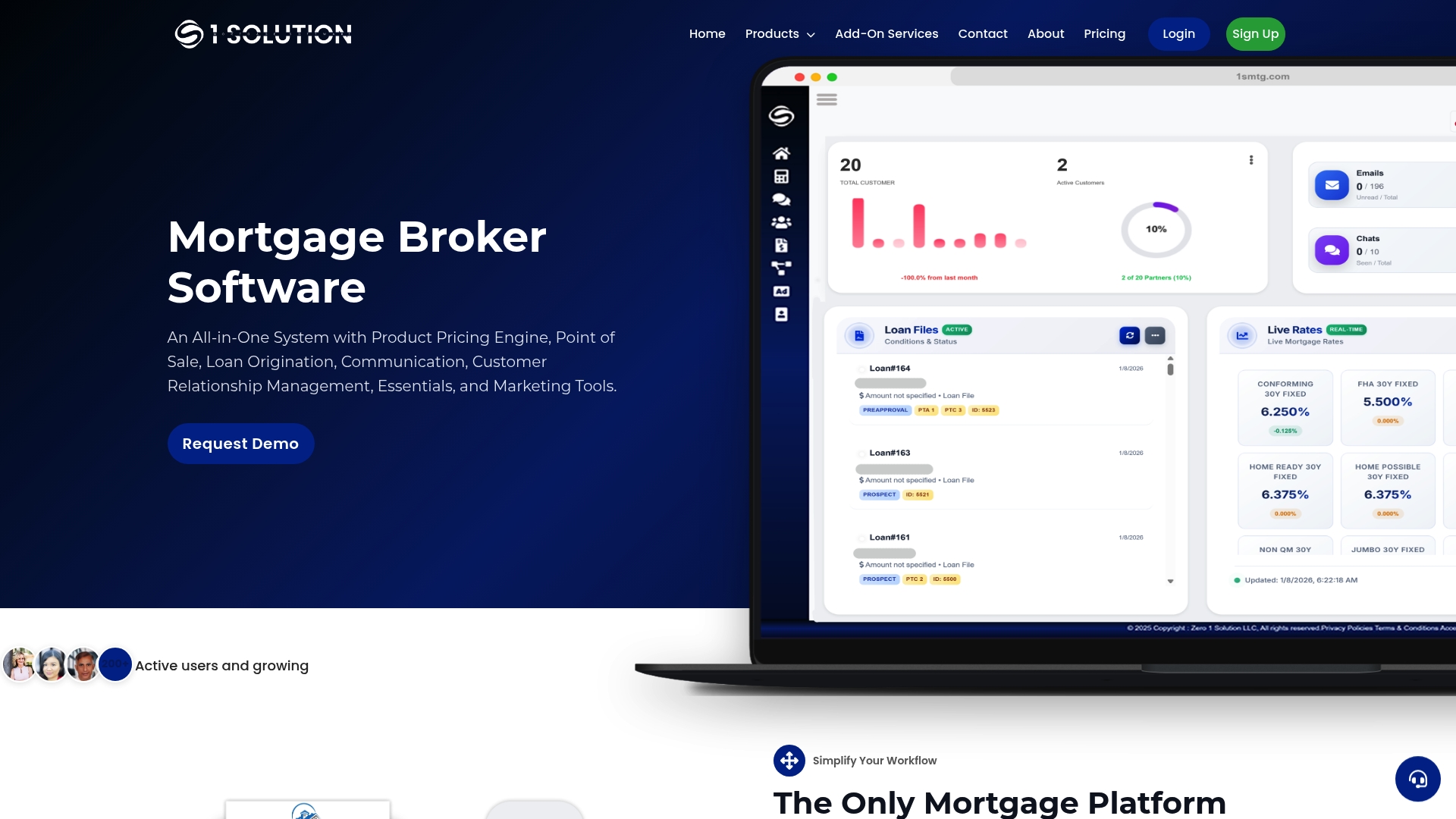
Founded by Omar Khamisa after 20 years working as a processor, underwriter, loan originator, and systems consultant, 1 Solution was built from real brokerage experience, not a boardroom. It is 100% self-funded and independent, which means product decisions are made for brokers, not investors. The platform covers pricing engine, CRM, borrower POS portal, LOS, e-signature, compliance, marketing automation, communication tools, partner management, and document storage. Cloud-based, subscription-priced, with optional add-ons for website development, branded email, and PBX. Implementation support is included, not an upsell.
If you are ready to replace fragmented tools with one platform built for independent mortgage professionals, request a demo at 1smtg.com.
Useful sources
"The primary differentiator is whether solutions connect front-office sales operations with back-office financial processes; disconnected systems lead to manual errors and compliance exposure." — Bouwflow, Top 5 Features of Real Estate Broker Management Software
- Top 5 Features of Real Estate Broker Management Software — Covers integration requirements and why connected front- and back-office systems reduce compliance risk.
- The Best Real Estate Brokerage Software for 2026 — Industry analyst view on the shift toward integrated platforms and selective AI add-ons.
- What is Broker Management Software? Features, Benefits & Market Trends — Explains deployment models, pricing structures, and implementation cost drivers.
- Transaction Management Software — Details compliance and audit trail features that matter most in regulated brokerage environments.
- Brokerage Management Software for Commercial Teams — Explains CRM capabilities and their limitations for end-to-end brokerage operations.
- Best Real Estate Brokerage Software — Distinguishes back-office and commission tracking systems from CRMs and LOS platforms.
- BrokerEdge Broker Management Software — Covers hyper-automation priorities and AI evaluation criteria for broker platforms.
- Mortgage Regulatory Compliance Explained for Brokers — Practical breakdown of compliance features U.S. mortgage broker platforms must support.