
The most effective mortgage proposal customization examples share one thing: they treat every client as a distinct scenario, not a template to fill in. A well-built custom proposal pulls together the client's loan amount, property type, occupancy status, and credit profile, then wraps those variables in clear pricing tables, personalized narrative, and locked compliance language. The result is a document that communicates terms precisely and moves the client toward a decision.
Here is what a modular, personalized proposal typically includes at the section level:
- Client-specific loan scenarios comparing fixed-rate, adjustable-rate, and interest-only options side by side
- Live pricing breakdowns pulled from an API-connected pricing engine, not manually copied rate sheets
- Personalized narrative blocks explaining why a specific product fits the borrower's financial goals
- Locked disclosure language that meets federal ESIGN and UETA requirements
- Signature and authorization sections with sequential routing and timestamped records
- Visual impact dashboards showing how rate or term changes affect monthly payments
- Timeline and process overviews so borrowers know exactly what happens after they sign
Getting these elements right from the start sets the tone for the entire client relationship. Compliance and clarity are not afterthoughts; they belong in the proposal's architecture from day one.
What every mortgage proposal template needs to cover
A proposal that wins client trust does more than list rates. It tells a complete story, from who you are to what the borrower owes and when.
Cover page and branding
Your cover page is the first thing a borrower sees. It should carry your logo, your NMLS number, the loan officer's name and photo, and the borrower's name and property address. A branded cover signals professionalism before the client reads a single number.

Service descriptions
Spell out the scope of your advisory role. Borrowers often do not know what a mortgage broker does versus a direct lender. A short, plain-language paragraph explaining your role, your lender relationships, and how you get compensated builds transparency before the numbers appear.
Pricing and rate tables
This is the section borrowers study hardest. Present the interest rate, APR, loan term, estimated monthly payment, origination fees, and total closing costs in a clean table. If you are comparing multiple products, put them in columns so the borrower can scan across rather than flip between pages.
Terms and conditions
Define the loan's legal boundaries: rate lock period, prepayment penalties if any, escrow requirements, and what triggers a change in circumstance. Keep the language plain but complete. Vague terms create disputes later.
Disclosure agreements
Federal law requires specific disclosures, including TRID-compliant Loan Estimate language and state-specific addenda. These sections must be locked against editing by anyone other than a compliance administrator. Borrowers need to see them; originators should not be able to remove them.
Signature, agreement, and acceptance
A sequential signature workflow, where the borrower signs before any countersignature, creates a clean audit trail. Digital signature standards for mortgage documents require timestamped records and identity verification to satisfy ESIGN requirements.
Timeline and process overview
Set expectations clearly. A simple milestone list showing application, processing, underwriting, appraisal, and closing dates reduces borrower anxiety and cuts inbound status calls to your office.
Pro Tip: Add a one-page "What Happens Next" section at the end of every proposal. Borrowers who know the next three steps are far less likely to go dark after receiving the document.
Advanced customization techniques that actually move clients
Static rate tables are a commodity. The proposals that convert are the ones that feel built for the specific borrower sitting across from you.
Scenario offer builders
Interactive scenario builders let you adjust rate, term, and repayment in real time while the borrower watches their monthly payment shift on screen. That live transparency does something a PDF cannot: it turns a passive review into an active conversation. Borrowers who participate in building their scenario are more likely to commit to it.
Live API pricing feeds
Pulling live rate data through a pricing engine API at the moment of proposal generation eliminates the manual copy-paste error that causes lock expirations and disclosure mistakes. The proposal reflects what the market actually shows right now, not what you typed in this morning.
Personalized narrative sections
A brief, client-specific explanation of why a product fits a borrower's situation converts better than raw data alone. The narrative layer, a short paragraph connecting the borrower's goals to the product recommendation, is what separates a professional proposal from a rate sheet. Brokers who add this layer consistently report stronger client engagement and fewer objections during the review call.
A practical template for this section: "Based on your purchase of [property address] and your goal of minimizing monthly payments over the next five years, we recommend the 5/1 ARM at [rate]% because [rationale tied to their timeline and credit profile]."
Visual impact dashboards
Charts showing how a 0.5% rate difference affects total interest paid over 30 years land harder than a number in a table. Dashboards that illustrate repayment curves, break-even points on points paid, and payment-to-income ratios give borrowers a visual anchor for their decision.
Drag-and-drop modular builders
Modular mortgage report builders let you toggle off sections that do not apply to a given borrower. A VA loan proposal does not need PMI fields. A cash-out refinance does not need a first-time buyer section. Removing irrelevant data reduces cognitive load and keeps the borrower focused on what matters to them.
Pro Tip: When using a modular builder, clone your best-performing proposal as a base template, then strip it down for each client type rather than building from scratch every time. You will cut preparation time significantly and maintain a consistent structure.
For brokers exploring secured loan scenarios alongside traditional mortgage products, the same modular approach applies: build the scenario, show the comparison, and let the client see the difference in real numbers.
How to keep customized proposals legally compliant
Customization creates risk when it touches the wrong sections. The most common compliance failures in mortgage proposals come from originators editing disclosure language or removing required fields to "simplify" the document for a client.
Federal ESIGN and UETA requirements
All digital mortgage proposals in the U.S. must comply with the ESIGN Act and UETA, which require that electronic signatures carry the same legal weight as wet signatures, provided the borrower has consented to electronic delivery and the document is tamper-evident after signing. Locked compliance language is not optional; it is the mechanism that makes the signature enforceable.
The risk of manual edits
When originators manually edit legal sections, they create version drift. A disclosure that was compliant in the master template may no longer be compliant after a loan officer removes a paragraph they found confusing. The solution is system-enforced locking: administrators control which fields are editable, and compliance sections are read-only for everyone else.
Version control and audit trails
Every proposal generation event should produce a timestamped PDF stored with the rate and fee snapshot that generated it. If a borrower disputes a fee six months later, you need the exact document they received, not a reconstructed version. Automated proposal systems with built-in version control handle this automatically, logging reminder frequency, signature order, and conditional routing settings alongside the document itself.
Centralized template management
Maintain one master template per loan product type: conventional purchase, FHA, VA, USDA, cash-out refinance, and HELOC. Administrators update the master; originators select from approved versions. This approach keeps mortgage regulatory compliance consistent across your entire team without requiring every loan officer to be a compliance expert.
- Lock all disclosure fields at the template level
- Require administrative approval before any template change goes live
- Store signed proposals with a 60-day minimum retention period per standard workflow settings
- Build jurisdiction-specific addenda into the template library for your top states by volume
- Route complex scenarios (high LTV, jumbo, non-warrantable condos) to manual compliance review before delivery
A step-by-step example of a fully customized mortgage proposal
Here is how a complete, tailored proposal comes together for a real borrower scenario. The client is purchasing a primary residence at $650,000 with 20% down, a 740 credit score, and a stated goal of keeping monthly payments as low as possible for the first seven years.
Step 1: Enter client data
Pull the borrower's 1003 fields into the proposal system: loan amount (a significant loan amount), property address, loan purpose (purchase), income, and credit pull date. The system maps these fields to the proposal template automatically, populating the cover page, disclosure jurisdiction, and product eligibility note.
Step 2: Pull live rate data and build the comparison table
The pricing engine API returns current rates for three product types. The comparison table populates instantly:
| Loan Type | Rate | APR | Monthly Payment | Total Interest (30 yr) |
|---|---|---|---|---|
| 30-Year Fixed | 6.125% | — | — | — |
| 7/1 ARM | 6.125% | — | — | — |
| Interest-Only | — | — | — | Varies |
For this borrower's seven-year timeline, the 7/1 ARM delivers a lower payment during the period they plan to hold the property, which the personalized narrative section will explain directly.
Step 3: Write the personalized narrative
"Based on your purchase of [property address] and your plan to sell or refinance within seven years, the 7/1 ARM at 6.125% reduces your monthly payment by $255 compared to a 30-year fixed. Over your expected hold period, that saves approximately $21,420 before any rate adjustment occurs."
This section is generated from a pre-approved narrative block mapped to the product type and LTV bucket, keeping the language compliance-reviewed while still feeling personal.
Step 4: Select and customize the proposal modules
- Toggle off PMI fields (20% down, no PMI required)
- Enable the visual impact dashboard showing payment curves for all three products
- Add the 7/1 ARM rate cap disclosure (required for ARM products)
- Include the state-specific addendum based on the property address
- Attach the timeline overview: application, appraisal, underwriting, and closing milestones
Step 5: Run compliance validation and finalize
The system checks that all required disclosures are present, that the rate matches the live pricing snapshot, and that no locked fields were altered. The proposal routes to the loan officer for a final review, then delivers to the borrower with a sequential signature workflow and a reminder set for any unsigned documents at a typical frequency.
Step 6: Next steps and client authorization
The final page of the proposal lists three clear actions for the borrower: review and sign the Loan Estimate acknowledgment, upload the required documents via the secure portal, and schedule a call to confirm the rate lock. The authorization section captures consent to electronic delivery and confirms the borrower's identity before the signature block appears.
Adapting this workflow for a borrower with a 620 credit score means swapping the conventional product for an FHA option, adjusting the narrative to address the mortgage insurance premium, and adding the FHA-specific disclosure addendum. The structure stays the same; the content shifts to match the client's actual financial position.
Why 1 Solution Mortgage Software was built for exactly this
We built 1 Solution Mortgage Software from the trenches, not a boardroom. Omar Khamisa spent over 20 years as a processor, underwriter, loan originator, and systems consultant before founding 1 Solution, and every feature reflects a problem he actually faced. Fragmented tools, manual pricing errors, compliance gaps, and proposals that looked nothing like the professional documents clients deserved. That is what we set out to fix.
1 Solution brings pricing, CRM, POS, LOS, compliance, and communication into one connected platform built specifically for independent mortgage brokers. You get digital mortgage application workflows, live pricing integration, and proposal tools that keep your disclosures locked and your branding consistent, without paying for a platform designed for banks.
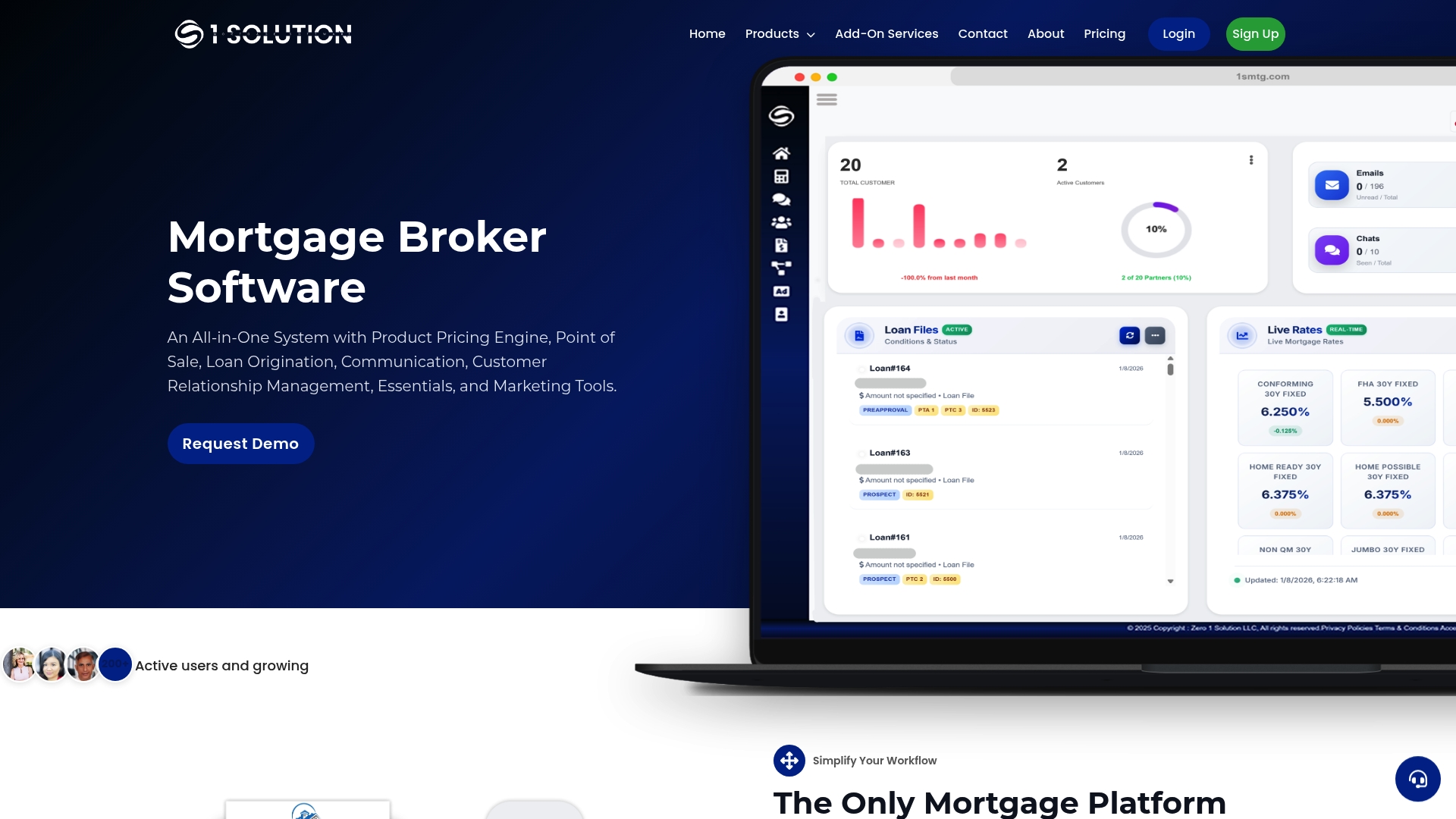
If you are ready to build proposals that actually reflect your expertise and close more loans, explore 1 Solution Mortgage Software and see what a platform built by brokers, for brokers, actually looks like.
Key Takeaways
A well-customized mortgage proposal combines live pricing data, client-specific narratives, locked compliance language, and clear next steps to convert borrowers faster and reduce documentation errors.
| Point | Details |
|---|---|
| Modular templates save time | Build one master template per loan type and strip irrelevant sections for each client. |
| Live API pricing prevents errors | Pulling rates at generation time eliminates manual copy-paste mistakes and lock expirations. |
| Narrative sections drive conversions | A short, client-specific explanation of product fit outperforms raw rate tables alone. |
| Locked disclosures protect compliance | System-enforced locking on legal sections prevents originator edits that create regulatory risk. |
| Sequential signatures create audit trails | Timestamped, version-controlled proposals with 60-day retention satisfy ESIGN and UETA requirements. |