

The fastest way to convert more referrals into funded loans is to run two trackers, one for activity and one for results, inside a CRM that automates partner attribution and status updates. Skip the spreadsheets. You need:
- An activity tracker logging every outreach, ask, and touchpoint with referral partners
- A referral/results tracker recording attribution, pipeline stage, and funded outcomes per partner
- Automation that fires post-close asks, partner status updates, and anniversary check-ins without you remembering to do it manually
Pro Tip: Loan officers who automate referral attribution report clearer visibility into conversion rates and funded volume per partner, which is exactly what you need to justify co-marketing spend. Platforms like 1 Solution Mortgage Software build this dual-tracker logic directly into the CRM, so tracking isn't a side project. It's baked into your daily workflow.
Key Takeaways
Reliable mortgage referral tracking requires running an activity tracker and a results tracker together inside a CRM that automates attribution, partner dashboards, and follow-up sequences.
| Point | Details |
|---|---|
| Run two trackers | Separate activity logging from results/attribution to see effort and outcome independently. |
| Automate the attribution loop | Connect unique referral links, GA4, pixels, and call tracking to close attribution gaps. |
| Pay partners within 14 days | Faster payouts correlate with stronger year-over-year partner retention. |
| Pilot before full rollout | Test tracking accuracy with a small partner group for 30 days before scaling firm-wide. |
| 1 Solution maps both trackers natively | An integrated CRM and LOS reduce reconciliation overhead and keep partner data connected. |
Authoritative Resources and Internal Guides
Verify partner licensing at NMLS Consumer Access, review CRM options via Forbes Advisor, and explore mortgage automation tools.
Table of Contents
- Why Mortgage Referral Tracking Matters for Loan Originators
- The Two Trackers Every Loan Officer Should Run
- Core Referral-Tracking Features and CRM Setup
- How to Set Up Referral Tracking: Step-by-Step
- Key Metrics and Reports to Run Weekly and Monthly
- Automation Playbook: Sequences That Convert Referrals Reliably
- Compliance, Payouts, and Partner Trust Practices
- How 1 Solution Implements Referral Tracking
- Examples of Successful Mortgage Referral Tracking Campaigns
- Common Challenges and Pitfalls in Referral Tracking
- Tips for Optimizing Partner Recruitment and Engagement
- Best Practices for Data Privacy and Compliance in Referral Tracking
- Integration Considerations With Other Marketing and Sales Tools
- What the Data Actually Supports
- Get Referral Tracking Built Into Your Workflow, Not Bolted On
- Sources
Why Mortgage Referral Tracking Matters for Loan Originators
Referral pipelines close at a higher rate than cold leads, but most originators still track them with a legal pad, a gut feeling, or a spreadsheet nobody updates past the first month. That gap is expensive. Top-performing shops report 40 to 60 percent of closed loans coming from referral channels, which means the channel producing most of your business is often the one you measure worst.
The failure modes are predictable. A partner sends a lead, you follow up twice, then life happens and the third touch never comes. Or three different referral sources touch the same borrower and nobody can say who actually gets credit. Or your best referral partner quietly stops sending business because they have no idea what happened to the last five people they referred.
When attribution breaks down, so does trust. A partner who can't see what happened to their referral assumes you dropped the ball, whether you did or not.
Mortgage lead tracking fixes this by making attribution and follow-up systematic instead of memory-dependent.
The Two Trackers Every Loan Officer Should Run
Tracking mortgage referrals well means separating what you do from what happens as a result. Conflating the two is why most manual systems collapse under their own weight.
- Activity tracker. This logs outreach: calls made, referral asks sent, partner check-ins completed, co-marketing touches delivered. It answers "did I do the work?"
- Referral/results tracker. This stores attribution source, pipeline stage, and funded outcome for every lead tied to a partner. It answers "did the work pay off?"
- Reconciliation step. Map events between the two. When an activity (a referral ask) produces a result (a new lead), the CRM should link them automatically rather than requiring manual cross-referencing.
Run these separately and you get clean signal on both effort and outcome. Run them as one blended list and you lose the ability to tell whether a slow month means you didn't ask enough partners, or you asked plenty and the leads just didn't convert. That distinction changes what you fix.
Core Referral-Tracking Features and CRM Setup
Not every CRM handles referral attribution the same way. Before you commit to one, confirm it can do the following:
- Generate unique or co-branded referral links and QR codes that auto-tag incoming leads to the correct partner
- Give each partner a profile and dashboard where they can see referral status without calling you
- Support custom status labels, tags, and multi-source attribution for leads that touch more than one channel
- Export reports in a format you can hand to a partner without manual reformatting
- Connect to GA4, conversion pixels, and call tracking so phone-originated referrals get credited correctly
Co-branded partner links that route borrowers to a landing page and auto-assign the correct loan officer are already standard practice across established mortgage platforms, according to Blend's referral partner documentation. If your current CRM can't replicate that, you're doing manual work a $30-a-month integration should be doing for you.
Pro Tip: Automated tracking lets you calculate true cost-per-acquisition by connecting your CRM to GA4 and conversion pixels instead of just counting leads. That single change shifts how you evaluate which partners are actually worth your marketing dollars.
How to Set Up Referral Tracking: Step-by-Step
Setting up mortgage referral management doesn't require a six-month rollout. Here's the sequence:
- Define partner types (real estate agents, financial planners, past clients, builders) and create a record for each in your CRM.
- Generate unique referral links or QR codes for every partner, then test that a sample click actually populates the correct fields.
- Connect analytics. Wire up GA4, install conversion pixels, and enable call tracking so phone-originated referrals get attributed correctly.
- Build automation for post-close referral asks, partner status notifications, and recurring check-ins.
- Pilot for 30 days with a small group of partners before rolling it out firm-wide. A short pilot with defined KPIs lets you validate tracking accuracy before you commit to it across your whole book.
Skipping the pilot is the most common mistake. You want to catch a broken tag or missed notification while it affects five partners, not fifty.
Key Metrics and Reports to Run Weekly and Monthly
Best practices for mortgage tracking start with a small, disciplined metric set, not a dashboard with forty widgets nobody reads.
| Metric | What it tells you |
|---|---|
| Lead to contact rate | How fast and consistently your team follows up on new referrals |
| Contact to application rate | Whether initial conversations are converting to submitted applications |
| Application to funded rate | Pipeline health and underwriting friction points |
| Funded volume per partner | Which relationships actually produce closed business |
| Average time-to-fund | How efficiently referred deals move through your process |
Run the funnel numbers weekly and the partner-level report monthly. Before you send anything to a partner, reconcile your CRM totals against your loan origination system. A mismatch between the two erodes partner trust faster than almost anything else, because it looks like you're either padding numbers or losing deals.
Automation Playbook: Sequences That Convert Referrals Reliably
Timing determines whether a referral ask feels natural or desperate. A practical mortgage referral tracking sequence looks like this:
- Day of close: automated thank-you to the borrower and a notification to the referring partner that the loan funded.
- Day 7 to 14 post-close: a referral ask window, when borrower satisfaction is highest and the experience is still fresh.
- Mid-pipeline milestones: automated partner updates at application received, rate locked, and clear-to-close, so partners never have to call and ask.
- Annual anniversary touch: a check-in that re-engages the borrower and reminds the partner you're still active in the relationship.
- Dormant-partner re-engagement: a quarterly nudge to partners who haven't sent a referral in 90 days, before the relationship goes cold entirely.
Automating post-close follow-ups, review requests, and partner touches is a documented best practice for scaling referral retention without adding headcount. The sequence matters more than the volume. One well-timed ask outperforms five generic ones.
Compliance, Payouts, and Partner Trust Practices
A few rules protect you and keep partners loyal:
- Verify licensing for any partner who may be a licensed mortgage professional using NMLS Consumer Access before formalizing a referral arrangement.
- Use configurable disclaimers on partner-facing pages and store referral agreements inside the CRM as a single source of truth your compliance team can audit quickly.
Automated commission tracking, rather than manual calculation, correlates with meaningfully higher year-over-year partner retention. Partners who can see their pipeline status and know exactly when they'll get paid stay engaged. Partners left guessing eventually stop sending business, quietly, without ever telling you why.
How 1 Solution Implements Referral Tracking
Founder Omar Khamisa spent over 20 years in mortgage operations, working as a processor, underwriter, loan originator, and systems consultant, before building 1 Solution Mortgage Software. That background shows up directly in how the platform handles referral tracking.
- Activity and results trackers map into shared CRM fields, so a partner ask and its outcome stay linked automatically instead of living in separate spreadsheets.
- Co-branded referral links and partner dashboards give partners real-time visibility into referred-borrower status, cutting the "just checking in" phone calls.
- Automation sequences handle post-close asks, milestone notifications, and anniversary touches without manual triggering.
- An all-in-one structure means CRM, LOS, and compliance tools share data, reducing the reconciliation work that eats up an ops team's week.
| Point | Details |
|---|---|
| Attribution stays connected | Activity and results data share fields instead of living in disconnected tools. |
| Partners get visibility | Dashboards show referral status directly, reducing manual check-in calls. |
| Automation runs the sequence | Post-close asks and milestone updates fire without manual triggering. |
Examples of Successful Mortgage Referral Tracking Campaigns
The shops seeing the strongest referral results share a common pattern: they treat referral partners like a marketing channel with its own funnel, not a favor system. A real estate agent who sends five deals a year gets tracked the same way a paid ad campaign would, with source attribution, conversion rate, and cost-to-acquire (in the form of co-marketing spend or time invested).
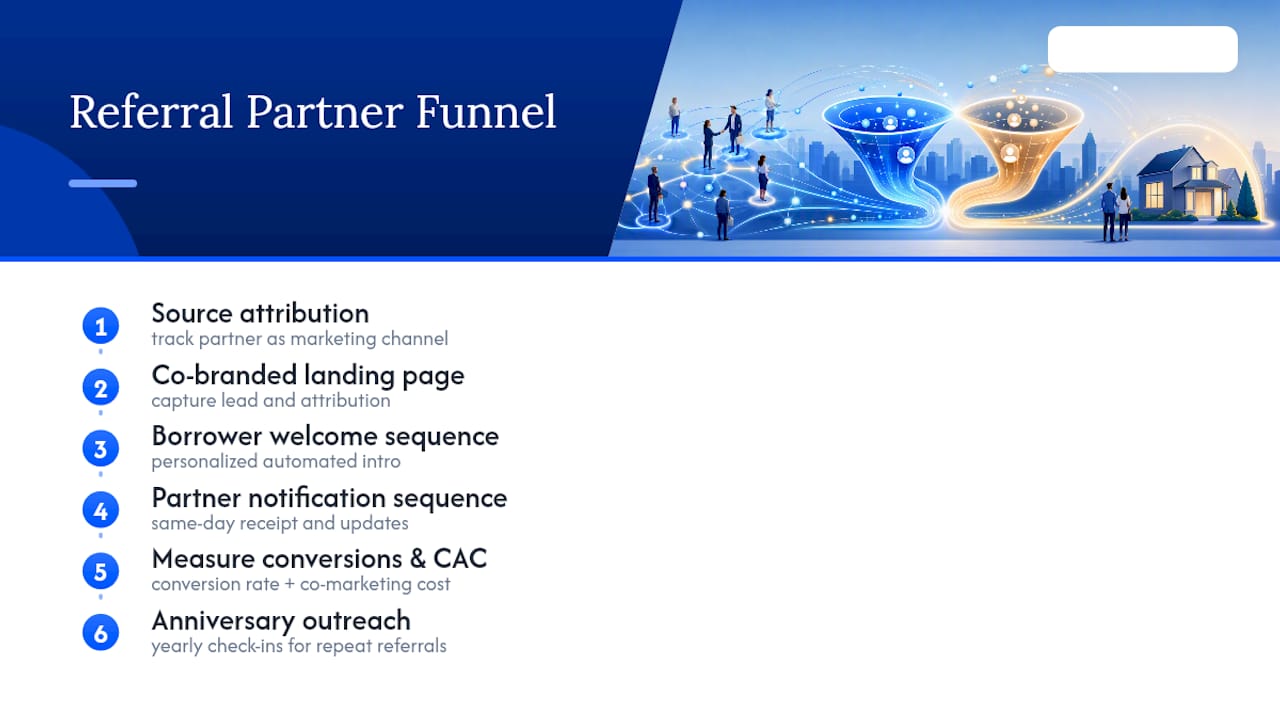
One recurring structure that works: pairing a co-branded landing page with an automated welcome sequence for the referred borrower and a parallel notification sequence for the partner. The borrower gets a warm, personalized intro. The partner gets a same-day confirmation that the referral was received and an automatic update when the application is submitted. Neither side has to wonder what happened next.
Another pattern shows up around anniversary campaigns. Loan officers who systematically reach out to past-client partners around the one-year mark of a closed loan, tied to a rate check or refinance opportunity, generate a disproportionate share of repeat referrals compared to officers who only reach out reactively when they need business. The mechanism is simple: showing up before you need something builds more trust than showing up only when you do.
The common thread across effective campaigns isn't creativity. It's consistency. A modest but reliable sequence that fires every time beats an elaborate one that only runs when someone remembers to trigger it.
Common Challenges and Pitfalls in Referral Tracking
The most common failure isn't a lack of tools. It's inconsistent use of the tools you already have. A CRM with referral tracking capability sitting half-configured is functionally the same as having no system at all.
Attribution conflicts rank second. When a lead comes through two channels, a partner referral and a paid ad click on the same day, most systems default to first-touch or last-touch attribution without asking whether that's actually fair to the partner. Decide your attribution rule before you need it, not while a partner is disputing credit for a deal.
Data decay is another quiet killer. Partner contact information goes stale, referral links get shared incorrectly, and tags stop mapping to the right fields after a CRM update. Schedule a quarterly audit of your top 20 referral sources to confirm links still work and data still flows correctly.
Partner fatigue happens when automation feels robotic rather than personal. An automated update that reads like a form letter erodes the relationship it's meant to strengthen. Write your automated messages the way you'd actually talk to that partner, and revisit the copy every few months so it doesn't go stale.
Finally, reporting mismatches between your CRM and loan origination system undermine partner trust fast. Reconcile the two before every partner meeting, not after a partner questions your numbers.
Tips for Optimizing Partner Recruitment and Engagement
Recruiting new referral partners works best when you can show, not just promise, what tracking looks like from their side. Walk a prospective partner through your dashboard before you ask them to send you a single lead. Seeing real-time status updates removes the biggest objection agents and planners have to referring business: not knowing what happens after they hand off a client.
Segment your partner outreach the way you'd segment borrower leads. A high-volume real estate agent needs a different cadence than a financial planner who sends two referrals a year. Treating both the same wastes effort on the low-volume partner and under-serves the high-volume one.
Recognition matters more than most originators assume. A partner dashboard showing year-to-date funded volume, paired with a simple thank-you at year-end, does more for retention than an occasional gift card. Partners want proof their referrals produce results, and transparent reporting delivers that proof automatically instead of requiring you to manufacture goodwill.
Look outside your immediate network too. Adjacent industries with referral-benefit structures, like the approach outlined in this estate agent referral benefits guide, illustrate how structured partner communication and clear benefit tiers keep referral sources engaged over time, a principle that transfers directly to mortgage partnerships.
Finally, don't let dormant partners disappear silently. A quarterly check-in to anyone who hasn't referred in 90 days, paired with a quick update on market conditions or rate movement, reopens more relationships than a generic "just checking in" email ever will.
Best Practices for Data Privacy and Compliance in Referral Tracking
Referral tracking touches borrower personal information the moment a lead enters your CRM, which means privacy discipline isn't optional. Limit partner dashboard visibility to status and stage information only. Partners don't need, and shouldn't have, access to a referred borrower's full loan file, income documentation, or credit details.
Document every referral agreement inside the CRM rather than in email threads or verbal understandings. A single source of truth for partner agreements lets your compliance team audit disclosures quickly if a regulator or investor ever asks. Configurable disclaimer text on co-branded partner pages should be standard, not an afterthought bolted on after a compliance review flags it.
Set data retention rules for referral records the same way you would for any borrower data, and make sure your CRM's access controls restrict who on your team can view partner-level financial details like commission payouts. Not every team member needs that visibility, and limiting it reduces both compliance risk and the odds of an awkward internal conversation about who's earning what from which partner.
Finally, confirm any partner who might fall under state or federal licensing requirements is properly verified, particularly if compensation is tied to loan-related referrals rather than a flat marketing arrangement.
Integration Considerations With Other Marketing and Sales Tools
Mortgage referral tracking doesn't operate in isolation. It needs to talk to the rest of your marketing and sales stack, or you end up with the exact fragmentation problem tracking was supposed to solve.
Your CRM should sync with email and SMS marketing tools so partner nurture sequences and borrower drip campaigns pull from the same contact database rather than two separate lists that drift out of sync. Connect it to GA4 and conversion pixels so digital marketing spend and referral-driven leads show up in the same reporting view, letting you compare cost-per-acquisition across channels honestly instead of judging referrals and paid ads by different yardsticks.
Call tracking deserves particular attention. Phone-originated referrals are notoriously hard to attribute correctly, and a dedicated tracking number per partner or campaign closes that gap. Without it, a meaningful share of referral-driven calls get miscategorized as direct or organic traffic, which understates how much business your partners are actually generating.

Finally, make sure your loan origination system and CRM share data cleanly. Every reconciliation problem mentioned earlier traces back to these two systems reporting different numbers because they weren't built to talk to each other. An integrated platform where LOS, CRM, and marketing automation share a data layer removes an entire category of manual cross-checking that eats into time you could spend on actual partner relationships.
What the Data Actually Supports
Most advice on referral tracking treats it as a marketing nicety, something you get to once the pipeline slows down. That framing gets it backward. The originators generating the highest share of funded volume from referrals are the ones treating attribution as infrastructure, not an afterthought bolted onto a CRM they bought for something else entirely.
The overrated piece of conventional wisdom is the idea that better relationships alone drive referrals. Relationships matter, but a partner who can't see what happened to the last three people they sent you will eventually stop sending them, no matter how much they personally like you. Transparency does more retention work than charm.
If you do one thing after reading this, separate your activity tracking from your results tracking this week. Most originators blend the two, which makes it impossible to diagnose whether a slow month is an effort problem or a conversion problem. That single change clarifies more than any new tool you could buy.
— Omar Khamisa
Get Referral Tracking Built Into Your Workflow, Not Bolted On
Most CRMs treat referral tracking as an add-on module you configure after the fact. 1 Solution Mortgage Software builds the two-tracker model directly into the platform, so activity logs, partner attribution, and funded outcomes share the same data layer as your LOS and compliance tools from day one.
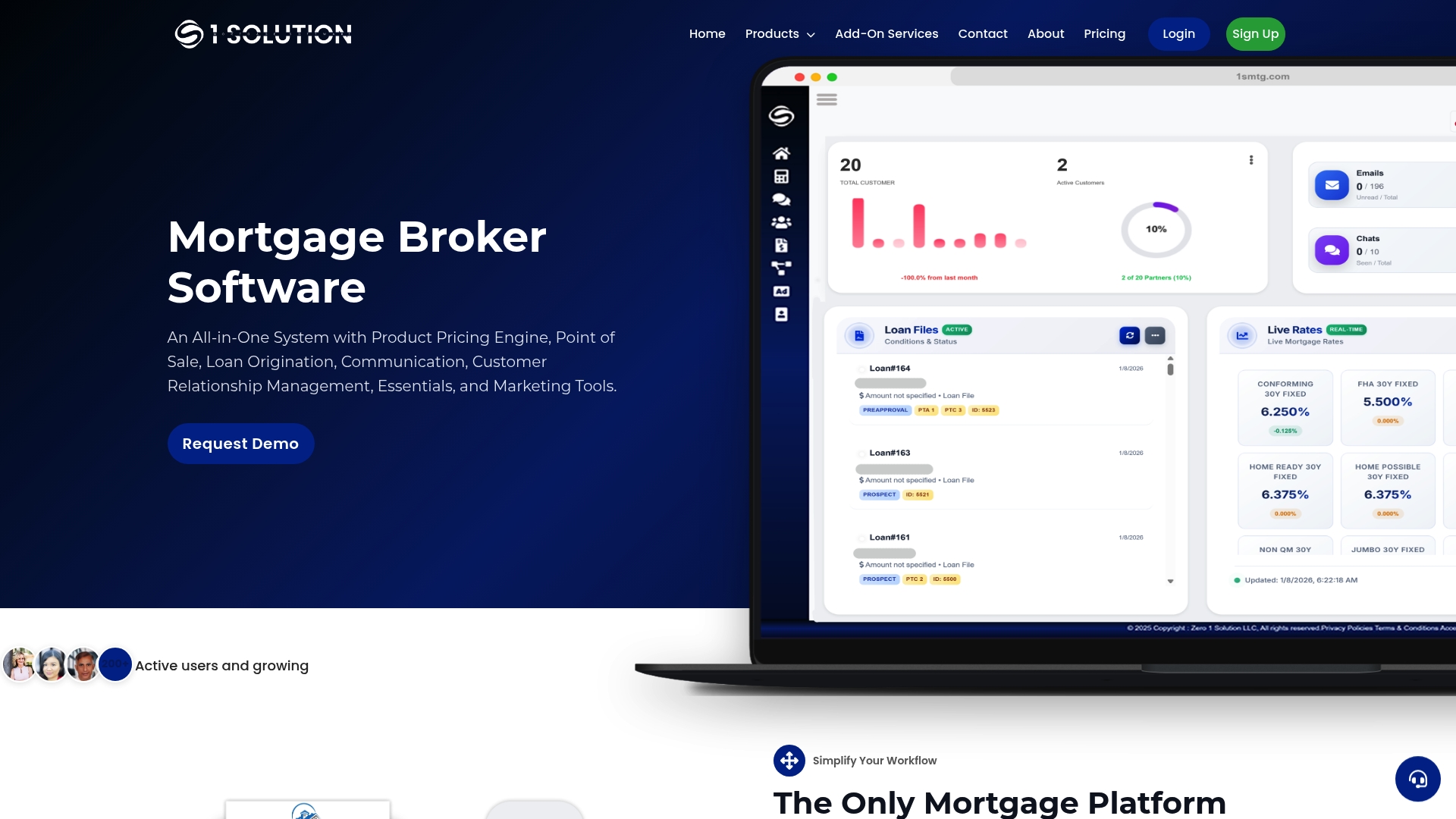
That matters because reconciliation overhead is the single biggest reason referral tracking programs quietly fall apart. When your CRM, POS, and LOS already share data, you're not manually cross-checking partner reports against loan status every month. Co-branded referral links, partner dashboards, and automated post-close sequences come configured for mortgage workflows specifically, not adapted from a generic sales CRM built for a different industry entirely.
If you're currently piecing together tracking across a spreadsheet, a generic CRM, and manual partner emails, request a demo of 1 Solution Mortgage Software and see how the platform maps your existing partner relationships into a working two-tracker system within your first pilot cycle.
Sources
- Mortgageleads
- Happy clients = more closings: Mortgage retention & referral automation playbook
- NMLS Consumer Access