

Yes, you can automate pre-approval letters to issue in hours instead of days, but only if a licensed loan officer still signs off before anything goes to a borrower. Automation handles intake, document collection, credit and AUS routing, and letter generation. The gains show up as faster cycle times, higher conversion, and more capacity per loan officer. None of that replaces the human judgment call at the end.
TL;DR:
- Automation speeds up pre-approval issuance to a few hours by handling intake, document collection, credit routing, AUS submission, and letter generation, but only with human sign-off for complex or ambiguous cases.
- Key integrations include LOS, POS portals, AUS, credit vendors, document portals, e-signature platforms, and CRM, all connected through APIs or webhooks to ensure seamless data flow.
- Focus on building a detailed condition matrix and SLA alerts upfront, because clear rules and exception management are more critical to success than the specific tools used.
- Implement automation gradually, starting with document checklists and reminders, then expanding to credit pulls and template-based letters, using pilot programs to refine processes.
- Future enhancements will emphasize real-time status visibility, AI-driven exception flagging, and proactive borrower updates, but final approval always remains with a licensed loan officer.
Table of Contents
- What Pre-Approval Letter Automation Actually Does
- How Does the Pre-Approval Pipeline Actually Flow?
- What Systems Need to Connect for Automation to Work?
- How Do You Keep Automated Pre-Approvals Compliant?
- Where Should You Start Implementing Automation?
- What Results Should You Expect to Measure?
- What Do 20 Years in Mortgage Operations Teach You About Automation?
- What Do Real Automation Rollouts Look Like?
- What Comes Next for Automated Pre-Approvals?
- The Real Bottleneck Isn't the Technology
- Why 1 Solution Fits Lenders Ready to Automate
- Sources
What Pre-Approval Letter Automation Actually Does
Automation earns its keep on the repetitive, rules-based parts of the file. It generates document checklists the moment an application lands, sends reminders when a borrower stalls, extracts data off pay stubs and bank statements, pulls credit, submits to the automated underwriting system (AUS), and drafts the letter itself once conditions clear. What it does not do is replace judgment on files that do not fit the rules.
Complex underwriting calls, ambiguous income or asset documentation, and the final decision to issue a letter still belong to a person with a license and a signature. Automation prepares the file. A loan officer approves it.
The practical outcome is fewer manual handoffs and a shorter clock. One implementation guide documents pre-approval issuance compressing from multiple business days to a few hours when intake, verification, AUS routing, and borrower communication run through a single orchestrated pipeline.
What gets automated, in practice:
- Document checklist generation triggered the moment an application is submitted
- Automated reminders for missing or expired documents
- AI-assisted data extraction from pay stubs, W-2s, and bank statements
- Credit pull initiation once required disclosures are on file
- AUS submission and result routing (DU, LPA)
- Template-based letter generation once conditions are met
- Delivery and logging through the borrower portal or CRM
What stays manual, by design: underwriting exceptions, non-standard income scenarios, and the sign-off itself.
How Does the Pre-Approval Pipeline Actually Flow?
A pre-approval pipeline is a chain of triggers and handoffs, not one big automation. Each stage needs a clear trigger, a minimal data set to act on, and an SLA that flags it when it stalls. Here is how the stages typically break down:
- Application capture. Trigger: borrower submits a form through the point-of-sale (POS) portal or CRM webhook. Minimum data: name, property type, loan purpose, estimated income, and consent to pull credit. SLA: file created in the loan origination system (LOS) within minutes of submission.
- Document collection. Trigger: file creation event. The system generates a checklist based on loan type and income structure, then sends reminders on a fixed cadence. SLA: flag any document older than 48 hours untouched.
- Parallel verification. Trigger: minimum document set received. Credit pull, AUS submission, and income/asset verification run at the same time rather than in sequence. This is where most time gets clawed back, since queuing one step behind another is what stretches a four-hour file into a four-day one, a point the pipeline guide makes directly.
- Underwriting and LO review. Trigger: AUS returns a finding (Approve/Eligible, Refer, etc.) and verification results land in the file. A condition matrix maps each finding to an action: generate the letter, generate a conditional letter listing only pre-approval-relevant items, or route to manual review.
- Pre-approval letter generation. Trigger: LO sign-off recorded. The system pulls the approved template, populates loan amount, rate assumptions, and conditions, and stages it for delivery.
- Delivery and logging. Trigger: letter approved for release. Delivery goes through the borrower portal or CRM channel, with every action, including who generated and who approved, written to an audit log.
Pro Tip: Set SLA alerts at 24, 48, and 72 hours on document aging and LO review delays. Files that stall past those thresholds are your early warning system for exceptions, not your automation failing.
A simple version of this: webhook fires on application submission, which creates the LOS file and pushes a document checklist to the borrower automatically, no manual data entry required.

What Systems Need to Connect for Automation to Work?
The pipeline above only works if the systems underneath it actually talk to each other. Your LOS stays the system of record. Everything else needs to feed it clean data and pull status back out.
The essential connections:
- LOS as the system of record for the loan file and its history
- POS/borrower portal for intake, document upload, and status visibility
- AUS (DU or LPA) for automated underwriting findings
- Credit vendor integration for pull initiation and result retrieval
- Document portal or identity verification (IDV) tool for upload, extraction, and fraud checks
- E-signature platform for disclosures and letter attestation
- CRM for borrower and referral partner communication
- Workflow/orchestration layer that sits above all of it and coordinates the handoffs
On the technical side, that means API or webhook access to each system, consistent field mapping between them, secure document storage, versioned audit logs, and defined error handling for when a vendor call fails midstream. Fannie Mae's research points to document collection gaps and manual re-entry between systems as a primary source of pre-approval delay, which is exactly what this integration layer is built to eliminate.
AI-assisted data extraction speeds document intake, but it needs a validation step before that data reaches the AUS. Feeding unverified extracted figures straight into underwriting is how bad data becomes a bad decision at scale. Lightweight prototyping tools like Jotform combined with AI analysis show the pattern at small scale before a team commits to a full build.
How Do You Keep Automated Pre-Approvals Compliant?
Speed without controls is how automation projects get shut down after the first audit. The fix is role-based permissions and a sign-off workflow that never lets a letter reach a borrower without a licensed set of eyes on it.
Guardrails worth building in from day one:
- Role-based permissions so only licensed loan officers can approve letter release
- E-signature or attestation attached to the LO's approval action, not just the letter itself
- Event logs capturing who generated what, and when, at every pipeline stage
- Template change control, so nobody edits a live letter template without a version record
- Document retention policies that match your compliance audit requirements
- Issuance caps and program eligibility filters that block letters for products the automation isn't configured for
- Expiration windows and condition filtering, so letters don't outlive their underlying AUS findings
Vendor documentation on pre-approval workflows, including Blend's lender-facing help center, confirms this is standard practice: generation is commonly gated behind a completed credit pull and an AUS Approve/Eligible result, with role permissions controlling who can trigger it.
Pro Tip: Build your condition matrix before you build anything else. If you can't map every AUS outcome to a specific automated action or manual flag in advance, your automation will improvise, and improvised compliance decisions are the ones that show up in an audit.
Human-in-the-loop design, where automation assembles a validated package and the loan officer makes the final call, keeps compliance risk down without giving back the speed gains.
Where Should You Start Implementing Automation?
Trying to automate everything at once is the fastest way to stall a project before it produces a single result. Sequence the work by return and by how little it disrupts existing files.
- Automate document checklists and reminders first. This is the lowest-risk, highest-frequency win, and it touches every file regardless of loan type.
- Trigger credit pulls automatically once required disclosures are captured, removing a manual step that adds no judgment value.
- Turn on AUS auto-submission for a defined product set, starting narrow (conventional, full documentation) before expanding to more complex programs.
- Enable template-based letter generation for files that clear your condition matrix, with LO sign-off as the release gate.
- Run a pilot on a limited product scope, monitor cycle time and exception rates weekly, and adjust the condition matrix based on what actually trips into manual review.
- Expand scope only after the pilot's exception rate stabilizes, not on a fixed calendar date.
Three mistakes derail most rollouts. Automating the final approval decision itself, rather than just the prep work leading to it, is the one that draws regulatory attention fastest. Skipping data validation on extracted documents is the one that quietly corrupts files without anyone noticing until underwriting flags it. And leaving out SLA alerts on document aging or LO review delays means files stall silently instead of surfacing as exceptions your team can act on. Teams rolling out this kind of workflow redesign tend to succeed when they treat the pilot as a data-gathering exercise, not a finished product.
What Results Should You Expect to Measure?
Track five numbers before and after rollout: time from application to letter, document collection time, LO review time, close rate, and cost per loan. Borrower satisfaction is worth tracking too, since a faster letter often shows up directly in early-stage NPS.
A complete application-to-pre-approval pipeline can compress issuance from multiple business days to roughly 4 to 8 hours by running document intake, parallel verification, AUS routing, and borrower communication through one orchestrated system.
Set your SLA thresholds using your own before-and-after baseline, not an industry average. Measure a representative 30-day sample of files before automation, then run the same measurement 60 days after rollout. The gap between those two numbers is what you report to leadership, and it is far more persuasive than any benchmark from outside your own pipeline.
What Do 20 Years in Mortgage Operations Teach You About Automation?
The lesson that took longest to learn: automation fails not because the technology is weak, but because the guardrails get built as an afterthought. A pipeline that generates a letter in ten minutes is worthless if nobody can explain, six months later, why that letter went out or who approved it.
The pipeline described above maps closely to how orchestration layers, LOS integrations, borrower portals, and template tooling can work together, with compliance controls built in rather than bolted on. We'd welcome the chance to add real client metrics and implementation case studies here as our platform team compiles them, strengthening this guidance with specific, verifiable results over time.
What Do Real Automation Rollouts Look Like?
The pattern that shows up across successful rollouts is narrower scope than most teams expect going in. Lenders who try to automate every product line and every borrower scenario in one release tend to spend months untangling exceptions before a single letter goes out faster than before. The ones who succeed start with one product type, usually conventional purchase files with W-2 income, and expand only after the condition matrix proves stable.
A workflow following the stage sequence outlined earlier, capture, checklist, parallel verification, condition matrix, LO sign-off, generation, tends to surface its exceptions in the first two to three weeks of a pilot. That's not a flaw. It's the pilot doing its job: showing you exactly which loan scenarios need a manual flag before you expand volume through the automated path.
Open-source workflow tools and no-code platforms have made it easier for smaller operations teams to prototype these flows without a full engineering build. A form-capture-to-AI-analysis workflow built on Jotform and connected to notification tooling shows the pattern at a scale a two-person operations team could stand up in a week, well before committing to a full LOS-integrated build. That kind of low-cost prototype is often the best way to prove the concept to leadership before requesting budget for the real integration work.
The common thread across working implementations isn't the specific tools. It's discipline about scope, a condition matrix built before launch, and an SLA alert system that catches stalled files instead of letting them sit.

What Comes Next for Automated Pre-Approvals?
The next wave of pre-approval automation is less about replacing steps and more about tightening the loop between them. Orchestration platforms are moving toward real-time status visibility across every connected system, so a loan officer sees a single unified file status instead of checking the LOS, the AUS portal, and the credit vendor separately.
AI's role is shifting too. Early automation used AI mainly for document data extraction. The next phase applies it to flagging likely exceptions before they reach a human reviewer, essentially pre-sorting files by how much judgment they'll actually need. That doesn't move the sign-off decision away from the loan officer. It makes the file that reaches them better prepared.
Expect tighter integration between AUS vendors and orchestration layers, reducing the lag between a credit pull and a routed AUS finding. Expect condition matrices to get more granular as lenders accumulate enough exception data to refine them. And expect borrower-facing communication to get more proactive, with status updates pushed automatically rather than borrowers calling in to ask where their file stands.
None of this changes the core constraint. Faster orchestration and smarter flagging make the human review faster and better informed. They do not remove the requirement for a licensed loan officer to be the last person who touches a pre-approval letter before it reaches a borrower.
The Real Bottleneck Isn't the Technology
Every lender I've talked to over the years thinks their pre-approval delay is a technology problem. It rarely is. The technology to automate this pipeline has existed for years. What's actually missing, in most shops, is the willingness to define a condition matrix precisely enough that a machine can act on it without a person double-checking every step.
Conventional advice on this topic leans hard on the tools, pick the right AUS integration, pick the right CRM, pick the right e-signature vendor, and treats the workflow design itself as an afterthought. That's backwards. The tools are commodities at this point. The competitive edge is in how tightly you've mapped your exceptions before you ever turn automation on.
If you're starting this work, prioritize the condition matrix and the SLA alerting before you touch integrations. A lender with mediocre tools and a precise exception map will outperform a lender with excellent tools and a vague one, every time. Speed is the easy part once the rules are clear.
— Omar Khamisa
Why 1 Solution Fits Lenders Ready to Automate
Some mortgage software platforms are designed to support pipelines like the one described here, integrating the LOS, borrower POS portal, pricing engine, and CRM in one place. This allows the orchestration layer, document intake, and template-based letter generation to run on infrastructure aimed at brokers rather than bank-scale software adapted for different workflows.
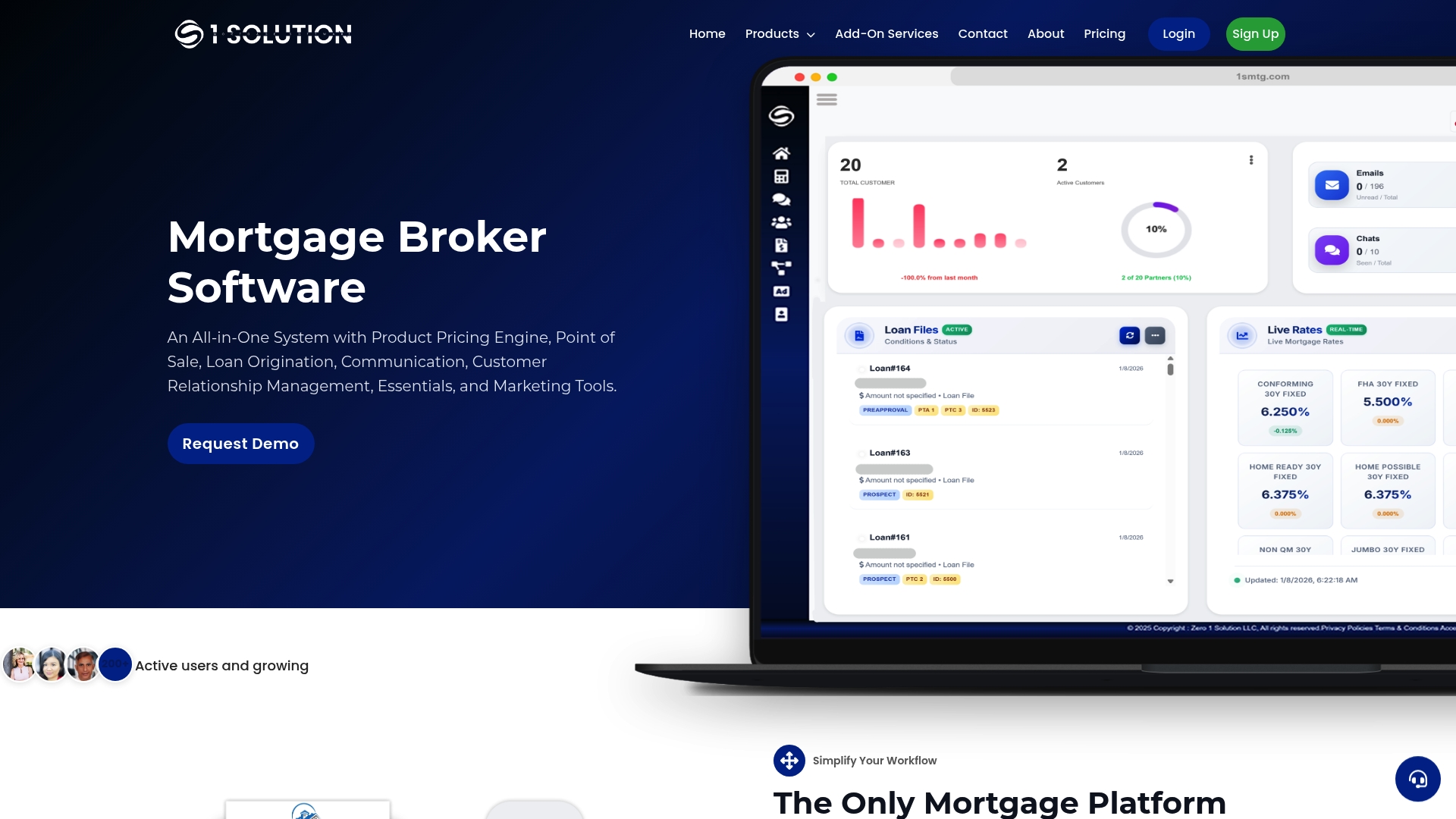
Compliance tooling and role-based permissions can be integral parts of a platform rather than added afterward, which is important given the role of guardrails in managing automation risk. If you're evaluating whether your current stack can support the pipeline described here, start with a platform audit: map your existing LOS, POS, and AUS connections against what you'd need for a pilot on one product line. Request a demo of 1 Solution Mortgage Software to see how the pieces fit together before you commit to a build.
Sources
- Mortgage Pre-Approval Pipeline: 4 Days to 4 Hours Guide
- Automate loan pre-approvals with Jotform, GPT-4 analysis & Gmail notifications
- Pre-Approval Letter - Lender Experience : Blend Help Center