
The fastest way to raise borrower portal adoption is to remove login friction and pair a task-driven onboarding flow with proactive notifications. Password resets and generic "log in to check your loan" invitations are the two biggest silent killers of engagement. Time-limited magic links that skip password creation entirely, combined with a first task that has a visible deadline, tend to convert far more borrowers than a bare welcome email. Get those two pieces right before you touch anything else on your product roadmap.
TL;DR:
- Replacing passwords with time-limited magic links and sending them immediately after application significantly increases portal activation rates.
- Keeping onboarding tasks short, with clear deadlines within the first 72 hours, improves digital engagement and reduces drop-offs.
- Integrating real-time loan status updates and in-portal communication supports borrower trust and reduces stale information gaps.
- Sending personalized, task-driven messages via SMS and email, with escalation flows for missed tasks, boosts follow-through and portal revisits.
- Most lenders benefit from buying proven portals with strong integrations, reserving custom development for large-scale operations with specific experience needs.
Table of Contents
- What Drives Borrower Portal Adoption in Practice?
- Why Do Borrowers Avoid Logging In?
- How Should Lenders Launch a Borrower Portal?
- [What Messages Keep Borrowers Coming Back?](#what-messages-keep-borrowers-coming-backhttpsbabylovegrowthaibloghow-to-humanize-ai-text)
- How Do You Measure Borrower Portal Adoption?
- Should You Build or Buy Your Borrower Portal?
- Who's Behind This Playbook?
- Why Portal Adoption Belongs on the Executive Agenda
- How 1 Solution Mortgage Software Fits Into Your Portal Strategy
- Sources
- FAQ
What Drives Borrower Portal Adoption in Practice?
Borrower portal adoption comes down to whether a borrower can complete a task in under two minutes without calling anyone. That's it. Every feature on a modern portal roadmap either shortens that path or gets in the way of it, and lenders who treat the portal as a static document repository instead of a task engine consistently see weaker sign-in rates.
Not every feature carries equal weight, and treating them as equal is how product teams waste a quarter building the wrong thing first.
Fast wins (weeks, not months):
- Magic links or SSO — remove the password barrier that causes the largest first-visit drop-off. Okta's guidance on passwordless access notes that time-limited, single-use tokens preserve security while cutting the friction that stops borrowers cold.
- Proactive notifications — a text or email the moment a document is needed, rather than a weekly digest, keeps the portal top of mind.
- In-portal loan officer messaging — borrowers already trust their loan officer more than an app; giving that relationship a digital home instead of routing everything through a call keeps both channels working together.
Medium-to-long-term investments:
- Real-time loan status synced to your loan origination system, so the portal never shows stale information that undercuts trust.
- Two-way document hub with OCR-assisted uploads and clear rejection reasons, not just a folder to dump files into.
- Task lists that sequence what's needed next, rather than dumping the full checklist on day one.
- Mobile-first UI, given that JD Power's 2025 digital experience study found many servicer apps still fail to deliver even foundational functionality.
- Payment tools and multi-user access for co-borrowers, plus baseline security and compliance controls that satisfy examiners without slowing borrowers down.
A useful list of what to demand from a vendor or build internally lives in this breakdown of borrower portal features that cut costs, which lines up closely with what Finanta's buyer's guide identifies as the features that separate adopted portals from ignored ones: secure upload, real-time status, automated alerts, and in-portal messaging.
One credit union documented in a Coviance case study saw high initial borrower engagement after pairing portal launch with process changes, and shaved multiple days off average close times in the process. That's the kind of number that should anchor your internal business case, not a vague promise of "better borrower experience."
Pro Tip: Ship magic links before you ship anything else on this list. Every other feature depends on borrowers actually getting into the portal in the first place.
Why Do Borrowers Avoid Logging In?
Most adoption problems trace back to five root causes, and each has a specific, testable fix.
- Password friction. Borrowers forget credentials created weeks earlier for a one-time process. Replace password creation with magic links or SSO tied to an existing identity provider.
- Unclear value. An invitation that says "access your portal" gives the borrower no reason to click. Replace it with a specific task and a deadline: "Upload your latest pay stub by Friday to avoid a delay."
- Poor timing. Sending the invite three days after application, once the borrower's attention has moved on, guarantees a lower open rate. Send it at the moment of highest intent, immediately after application submission, and follow with deadline-driven task reminders.
- Fragmented data and trust gaps. A portal showing "processing" for two weeks while the loan actually moved forward erodes confidence fast. Fix this with short-term data syncs to your loan origination system, canonical status fields that mean the same thing everywhere, and a plain-language note explaining what each status actually means.
- Device and accessibility gaps. A portal that renders poorly on a phone loses a huge share of borrowers who never touch a desktop. Run a mobile-first QA checklist before every release, not after complaints arrive.
Fannie Mae's National Housing Survey found that many consumers remain uneasy handling complex financial tasks without human backup. That's not an argument against digital tools. It's an argument for building portals that make the human handoff obvious the moment a borrower gets stuck.
How Should Lenders Launch a Borrower Portal?
A launch plan built around the first 72 hours determines whether a portal becomes a habit or gets abandoned after one visit.
- Align stakeholders before launch. Pick a pilot group of borrowers, agree on baseline metrics (current call volume, current time-to-document), and get loan officers bought in on the plan, not just informed of it.
- Time the invite to the moment of highest intent. Send the magic-link invite within minutes of application submission, not at end-of-day batch processing.
- Layer the channels. SMS for the first nudge, email for the fuller task list, and a follow-up text 24 hours later if the first task is incomplete.
- Give borrowers a 48 to 72 hour task list, not a 12-item checklist. Three tasks with visible deadlines beat a wall of requirements every time.
- Enable loan officers with scripts. A short line like "I just sent you a secure link, it takes two minutes" during the application call does more for adoption than any email subject line.
- Measure and iterate weekly during the pilot. Track sign-in rate and first-task completion daily for the first two weeks, and adjust message timing before you scale.
A pilot cohort of roughly 100 to 300 borrowers is large enough to be representative and small enough that your team can catch edge cases without operational strain.
Pro Tip: Have your loan officers send the first portal link personally during the intake call instead of letting an automated email handle it alone. Borrowers respond faster to a link that comes from someone they've already spoken with.

For teams rethinking how technology fits into daily origination workflows, this overview of mortgage technology adoption covers the change-management side that a launch checklist alone won't solve.
What Messages Keep Borrowers Coming Back?
Generic marketing blasts train borrowers to ignore your notifications. Task-driven messages train them to open every one.
- Replace "Check your loan status" with "We need your homeowner's insurance declaration page. Upload by Thursday to stay on schedule."
- Use SMS for urgent, time-sensitive requests, email for fuller summaries with attachments and context, and in-portal banners for anything that needs supporting detail a text can't carry.
- Personalize by loan stage: a borrower in underwriting needs different nudges than one approaching closing, and a co-borrower needs their own task list, not a copy of the primary applicant's.
- Build an escalation flow for missed tasks. A skipped 48-hour deadline should trigger a second channel, and a skipped 96-hour deadline should route to the loan officer for a phone call.
- Get explicit consent for SMS and push before you send anything, and make opting out as easy as opting in. This isn't just good practice. It keeps you clear of carrier and regulatory complaints that can shut a messaging channel down entirely.
Solidifi's research makes the case plainly: the strongest borrower experiences combine digital transparency with real human contact, and portals that try to replace loan officers outright tend to underperform ones that support them.
How Do You Measure Borrower Portal Adoption?
Three numbers tell you almost everything about whether a launch is working.
- Activation rate (invite to first sign-in): a well-run launch should see most invited borrowers activate within the first week; anything trailing far behind that signals a friction problem in the invite itself, not the portal's features.
- Document upload rate and task completion: track the share of assigned tasks completed without a phone call, since every one completed digitally is a call your operations team didn't have to take.
- Retention and satisfaction: repeat visits per loan and NPS or CSAT scores tied specifically to portal interactions, not your overall borrower survey.
JD Power's 2025 study found that only a minority of servicer digital experiences deliver even foundational functionality well, which gives you a low bar to clear and a real opportunity to differentiate on execution alone.
Structure experiments to isolate one variable at a time: test invite timing (immediate versus next-day), access method (magic link versus traditional login), and UI changes (task list ordering) separately, never all three in the same release, or you won't know which change actually moved the number.
Should You Build or Buy Your Borrower Portal?
Buying an established portal with strong loan origination system integrations is the faster, lower-risk path for most independent lenders and servicers, and it's usually the right call unless you have a genuinely differentiated borrower experience to design and the engineering capacity to maintain it long-term.
KPMG's 2025 mortgage executive research notes that generative AI is making custom front-end development cheaper at scale, which is shifting some larger lenders toward building tailored experiences. That economics shift matters less if you're an independent broker or mid-size servicer without a dedicated engineering team.
Whichever path you choose, sequence integration work the same way:
- SSO and magic-link authentication first, since nothing else matters if borrowers can't get in.
- Canonical loan status synced from your loan origination system, so the portal never contradicts what a loan officer tells a borrower on the phone.
- API-based document exchange with your loan management system and CRM, rather than manual re-entry that introduces errors.
- Notification orchestration that avoids duplicate or conflicting alerts across email, SMS, and in-portal channels.
KPMG's own research warns against silo upgrades: teams that bolt on point solutions one at a time tend to produce inconsistent borrower experiences that undercut the very adoption they're trying to build. A modular, middleware-driven architecture avoids that trap far better than a patchwork of disconnected tools.
Who's Behind This Playbook?
This playbook draws on more than 20 years of hands-on mortgage operations work from Omar Khamisa, founder of 1 Solution Mortgage Software, who has worked as a processor, underwriter, loan originator, and systems consultant before building technology for brokers directly. That background shapes every recommendation here toward what actually reduces phone calls and speeds closings, not what looks good in a product demo.
For deeper operational detail on the workflows referenced above, see borrower portal features that cut servicing costs and document submission workflows for loan officers. Case studies and borrower quotes specific to 1 Solution deployments will be added here as they become available.
Why Portal Adoption Belongs on the Executive Agenda
Portal adoption isn't a feature checkbox. It's a retention and efficiency lever that shows up directly in call center staffing, borrower satisfaction scores, and time-to-close. The tradeoff between quick wins like magic links and architectural investments like canonical status integration is real, but it's not either/or. Ship the friction fixes first, fund the integration work in parallel, and put activation rate and task completion on the same dashboard as pipeline volume. Adoption should have a cross-functional owner, not a team that only meets when something breaks.
— Omar Khamisa
How 1 Solution Mortgage Software Fits Into Your Portal Strategy
1 Solution Mortgage Software is built to solve the exact fragmentation problem that kills borrower portal adoption in the first place: a borrower POS portal, loan origination system, CRM, and communication tools (email, SMS, chat, voice, and video) that all sit inside one connected platform instead of five disconnected logins.
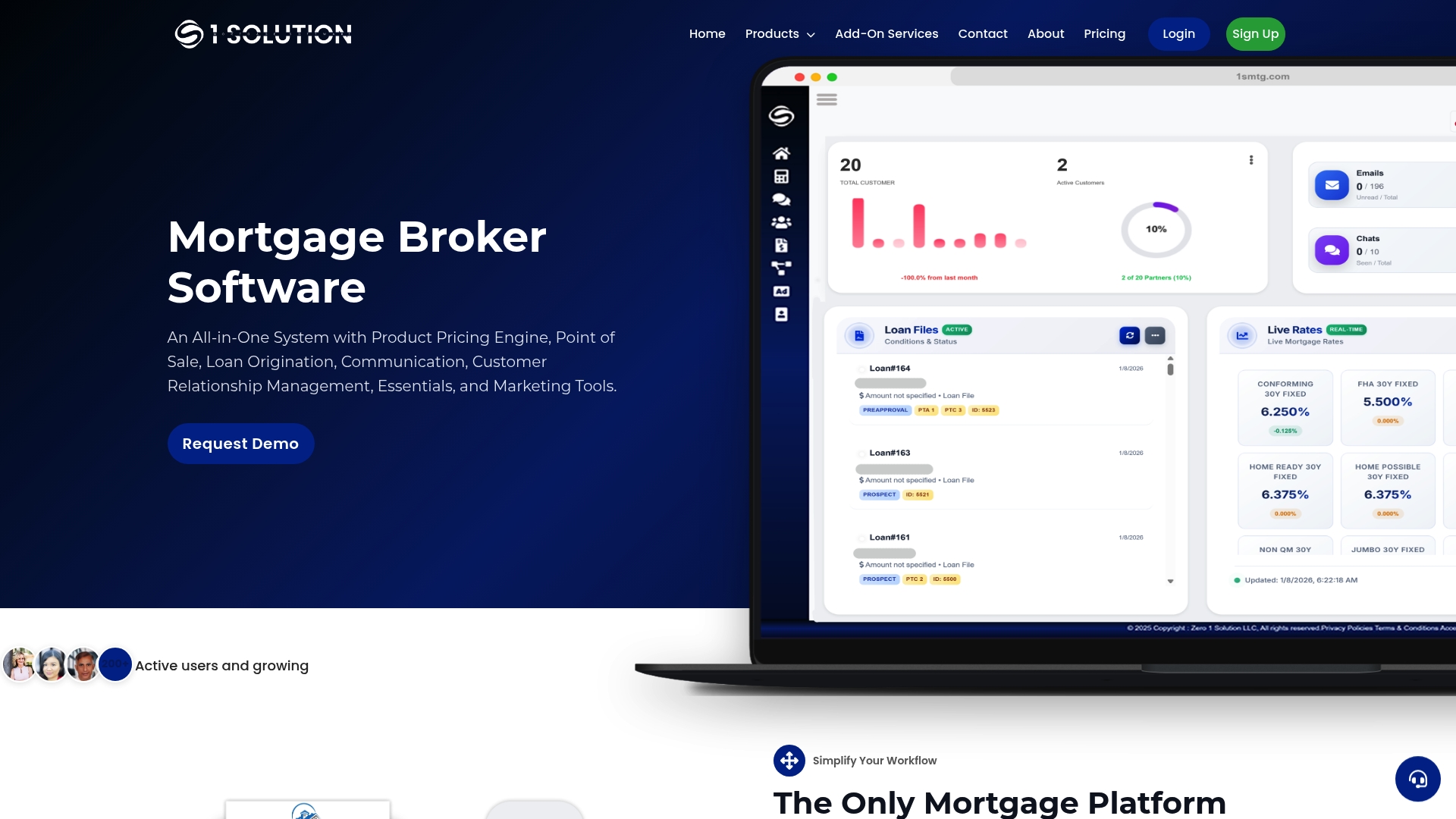
The platform is built to focus on integration decisions that support independent brokers in closing loans faster. This means canonical loan status, document exchange, and borrower messaging live in one ecosystem instead of requiring separate middleware to stitch together. Communication add-ons like phone system minutes, text messages, and fax are billed per use, according to published pricing. If your current setup requires borrowers to bounce between a portal, a separate CRM, and a third-party texting tool, that's exactly the fragmentation this playbook warns against. Visit the 1 Solution Mortgage Software platform to request a demo and see how a single connected system changes your activation numbers.
This article is general information, not a substitute for advice from a qualified financial advisor. Consult a qualified financial professional about your own circumstances before acting on anything here.
Sources
- Pent-Up Demand Expected to Fuel Renewed Mortgage Market Activity | Solidifi
- National Housing Survey: Banks' Online Services Appreciated, but Big Tech Competitors Loom | Fannie Mae
- 2025 U.S. Mortgage Servicer Digital Experience Study | JD Power
- Magic links (Okta blog)
FAQ
What Is the Biggest Driver of Borrower Portal Adoption?
Removing login friction is the single biggest driver. Replacing passwords with time-limited magic links removes the most common point where borrowers abandon a portal before ever using it.
How Long Should Borrower Portal Onboarding Take?
Onboarding should require no more than two or three tasks in the first 48 to 72 hours, each with a visible deadline. Longer checklists dumped on day one tend to overwhelm borrowers and suppress first-week activation.
Do Borrowers Still Want Human Contact With a Digital Portal?
Yes. Fannie Mae's research shows many consumers remain more comfortable with complex mortgage tasks when a person is available, so the strongest portals support loan officers rather than replace them.
What Does 1 Solution Mortgage Software Cost?
1 Solution offers a Subscription Account with pricing available on request through the 1 Solution Mortgage Software website. Add-on communication fees, such as $0.10 per minute for phone system usage and $0.10 per text message sent or received, are published directly on the site.
Should a Lender Build a Custom Portal or Buy One?
Buying an established portal with strong loan origination system integrations is faster and lower risk for most independent lenders. KPMG's research notes that custom builds only make sense at scale where generative AI economics justify the engineering investment.