

A borrower onboarding workflow is the staged, gated sequence that carries an application from intake to funded status, with each stage requiring specific verified information before the file moves forward. The single highest-impact fix most lenders can make right now is removing document friction: replace catch-all upload lists with gated, automated verification and task-based borrower requests. Everything below explains how the stages work, which technology closes the gap fastest, what to measure, and how to roll it out.
TL;DR:
- Speeding up document request and verification through conditional requests and automation significantly reduces abandonment at the verification stage.
- Assigning clear, accountable owners for each onboarding stage prevents files from stalling at handoffs and improves overall workflow visibility.
- Integrating credit and fraud systems early in the process helps identify issues sooner, lowering decision time and exposure to risk.
- Implementing task-based borrower portals and automated reminders enhances borrower engagement and shortens time-to-fund.
- Focusing on measuring and improving time from application to funding offers the most direct insight into bottlenecks that most impact cycle length.
Table of Contents
- What Are the Core Stages of a Borrower Onboarding Workflow?
- Why Does Onboarding Speed Actually Affect Your Bottom Line?
- Where Does Borrower Onboarding Break Down?
- Which Technologies Actually Speed Up Onboarding?
- Which Metrics Deserve a Dashboard, and Which One Matters Most?
- How Do You Roll Out a New Onboarding Workflow in 90 Days?
- What Do 20 Years of Mortgage Operations Actually Teach You?
- Who Owns Each Handoff in the Onboarding Chain?
- What Compliance and Privacy Rules Govern Borrower Onboarding?
- How Do You Keep Borrowers Engaged Through a Slow Process?
- How Should Onboarding Connect to Credit and Fraud Systems?
- How Do You Get Staff to Actually Adopt a New Workflow?
- What Should Lenders Actually Prioritize First?
- How Does an Integrated Platform Shorten Time-to-Fund?
- Where Can You Read More on Onboarding Timelines and Workflow Design?
- Sources
What Are the Core Stages of a Borrower Onboarding Workflow?
A borrower onboarding workflow moves through predictable gates, and each one has to produce a clear "done" signal before the file advances. Skip that signal, and files stall in someone's queue without anyone noticing for days.
- Prequalification. The borrower shares basic income, credit, and loan-purpose data. Done means a soft-pull or self-reported snapshot confirms the loan is worth pursuing.
- Application. The borrower completes the full credit application. Done means every required field and disclosure is signed and submitted.
- Verification and document collection. Income, assets, identity, and employment get verified. Done means every triggered document is received and validated, not just requested.
- Underwriting and decisioning. The file gets scored against guidelines. Done means an approval, conditional approval, or denial with clear conditions.
- E-sign and document vault. Closing documents get generated, signed, and stored. Done means every signature is captured and the file is indexed for compliance retrieval.
- Funding. Money moves. Done means disbursement is confirmed and reconciled.
- Post-funding handoff. Servicing or the customer success team takes over. Done means the borrower has a named point of contact and next steps.
Timelines vary sharply by product. Personal loans typically close in 3 to 7 days, while mortgages routinely run 30 to 45 days or longer because of appraisal, title, and underwriting complexity. If you want a deeper breakdown of how these stages map to a functioning office, our guide on mortgage office workflow design walks through the operational layer underneath this list. For a plainer definition of the origination process itself, see what loan origination actually means for borrowers and brokers alike.
Why Does Onboarding Speed Actually Affect Your Bottom Line?
Onboarding speed is not a customer-service metric you track for optics. It is directly tied to conversion, cost per funded loan, and the quality of the portfolio you end up holding.
Faster, cleaner onboarding produces measurably better outcomes: higher completion rates, faster approvals, and lower per-file operating cost, all of which support portfolio growth over time, according to TurnKey Lender's analysis of onboarding strategy. A borrower who abandons at the document-upload stage does not just cost you that one deal. It costs you the marketing spend that generated the lead and the loan officer's hours already sunk into the file.
Track these five KPIs to know whether your workflow is actually working:
- Completion rate — the percentage of started applications that reach funding.
- Time-to-decision — days from full application to underwriting decision.
- Time-to-fund — days from application submission to disbursed funds.
- Document turnaround — average hours or days between a document request and a validated upload.
- Borrower NPS — a direct read on whether the experience felt controlled or chaotic.
Statistic to remember: credit score thresholds still shape approval odds at the front end of this funnel. Borrowers with scores above roughly 650 generally see favorable approval terms, while those under 600 face higher rates or outright rejection, which means your prequalification stage needs to set expectations honestly before anyone wastes days on a file that was never likely to close.
Where Does Borrower Onboarding Break Down?
Most drop-off happens in a handful of predictable places, and almost none of them require a new hire to fix. They require better sequencing.
- Document friction. Catch-all upload lists ask borrowers for everything up front instead of only what their answers actually trigger, and that overload is a leading cause of abandonment.
- Slow manual verification. When a human has to manually confirm income or employment, turnaround stretches from hours to days, and the borrower loses momentum waiting.
- Broken handoffs. A file moves from sales to processing to underwriting, and if no single person owns it at each step, it sits untouched while everyone assumes someone else has it.
- No status visibility. Borrowers who cannot see where their file stands call your office repeatedly, which burns staff time that should go toward moving other files forward.
Pro Tip: Replace your generic "please upload the following documents" list with conditional requests. Only ask for tax returns if the borrower indicated self-employment income, and only request a gift letter if the down payment source field flags a gift. Smaller, relevant lists get completed faster than long generic ones.
Which Technologies Actually Speed Up Onboarding?
The right automation stack does not eliminate judgment calls. It eliminates the manual busywork that delays the judgment calls that matter.
Five automation patterns produce most of the measurable speed gains:
- Task-based borrower portals. Platforms that generate discrete SmartTasks, each with its own due date, make outstanding requests visible to the borrower instead of buried in an email thread. Many systems default these tasks to a three-day due date with automated reminders that fire before the deadline hits.
- Open Banking-style verification. Connecting directly to bank data for income and asset verification cuts the manual document chase almost entirely and is one of the highest-leverage automations available for reducing onboarding abandonment.
- Automated credit pulls and AUS decisioning. Letting an automated underwriting engine handle the first pass frees underwriters to focus on exceptions rather than routine files.
- E-sign and document vaults. Digital signature capture paired with a searchable, compliant document store removes the printing, scanning, and re-uploading cycle that stalls closings.
- Workflow orchestration. Gated transitions with condition-triggered follow-ups mean a file cannot silently sit in a queue. If a condition isn't cleared in 48 hours, the system escalates automatically.
When you sequence these for implementation, integration order matters:
- CRM captures the lead and initial borrower data.
- POS/LOS carries the application and document collection.
- Decisioning engine handles the automated underwriting pass.
- E-sign and document vault closes out the paperwork and stores it for compliance.
Building this stack from scratch benefits from a clear model of what "scalable" actually looks like, and a scalable loan origination workflow coordinates exactly these handoffs across sales, processing, underwriting, and closing. Lenders exploring more advanced customer-facing automation, including AI-driven document intake, can also look at what AI automation services now offer for reducing manual paperwork load at scale.
Which Metrics Deserve a Dashboard, and Which One Matters Most?
Not every KPI needs its own chart. Build stage-level dashboards around the metrics that predict problems before they become abandoned files.
The core set to instrument:
- Stage duration — how long a file sits at each gate, flagged when it exceeds a threshold.
- Drop-off rate by stage — where in the funnel borrowers actually disappear.
- Document turnaround time — request to validated receipt, averaged weekly.
- Underwriter queue depth — how many files are waiting versus actively worked.
Set alerts on stage duration outliers, not just averages. A file sitting three days past your median at the verification gate is a signal worth a human check, even if your overall averages look fine.
If you can only prioritize one number, prioritize time from application submission to funded (or first decision). This single elapsed-time metric captures the compounding effect of every friction point in the workflow, and it's the number a scalable origination process is ultimately built to shrink, as outlined in the operations guide on scalable loan origination. For a tactical breakdown of what actually shortens this number, our piece on speeding up loan approval covers specific levers worth pulling first.
How Do You Roll Out a New Onboarding Workflow in 90 Days?
You don't need a full platform migration to see results. You need a disciplined pilot, a baseline, and the willingness to measure honestly.
- Assign a single owner for each stage. Prequalification, verification, underwriting, and closing each need one accountable person, because shared ownership is how files languish between teams.
- Map your current workflow and measure baseline metrics. Before changing anything, know your existing completion rate, time-to-fund, and document turnaround.
- Pick one or two quick wins. Smart document requests and task-based borrower portals are the fastest to implement and the easiest to measure.
- Pilot, then measure. Run the change on a subset of files for two to four weeks and compare against baseline.
- Scale what works. Turn the pilot into a template, automate the reminder cadence, and roll it out to the full pipeline.
A sample checklist by phase:
- Days 1 to 30: Map stages, assign owners, capture baseline KPIs, and audit your document-request lists for unnecessary breadth.
- Days 31 to 60: Launch smart document collection and borrower SmartTasks on a pilot segment; target a 15 to 20 percent cut in document turnaround time.
- Days 61 to 90: Expand successful pilots pipeline-wide, automate condition-triggered reminders, and re-measure time-to-fund against your baseline.
Reviewing how your file submission process holds up under this scrutiny is worth doing in parallel. Our breakdown of mortgage file submission for loan officers covers exactly where completeness checks tend to fail before underwriting ever sees the file.
What Do 20 Years of Mortgage Operations Actually Teach You?
Omar Khamisa has spent over two decades working mortgage files as a processor, underwriter, loan originator, and systems consultant, and the pattern repeats regardless of the era or the technology: files stall where accountability is vague, not where technology is missing.
The lenders who fix onboarding fastest are not the ones who buy the most software. They are the ones who force every stage to have one owner and one visible "done" condition. SmartTask-style borrower portals work because they make that visibility automatic instead of dependent on someone remembering to send a follow-up email.
Integrated POS and LOS systems reduce rework specifically because they stop data from being retyped between disconnected tools, which is where most of the silent errors creep in.
Who Owns Each Handoff in the Onboarding Chain?
A borrower onboarding workflow fails most often not at any single stage, but at the seams between stages. The loan officer hands the file to processing. Processing hands it to underwriting. Underwriting hands conditions back to the borrower, then the file returns for closing. Every one of those handoffs is a place where a file can sit untouched if nobody has explicit ownership.
The fix is not more communication. It's clearer role definition. Each stage needs a named owner with authority to move the file forward or explicitly reject it back a step, and that ownership needs to be visible in your loan origination system, not just written into a policy document nobody reads twice.
A practical role map looks like this:
- Loan officer owns prequalification and the initial application intake, and is accountable for setting borrower expectations on documents and timeline.
- Processor owns verification and document collection, and is accountable for confirming every triggered document is received and valid before submitting to underwriting.
- Underwriter owns decisioning, and is accountable for issuing clear, specific conditions rather than vague requests that bounce back to the borrower twice.
- Closer owns e-sign and funding, and is accountable for reconciling every signature and disbursement detail before the file transitions to servicing.
When ownership is explicit, accountability structures actually hold instead of collapsing the moment volume spikes. Brokerages scaling quickly should also look at how lender relationships get built and maintained, since strong broker-lender relationships often determine how flexible those handoffs can be when a file needs an exception.
What Compliance and Privacy Rules Govern Borrower Onboarding?
Every stage of borrower onboarding touches regulated data, and treating compliance as a final review step instead of a built-in gate is how lenders end up with costly rework.
Federal requirements shape the earliest stages of intake. The Truth in Lending Act and the Equal Credit Opportunity Act govern how you disclose terms and evaluate applicants, and your prequalification and application stages need to bake those disclosures in rather than bolt them on afterward. The Gramm-Leach-Bliley Act sets baseline requirements for how you safeguard borrower financial data, which matters directly for how you store documents in your e-sign and vault stage. State-level licensing and disclosure rules add another layer on top, and they vary enough that a workflow built for one state's timeline requirements can create compliance gaps in another.
Data privacy considerations run in parallel to lending law. Every document uploaded, every bank connection authorized through Open Banking style verification, and every credit pull needs to be logged with a clear audit trail showing who accessed what and when. A document vault that stores files without indexed access logs is a liability, not a convenience.
The practical takeaway: build compliance checkpoints into the same gates that already exist in your workflow. Don't create a separate "compliance review" stage that runs parallel to origination. Attach the disclosure check to the application gate, the data-handling check to the verification gate, and the audit-trail requirement to the vault stage itself.

How Do You Keep Borrowers Engaged Through a Slow Process?
Borrowers do not abandon applications because the process takes time; they abandon because they don't know it is still moving.
Lenders who treat onboarding as an interactive digital experience, with real-time progress indicators and automated status notifications, retain more borrowers through the full funnel than those relying on periodic phone calls or generic email updates. The difference is not the underlying speed of underwriting. It's whether the borrower can see that something is happening.
A few communication patterns consistently improve completion rates:
- Automated stage-change notifications. The moment a file moves from verification to underwriting, the borrower gets a message confirming it, even if the message is short.
- Proactive reminders before deadlines, not after. A reminder sent one day before a SmartTask due date outperforms one sent after the task is already overdue.
- Plain-language status labels. "We're verifying your income documents" beats "In underwriting queue" for a borrower who has never worked in lending.
- A single point of contact for questions. Borrowers who get bounced between departments disengage faster than those with one name to call.
Lead-nurturing principles from outside the mortgage industry apply directly here. The same sequencing and cadence strategies that improve conversion in marketing funnels work just as well for keeping a borrower engaged between application and funding. The goal is the same: never let silence be the borrower's only signal.
How Should Onboarding Connect to Credit and Fraud Systems?
A borrower onboarding workflow that runs in isolation from your credit reporting and fraud detection tools creates two problems: slower decisions and higher risk exposure, often at the same time.
Credit bureau integration needs to happen early, ideally at the prequalification gate, so a soft pull can set realistic expectations before a borrower invests time in a full application. Waiting until underwriting to run a hard pull means you've already spent processor hours on a file that credit data might have flagged as unlikely to qualify in the first fifteen minutes.
Fraud detection needs to run in parallel with document verification, not after it. Identity verification, document authenticity checks, and income verification through Open Banking connections all feed into a fraud risk score that should gate the file before it reaches underwriting, not after an underwriter has already spent an hour reviewing a fraudulent application.
The practical integration order looks like this: credit bureau checks fire at prequalification and again at final underwriting to catch any change in the borrower's profile between application and closing. Fraud detection tools run continuously from application submission through funding, flagging anomalies like mismatched addresses, inconsistent income documentation, or rapid multiple applications across lenders. When these systems are wired directly into your workflow orchestration instead of run as separate manual checks, a flagged file gets routed to a review queue automatically instead of proceeding on autopilot until a human happens to notice.

How Do You Get Staff to Actually Adopt a New Workflow?
The best-designed borrower onboarding workflow fails if the people running it default back to old habits within a month. Change management matters as much as the workflow design itself.
Start training with the "why," not the "how." Staff who understand that smart document requests reduce their own follow-up workload adopt the new process faster than staff who are simply told to use a new screen. Frame every process change around what it removes from the processor's or loan officer's plate, not just what it adds to the borrower's experience.
Run parallel processing for the first pilot cycle rather than a hard cutover. Let staff work a subset of files on the new workflow while the rest continue on the old one, so mistakes surface on a small sample instead of across the full pipeline.
Assign workflow champions on each team, one processor and one loan officer who learn the new system first and can answer peer questions without escalating every issue to management. Peer troubleshooting resolves friction faster than a formal help desk ticket, especially in the first few weeks.
Finally, revisit the KPI dashboard with staff directly, not just management. When a processor can see that document turnaround dropped from four days to a day and a half after adopting SmartTasks, the number becomes proof rather than an abstract goal handed down from above.
What Should Lenders Actually Prioritize First?
Most advice on borrower onboarding treats every friction point as equally urgent, and that is the wrong starting instinct. Not every fix deserves the same attention in the same quarter.
The conventional wisdom says "digitize everything" as if a portal alone solves the problem. It doesn't. A borrower portal with a poorly designed document request list just moves the same friction into a nicer interface. The actual leverage point is upstream of the technology decision: define what "done" means at each gate, assign one owner per stage, and only then layer in SmartTasks and Open Banking verification to make those gates move faster. Skip the ownership work and the automation just makes stalled files look busy instead of actually moving.
If you take one thing from this entire guide, take this: measure time from application to funded before you buy anything. That single number tells you where your real bottleneck sits, whether it's slow manual verification, underwriter queue depth, or borrowers abandoning at the document stage. Fix the diagnosed problem first, then automate it. Reverse that order, and you end up automating the wrong step faster.
— Omar Khamisa
How Does an Integrated Platform Shorten Time-to-Fund?
Independent brokers juggling separate CRM, POS, LOS, and e-sign tools lose hours every week just moving data between systems that were never built to talk to each other. An integrated platform serves as an alternative to stitching together disconnected point solutions: one connected platform carries the borrower from prequalification through funding without re-keying data at every handoff.
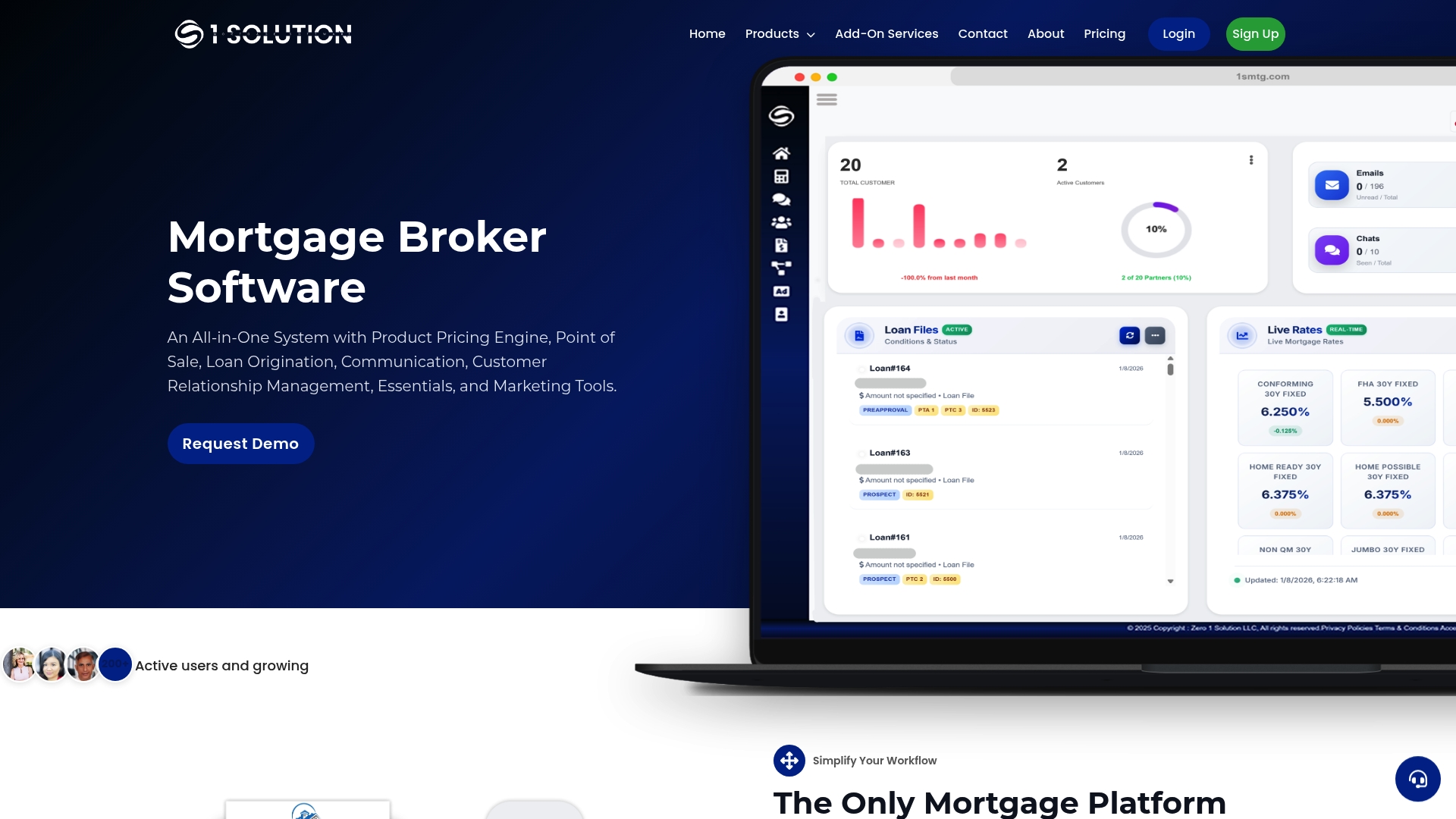
The borrower portal, SmartTask automation, and integrated document vault work the way this guide describes: gated stages, visible status for the borrower, and automated reminders that chase documents so your processors don't have to. Smaller brokerages often face challenges without sufficient staff to manually patch together multiple disconnected tools the way larger shops do. If your current workflow relies on email threads and spreadsheet trackers to know where a file stands, that gap is exactly what an integrated system closes. Visit 1 Solution Mortgage Software to request a demo and see the workflow templates in action.
Where Can You Read More on Onboarding Timelines and Workflow Design?
For deeper technical detail, consult the FICO glossary on loan originations for timeline benchmarks, Maxwell's documentation on borrower tasks for SmartTask design, and the StartupBooted operations guide for scalable workflow architecture.
Sources
- Loan originations and onboarding (FICO glossary)
- Onboarding: how lenders can nail the first step of the lending process (Powens)
- Borrower tasks (Maxwell docs)