
Automation delivers continuous controls, examiner-ready evidence, and measurable risk reduction when it is built to collect that evidence as work happens, not scrambled together before an exam. The payoff shows up as fewer missed disclosures, faster cycle times, and audit trails that hold up under scrutiny. This guide covers the technologies behind mortgage compliance automation, what regulators expect from it, how to roll it out, and what to demand from any vendor claiming to deliver it.
TL;DR:
- Automation reduces regulatory risk by ensuring consistent application of rules and generating reliable, exam-ready evidence, especially for disclosures and AVM governance.
- Vendors must provide a configurable rules engine, examiner-ready exports, and detailed audit logs, with red flags including opaque models and limited integration options.
- Implementing automation should start with risk assessments and high-impact pilots, emphasizing data governance, integration, validation, and change management.
- Strong vendor management includes documented controls, independent testing, and clear service-level agreements, as well as integrating compliance tools into existing loan and customer systems.
- Prioritize system architecture, connectivity, and evidence trails over feature count to build scalable, reliable compliance automation that can adapt to changing regulations.
Table of Contents
- What mortgage compliance automation actually involves
- What automation actually changes: risk, speed, and audit readiness
- What regulators and examiners expect from your systems
- How to plan and roll out automation without breaking something else
- What to require from a vendor, and what should make you walk away
- Lessons from building compliance tools inside a brokerage
- The checklist myth in mortgage compliance automation
- How a broker-focused platform puts these controls in one place
- Where to go deeper
- Sources
- FAQ
What mortgage compliance automation actually involves
Mortgage compliance automation means using software to apply regulatory rules consistently across loan files, document that application, and produce evidence on demand. It differs from generic process automation because the rules come from regulators, not internal preference, and the evidence has to satisfy an examiner, not just a manager.
A handful of technologies do the heavy lifting:
- Intelligent document processing (IDP) extracts and classifies data from loan documents so compliance checks run on structured fields instead of scanned PDFs.
- Rules engines encode disclosure timing, fee tolerances, and eligibility logic so every file gets the same test applied the same way.
- Robotic process automation (RPA) handles repetitive steps like pulling credit reports or routing exceptions to the right queue.
- Workflow orchestration sequences tasks across origination, underwriting, and closing so nothing moves forward without its required check.
- Analytics and reporting turn transaction-level data into trend views and exportable packages.
The most common use cases are TRID and disclosure validation, Automated Valuation Model (AVM) governance, CIP and BSA/AML checks during onboarding, exception handling, and the audit trail that ties all of it together.
What automation actually changes: risk, speed, and audit readiness
The clearest benefit is fewer missed disclosures and timing errors, since a rules engine applying the same TRID logic to every file catches what a tired processor might miss on file three hundred of the week. That consistency is the real value, more than any single feature.
Industry coverage notes lenders are adopting automation specifically to reduce regulatory risk and build more reliable audit trails, according to HousingWire's reporting on compliance automation. That tracks with what operations leaders already feel: fewer manual touches, shorter cycle times, a smaller exception backlog, and a trail that reconstructs itself instead of needing to be rebuilt from memory.
Exam readiness is where this compounds. Teams that collect evidence continuously spend less time before an exam pulling files together and more time running the business, because the documentation already exists in exportable form. Our related piece on what a mortgage compliance audit actually involves walks through the gap between exam-time scrambling and continuous readiness in more detail.

What regulators and examiners expect from your systems
Automation built without regulatory architecture in mind creates a different kind of risk: a fast, consistent process that still fails an exam because it cannot produce what an examiner needs to see. Three bodies of guidance should shape how you design and buy.
The CFPB uses a vendor-owned Compliance Tool during supervision to analyze loan information, and that tool requires structured loan data and examiner-entered fields to verify disclosures and other requirements, according to the CFPB's own privacy impact assessment. Plan your export formats with that reality in mind rather than discovering it mid-exam.
AVM governance has its own standard. The CFPB and other federal agencies issued a final rule requiring quality-control standards for Automated Valuation Models used in credit decisions, and institutions must adopt policies, testing procedures, and sampling controls proportionate to their size and risk, per the CFPB's small entity compliance guide. If your platform touches AVMs anywhere in the valuation process, that vendor's testing evidence needs a home in your audit trail.
BSA/AML obligations round out the picture. FFIEC guidance on assessing BSA/AML compliance programs sets out written policies, independent testing, a risk-based CIP and CDD program, and board approval as non-negotiable program elements. Automation supports those components. It does not substitute for the governance behind them.

Across all three, the common thread is third-party vendor management: documentation of what a vendor does, service-level agreements, independent validation of its outputs, and an audit trail showing you checked. Our guide to mortgage vendor management essentials covers the oversight steps examiners expect you to have documented.
How to plan and roll out automation without breaking something else
Rolling out automation badly creates new risk faster than it removes old risk, so sequence matters more than speed.
- Start with a risk assessment that maps your current manual controls to specific automation candidates, ranked by exposure.
- Pilot narrow and high-impact: disclosure validation and audit-trail capture are usually the fastest wins because the rules are well defined and the evidence gap is obvious.
- Define data governance up front, covering where data comes from, how long it is retained, who can access it, and what gets logged.
- Plan integration with your LOS, CRM, document repositories, and third-party vendor feeds, including the export formats examiners will actually want to see.
- Build in validation and independent testing, whether that means AVM testing, periodic rules review, or scheduled sampling with a documented trail.
- Manage the change, not just the technology: train the team, set acceptance criteria before go-live, and keep governance oversight visible throughout.
Pro Tip: Pilot on one loan type or one branch before rolling automation out firm-wide; a contained failure is a fixable one.
The mortgage compliance setup checklist for 2026 breaks this sequence into a step-by-step format, and the TRID disclosure automation guide goes deeper on the specific features that make disclosure validation a strong first pilot.
What to require from a vendor, and what should make you walk away
Picking the wrong platform locks you into the wrong controls for years, so the evaluation matters as much as the implementation.
Require these as baseline:
- A configurable rules engine you can adjust as regulations change, not a fixed black box.
- Examiner-ready export in formats that match what supervisory tools expect.
- Data lineage and audit logs that show who touched what, and when.
- Secure document handling built into the platform, not bolted on.
- Integration with your LOS and CRM so compliance data does not live in a silo.
On the control side, demand vendor documentation, evidence of independent testing, clear service-level agreements, and a traceable change history for every rule update.
Red flags run the other direction: opaque models with no export path, no audit logging, limited integration options, or a vendor who cannot describe how they are overseen. Our breakdown of audit-ready moves for brokers covers this checklist with more detail on what examiner-ready reporting should look like in practice.
Lessons from building compliance tools inside a brokerage
Twenty years across processing, underwriting, origination, and systems consulting teaches you that most compliance failures are not rule failures. They are handoff failures, where a document sits in the wrong queue or an exception never gets logged. Broker-focused platforms that build compliance into the same system as the LOS and CRM avoid a lot of that, because there is no second system for data to fall between.
— Omar Khamisa
The checklist myth in mortgage compliance automation
The conventional advice treats compliance automation as a checklist exercise: buy a tool, enable some rules, call it done. That misses the actual failure mode, which is not missing a feature but missing the connective tissue between systems. A rules engine that cannot talk to your LOS is not automation, it is a second spreadsheet with better branding.
What gets underrated is data lineage. Compliance officers focus on whether a rule fired correctly and spend less time asking whether they could reconstruct, six months later, exactly why it fired and on what data. That question is what an examiner actually asks.
My take: prioritize integration and evidence trails over feature count. A platform with five well-connected compliance checks that export cleanly will outperform one with twenty checks sitting in isolation. Start there, then build out, because the rules will keep changing but the architecture underneath them should not have to.
How a broker-focused platform puts these controls in one place
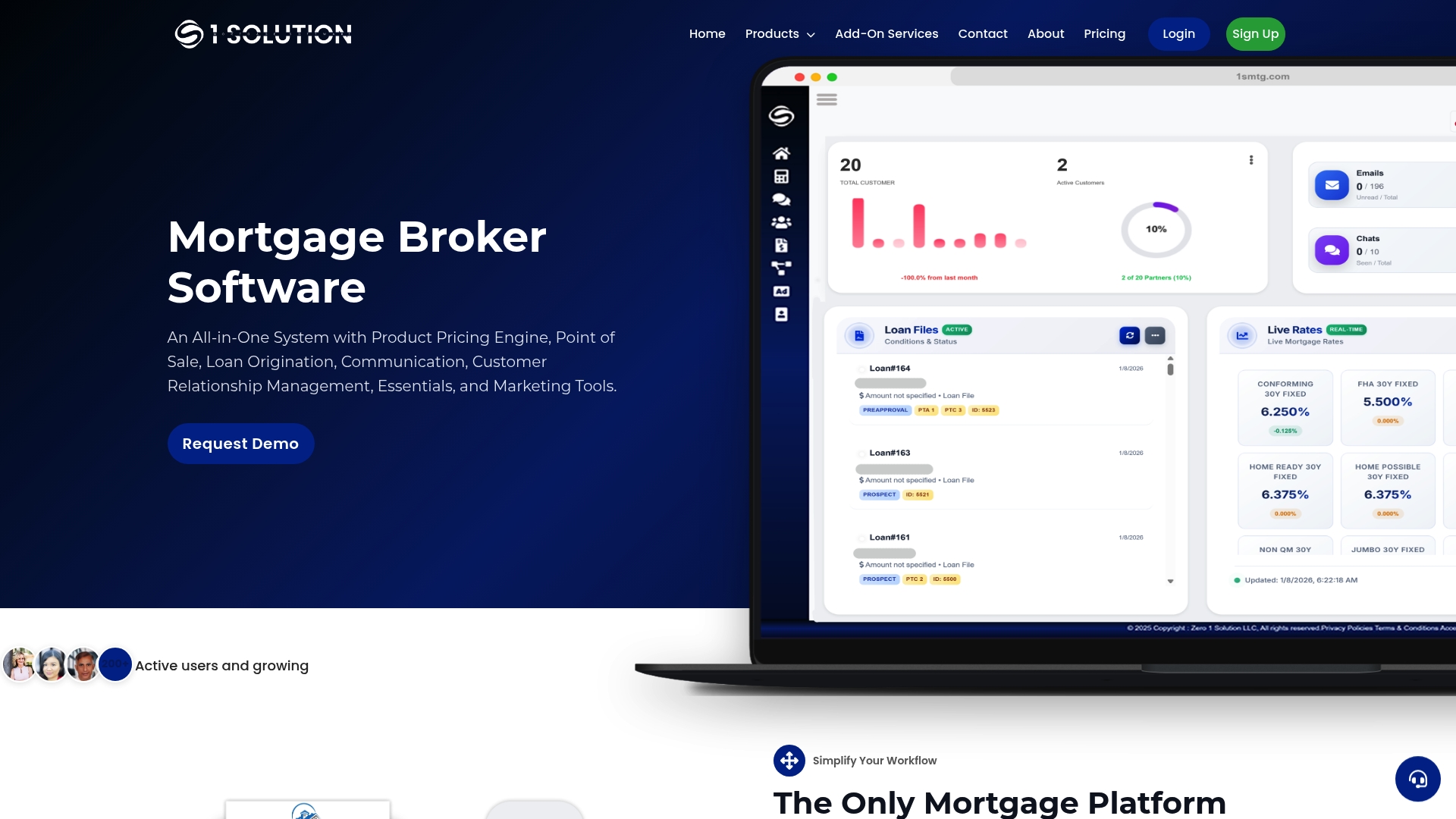
An integrated platform built for brokers means configurable rules, document storage, and examiner-ready reporting live alongside your CRM and communications instead of in a separate system you have to stitch together yourself. A broker-focused platform brings those pieces, plus pricing, point of sale, and loan origination tools, into one connected workspace.
- Subscription Account gives your team access to the platform.
- Mortgage Website, SMTP domain, and PBX Solutions are available as add-ons for brokerages seeking a fully connected setup.
Visit 1smtg to see the platform or request a demo.
Where to go deeper
Primary regulator sources: the CFPB Compliance Tool privacy assessment, the CFPB AVM quality control guide, and FFIEC BSA/AML guidance. For consumer-facing background, see this mortgage compliance explainer.
This article is general information, not a substitute for advice from a qualified financial advisor. Consult a qualified financial professional about your own circumstances before acting on anything here.
Sources
- CFPB — Compliance Tool PIA (2024-12)
- FFIEC — Assessing the BSA/AML Compliance Program
- HousingWire — The case for compliance automation
FAQ
What is the 3-7-3 rule for a mortgage?
The 3-7-3 rule refers to the Truth in Lending Act's requirement that lenders provide a Loan Estimate within three business days of application and provide a revised disclosure at least three business days before closing if terms change materially. Automated disclosure validation tools are built specifically to track these deadlines and flag timing risk before it becomes a violation.
What is mortgage automation?
Mortgage automation refers to software that handles repetitive or rules-based steps in the loan lifecycle, from document extraction to disclosure checks to exception routing, reducing manual work and inconsistency. In compliance specifically, automation applies regulatory rules the same way to every file and keeps a record of that application for later review.
What are the best compliance automation tools?
The right tool depends on your loan volume, existing systems, and which regulations create the most exposure for your business, so there is no single best answer. Look for a configurable rules engine, examiner-ready export, clear data lineage, and solid integration with your LOS and CRM, as outlined in the selection checklist above.
What does a mortgage compliance specialist do?
A mortgage compliance specialist monitors loan files and company processes for adherence to regulations like TRID, BSA/AML, and fair lending rules, and manages the documentation that proves that adherence during an exam. The role increasingly involves overseeing automated systems rather than performing every check manually, with the specialist focused on exceptions, policy updates, and vendor oversight.