
Mortgage software total cost of ownership (TCO) is the sum of everything you spend to own and run your tech stack, not just the subscription line on your card statement. For an independent broker, the lowest TCO usually comes from replacing a pile of separate tools with one connected platform. That means fewer seats, fewer integrations to maintain and fewer vendors to chase. That is the case we build for at 1 Solution, and this guide gives you the model to test it with your own numbers.
TL;DR
- TCO adds up purchase, setup, running costs, usage fees and the cost of leaving, over the whole life of the tool.
- Per-seat and per-app fees are the line that grows fastest. Freddie Mac's 2024 Cost to Originate study reports originators seeing vendor costs per seat and application rise, especially for third-party tools.
- Five separate tools (LOS, CRM, POS, pricing engine, e-sign) mean five invoices, five logins and the integration work between them.
- Model cost per loan, not cost per month. It is the only number that compares a small shop with a large one.
- A single all-in-one platform cuts the number of cost lines you have to model, and to control.
Table of Contents
- What TCO means for a mortgage business
- The cost lines to put in your model
- Measure it per loan, not per month
- A worked example: five tools versus one platform
- Why compliance belongs in the model
- Switching costs: price them honestly and once
- Perspective
- What a consolidated platform changes in the numbers
- See your own TCO with 1 Solution
- FAQ
- Sources
What TCO means for a mortgage business
TCO is an old procurement idea. The UK government's TCO guidance notes that Gartner developed these models in 1987 for IT buying decisions. The U.S. EPA's TCO guidance describes it as counting direct and indirect costs across the whole life cycle: acquisition, operation and maintenance, and end of life. It also makes the point that matters most here: the initial purchase price is typically a small part of the total cost of owning and operating most IT products.
For a mortgage shop, translate that into plain terms. The demo price is the tip. Below the waterline sit onboarding, data migration, add-ons, texting and phone usage, staff time lost to switching between screens, and the day you want out.
The cost lines to put in your model
Build your spreadsheet with one row per line below. Each tool in your stack gets its own column. Then total the columns.
| Cost line | What to capture | Where it hides |
|---|---|---|
| Subscription | Monthly or annual fee, per user or flat | Tiers that unlock features you assumed were included |
| Seats | Every LO, processor, assistant, partner login | Per-seat pricing that rises as you hire |
| Setup and onboarding | Configuration, training, template building | Paid onboarding hours, or your own unpaid time |
| Data migration | Moving contacts, pipeline and documents | Export limits, cleanup work |
| Add-ons | Pricing engine, e-sign, portal, marketing | Each module billed separately |
| Usage fees | Texts, calls, fax, document volume | Small per-unit charges that scale with volume |
| Integrations | Connectors between tools | Middleware fees and broken syncs |
| Compliance | Audit trail, disclosures, record retention | Manual tracking across systems |
| Staff time | Re-keying data, switching logins | Hours that never show on an invoice |
| Exit | Contract terms, data export | Annual lock-ins and fees to retrieve your own data |
The Freddie Mac study also flags rising technology cost as a top concern for smaller organizations with fewer resources. That is the independent broker's situation: every extra line hits a thinner margin.
Measure it per loan, not per month
A monthly fee tells you nothing about whether you are spending well. The Mortgage Bankers Association's ROI guide for evaluating tech stacks recommends computing direct cost per loan from software costs, labor and volume, then comparing the current stack with the replacement. It names total cost of ownership as an alternative method.
Its case study shows how it works. A company closing 1,000 loans a month spent $3,692 monthly on QC software and $20,416.67 on QC staff. That came to $24.11 per loan closed. Notice that staff cost dwarfs software cost. The same logic applies to your stack: the tool that saves the most processor and LO hours often beats the cheapest tool.

The same paper reports that average production expense per loan in Q3 2022 was over $11,000, the highest in industry history. Against a number like that, a few dollars per loan in software are small, but wasted hours and missed follow-ups are not.
A worked example: five tools versus one platform
The figures below are placeholders to show the method. Replace them with your own invoices.
Say a brokerage with four loan officers and one processor, closing 20 loans a month, runs separate tools:
- LOS: $X per month
- CRM: $Y per user per month
- Borrower portal and POS: $Z per month
- Pricing engine: $P per month
- E-signature: $S per month
Step through it:
- Add the five subscriptions across five seats where per-seat pricing applies.
- Add usage and add-ons: texting, phone, branded email, a website.
- Add setup and migration once, then spread it over 60 months.
- Add integration upkeep: an hour a week fixing syncs and re-keying loans is 52 hours a year.
- Value staff time at the loaded hourly cost of the person doing it.
- Total the five years and divide by loans closed (20 a month for 60 months is 1,200 loans).
Run the same steps for a consolidated platform. You will usually see the biggest gap in steps 1, 4 and 5: fewer subscriptions, no integration upkeep and no re-keying, because one record serves the CRM, LOS, portal and pricing engine.
Our own mortgage software cost guide for brokers walks through the pricing side in more detail, and the mortgage CRM cost breakdown covers that one line on its own.
Why compliance belongs in the model
Compliance is a real cost, and it scales per loan. The CFPB's 2013 RESPA servicing rule assessment found larger servicers estimated ongoing annual compliance costs of roughly $3.00 to more than $11.00 per loan, plus one-time implementation costs (technology and personnel) of about $1.00 to $14.00 per loan. That report concerns servicing, not brokering, but it shows the pattern: compliance work is a per-loan cost, and manual processes make it larger.
When disclosures, communication records and documents live in one system, you track one audit trail instead of five. For brokers, that is a TCO line most spreadsheets leave blank.
Switching costs: price them honestly and once
If you are moving off a current LOS or CRM, count the move as a one-time cost. The Canada Mortgage and Housing Corporation's study on mortgage data standards found lenders on modern or off-the-shelf origination systems face implementation costs under $1 million, while those on legacy platforms face several million. The lesson scales down to any size: the older and more fragmented the stack, the more expensive the change, and the more reason not to put it off.

Plan the move in a sequence. Our setup guide for mortgage business software and the piece on mortgage technology adoption cover timelines, training and how to keep loans moving during the switch.
Perspective
Twenty years in mortgage operations, as a processor, underwriter, loan originator and systems consultant, taught me where the money actually goes. It is rarely the sticker price. It is the third login, the contact typed twice, the pricing sheet that is stale by lunch and the vendor whose roadmap serves a bank, not a broker.
We built 1 Solution from the trenches for independent brokers. Pricing, CRM, communication, POS, LOS, compliance, marketing and operational tools sit in one connected platform, so your TCO model has fewer lines and fewer surprises. We are 100% self-funded and independent, with no outside investors setting our priorities.
Run your own numbers. Count every tool, every seat and every hour. We think a broker who does that will want one platform, one team to call and full control of the business.
Omar Khamisa
What a consolidated platform changes in the numbers
Here is how our platform maps onto the cost table above:
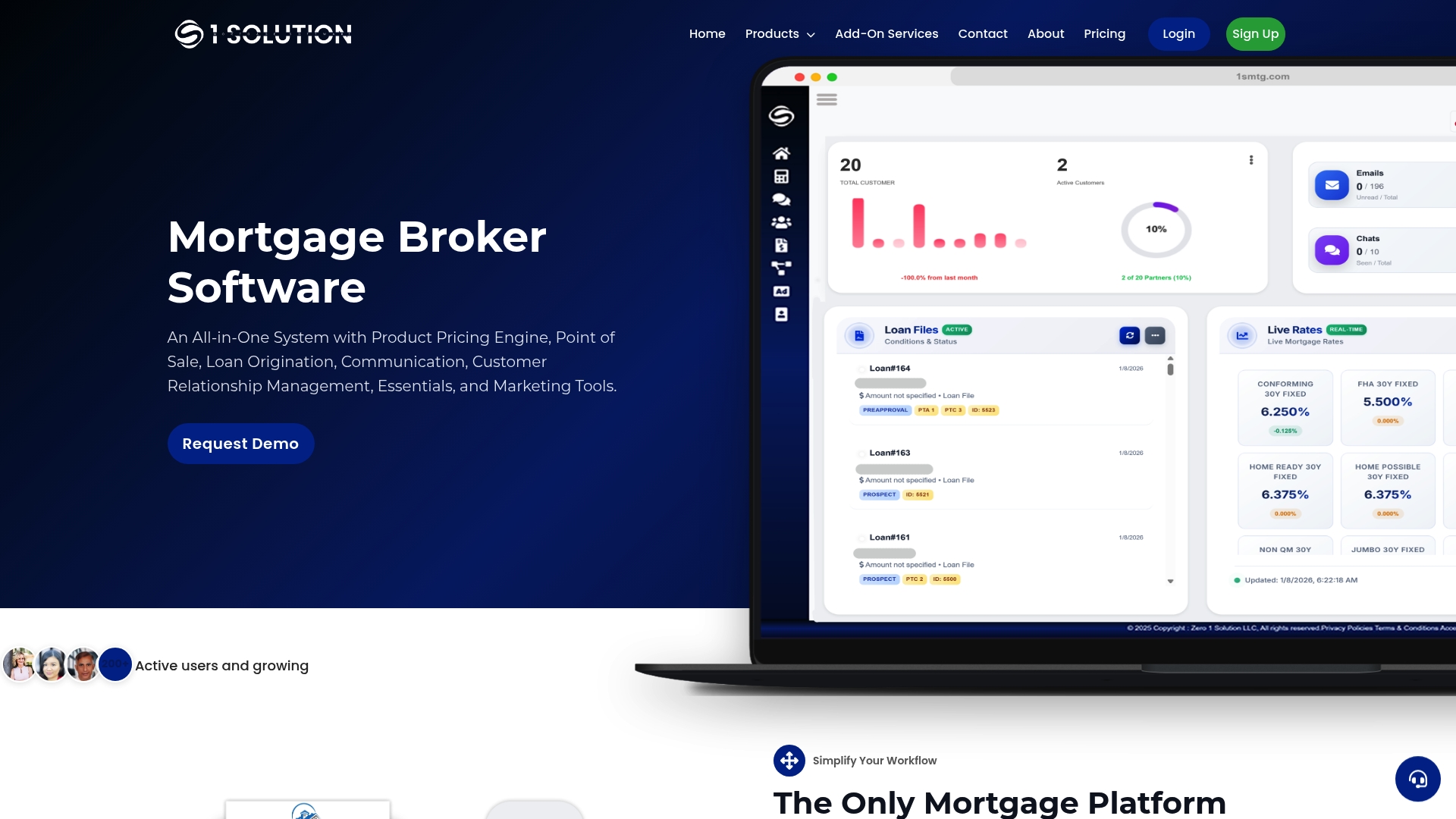
- Fewer subscriptions. LOS, CRM, pricing engine (PPE), borrower POS portal, e-signature, compliance and marketing automation are part of one cloud platform.
- Communication in one place. Email, SMS, chat, voice and video run inside the platform. Usage is published at $0.10 per minute for the phone system, $0.10 per text sent or received and $0.10 per fax sent or received, so you can model volume directly.
- Onboarding included. The platform comes with integrated onboarding, document storage and a customer portal.
- Optional add-ons. A mortgage website, branded email setup (SMTP domain) and PBX solutions are available when you want them, so you only model what you use.
- One record per borrower. Rate comparison, proposals and pre-approvals come from the same data as your pipeline.
If pricing accuracy is a line in your model, read our pricing engine setup guide. For the security question every buyer should ask, see what to demand on data security.
See your own TCO with 1 Solution
If you are replacing several subscriptions, or moving off a current LOS or CRM, we will help you set up the comparison against your own invoices. The subscription account covers the full platform for your team, and onboarding is personalized with real human support. Start at 1 Solution.
FAQ
What is a TCO model?
A TCO model counts every cost of owning an asset over its whole life: purchase, operation and maintenance, and disposal. The EPA's guidance describes it as direct plus indirect costs, usually expressed per year. For mortgage software, add usage fees, integrations, staff time and exit costs.
What time frame should I use for mortgage software TCO?
Five years is a practical window. It is long enough to spread setup and migration, and short enough to reflect the pace of change in mortgage technology. Use the same period for every option you compare.
Which cost do brokers most often miss?
Staff time. Re-keying loan data between systems and switching logins never appears on an invoice, but it is paid for in salary. Per-unit usage fees for texts and calls are the second most missed, because they scale quietly with volume.
Should I compare cost per month or cost per loan?
Cost per loan. The MBA's ROI guide recommends computing direct cost per loan from software, labor and volume. It lets you compare stacks fairly as your volume changes.
Sources
- Total Cost of Ownership Modeling for Electronics, U.S. EPA (2012)
- Total Cost of Ownership, UK government (2011)
- 2024 Cost to Originate, Freddie Mac
- A Definitive ROI Guide to Evaluating Risk & QC Tech Stacks, MBA (May 2023)
- 2013 RESPA Servicing Rule Assessment Report, CFPB (January 2019)
- Study of the Benefits of Mortgage Data Standards, CMHC (2020)